Author: Brandy VanDeWalle
2019 Wilber Crop Clinic
There are many timely topics planned for Southeast Nebraska agricultural producers and agri-professionals at the 2019 Wilber Crop Clinic. Host Extension Educator Randy Pryor said a wide range of presentation topics and commercial displays will be featured at this year’s event scheduled for Friday, February 8, 2019 at Sokol Hall in Wilber.

Pryor said we strive to bring cutting edge, research-based information to attendees and with over 20 commercial sponsors we are able to offer this program free to clientele. The clinic will begin with registration, viewing of sponsor displays, coffee, kolace, and rolls at 8:00 a.m. The educational program starts at 9:00 a.m. to 2:30 p.m.
Speakers and topics include:
- Al Dutcher, Associate State Climatologist, on how El-Nino impacts will likely dominate the first half of 2019.
- Jeff Peterson, Grain Marketing Analyst, Heartland Farm Partners, will discuss his corn and soybean marketing outlook and opportunities for 2019.
- Tim Creger, Program Manager for the Department of Agriculture Pesticide Division, will discuss key dicamba label changes for 2019 and program update.
- Brad Lubben, UNL Agricultural Economics Professor, will inform attendees key provisions in the 2018 Farm Bill and what to expect.
- The most interesting title of the program is “Don’t Get Caught with Your Plants Down!” by Tamra Jackson-Ziems, UNL Plant Pathology.
- Ray Ward, Ward Laboratories, will discuss how soil health improves fertilizer efficiency and profitability.
- Randy Pryor will discuss on-farm research being done in the area and assist with the door prizes at the end of the program.
For more information or for commercial booth space, contact Lou Hajek at the Nebraska Extension Office in Saline County at 402-821-2151. For program sponsors and more details, see the program flyer at Saline.unl.edu or CropWatch.unl.edu. CCA credits will be available.
February Farm Clinic Dates
Great program opportunities…

Farmers and ranchers are invited to attend a FREE clinic. The clinics are one-on-one, not group sessions, and are confidential. The Farm Finance clinic gives you a chance to meet with an experienced Ag law attorney and Ag financial counselor. These clinic staff specialize in legal and financial issues related to farming and ranching, including financial planning, estate and transition planning, farm loan programs, debtor/creditor law, water rights, and other relevant matters. Here is an opportunity to obtain an experienced outside opinion on issues that may be affecting your farm or ranch. Bring your questions!
The FREE farm and ranch clinics will be in these locations:
- Grand Island – Thursday, 7th
- North Platte- Thursday, 14th
- Fairbury – Thursday, 21st
- Valentine – Tuesday, 26th
- Norfolk – Wednesday, 27th
To sign up for a clinic or for more information, call Michelle at the Nebraska Farm Hotline: 1-800-464-0258.
The…
View original post 14 more words
Annie’s Inspired – A Three Hour Session for Farm Women Involved in Agriculture
Farm and ranch women are generating a cultural tide in American agriculture that is moving management, assets and opportunities to a new wave of farmers across the country. At Annie’s Project workshops, farm women become empowered to be better business partners or sole operators through networks and by managing and organizing critical information. Whether you are a woman working full-time in the operation or have off-farm employment, Annie’s Project is for you.
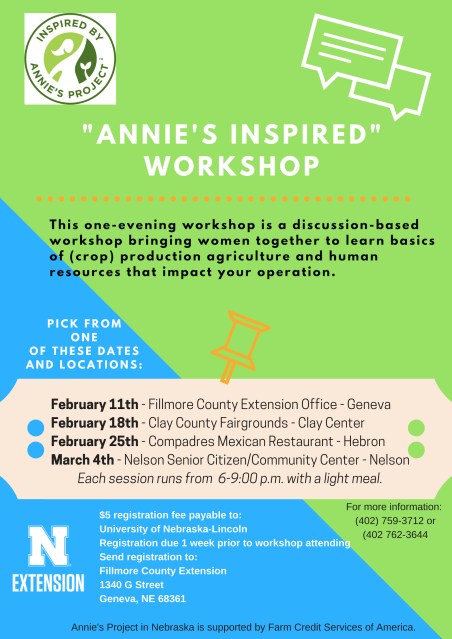
A new “short-course”, titled Annie’s Inspired will be held in four different locations in South Central Nebraska. This one-evening workshop is being repeated in Fillmore, Clay, Nuckolls and Thayer Counties, all running from 6-9:00 p.m. with a light meal included. Registration is $5 per participant and due one week prior to the respective program date. Program dates and locations include:
- February 11th – Fillmore County Extension Office – Geneva
- February 18th – Clay County Fairgrounds – Clay Center
- February 25th – Compadres Mexican Restaurant – Hebron
- March 4th – Nelson Senior Citizen/Community Center – Nelson
The workshop is designed to be discussion-based, bringing women together to learn from experts in human resources, basic crop production issues, and other topics of interest to the group. There will be plenty of time for questions, sharing, reacting and connecting with presenters and fellow participants. The learning environment will be relaxed and fun, providing a dynamic way to learn, grow and meet other farm and ranch women.
To register, the $5 fee is payable to University of Nebraska-Lincoln due 1 week prior to the workshops attending and can be sent to: Fillmore County Extension, 1340 G Street, Geneva, NE 68361. Statewide program sponsor includes Farm Credit Services of America. Annie’s Project courses have successfully reached more than 9,000 farm and ranch women in 33 states. Linda, an Annie’s Project alumna says, “I took the class to gain a better understanding about agribusiness and how financial decisions impact our farm operation. I have a better understanding of balance sheets and the futures market…this class has improved communication with my spouse on concerns he works with on a daily basis.”
Course size is limited, so please register by calling the Fillmore or Clay County Extension office at 402.759.3712 or 402.762.3644 or for more information, go to: https://wia.unl.edu/anniesproject. For more information contact Brandy VanDeWalle at 402.759.3712 or brandy.vandewalle@unl.edu.
Managing Agricultural Land for the 21st Century
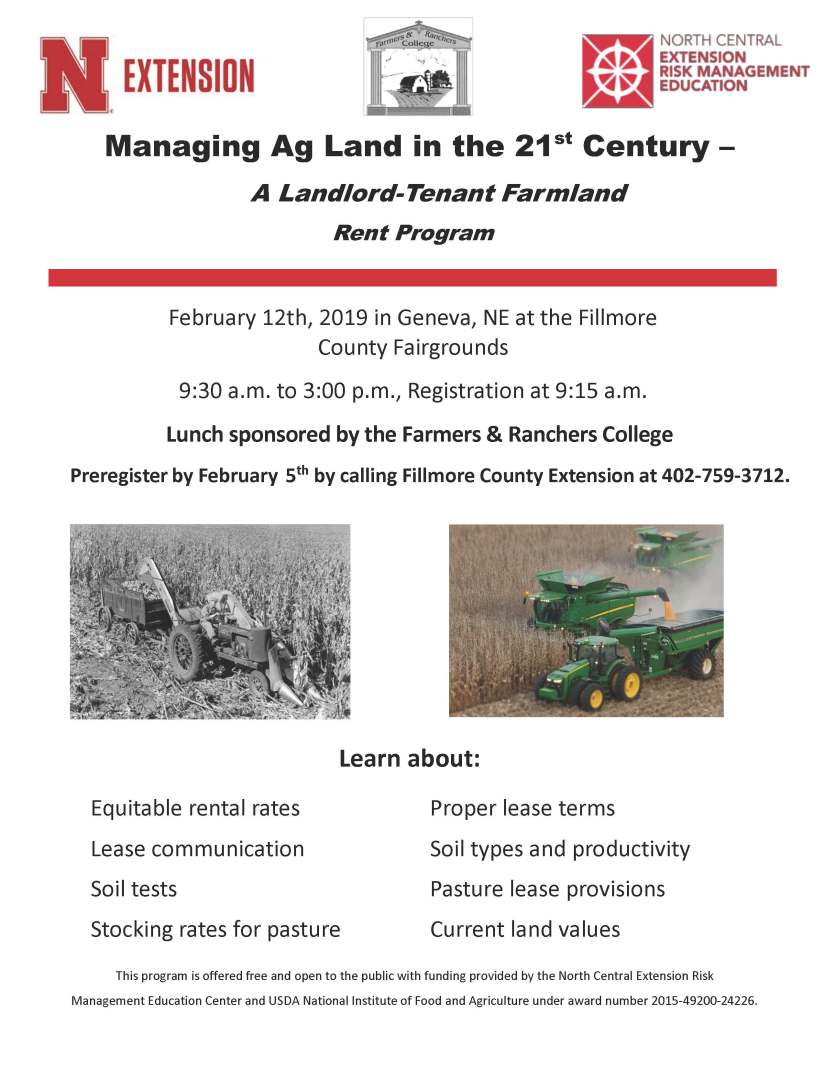
Current and future landowners and tenants should make plans to attend a free land management workshop sponsored by the University of Nebraska-Lincoln Extension. “Managing Agricultural Land for the 21st Century” will cover current trends in cash rental rates, lease provisions, and crop and grazing land considerations.

This meeting is being held in Geneva at the Fillmore County Fairgrounds on February 12, 2019. Registration is at 9:15 a.m., program starting at 9:30 a.m., and ending by 3:00 p.m. The meeting is free due to the generous contributions of the Farmers & Ranchers College donors. For an accurate meal count, please, please register by calling (402) 759-3712 by February 5th.
Nebraska Extension Educators Allan Vyhnalek, Aaron Nygren, and Jim Jansen conduct research and outreach in land management, agronomy and beef production. They will address common agricultural landlord and tenant questions. What does an equitable rental rate look like for my land? How do I manage a farmland lease? What should I expect for communications between the landlord and tenant? What does a soil test tell me? I hear about organic or natural production; how does that vary from what my farmer is currently doing? If corn or soybeans are not making money, should something else be raised on my land? What are key pasture leasing considerations including stocking rates? Who is responsible for cedar tree removal from grazing land?
“Landlords and tenants often struggle with land management questions.” said Allan Vyhnalek, Extension Educator and workshop presenter. “Both are concerned with fair treatment but it can be difficult to keep up with the current trends. Our workshop will provide participants with up-to-date information so they can be confident about their lease arrangements.”
This program is free and open to the public with funding provided by the North Central Extension Risk Management Education Center and USDA National Institute of Food and Agriculture under award number 2015-49200-24226.
For more information or assistance, please contact me at 402-759-3712 at Fillmore County Extension, Allan Vyhnalek, Extension Educator, Farm Succession, at 402-472-1771 or e-mail avyhnalek2@unl.edu, or contact Jim Jansen, Extension Economist for eastern Nebraska at 402-261-7572 or e-mail jjansen4@unl.edu.
This is 4-H
My colleague, Megan Burda in York County did a great job describing 4-H in one of her recent columns so I decided to share facts about 4-H in case you are unfamiliar or haven’t experience 4-H in many years, as it has changed and evolved with the times.
The 4-H Pledge – I pledge my head to clearer thinking, my heart to greater loyalty, my hands to larger service, and my health to better living, for my club, my community, my country, and my world.
Head, Heart, Hands, and Health are the four H’s that describe how youth are engaged in the 4-H program. Using their heads they learn to manage many different things in their 4-H projects and life. Through their heart, they learn to relate to others and be caring to those around them and their projects. With their hands, 4-Hers are able to work on various projects. By living healthy they are practicing being capable of caring for self and others.
How can being involved in 4-H foster youth’s success? In 2002 the 4-H Study of Positive Youth Development longitudinal study began and was then repeated annually for eight years. There were more than 7,000 adolescents from across 42 states in the United States that participated in the study. The Tufts research team examined how structured-out-of-school time learning, leadership experiences, and adult mentoring that young people receive through 4-H plays a role in helping them achieve success.
4-Hers practice responsibility by being involved in a variety of different projects offered through the program. The project areas are Animal Science, Communication and Expressive Arts, Entrepreneurship, Environmental Education and Earth Sciences, Family and Consumer Sciences, Healthy Lifestyle Education, Leadership and Citizenship, Plant Science, and Plant Science and Technology. If a youth chooses to participate in a Healthy Lifestyle Education project, they may learn the skill of meal planning for themselves and their family. This skill could lead to them actually planning out healthy meals for themselves and their family members and may even include keeping a food budget for their family.
4-Hers practice responsibility by caring for animals daily in various animal science projects. 4-Hers make sure their animals have a safe place to be, have appropriate food and water, and that their animals are cared for and can be handled. This takes much time and dedication by the 4-Her and their family and does not just happen one week out of the year at the county fair. 4-Hers in livestock projects take 4-H Livestock Quality Assurance to help prepare them for daily care and management. They also work closely with their family members and veterinarian and participate in animal science contests throughout the year.
The Tufts research longitudinal study showed that compared to their peers, youth involved in 4-H programs excelled in several areas.
4-Hers are:
- Nearly 4x more likely to make contribution to their communities.
- About 2x more likely to be civically active.
- Nearly 2x more likely to participate in science programs during out-of-school time, 2x more likely (Grade 10) and nearly 3x more likely (Grade 12) to take part in science program compared to girls in other out-of-school time activities.
- Nearly 2x more likely to make healthier choices.
For information on how you can be involved in 4-H in Fillmore County, go to fillmore.unl.edu or for Clay County 4-H information, go to clay.unl.edu.
Source: The Positive Development of Youth; Comprehensive Findings from the 4-H Study of Positive Youth Development, Institute for Applied Research in Youth Development, Tufts University.
Cow/Calf College Moved
With the government shut-down, the Meat Animal Research Center is closed, thus we are forced to move the Cow/Calf College program to the Clay County Fairgrounds. The Fairgrounds are located on the west side of Clay Center, located off of West Johnson Street. Registration is filling quickly, so if you would like to attend, please register.
Cow/Calf College – January 14th
The annual Farmers and Ranchers Cow/Calf College “Partners in Progress – Beef Seminar” will be held at the U.S. Meat Animal Research Center and Great Plains Veterinary Education Center near Clay Center on January 14, 2019 with registration, coffee and donuts starting at 9:30 a.m. The program will run from 9:55 a.m. until 3:30 p.m. This program is sponsored by Nebraska Extension’s Farmers and Ranchers College and will feature several outstanding speakers discussing issues and management strategies that can affect the profitability of all beef producers. There is no cost for the event and the public is invited. It does include a noon meal, which means that early registration is necessary to reserve materials and a meal.
The “Cow/Calf College” will begin at 10:00 a.m. with a welcome by Dr. Mark Boggess of USMARC and Dr. Dale Grotelueschen, Director of the Great Plains Veterinary Education Center. Mary Drewnoski, Nebraska Extension Beef Systems Specialist will kick off the presentations with “To Graze or Not to Graze? Factors that Affect Risk Nitrate Toxicity in Annual Forages”. Mary is a cattle nutritionist with expertise in growing calf and cow nutrition, currently focusing on use of cover crops and crop residues as forage sources.
Rick Funston, Nebraska Extension Reproductive Physiologist will present “Increasing Production Efficiency”. Rick has been honored for his beef and heifer management work and has helped provide ranchers new market options and reduced feed costs. He has been a leader in the concept of fetal programming, a concept in the livestock industry based on the notion that the nutrient status of gestating cows has various long-term implications on their offspring.
Lunch is provided and will be handled with a rotation system featuring a session on: “Family Farm Stress” from Nebraska Extension Educator, Brandy VanDeWalle. As margins continue to tighten, there is an additional amount of stress on producers and their families. Strategies for handling stress and open communication among family members is important to address.
The afternoon session will start with Amy Schmidt, Associate Professor with Biological Systems Engineering and Animal Science with “Top 3 Environmental Considerations During Short-Term Cow-Calf Confinement”. Amy’s extension interests include manure management, nutrient management and water quality. Her areas of research and professional interest include nutrients fate and transport, pathogen fate and transport and water quality.
Dr. Kip Lukasiewicz, Production Animal Consultation will lead you through “Animal Husbandry Strategies to Improve One’s Efficiency”. Back by popular demand, Dr. Kip is sure to entertain you while being right on target to address some of critical information on cattle health, antibiotic use and also inform participants on effective animal husbandry and stockmanship techniques. Dr. Kip spends his days working with farmers and ranchers and teaches people to better understand our animals.
All presenters will then pull everything together, give their final thoughts and considerations and provide a coffee-shop style panel discussion during which cattlemen can ask questions and get answers on questions that came to them during the day’s sessions. A chance for door prizes will be awarded to those that stay for the entire event.
Preregistration is preferred by January 8th, to the Nebraska Extension Office in Fillmore County or call (402) 759-3712 to assure a seat and lunch. Walk-ins are accepted, but may not get a lunch. You may also complete your registration online on fillmore.unl.edu or http://go.unl.edu/farmersrancherscollege. Remember, your contact information is required to be on the U.S. MARC property, so pre-registration is helpful and will save you time at the door!
Happy New Year!

Wishing you and yours a very Happy and Healthy New Year!
Happy Holidays!

 Views from VanDeWalle