Crops, Programming

Farm Bill Webinar

The 2014 Farm Bill provides agricultural producers with a variety of different programs and opportunities to participate; however, the decisions facing them have never been more complex. This bill is designed to offer more of a risk management approach to the federal farm safety net as opposed to the more traditional price and yield support. It is important participants understand how the 2014 Farm Bill works and how these programs may affect their operations. Nebraska offers some unique challenges relative to variability in the type of commodities and the practices in which they grown. In the Spring and Summer of 2014, agricultural producers will be offered an opportunity to update their base acres and program yields. It is important that they understand how these decisions work, to make a well-informed decision.

UNL Extension will be hosting a public webinar open to any interested party, to assist the producer with these decisions. The following are details on how to participate:

Name: Farm Bill Public Webinar
URL: https://connect.unl.edu/publicfarmbill/
Start Time: 10:00 am Central Time Zone
Start Date: May 21, 2014
Duration: 2 hours

Participants will need to have adequate speakers with their computer to hear the presentation. This meeting will also be archived for later viewing; however those connecting live will have an opportunity to ask questions of the speaker. Any additional questions may be directed to Tim Lemmons, Ext. Educator, at tlemmons2@unl.edu.

Crops

Cash Rental Rates Released

The cash rental rates survey published by UNL Extension is one of the most popular agricultural publications sought. Last week these were released so I’ve decided to share some of the highlights in this column. Authors Jim Jansen, Research Analyst and Roger Wilson, Budget Analyst Farm Management both from UNL’s Ag Economics Department reported that “even with the strong increases in farmland values over the past several years and the reduction in commodity prices experienced during 2013, agricultural land markets in Nebraska remained steady early in 2014.”

The survey shows that 2014 cash rental rates for cropland on average declined with lower commodity prices, while pasture and cow-calf pair rental rates significantly increased, due to higher beef cattle prices, the lingering effects of the drought and the conversion of some marginal land to crop production. Lower anticipated grain prices in 2014 have led to lower average cash rental rates for dryland, gravity irrigated and center pivot irrigated cropland, as profit margins begin to tighten. This survey data is obtained from land appraisers, farm managers or agricultural finance professionals in Nebraska. Our area is located in the southeast district for the survey and shows that the average value of Nebraska Farmland is $6,105/acre, a 6% increase. Dryland cropland is valued at $5,355/acre in the southeast district, while $8,280/acre was reported for gravity irrigated cropland and $9,745/acre in center pivot irrigated cropland.

Average cash rental rates for the southeast district in center pivot irrigated cropland is $331/acre, a 4% decrease from last year. Average dryland cash rental rates were estimated at $175/acre and gravity irrigated cropland at $290/acre, a 3% decrease. Pasture cash rental rates were estimated at $50/acre in the southeast district. For a copy of this survey, go to the UNL Agricultural Economics webpage at or stop by your local extension office to pick one up.

As always, this survey is not meant to be a “one-size fits all” rate. These are merely guidelines and a starting place. The landlord and tenant must communicate with each other so appropriate factors are taken into consideration and a fair rate is established.

Crops, Programming

Farm Leasing

Landlord/Tenant Cash Lease Workshop

On November 20, 2013 a Landlord/Tenant Cash Lease workshop to help landlords and tenants develop a lease that is right for both parties while maintaining positive farm lease relations will be held at the Community Building in Shickley, NE starting at 9:00 a.m. The Nebraska Soybean Board and North Central Risk Management Agency sponsors this free workshop with lunch provided by the Farmers & Ranchers College and additional presentations continuing until 3:00 p.m. Afternoon presentations include information on programs available for producers, including information on the Beginning Farmer program.

As crop budgets tighten, it is more important than ever to learn the latest information about leasing options and issues. Please call the Fillmore County Extension Office at (402) 759-3712 to preregister.

Relatives and Farm Leasing

Hopefully you plan to attend the program described above, but if you were unable to participate, I’ve included excerpts of a recent CropWatch article written by Allan Vyhnalek, Extension Educator in Platte County. Clearly dealing with relatives can be one of the hardest issues to address as it relates to farm leases. However, with good communications and a written lease agreement, you can set up relationships that are not hard on the family.

First, have all leases in writing. This cannot be stressed enough. The handshake lease made by grandparents and great uncles and aunts does nothing but create suspicion and confusion because when that generation passes on, no one knows exactly what the agreement was.

Next, understand there are ownership costs for that land that the tenant is probably just providing without compensation. Items like: mowing road ditches, spraying weeds, controlling volunteer trees, maintaining terraces, maintaining buildings, grading and rocking driveways, and keeping fences up are just a few of the landowner costs that in many cases are just taken care of by the tenant.

In some cases, landlords think they don’t receive enough cash rent from a relative. When we discuss the land ownership costs and how they are taken care of, the landlord quickly realizes that the tenant is providing the labor and cash investment in those items. If the rent isn’t the going “coffee shop” rate, the landowner is simply recognizing that the tenant is receiving a discounted rent as compensation for their efforts to keep the land and property in good order.

The rent to a relative doesn’t have to be at the ‘”top” of the range, but it should be fair. What one family does will be very different from another family. Tenants need to communicate clearly by sharing information about the farm. Information like actual yields and prices received will go a long way to building good trust for the family to continue the leasing arrangement for another generation.

Vyhnalek summarizes the most compelling reason to have a lower rent for a relative is that they are relatives. Especially if we have younger folks coming to replace our older generation, this provides an opportunity to help that generation establish themselves. Utilizing the land resource properly is a business, and the lease should be fair to both parties. With clear communication and having the lease in writing, most problems with lease terms can be minimized.

Crops, Livestock

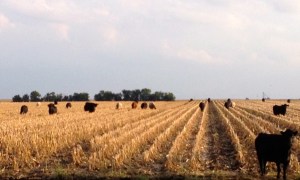
Grazing Corn Stalks

As I drive to work every morning, I go past a field or two being grazed by cattle. Bruce Anderson, UNL Extension Forage Specialist recently wrote an article on grazing corn stalks, which I’ve included in this week’s column.  Grazing corn stalks during winter has many benefits.  It can save over a dollar a day per cow compared to feeding expensive hay.

photo 3

But, the way you manage grazing of stalks by your cattle can have a big effect on its success.  For instance, maybe you have a goal of feeding as little protein supplement as possible while winter grazing.  Then you must make sure you have enough acres of corn stalks so your cattle only need to select just the higher quality plant parts to eat.  And whenever the grain and husks are gone, move to a fresh field.  Or, maybe you use stalks just as a filler to keep cows from bellowing while you limit feed corn, distiller’s grains, or other more nutrient dense feeds.  Then high stocking levels and unrestricted access might be best.

Another strategy might be to stretch winter stalks as far as possible.  In that case, restricting animal access to small areas at a time by strip grazing until nearly all the grazable stalks are gone might be best.  Be careful, though, about forcing cows to eat the lower stalks.  They won’t get much protein or energy from lower stalks but the nitrate levels might be dangerously high.

Whatever your strategy, consider carefully what kind of nutrition animals are getting from the stalk pasture so you neither underfeed nor overfeed expensive supplements.

Also be sure to provide salt, calcium, phosphorus, and vitamin A free choice at all times.  And once all the grain is gone, cows need about half a pound per day of an all-natural protein to meet nutrient needs. Stalk season is here.  Make wise decisions to use them best.

Crops

Wet Harvest Conditions

There were some places in the county that received over four inches of rain last week within 2 days, thus causing some very wet field conditions making it difficult for harvest. I heard that there were some minimal soybean losses and some dryland corn also down, but for the most part it sounds like we dodged the bullet and things could have been much worse. With all of the rainfall and some damaged crops, producers are most likely anxious to get back in the field. There are a few things one should consider however to determine if it’s worth harvesting while soil conditions are still wet. This week I’ve chosen to use some excerpts from an article, extension engineer Paul Jasa shared in a previous CropWatch article for farmers to consider.

As I write this, it will most likely be atleast a week before some fields dry up enough. Remember that if you leave ruts on the soil surface; compaction occurs below them and that compaction can impede the crop’s roots next season and increase runoff because of reduced infiltration. Compaction is the loss of pore space between soil particles and occurs when that space is squeezed out of the soil and reappears somewhere else, such as in the form of a rut. If a rut wasn’t formed, there was enough soil structure present to support the weight without causing additional compaction.

Jasa discusses the importance of controlling traffic and compaction and says that eighty to 85 percent of soil compaction damage is done with the first pass of the tires. If additional passes are made on the same traffic lanes, little additional compaction occurs. Because once a traffic lane has been driven on and the soil has been firmed up, subsequent passes have little effect on the amount of compaction. By using the same traffic lanes year after year, the soil structure and water infiltration in the untrafficked areas greatly improve.

Controlled traffic lanes improves traction, soil load bearing, and timeliness of planting and harvesting operations while minimizing potential yield reduction from compaction. Compaction is managed, not eliminated, and the area subjected to compaction is minimized. The concept is to separate traffic zones from root zones. Controlled traffic keeps compaction where it is less detrimental to root development and uptake of nutrients and water. Fertilizer placement and furrow irrigation practices can be modified as these traffic zones are established and the traffic lanes are known.

To minimize wheel compaction at harvest time, grain carts should be following the same tracks as the combine. A lot of grain cart drivers think they should move over a few rows and spread out compaction, but this will only compact more of the field. Likewise, grain trucks shouldn’t be driven in the field as the axle loads and tire pressures are not suitable for soils.

If ruts are cut at harvest, wait until the soil is dry to smooth them out to avoid causing additional compaction. This smoothing operation may be a light tillage operation next spring before planting. Deeper tillage in the spring will usually cause more compaction as the soil is wet and the tillage will break up soil structure.

To fracture the compaction in the ruts from this year’s harvest, a producer may have to wait until next fall before the soil is dry enough. However, often the compaction in the bottom of the ruts extends deeper into the soil than most producers will be able to till. This is a case where prevention is far more effective than the cure. It’s best to build soil structure and not drive on wet soils if possible. Controlled traffic, no tillage, and cover crops will all help build soil structure and reduce compaction concerns

(Source: Jasa, Paul. Avoiding Compaction at Harvest, October 13, 2006)

Crops

Sudden Death Syndrome

Several years ago, I was called to a field with some soybean issues and confirmed with the UNL Diagnostic Lab that it was sudden death syndrome, or SDS. SDS was first confirmed in Nebraska in 2004 and often is contained to areas within a field. Brown stem rot has been a disease of Nebraska soybean for many years.

A recent UNL CropWatch article written by Loren Giesler, Extension Plant Pathologist and Kevin Korus, Manager, Plant and Pest Diagnostic Clinic shared some information on sudden death syndrome which I have included in this week’s column. First of all, sudden death syndrome was recently confirmed in soybeans in the southeast, central, and east central districts of Nebraska. A soil-borne fungal disease, SDS produces a very resistant survival structure that is not affected by crop rotation.

Giesler and Korus shared that research at Iowa State University has shown that the SDS pathogen also survives well on corn kernels on the soil surface. This is relevant to Nebraska producers who have had SDS in their fields and this year experienced late season hail with grain loss. These kernels could serve as a site for this and other fungal pathogens to overwinter.

Foliar symptoms of SDS are similar to those of brown stem rot; however, stem damage is different. Split the stem to more closely exam symptoms. With brown stem rot the center of the stem will be discolored and typically will be brown from the soil line upward. With sudden death syndrome discoloration will be confined to the outer layers of the split stem. The center will not be discolored, but the root cortex will be light gray to brown and may extend up the stem

As with many plant diseases, the main management option is to select resistant varieties. Correct diagnosis is important so you’re aware of the pathogens in this year’s crop that may overwinter and cause problems for next year’s harvest. Fields with high SDS should not be planted early in future years and should be managed to reduce any compaction issues. Rotation will not affect SDS. Fields with brown stem rot will benefit from longer rotations. Foliar fungicides are not recommended for managing either disease.

For assistance in correctly identifying these diseases, submit a sample to the UNL Plant and Pest Diagnostic Clinic. This original article with pictures can be viewed at UNL’s CropWatch website.

Crops

Harvest Safety

It is hard to believe that harvest will soon be upon us! With harvest comes more traffic on the county roads and other stresses for farmers. It never fails, that equipment can break, there can be delays at the elevator and those extra-long hours can all add extra stress to farmers. That being said, it is important to carefully slow down and realize the many hazards you are being exposed to during harvest.

An Iowa State Extension publication, Harvest Safety Yields Big Dividends points out that injuries can occur by  taking shortcuts to perform routine tasks, not getting enough sleep or regular breaks, or failing to follow safety practices. Some injuries occur when operators are pulled into the intake area of harvesting machines, such as balers, combines, or corn pickers, and many injuries occur from slips or falls around these machines. Exposure to powerful machinery is highest during the harvest season. The equipment must be powerful to effectively handle large amounts of agricultural commodities. When equipment plugs, NEVER try to unplug it with live equipment, instead always disengage power and turn off the engine before trying to manually clear a plugged machine. Regular maintenance of these machines can also make harvest go smoother. Also, lots of accidents actually happen by the operator slipping and falling off equipment.

Harvest

In the same publication listed above, there are several tips for reducing fall hazards:

  • Always keep all platforms free of tools or other objects.
  • Frequently clean the steps and other areas where workers stand to service, mount and dismount, or operate the machine.
  • Wear well-fitting, comfortable shoes with non-slip soles.
  • Use grab bars when mounting or dismounting machinery.
  • Be sure your position is stable before you work on a machine.
  • Recognize that fatigue, stress, drugs or alcohol, and age may affect stability.

Other helpful tips during harvest are to keep kids away from machinery. Tell them the dangers that can occur and not to play near the equipment, even when it is shut off; you never know when they will be playing in hidden areas of the equipment. Operators should double check where kids are before moving the equipment. Too many accidents can occur when youth are in the path of equipment out of the operator’s view. Operators of all equipment should check in regularly and let someone know where you are. Keep all guards on equipment; it is there for a reason!

It is also important for the public to understand the increased traffic on public roads and be patient. The greatest threat raised between farm equipment and passenger vehicles is the difference in speed. Farm equipment runs at an average speed of 20 miles per hour while passenger vehicles average 60 miles per hour. If the motor vehicle overtakes a tractor, the impact is comparable to a passenger vehicle hitting a brick wall at 40 miles per hour. If the tractor and a car, mini-van or pickup collides head on, the impact is the same as hitting a brick wall at 60 miles per hour. Farmers can reduce the chances of an accident by using warning lights, reflectors and reflective tape on their machinery to keep

Some farm equipment, such as combines, can take up more than half of the road. Even so, it is up to both drivers to be aware of their own limitations and adjust accordingly. Farmers should not take up more space than is needed, but other drivers should try to provide as much room as possible. It is a good idea for passenger vehicles to turn off onto side or field roads until larger machinery has passed. Whenever possible, farmers should use an escort vehicle such as a pickup to precede or follow large machinery and equipment on public roads. More than one escort may be necessary. Ideally, the escort vehicle would have extra warning lights and a sign indicating oversized or slow equipment ahead or following.passenger vehicle operators aware of their presence on roads. Some farmers may choose to install supplemental lights to increase visibility. It also is a good idea for producers to keep off heavily traveled roads as much as possible and avoid moving equipment during the busiest part of the day.

Have a safe harvest!

Source: Harvest Safety Yields Big Dividends, Iowa State University

Crops

Soybean Stem Borer

Several years ago I received a call from a grower who had lots of soybeans that were lodged; it was confirmed their fields had the soybean stem borer, which was one of the first times it was reported in Nebraska in recent years. This year at the Soybean Management Field Day, entomologists reported that it has now moved north of the interstate and into York County as well.MussmanField 003

UNL extension entomologists, Bob Wright and Tom Hunt wrote an article last year on CropWatch providing the following information. This beetle (Dectes texanus texanus) has been moving into Nebraska from north central Kansas over the last decade.

The adult is a gray, elongate beetle about 0.5 inch long with antennae that are longer than the body. Females lay eggs from late June to August on various plants, including cocklebur, giant ragweed, sunflower, and soybean. On soybean, eggs are primarily laid in the leaf petioles. Larvae feed on the pith and tunnel down into the main stem. Each of four larval stages tunnels up and down the stem.

Initial damage is seen when larvae tunnel down the leaf petiole and enter the stem. The leaf tissue above this point wilts and dies. If you split the leaf petiole, you can see the tunneling and may still see the larva. Economic damage is caused primarily by lodging and subsequent harvest difficulties. Girdling is most severe in earlier maturing varieties, and lodging is most severe in earlier planted soybean.

Chemical treatment of larvae is ineffective because the larvae are in the stem; effective chemical control of the adults is difficult due to the extended adult emergence period. Research found that burying borer-infested stubble after harvest can reduce Dectes populations. Entomologists at Kansas State University have been studying this insect as a pest on soybeans for several years. They have not identified resistance in any commercially available soybean cultivars, and labeled planting time and foliar insecticide applications were not effective. KSU has conducted a great deal of research on this insect. Its reports and extension publications are available online.

Fields with a history of injury or with symptoms this year should be carefully watched during August and September. Fields with extensive stalk tunneling by the Dectes stem borer are at risk for lodging and harvest losses, depending on weather conditions. Those fields should be targeted for harvest first to minimize harvest losses due to stem borer injury. In the absence of lodging losses, this insect does not usually cause noticeable yield reductions.

For more information on this soybean pest, see the UNL NebGuide.  

Crops, Irrigation

Final Irrigation

The ETgage reading south of Geneva dropped 0.8 inches for the week of Aug. 9 – 16th. For corn and soybeans in our area it time to start thinking of the last irrigation. Producers with watermark sensors should be checking them to see how many inches they have to carry plants through to physiological maturity.  Corn that hasn’t approached full dent and soybeans in the R5 stage has a coefficient of 1.1. To estimate crop water use we multiply 0.8 times 1.1 for a total crop ET of 0.88 inches a week or about 0.13 inches a day.

As the crop begins to reach maturity, the crop water use slows. For example, corn at ¼ milk line requires 3.75 inches until maturity, while corn at ½ milk line only needs 2.25 inches. Soybeans at R5 (beginning seed enlargement) need 6.5 inches while soybeans at R6 (end of seed enlargement) need 3.5 inches.

Generally speaking, a silt loam soil can hold 2.2 inches per foot or 8.8 inches in the top 4 feet. The target is to have 60% available soil moisture depleted at the end of the season.  My colleague from York, Gary Zoubek provided a good example which relates to most soils in the area. His example uses a silt loam soil. If we draw down the available soil water to 60%, we would have 0.88 inch of water per foot of soil or 3.5 inches remaining in the top four feet of soil. Even though you have 3.5 inches remaining, if you draw the soil water past 60%, it can affect yields; therefore, our target is to have 60% depleted at the end of the season. This will leave room to capture 5.28 inches of water during the off season from rain or snowfall.

For more information on the last irrigation, Predicting the Last Irrigation of the Season is available online.

Crops, Programming

Soil & Water In-Field Day

Soil & Water In-Field Day

Last year I helped coordinate a soils field day for Nebraska ag teachers which focused on understanding how the overall health of the soil relates to the productivity of the land. This spurred a lot of interest, thus a workshop is now open to the public who want to learn how improving and maintaining soil quality is essential to the productivity of land for current and future use. University of Nebraska-Lincoln Extension‘s physical, chemical, and biological properties of soil and water clinic will provide hands-on training.

2013CMDC-soils

The Aug. 28 workshop will be conducted at the UNL’s Agricultural Research and Development Center near Mead. This training session is conveniently located a short driving distance from Omaha, Lincoln and Wahoo. The coordinator of this event, UNL Extension educator Keith Glewen says the in-field training is ideal for agribusiness professionals and those who work with soil and water management. “The training provides 7.5 total Certified Crop Advisor credits in nutrient management and soil and water management. It can be challenging to find that many credits focusing on these topics. We have a well-versed line up of speakers addressing soil and water topics which, of course, are the cornerstones of our food production system.”

Registration begins at 7:30 a.m. The training begins at 8 a.m. Pre-registration required. All registrants will be sent a confirmation letter, receipt and finalized schedule. Space is limited and registration is not guaranteed unless payment is received. Cancellations received one week before the clinic will receive a full refund.

In the event of program cancellation by UNL, pre-registered participants will be contacted and will receive a full refund. UNL is not responsible for any expenses incurred by registrants.

Registration before Aug. 21 is $160; $210 after. Fees include training, lunch and reference materials.

For more information or to register, contact the ARDC CMDC Programs, 1071 County Road G, Ithaca, NE 68033, call (800) 529-8030, fax (402) 624-8010, e-mail cdunbar2@unl.edu or visit the Web.

Topics include:  Physical, Chemical and Biological Properties of Soil and Water: The Cornerstone of the Human Race; Cover Crops for Improving the Soil; Infiltration Test and Organic Matter; Soil Temp., Electrical Conductivity, pH, N and P tests; Irrigation and Soil Water; Using Solvita Respiration Tests and N Flush; Soil Profile and Positioning of Landscape; and Management Considerations to Improve the Physical, Chemical and Biological Properties of Soil.

Certified Crop Adviser credits of 7.5 (2 in nutrient management and 5.5 water management) have been applied for and are pending approval for this clinic.

 Source: IANR News- July 30, 2013 (Glewen & Karstens)