Crops, Programming

Landlord/tenant cash rent workshops

Nebraska Extension’s Landlord/Tenant Cash Rent Workshops for 2020 and Beyond will provide the latest leasing, real estate and management information to operators, tenants and landowners in Nebraska this winter.

photography of one us dollar banknotes
Photo by Burst on Pexels.com

The workshop is scheduled in 19 communities throughout the state, between Dec. 6, 2019, and March 18, 2020.

Extension educators Austin Duerfeldt, Jim Jansen and Allan Vyhnalek, all working in the Department of Agricultural Economics, have collaborated to develop a program that will address agricultural finance and the real estate market, negotiation skills and considerations for leases and strategies for farmland succession and communication.

“Austin, Jim and I have put together an excellent set of topics and have completely rewritten our land management curriculum for this set of workshops,” said Vyhnalek. “We encourage both landowners and farmers to attend to hear about land management in the next decade.

For the purpose of this column, I have included the workshops closest to us, including York and Clay Center. Registration for the free workshop is requested to ensure enough materials are available. Updated information is available at farm.unl.edu.

 Landlord/Tenant Cash Rent Workshops for 2020 and Beyond

Omaha
When: Dec. 17, 2019, 6-9 p.m. at Nebraska Extension in Douglas-Sarpy Counties
Address: 8015 W Center Road, Omaha, NE 68124
Registration: 402-444-7804

 Seward
When: Jan. 7, 2020, 1:30-4:30 p.m. at Nebraska Extension in Seward County office
Address: 322 S. 14th St., Seward, NE 68434
Registration: 402-643-2981

York
When: Jan. 8, 2020, 9 a.m.noon at York County Fairgrounds – 4-H Building
Address: 2345 N. Nebraska Ave., York, NE 68467
Registration: 402-362-5508

Clay Center
When: Jan. 15, 2020, 1-4 p.m. at Clay County Fairgrounds – 4-H Building
Address: 111 W. Fairfield St., Clay Center, NE 68933
Registration: 402-762-3644

Kearney
When: Feb. 24, 2020, 9 a.m.-noon at Nebraska Extension in Buffalo County office
Address: 1400 E. 34th St., Kearney, NE 68847
Registration: 308-236-1235

Crops, Irrigation, Programming

Farm Bill Programs

Nebraska Extension and USDA Farm Service Agency in Nebraska will host a series of Farm Bill education meetings over the next two months to assist producers as they begin to make farm-bill related program decisions. The 2018 Farm Bill, signed into law last December, reauthorized the existing Agriculture Risk Coverage (ARC) and Price Loss Coverage (PLC) safety net programs that were in the 2014 Farm Bill, however producers will need to make new program enrollment decisions over the coming months.

cornfield
Photo by cottonbro on Pexels.com

While the ARC and PLC programs under the new farm bill remain very similar to the previous farm bill, a few program changes coupled with changes in market conditions and outlook could significantly impact producer decisions.

“These meetings will help producers understand the programs and recent changes, as well as the decisions to be made at sign-up now and in the coming years,” said Nancy Johner, State Executive Director for the USDA Farm Service Agency in Nebraska. “There are some changes, such as an optional PLC program yield update, and other tweaks to the ARC and PLC programs that producers should consider as they make their selections.”

“Producers face a familiar choice between ARC and PLC, but under very different circumstances now as compared to 2014,” said Brad Lubben, Policy Specialist with Nebraska Extension. “Understanding the program mechanics, analysis and available decision tools will help producers make sound enrollment decisions with FSA.”

The joint Nebraska Extension and Nebraska Farm Service Agency producer education meetings are scheduled at numerous locations across the state from late November to mid-December in advance of the coming ARC/PLC enrollment deadlines in early 2020.

analysis blackboard board bubble

The meetings are all free and open to the public. Advance registration is encouraged for planning purposes for materials and facilities. Attendees can register for any of the meetings conveniently on the web at farmbill.unl.edu or by calling or visiting their county FSA or Extension office. The educational programs are each set to run three hours in length, featuring information and insight from FSA specialists and Extension experts, as well as other relevant information from local agencies.

The meetings are available statewide with several locations in each region of the state. The schedule for programming closest to us is as follows:

  • Red Cloud – Community Center – November 25, 1-4 PM
  • Bruning – Bruning Opera House – December 5, 1:30-4:30 PM
  • Grand Island – College Park Fonner Park Room – December 5, 1-4 PM
  • York – York County Fairgrounds Cornerstone Building – December 6, 9 AM-12 NOON
  • Lincoln – Lancaster County Extension Center – December 16, 9 AM-12 NOON
  • Kearney – Buffalo County Fairgrounds Antelope Meeting Room – December 17, 1-4 PM
  • Beatrice – Gage County Fairgrounds 4-H Building – December 17, 9 AM-12 NOON
  • Geneva – Fillmore County Fairgrounds Ag Hall – December 18, 9 AM-12 NOON

Please check the website for updates on locations, dates and times. All times are local with registration beginning 30 minutes ahead of start. Several additional meetings also are being planned locally across the state in various locations. Keep alert to additional opportunities and details as they are developed by checking the website for information or by contacting your county Extension or FSA office.

There also are resources available online that can educate producers in their ARC/PLC decision-making process. Links to these resources are available from FSA at www.fsa.usda.gov/ne under the Spotlights section or from Extension at farmbill.unl.edu.

Source: Brad Lubben, Nebraska Extension Policy Specialist: Email: blubben2@unl.edu

Crops, Livestock, Programming

Farmers & Ranchers College

The Farmers & Ranchers College was formed in January 2000 with the purpose of providing high quality, dynamic, up to date educational workshops for area agricultural producers in south central Nebraska through a collaborative effort between business, industry and higher education leaders. Furthermore, the Farmers & Ranchers College will provide the tools necessary so that agricultural producers will be able to respond positively to these changes using a profitable decision making process.frcollege-logo-front-panel

The Farmers and Ranchers College is a unique opportunity to educate agricultural producers in south central Nebraska. Approximately two hundred fifty producers participated in the 2018-19 Farmers & Ranchers College programs. Producers attending these workshops managed over 100,000 acres and managed nearly 10,000 head of beef animals. Participants surveyed indicated a potential impact of nearly $1 million from knowledge gained from participating. The 18th annual Partners in Progress- Beef Seminar featured a variety of industry, University and agricultural organization presenters. Ninety-eight percent of participants surveyed were very satisfied or satisfied with the program quality and fifty-five percent indicated that previous programming improved their knowledge of making risk management decisions.

Contributions and support of area businesses allow participants to attend at no cost, however for programs that have meals, it is requested that people RSVP at least a week in advance for an accurate meal count by calling Fillmore County Extension at (402) 759-3712.

The Farmers and Ranchers College Committee consists of Fred Bruning of Bruning, Bryan Dohrman of Grafton, Sarah Miller of Carleton, Jennifer Engle of Fairmont, Ryne Norton of York, Jim Donovan of Geneva, Bryce Kassik of Geneva, Eric Kamler of Geneva, and Brandy VanDeWalle of Ohiowa.

2019-2020 Program Schedule

December 9, 2019 – “Agriculture Today: It is What it is…What Should We Do About It” w/ Dr. David Kohl, Professor Emeritus, Dept. of AAEC, VA TECH at the Opera House in Bruning, NE from 1-4:00 pm

January 28, 2020** – “Partners In Progress Beef Seminar” Cow/Calf College at U.S. MARC near Clay Center, NE from 10-3:30 p.m., Registration at 9:30 a.m.

March 2020 – “Strategies for Family Farming Success in the Shark Tank” with Dr. Ron Hanson, UNL Harlan Agribusiness Professor Emeritus at the Fillmore Co. Fairgrounds- Geneva, NE     Details are still being finalized for this program.

 ** Programs are free; however registration is appreciated for a meal count. Please call the Fillmore Co. Extension Office at (402) 759-3712 one-week prior to the program to reserve your spot.

Crops, Livestock, Youth

Remember Ag Safety

Last week I attended the Progressive Agriculture Safety Day coordinator training. This training provides excellent resources for the annual Progressive Agriculture Safety Day we have each May in Geneva. By participating in this program, national donors provides us the opportunity to provide youth t-shirts, access to vital curriculum materials and other support. At the training, two staggering statistics reinforced my reason for continually offering this program to area youth. In North America, every 3 days, a child dies due to an ag-related accident. Also, in North America, every day 33 youth are injured in an agricultural setting.img_6564

The vision of Progressive Agriculture Foundation is that “no child would become ill, injured or die from farm, ranch or rural activities.” As the mother of two school-aged children, I try to stress the importance of safety in and around crop and livestock areas, but it just takes one moment for an accident to happen so please remember to take it slow and easy this harvest season. The stress of farming and ranching is large and taking care of yourself is important not only for your health but to those around you.

Our local ag safety day planning committee will be meeting after the first of the year to plan our program. If you or your business would like to contribute financially to our local youth or be involved in our program, please contact me at (402) 759-3712 or brandy.vandewalle@unl.edu and I’d be glad to talk about ways to effectively teach our youth about ag safety.

Crops

CropWatch Resources

The year 2019 will definitely go down as one of the most challenging years in recent memory. With flooding in the spring and recent localized flooding last week, many are ready to wrap up this year and hope for a much better year in 2020. Just a reminder that the UNL CropWatch website has many resources to answer your questions and can be accessed by going to cropwatch.unl.edu.

cropped-n_4h-ext-3c.png

Also, please consider helping Nebraska Extension by completing the Nebraska Weed Issues Survey: By completing the survey you will be helping with a research project to update issues impacting you. Survey at: https://www.surveymonkey.com/r/QZV8Z2T

Crops, Irrigation, Livestock, Programming

Free Ag Law and Farm Finance Clinics

Free legal and financial clinics are being offered for farmers and ranchers at seven sites across the state in October. The clinics are one-on-one meetings with an agricultural law attorney and an agricultural financial counselor. These are not group sessions, and they are confidential.

close up court courthouse hammer
Photo by Pixabay on Pexels.com

The attorney and financial advisor specialize in legal and financial issues related to farming and ranching, including financial and business planning, transition planning, farm loan programs, debtor/creditor law, debt structure and cash flow, agricultural disaster programs, and other relevant matters. Here is an opportunity to obtain an independent, outside perspective on issues that may be affecting your farm or ranch.

To sign up for a free clinic or to get more information, call the Nebraska Farm Hotline at 1-800-464-0258.

Funding for this work is provided by the Nebraska Department of Agriculture, Legal Aid of Nebraska, North Central Extension Risk Management Education Center, and the USDA National Institute of Food and Agriculture.

Clinic Sites and Dates

  • North Platte — Thursday, October 10
  • Lexington — Thursday, October 17
  • Fairbury — Wednesday, October 23
  • Valentine — Tuesday, October 29
  • Norfolk — Wednesday, October 30
Crops

Harvest Safety

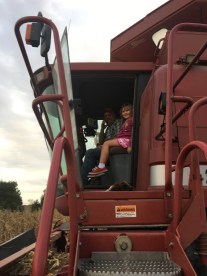
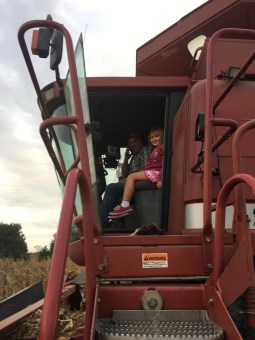
It is hard to believe that harvest is starting and just as a reminder that with harvest comes more traffic on the county roads and other stresses for farmers. It never fails, that equipment can break, there can be delays at the elevator and those extra-long hours can all add extra stress to farmers. That being said, it is important to carefully slow down and realize the many hazards you are being exposed to during harvest.IMG_3695

An Iowa State Extension publication, Harvest Safety Yields Big Dividends points out that injuries can occur by taking shortcuts to perform routine tasks, not getting enough sleep or regular breaks, or failing to follow safety practices. Some injuries occur when operators are pulled into the intake area of harvesting machines, such as balers, combines, or corn pickers, and many injuries occur from slips or falls around these machines. Exposure to powerful machinery is highest during the harvest season. The equipment must be powerful to effectively handle large amounts of agricultural commodities. When equipment plugs, NEVER try to unplug it with live equipment, instead always disengage power and turn off the engine before trying to manually clear a plugged machine. Regular maintenance of these machines can also make harvest go smoother. Also, lots of accidents actually happen by the operator slipping and falling off equipment.

In the same publication listed above, there are several tips for reducing fall hazards:

  • Always keep all platforms free of tools or other objects.
  • Frequently clean the steps and other areas where workers stand to service, mount and dismount, or operate the machine.
  • Wear well-fitting, comfortable shoes with non-slip soles.
  • Use grab bars when mounting or dismounting machinery.
  • Be sure your position is stable before you work on a machine.
  • Recognize that fatigue, stress, drugs or alcohol, and age may affect stability.

img_6564

Other helpful tips during harvest are to keep kids away from machinery. Tell them the dangers that can occur and not to play near the equipment, even when it is shut off; you never know when they will be playing in hidden areas of the equipment. Operators should double check where kids are before moving the equipment. Too many accidents can occur when youth are in the path of equipment out of the operator’s view. Operators of all equipment should check in regularly and let someone know where you are. Keep all guards on equipment; it is there for a reason!

It is also important for the public to understand the increased traffic on public roads and be patient. The greatest threat raised between farm equipment and passenger vehicles is the difference in speed. Farm equipment runs at an average speed of 20 miles per hour while passenger vehicles average 60 miles per hour. If the motor vehicle overtakes a tractor, the impact is comparable to a passenger vehicle hitting a brick wall at 40 miles per hour. If the tractor and a car, mini-van or pickup collides head on, the impact is the same as hitting a brick wall at 60 miles per hour.

Farmers can reduce the chances of an accident by using warning lights, reflectors and reflective tape on their machinery to keep passenger vehicle operators aware of their presence on roads. Some farmers may choose to install supplemental lights to increase visibility. It also is a good idea for producers to keep off heavily traveled roads as much as possible and avoid moving equipment during the busiest part of the day.

Some farm equipment, such as combines, can take up more than half of the road. Even so, it is up to both drivers to be aware of their own limitations and adjust accordingly. Farmers should not take up more space than is needed, but other drivers should try to provide as much room as possible. It is a good idea for passenger vehicles to turn off onto side or field roads until larger machinery has passed. Whenever possible, farmers should use an escort vehicle such as a pickup to precede or follow large machinery and equipment on public roads. More than one escort may be necessary. Ideally, the escort vehicle would have extra warning lights and a sign indicating oversized or slow equipment ahead or following.

Have a safe harvest!

Crops, Irrigation, Programming, Youth

Youth Learn Crop Scouting Skills

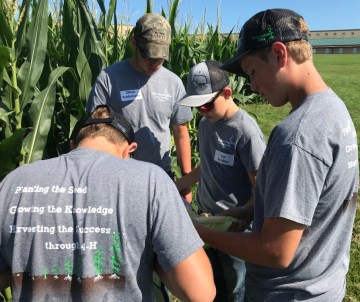
group 0On July 23, 2019, the sixth annual Crop Scouting Competition for Nebraska youth was held in which seven teams from across Nebraska competed. It was held at the Eastern Nebraska Research and Extension Center near Mead, Nebraska on July 23, 2019. Teams of students (those completing 5-12th grades) participated by completing a written knowledge test and seven crop scouting exercises in field plots.

The purpose of the competition w­­­as to provide students an opportunity to learn crop scouting and principles of integrated pest management (IPM) for corn and soybeans in Nebraska, to obtain knowledge and skills that will be helpful in future careers and to demonstrate newer crop scouting technologies.

Results from the 2019 competition were as follows:

First place- Colfax County 4-H (R. J. Bayer, Jestin Bayer, Austin Steffensmeier, Logan Nelson, and Brad Kratochvil)

Second place – Kornhusker Kids 4-H Club #1 (Payton & Levi Schiller, Matthew Rolf, and Kaleb Hasenkamp)

Third place – Kornhusker Kids 4-H Club #2 (Landon Hasenkamp, Ethan Kreikmeier, James Rolf, and Ian Schiller)

Also participating was

Humphrey FFA with Bryce Classen, Jacob Brandl, and Mikayla Martensen

Twin River FFA with Keaton Zarek, Kyle Kemper, Jacob Czarnick, and Landon Cuba

Auburn FFA with Kellen Moody, Austin Youngquit, Braden Gerdes, and Riley Stukenholtz

Wayne FFA with Justus Greves, Noah Lutt, Tyler Reinhardt, Elle Barnes, and Alyssa Carlson

Top-scoring teams won prizes: $500 for first, $250 for second, $100 for third place. The top two teams will represent Nebraska at the regional competition held in Iowa on August 26, 2019.

Teams were expected to know the basics of scouting corn and soybean fields. This included crop staging; looking for patterns of crop injury; disease, insect and weed seedling identification; etc.

corn growth staging, maturity, development 2
Kornhusker Kids team determine the corn growth during the program.

More information about the crop scouting competition are available online at cropwatch.unl.edu/youth. Click on the link that says, “Crop Scouting Competition”.

This program was sponsored by DuPont Pioneer, the Nebraska Independent Crop Consultant Association and Farm Credit Services of America in collaboration with Nebraska Extension. If you know of a company or you would are interested in sponsoring the 2020 program, please contact me at brandy.vandewalle@unl.edu.

Crops, Irrigation, Livestock

Stress is a Part of Life

First of all, I’d like to give a shout-out to the many volunteers who helped contribute to a successful county fair!  Without great volunteers so freely giving their time and talents to the youth in the 4-H program, 4-H would not be the success it is! I would like to personally thank all of the extension staff, fair board members, 4-H Council members, superintendents, and other volunteers for their dedication to the 4-H program. Fair can be a stressful time; however, when we don’t lose sight of its purpose can create long-lasting and positive memories.

woman working girl sitting
Photo by Alexander Dummer on Pexels.com

Speaking of stress, this week I’ve captured a few stress relieving tips to consider as summer comes to an end and youth will be in school. Stress is a part of life; we can’t live without it, but sometimes we feel that we can’t live with it!

Stress comes from many sources: a family crisis such as death, divorce or long separation; It might be from overloaded schedules; maybe expectations that cannot be met or unexpected circumstances; A loss of job, health, home or friendship; it can even come from a happy event as marriage, the birth of a child, or moving into a new home. Regardless of the cause, the following are three ways you can manage your stress: alter it, avoid it, or accept it.

Alter your life by removing the source of stress. Some stressors can be relieved by better planning or organization in your life. Simple things like having emergency supplies on hand, not shopping at the busiest times of the week, or organizing your work space can each be stress relievers. If morning schedules are tight, lay out children’s clothes or set the table for breakfast the night before.

Avoiding stress is another management strategy. Learn to say no, when an addition to your schedule will only add to your stress. If you are stressed by long waits, plan something to do (like reading a book) while you wait for an appointment. If there is too much tension in your home or office, go for a walk to clear your mind and relieve the tension.

man in blue and brown plaid dress shirt touching his hair
Photo by Nathan Cowley on Pexels.com

Find a way to accept the stressors that we have no control over. Talking to a trusted friend will help you put things in perspective. Keeping in good health by eating well, getting enough sleep and keeping a routine are essential. Look for the good. Even in the worst of circumstances, there are things that can bring a smile to your face, reasons to be thankful, and opportunities to help others.

Source: How to Manage Daily Stress@ by Dr. Herbert G. Lingren, Extension Family Scientist, NF98-388.

Resources for Nebraska Farmers, Ranchers, and Their Families
We hope you reach out if you are feeling stressed.

  • Rural Response Hotline: The hotline offers access to many attorneys, financial advisors, professional counselors, mediators, clergy, and others. There are 167 behavioral health professionals working with the Rural Response Hotline.  Ask about no-cost vouchers for counseling services. 800-464-0258
  • National Suicide Prevention Lifeline: A national network of local crisis centers that provides free and confidential emotional support to people in suicidal crisis or emotional distress 24 hours a day, 7 days a week. 800-273-8255.
    – Crisis Text Line: Free, 24/7 support for those in crisis, connecting people in
    crisis to trained Crisis Counselors. Text GO to 741741
  • Veterans Crisis Line: Connect with this resource to reach caring, qualified responders within the Department of Veterans Affairs. Many of them are Veterans themselves. 800-273-8255, Press 1 or Text to 838255
  • Negotiations Program: Mediation services for agricultural borrowers, creditors, and USDA program participants. Free one-on-one education on agricultural financial and legal matters. 402-471-4876
  • The Boys Town National Hotline: Not just for boys. For all teens and their parents, this hotline is available 24 hours a day, 365 days a year, with specially trained counselors. A TDD line is available (1-800-448-1833), allowing counselors to communicate with speech-impaired and deaf callers. 800-448-3000
  • SAMHSA National Helpline: Free, confidential, 24/7, 365-day-a-year treatment referral in English and Spanish for individuals and families experiencing issues with alcohol, prescription drug, or other substance abuse. 800-662-HELP (4357)

YOU ARE NOT ALONE.
We care about you!

Crops, Irrigation, Livestock

FSA County Committee Nomination Deadline

It is important for one to stand for what they believe in and takes an active role in one’s community. Effective leadership is crucial to any community or organization.  An effective leader understands the issues at-hand, is knowledgeable in his/her area, knows the proper ways to motivate others, embraces change, can work in a variety of settings and with a variety of personalities, and involves the group or followers in important decision-making. That being said, remember that a leader is not only a political figure or someone that is well known, but a leader can be a farmer, local businessmen/women, or anyone in a community or organization.  For those individuals desiring to take on leadership roles, consider serving on the FSA County Committee. Details for how to step into this role follow.

houses in farm against cloudy sky
Photo by Pixabay on Pexels.com

The U.S. Department of Agriculture (USDA) Farm Service Agency (FSA) encourages all farmers, ranchers, and FSA program participants to take part in the County Committee election nomination process.

FSA’s county committees are a critical component of the day-to-day operations of FSA and allow grassroots input and local administration of federal farm programs.

Committees are comprised of locally elected agricultural producers responsible for the fair and equitable administration of FSA farm programs in their counties. Committee members are accountable to the Secretary of Agriculture. If elected, members become part of a local decision making and farm program delivery process.

A county committee is composed of three elected members from local administrative areas (LAA). Each member serves a three-year term. One-third of the seats on these committees are open for election each year.

County committees may have an appointed advisor to further represent the local interests of underserved farmers and ranchers. Underserved producers are beginning, women and other minority farmers and ranchers and landowners and/or operators who have limited resources.

All nomination forms for the 2019 election must be postmarked or received in the local USDA service center by Aug. 1, 2019. For more information on FSA county committee elections and appointments, refer to the FSA fact sheet: Eligibility to Vote and Hold Office as a COC Member available online at: fsa.usda.gov/elections.