Crops, Livestock

Grazing Summer Annuals

IMG_2486.jpg
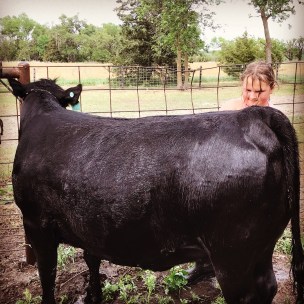
McKenzie giving her calf a bath. We split the pen so that some of it is seeded to millet for grazing later this summer. 

Recently, my husband and I added fencing for my daughter’s 4-H second year bucket calves and hope she can eventually expand to a small cattle herd someday. That is what I did through my 4-H and FFA projects so hopefully she will want to follow in my footsteps. With an area of bare soil, my Dad recommended seeding some millet for grazing, not to mention holding soil in place to prevent dusty conditions. We had to water the area to get the seed up, but now have a decent stand. This past week, my colleague Brad Schick who is focused in the beef area published an article on Extension’s BeefWatch website which I’ve decided to share with you this week.

Brad shares how grazing summer annual grasses is a great way to add flexibility to an operation, but in order to make it worth your time and money some management decisions are required. Your goals and your location will determine what type of summer annual you should plant. His article will addresses the type of annual and planting date, timing of grazing, prussic acid and nitrate concerns.

The most common summer annuals for grazing are sorghum-sudangrass (often call sudex), sudangrass, pearl millet, foxtail millet, and teff. For forages that can be grazed slightly earlier, the sorghums and sudangrasses can be used, but should only be planted once the soil temperature is above 60 degrees Fahrenheit. Generally, a late May to early June planting date will meet the 60 degree Fahrenheit requirement.

For millets and teff, the soil temperature needs to be 65-70 degrees F before planting. Planting into soil that maintains a lower temperature can cause stunted growth and reduce forage yield. Planting mid- to late June and into July should give good results with enough water. The millets and teff are fairly drought tolerant, and more tolerant to drought than the sudangrasses and sorghums.

Another consideration for planting is forage availability. A good rule to follow is that forage will be ready to graze 6-8 weeks after planting. To reduce the chance of forage getting ahead of the cattle, stagger plantings of a forage type by two weeks. By staggering planting, rotational grazing can be implemented and the forage will be grazed more efficiently. Staggering of planting can be done using one forage type such as sorghum-sudangrass, or using two or more types. For example, sorghum-sudangrass is planted on a portion of the field. Two weeks later on the next portion of the field, sorghum-sudangrass or a different annual such as pearl millet is planted as long as temperature requirements are met.

Maximizing the harvest efficiency while grazing annual forages is a significant factor when planning the annual type and planting date. However, issues can occur when cattle moves are not managed properly. Use a short, rotational system for grazing. Fields should have a minimum of three paddocks to allow for regrowth after the first rotation. A goal should be to graze the paddocks for about 7-10 days and allowing regrowth for at least 14-20 days.

Grazing sorghum-sudangrass should be delayed until plants are 18-24 inches tall in order to avoid prussic acid poisoning, which can cause death in cattle. Sudangrass, foxtail and pearl millet, can be grazed once they reach 15-20 inches in height. Another guideline is to graze all these summer annuals leaving about 6-8 inches of stubble during that 7-10 day rotation. If choosing between leaving cattle on a paddock for a longer or shorter time, just remember that retaining some leaf area will cause more photosynthesis and ultimately a faster regrowth.

A significant concern for grazing some summer annuals is prussic acid poisoning, also known as cyanide poisoning. The regrowth and young leaves of the sorghums, sudangrasses, and sorghum-sudangrasses produce prussic acid and can be deadly if cattle consume a high concentration. Graze when the plants have reached an appropriate height and time the grazing periods appropriately. Turning cattle out full and with plenty of water will reduce the chance of prussic acid poisoning. Nitrates in grazing situations are generally not a concern if the forage isn’t grazed too low because the lower one-third of the plant will contain the highest nitrate concentration. Nitrates are something to watch when grazing any summer annual grass, even beyond drought years.

Grazing summer annual grasses can be a great addition to an operation when annuals are chosen correctly and grazing plans are used. Finally, planting a few extra acres of summer annuals is a good option as part of a drought plan for either grazing or haying. It’s also a fall back to the annuals grazing program just in case growth and regrowth isn’t as productive as planned. Summer annuals are also a great option before reseeding an aging alfalfa stand. This can provide quality hay or grazing. Setting clear goals can make grazing summer annuals worth your time and money.

For more information on this topic, check out Brad’s article with resources at beefwatch.unl.edu.
 

Crops, Irrigation

Irrigation Information

If you would like to participate in a dynamic irrigation program, called the Nebraska Ag Water Management Network, let me know and I’d be happy to help and get you started! If you are in the NAWMN, consider installing your ETgage soon and once done with planting, start the soaking/drying cycle on your Watermark sensors to be sure they work! It’s also important to replace the #54 alfalfa canvas covers and wafers on a regular basis at the start of each season. For more information, go to: https://nawmn.unl.edu/.

ETgage

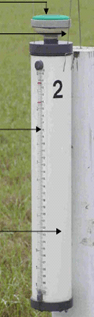
I plan to report the weekly evapotranspiration (ET) in my weekly blog. The ETgage I check is in the center of the county, just south of Geneva; hopefully it will help others become aware or have an idea what the local ET is.

The ETgage I check outside of Geneva changed 2.0 inches for the week of May 25-June 1st. Corn in the V-4 stage has a coefficient of .18”. To calculate how much water, corn at V-4 stage used you simply multiply .18” x 2.0” for a weekly use of .36” or .05 inches/day. Corn approaching V-6 would have used .70”/week or .07” per day.  Fortunately, we received about 1.2” rain in this location as well.

For more information about ETgages and Watermark sensors, check out the NAWMN website https://nawmn.unl.edu/.

Crops, Programming

Weed Management & Cover Crops Field Day

To see on-site demonstration of new technologies and herbicides for weed control in corn, soybean sorghum and cover crops research, plan to participate in the Weed Management & Cover Crops Field Day held June 27, 2018 from 8:30 a.m. – 3:00 p.m. Registration starts at 8:00 a.m. for this free event which will be held at  the South Central Ag Lab near Clay Center, NE. Thanks to numerous sponsors, this event is free for participants. Registration is appreciated for a meal count and can be done by going to http://agronomy.unl.edu/fieldday.pexels-photo

Some topics include: comparison of herbicide programs for weed control in soybeans and corn, weed control and crop safety in MGI soybean, response of white and yellow popcorn hybrids to glyphosate Enlist DUO, or XtendiMax (26), control of Roundup Ready/Liberty Link volunteer corn in Enlist corn, weed control and crop response in INZEN sorghum, soybean yield and critical time for weed removal as influenced by soil applied herbicide. In addition, an overview of the effects of cover crops on weed suppression pests and beneficial insects will be shared.

There are CCA credits available for those who need them. More information may be obtained by contacting Roger Elmore at roger.elmore@unl.edu or (402) 472-1451.

Crops, Programming

Wheat Field Day

Growers can learn about the latest wheat varieties and view many of them in the field at the Wednesday, May 30th Wheat Variety Plot Tour near Fairbury. The event, sponsored by Nebraska Extension, will begin at 6:30 p.m. in a plot hosted by Mark Knobel.

Speakers include Stephen Baenziger, University of Nebraska-Lincoln professor and wheat breeder, Paul Jasa, Nebraska extension engineer, will provide tips on setting no-till drills to increase wheat stand consistency. He will also share cover crop opportunities following wheat and Stephen Wegulo, Nebraska Extension plant pathologist, will discuss wheat disease prevention strategies in southern Nebraska.

agriculture arable barley blur
Photo by Pixabay on Pexels.com

From Fairbury:  Travel northeast on Highway 136 for 3 miles and turn north on 571 Avenue. Go north for 2.6 miles on 571 Avenue. Turn east on 716 Road for 0.2 mile. Plot is on the south side of the road. GPS Coordinates 40.204547, -97.120798.

Alternate Route:  On Highway 15, go 2 miles north of Fairbury, take 716 Road east 3.2 miles (Note: Two miles is minimum maintenance. If it’s muddy, consider taking Road 715 or Road 718 as alternate roads.) Fresh kolace will be served made from winter wheat!

For more information about the plot tour, contact Randy Pryor at the UNL Extension Office in Saline County at 402-821-2151 or e-mail rpryor1@unl.edu or view the program flyer.

Crops, Programming, Youth

Connecting Youth with Crops

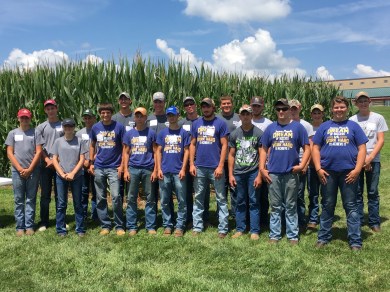
Looking for a fun project for 4-H or FFA youth? Want to unite your club members? Running out of ideas for youth projects?  If you answered, “yes” to any of these questions, help is on the way!  Nebraska Extension is pleased to present the 5th annual Crop Scouting Competition for Nebraska youth. Youth interested in crops have the opportunity to learn about crop growth & development and basic crop scouting principles.IMG_9071.jpg

Don’t know a lot about crops?  Ask a local agronomist to assist by providing a short lesson on crop production. You can have the agronomist meet with youth a little during each meeting or outside of the meeting. This is one way to engage those youth interested in crops.

This contest will be held at the ARDC near Mead, Nebraska on July 26, 2018. The event will include both indoor and outdoor events. Teams of junior high and high school students (those completing 5-12th grades) from across Nebraska are invited to participate. This event is limited to the first ten teams who sign-up!

Clubs or other organizations may enter a team composed of three to five participants. An adult team leader must accompany each team of students. Team leaders could be FFA advisors, crop consultants, extension staff, coop employees, etc.IMG_9110.jpg

Top-scoring teams win prizes: $500 for first, $250 for second, $100 for third place. Top two teams will be eligible for regional competition in August at Nebraska.

Teams will be expected to know the basics of scouting corn and soybean fields. This includes crop staging; looking for patterns of crop injury; disease, insect and weed seedling identification; etc. Other topics many include but are not limited to, pesticide safety, nutrient disorders, and herbicide injury.

More information about the crop scouting competition and instructions on how to register a team are available online at cropwatch.unl.edu/youth. Register at: go.unl.edu/cropscoutingregistration. For more questions, contact me at brandy.vandewalle@unl.edu or (402) 759-3712.

Teams must be registered by July 18. This program is sponsored by Nebraska Independent Crop Consultant Association, DuPont Pioneer, Farm Credit Services of America and Nebraska Extension.

Crops, Irrigation

NE Ag Water Management Network

pexels-photo-347925.jpeg

It’s certainly proving to be a dry spring so far. One of the ways to better manage irrigation costs is through participation in the Nebraska Ag Water Management Network. In addition to saving costs and water, producers report a reduction in nutrient loss. Evaluation results have shown a one to two-inch savings of irrigation since its inception. The Network has been having significant impacts on both water and energy conservation due to farmers adopting information and implementing technologies in their irrigation management. The cost of applying an additional 2 inches of water is going to vary depending on your depth to water, system pressure, and equipment costs, but could easily run from $10 to $30 per acre.

To determine the actual cost, I recommend using the IrrigateCost app, developed by Nebraska Extension. The app, which is available for both Apple and Android products, allows users to input their specific information such as acres irrigated, pumping lift, system PSI, pump and pivot life, and inches applied as well as related costs such as for the well and engine, labor, energy, district fees, and taxes. The app then calculates total irrigation, total ownership, and total operating costs. It also breaks down costs by irrigation well, pump, gear head, pump base, diesel eirrigatecostngine and tank and system and calculates per acre annual cost and per acre-inch annual cost.
A couple of the tools the NAWMN uses are ETgages® or Atmometers which mimic crop evapotranspiration or ET and Watermark soil matrix sensors which measure soil matric potential or the energy required to remove water from the soil. These two tools have really worked well and have made irrigation management much easier than those gut feelings.  The more information you have the better decisions you can make!

ETgage

If you are in the NAWMN, and have not already installed your equipment, be sure to remember to start the soaking/drying cycle on your Watermark sensors to be sure they work! It’s also important to replace the #54 alfalfa canvas covers and wafers on a regular basis at the start of each season. For more information, go to: http://water.unl.edu/web/cropswater/nawmdn.

Once you have your ETgage out, I hope you will post your weekly readings to the Nebraska Ag Water Management Network (NAWMN) website. As a reminder, once you are on the main screen, you can login to your site by entering your site name and password and clicking on “Login.” Once you have logged in, you will be taken to your weekly data from past weeks, including last year. To enter your weekly data, click on the “Add new ETgage reading” link which will take you to the data entry page where you can enter your growth stage, rainfall, and ETgage change.

If you’ve forgotten your site name or password, please contact Aaron Nygren at anygren2@unl.edu or 402-352-3821.

Crops, Irrigation, Programming

Crop Scout Training

Have you ever thought about where crop scouts and agronomists receive some of their training? Nebraska Extension helps provide education for them and others; one opportunity will be coming up on May 9th. The course is from 8:55 a.m. to 5:10 p.m. with registration at 8:30 a.m. at the University of Nebraska’s Eastern Nebraska Research and Extension Center near Mead. The training course is scheduled for industry representatives and corn and soybean growers wanting to learn how to better manage corn and soybean pests.nature-field-sun-agriculture.jpg

Keith Glewen, extension educator who coordinates the program said, “The training is designed for entry-level scouts who are working for crop consultants, industry agronomists or farm service centers in Nebraska and neighboring states”. The training course is also ideal for growers who scout their own fields or are interested in improving productivity, as well as for students being employed by agribusinesses. The day-long event provides participants practical/working knowledge and better accuracy in field scouting. Topics include: corn and soybean insect Scouting, identification and management; crop diseases; identifying weeds – plant morphology, using a key to identify weed seedlings; nutrient deficiencies in corn and soybeans; and understanding corn and soybean growth and development.

The cost for the program is $165, which includes lunch, refreshment breaks, workshop materials and instruction manual. Updated reference materials are included in this year’s take-home instruction manual.  For those attending the day-long training without the resource book, the fee is $50. Attendees should preregister to reserve their seat and to ensure workshop materials are available the day of the training session.

Certified Crop Advisor continuing education credits are available with 6 in pest management, 1 in crop management and .5 in fertility/nutrient management.

For more information or to register, contact Nebraska Extension at (402) 624-8030, (800) 529-8030, e-mail Keith Glewen at kglewen1@unl.edu, or online at https://enre.unl.edu/crop.

Crops, Irrigation, Programming

Nebraska On-Farm Research Network Opportunities

The Nebraska On-Farm Research Network (NOFRN) is seeking growers who would like to conduct research trials in the 2018 crop season. NOFRN is designed to help growers test and answer questions they have about products or practices they’re considering implementing on their farm. The on-farm research studies provide a unique opportunity to collaborate with university and industry experts to design and conduct research suited to the farmer’s own operation.

A number of NOFRN research protocols are available for 2018 and even more can be customized to address specific farmer questions, said Laura Thompson, Extension educator and NOFRN co-coordinator with extension educator Keith Glewen. For more information, go to https://cropwatch.unl.edu/on-farm-research.onfarmapp

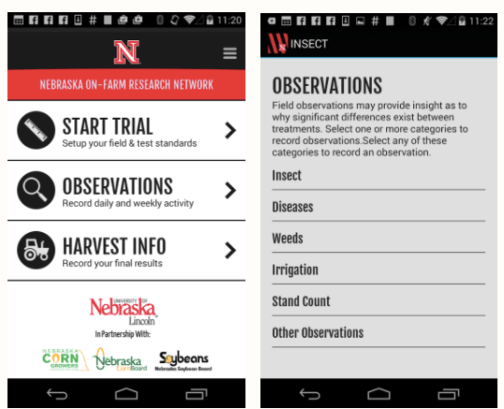
Accessing resources from the Nebraska On-Farm Research Network is available at your fingertips – in the field, in the tractor or truck, or wherever you want to use the research app.  The research app was launched in April 2015 is available for iPhone, iPad and Android users. The app enables users to create treatment strips in their own fields and develop a map of their research study. Once the field is created the user has the ability to enter periodic observations related to insects, diseases, weeds, irrigation totals, or other key observations, including photos. At the conclusion of the research trial, the user inputs the harvest results and exports them to an excel file.  The plot layout, observations, and yield data can all be emailed at any time as an excel file.  The data collected will be beneficial to both the app user and to those evaluating the data and results with the Nebraska On-Farm Research Network.

Crops, Livestock, Youth

Celebrate Agriculture

IMG_1370
My daughters, McKenzie and Meredith love caring for their calves, helping in the garden and learning about agriculture.

Growing up on a small farm in Saline County, I appreciate the work of our farmers and ranchers. My dad still farms and my girls enjoy visiting the farm and I hope I can instill the same hard-working values and beliefs my parents instilled in my sister and I. This is part of the reason, my husband and I have starting raising a few chickens and have bucket calves for the girls to care for. With my husband as the Fillmore Central ag education instructor and myself as an extension educator for UNL, we hope to be teaching future generations the vast opportunities available in the agricultural industry. This week marks the time to celebrate agriculture so I have included some of the Agriculture Council of America’s press release in my column this week as well as some of Extension’s work in agriculture literacy.

2017AgDay 625x90The Agriculture Council of America (ACA) will host National Agriculture Day on March 20, 2018. This will mark the 45th anniversary of National Ag Day which is celebrated in classrooms and communities across the country. The theme for National Ag Day 2018 is “Agriculture: Food For Life.”

On March 20, 2018, ACA will host major events in the nation’s capital including an event at the National Press Club as well as a Taste of Agriculture Celebration. Additionally, the ACA will bring approximately 100 college students to Washington to deliver the message of Ag Day. These events honor National Agriculture Day and mark a nationwide effort to tell the true story of American agriculture and remind citizens that agriculture is a part of all of us. A number of producers, agricultural associations, corporations, students and government organizations involved in agriculture are expected to participate.

National Ag Day is organized by the Agriculture Council of America. ACA is a nonprofit organization composed of leaders in the agricultural, food and fiber community, dedicating its efforts to increasing the public’s awareness of agriculture’s role in modern society. The National Ag Day program encourages every American to:

  • Understand how food and fiber products are produced.
  • Appreciate the role agriculture plays in providing safe, abundant and affordable products.
  • Value the essential role of agriculture in maintaining a strong economy.
  • Acknowledge and consider career opportunities in the agriculture, food and fiber industry.

You might be glad to know that Nebraska Extension has a team of extension staff working on programming to educate consumers and youth about agriculture and tell the story of the American farmer and rancher. This is being done through agricultural literacy-focused festivals and programs, development of beef-booster curriculum, quality assurance programs and many others. In fact, over 26,000 youth learned about agriculture through ag literacy programs in 2017 alone and 216,000 individuals accessed web materials to teach/learn about food labeling, when food is still acceptable to eat and how to reduce food waste. Over 3,600 Nebraska youth were certified in Livestock Quality Assurance to implement good production practices ensuring animal care and well-being.

Check out the impact this group had in 2017 related to agriculture literacy. 

Crops, Livestock, Programming

Farm and Ranch Succession Workshop

Persons of all ages are invited to attend a “Farm and Ranch Estate Planning Workshop” hosted by UNL Extension.  This workshop will be held on Friday, March 23, 2018, 9:30 AM – 2:30 PM at Nebraska Extension in Saline County, 306 West 3rd Street, Wilber, NE.

Cost to attend is $20.00 per farm operation and $10.00 for each additional family member.  Please preregister by Tuesday, March 20, 2018 by calling Nebraska Extension in Saline County, phone (402) 821-2151, to ensure that there are enough handouts, food and other materials.  The registration fee will include your meal, handouts, and presentations.pexels-photo-315653.jpeg

One presentation will focus on the decisions and situations which should be addressed when thinking about how your farm or ranch estate will be passed.  Topics will include: the need for planning, proper family communications, who makes the decisions, concept of fair versus equal, preparing to meet with an attorney, and much more.  The presentation is designed to give some basic information to those that haven’t yet started to think about their succession or transition plan for their assets.

In addition, an agriculture attorney will be making his presentation to give agricultural families the basics of what they need to start planning their wills, trusts, and other end of life documents that need to be in order.  The objective is to start the process of having the farm succession or transition planned.

Allan Vyhnalek, UNL Extension Educator for Farm Succession, will present.  He was just assigned to the Ag Economics Department recently to work on farm and ranch succession and transition.  Joe Hawbaker, Omaha based attorney, will make the legal presentation.  He has worked with farmers for over 30 years and will cover the legal aspects of end of life decision making. Hawbaker will cover estate planning basics, including incapacity planning, then succession tools and how to use a decision tree.

Participants at previous events always report that they wished they would have started sooner, when asked about the value of attending the presentation.  The consequences of not having an appropriate plan in place can jeopardize the financial stability and the future of the family.  More importantly, we need to have our wishes known to others so the legacy of the farms and ranches can be passed to the individuals or entities intended.

For more information or assistance, please contact Randy Pryor, UNL Extension Educator, phone (402) 821-2151.