Crops, Horticulture, Irrigation, Livestock, Uncategorized, Youth

Celebrate Agriculture!

The Agriculture Council of America (ACA) hosts National Agriculture Day on March 21, 2017. This marks the 44th anniversary of National Ag Day, which is celebrated in classrooms and communities across the country. The theme for National Ag Day 2017 is “Agriculture: Food For Life.” The purpose of National Agriculture Day is to tell the true story of American agriculture and remind citizens that agriculture is a part of all of us. A number of producers, agricultural associations,Ag Day2017 corporations, students and government organizations involved in agriculture are expected to participate.

National Ag Day is organized by the Agriculture Council of America. ACA is a nonprofit organization composed of leaders in the agricultural, food and fiber community, dedicating its efforts to increasing the public’s awareness of agriculture’s role in modern society. The National Ag Day program encourages every American to:

  • Understand how food and fiber products are produced.
  • Appreciate the role agriculture plays in providing safe, abundant and affordable products.
  • Value the essential role of agriculture in maintaining a strong economy.
  • Acknowledge and consider career opportunities in the agriculture, food and fiber industry.NewAgDay_Original.jpg

Since National Ag Day is one day out of the year, it is important for us to note that we everyday we should promote agriculture and share our story. Did you know how amazing Nebraska agriculture is?  The Nebraska Department of Agriculture publishes some statistics that are interesting to read! For example, nationally, Nebraska ranks first in popcorn production, Great northern bean production and commercial red
meat production. Nebraska ranks second on pinto bean production, number of head of bison and proso millet production. We rank third for corn grain production and corn exports and fourth in cash receipts for all farm commodities. Nebraska ranks fifth soybean and grain sorghum production.

Cash receipts from farm marketings contributed over $23 billion to Nebraska’s economy in 2015 and 6.1 percent of the U.S. total. Every dollar in agricultural exports generates $1.22 in economic activities such as transportation, financing, warehousing and production. Nebraska’s $6.4 billion in agricultural exports in 2015 translate into $7.8 billion in additional economic activity.

One in four jobs in Nebraska is related to agriculture, thus the importance agriculture has on our economy. In Extension, we have several great programs that not only teach youth the importance of agriculture, but also strive to make youth aware of the numerous career opportunities in agriculture. As technology continues to advance, types of careers in agriculture will also continue to expand.

In conclusion, while March 21st is one day devoted to celebrating agriculture, we should celebrate agriculture everyday. If you ate, thank a farmer or rancher who produced your food. From the food we eat to the clothes we wear, tires on our cars, toothpaste, crayons, windshield wiper fluid, etc., we need to thank our American farmers and ranchers for providing us with products that are affordable and good for the environment. Thank you farmers and ranchers!

Horticulture, Uncategorized

Windbreak Renovation Workshops

Windbreaks are an Integral part of area farms and acreages providing critical protection for farmsteads, livestock and crops. Unfortunately, many older windbreaks are losing their effectiveness due to age, poor health or neglect. In some cases, the windbreak no longer has the necessary density to provide winter protection.windbreak

Learn what to do about an old or new windbreak on your property. Nebraska Extension, Nebraska Forest Service and the Lower Big Blue Natural Resource District have teamed up to bring landowners the best and latest information on tree and shrub recommendations and how to renovate windbreaks. Steve Karloff, Forester who has made tree plans for many landowners in Southeast Nebraska will be the keynote speaker. The seminar will cover renovating old and damaged windbreaks, planting new windbreaks, NRD programs and cost share availability, tree health issues including tree recommendations, ash borer update and discovering the newly available root maker trees.

The program will be held in two locations as follows: Tuesday, February 14 at Saline Center (north of Western) in Saline County along highway 15 and a repeat session on Friday, February 17 at the Gage County Extension Office in Beatrice. Both programs will be held from 9 a.m. until noon with registration beginning at 8:30. Refreshments are provided and pre-registration is due February 10.

Register with the Gage County Extension Office at 402-223-1384 or the Saline County Extension Office at 402-821-2151. In the case of inclement weather, please check with either Extension Office or alerts on KWBE or KUTT radio stations.

If you have any additional questions you can contact Nicole Stoner at Gage County Extension (402) 223-1384 or by email at nstoner2@unl.edu.

Horticulture, Uncategorized

Ice Storm Impact on Plants

img_6897
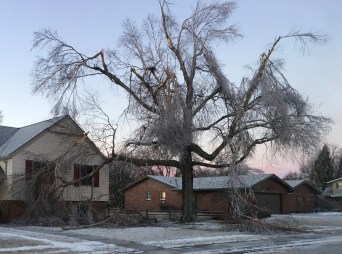
Trees down out my house; glad we took out the unhealthy, large tree right next to our house or it might have hit our house!

As I drove into town this morning I saw three trucks hauling tree branches out of town. When the ice storm was over, we had lots of branches of our own at our house that fell down and have to deal with. I asked Nicole Stoner, Extension horticulturist covering our region on information impacting the trees, so this week I’ve included her information in my column.

Many people do not like winter due to cold weather and the bad driving conditions such as snow and ice. Our plants are not much different in this respect; snow and ice can cause problems to our plants. The recent ice storm we saw covered our trees and shrubs in a thick layer of ice.

img_6895
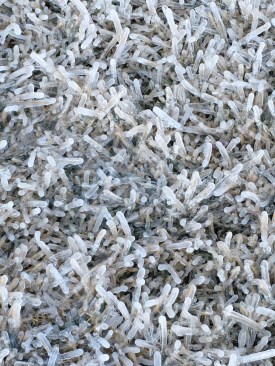
The grass was even slippery, but it made a neat pattern!

As trees become covered with ice, problems can occur. The best way to avoid any problems from a heavy layer of snow or ice would be to let it melt naturally. Heavy snow or ice loads look damaging to the tree that makes people want to knock the ice off of the trees to help the plant. However, it is really better to leave it alone. The snow and ice will eventually melt off of the plants and they will spring back up to their normal form after a while. If you try to break ice off of a tree or shrub, it can break the branches or crack them, leaving them vulnerable to other problems. Again, the ice will eventually melt off of the tree or shrub and it will be fine.

Many tree branches broke after the weight of the ice from the last storm proved to be too much. The best management practice for helping a tree that has broken branches due to snow and ice would be to go out and trim those branches to make them a clean cut rather than a jagged cut. Leaving a break rather than having a clean cut will prevent the tree from naturally healing the wound and this opening will lead to decay in the tree. This is much more damaging to the tree so it is best to prune the tree between the break and the bark collar or hire a professional to do this for you. If your tree split down the middle or lost a great number of branches, it may be time to to think about replacing this tree. It would be best to call a certified arborist in this case to assess the damage and give recommendations on the next steps for your tree.img_6899

Deicers are another plant consideration in the winter. They can cause damage to concrete sidewalks and to plants growing beside them. Many deicing agents contain salt substances, such as sodium chloride and potassium chloride. Because of the salt content found in these products, it can cause severe damage to our plants if too much is piled on them too often. Typical plant symptoms of salt damage are desiccation (drying out), stunting, dieback, and leaf margin and tip damage that looks as though the leaves were burned by a chemical.

To avoid damage to concrete, remove the salt as soon as you can. Deicers are meant to make shoveling easier, not to completely melt away snow and ice. As soon a

img_6901
It was sad the morning after the storm, seeing all the branches down in town (Geneva, NE).

s the salt melts through the ice and snow enough that it can be removed, go out and shovel it off of the concrete. When removing the snow, do it in a manner that protects the landscape plants growing in the yard. Do not pile the snow onto trees, shrubs, or flower gardens. If it has to be piled onto your landscape, move the salt onto the grass and try to do it in a manner that makes it more uniform on the grass surface. If too much salt continually gets piled up on the grass in one location, the turf can be harmed. If you are very concerned with the effect the deicers have on your plants, you can use alternate products for melting the ice, such as calcium magnesium acetate that contains no salt.

If you have any further questions please contact Nicole Stoner at (402) 223-1384.

Horticulture, Programming, Uncategorized

Extension Master Gardener Program Trainings Offered

Do you enjoy plants and gardening? Looking to learn more and hone your skills but don’t know where to go? The Extension Master Gardener program will educate you on many aspects of horticulture, allow you to test your knowledge and skills, all while serving your local community.

The Nebraska Extension Master Gardener program is a horticulture related volunteer training program based in many counties throughout the state. It has been part of Nebraska Extension since 1976. Master Gardener volunteers are trained by Nebraska Extension faculty and staff. They contribute time as volunteers working with their local Extension office to provide horticulture-related information to their community. Participants are required to complete 40 hours of training and 40 hours of volunteer service during the initial year of their involvement in the program. Master Gardener volunteers retain their certification through annual training and volunteering.bea-mg

Volunteer hours can be completed through various activities. These activities could include: planting and maintaining demonstration gardens, collecting data on research projects, helping with county and state fair activities, speaking to community groups, leading garden tours, collecting plant samples, answering phone questions, teaching youth programs, or whatever sparks your interest and utilizes your talents.

Educational topics will cover a wide range of horticultural issues. Topics that have been covered in previous training sessions include: native plants for water conservation, an in-depth look at fertilizers, turfgrass and related insects, beneficial pollinating insects and vegetable garden pests, tree and shrub pruning, pesticide safety and non-chemical pest control techniques, and small fruits and tree fruit basics. The content of the topics is focused on the home gardener, but those employed in the green industry are also welcome.

Are you interested in becoming a Master Gardener? Nebraska Extension in Hall County will be offering two Master Gardener training sessions at the Hall County Extension Office meeting rooms in Grand Island. The first session will offer six trainings on Tuesday evenings February 7 through March 21, 6:00 to 9:00 p.m. The second session will be held during the day from 9:00-12:00 noon and from 1:00-4:00 p.m. March 13, 15, 17, 20, 22, and 24. Individuals who wish to become new Master Gardeners the fee is $170. With that fee the Master Gardener interns receive a large resource notebook, an integrated turfgrass management book, a short-sleeved t-shirt, and a name tag. The fee will also help fund handout materials, speaker travel expenses, room rental, and other costs associated with the training program. For returning Master Gardeners, the fee is $20 to help fund costs associated with the training program. The ProHort program is for green industry professionals and has a fee of $325. ProHort participants will receive a large resource notebook, an integrated turfgrass management book, and 40 hours of education. The general public is also welcome to attend sessions for a fee of $5 per person for each training session. Please contact Elizabeth Killinger, 308-385-5088, prior to January 30th with the Master Gardener training session you are interested in attending. More information, updated schedules, and a brochure can be found at http://hall.unl.edu

For more information e-mail Elizabeth Killinger at ekillinger2@unl.edu, call 308-385-5088, or visit the Nebraska Extension in Hall County website.

Locally, Clay County Extension will host six trainings on Tuesday evenings February 7 through March 21, 6:00 to 9:00 p.m. via a webinar format. If interested contact Deanna at the Clay County Extension office at (402) 762-3644.

Horticulture, Uncategorized

Christmas Tree Farms

With the Holiday season approaching, I thought it was appropriate to include some pointers on selecting a real Christmas tree. If you plan to use a live cut tree, buy a fresh tree. The best way to ensure freshness is to buy from a local grower. To locate area Christmas trees growers, refer to the Nebraska Christmas Tree Growers Association at nebraskachristmastreegrowers.com. There are Christmas tree farms in 16 counties so it shouldn’t be difficult to find a tree farm.xmastree

When buying an already cut tree, check the tree closely for freshness. Do not buy a tree with brittle or shedding needles. Tap the base of the trunk on the ground and comb your fingers through branches to look for shedding needles. Bend a few needles in half to check for brittleness. After bringing the tree home, make a clean cut across the base of the trunk to better allow the tree to take up water. Keep the tree in a sturdy stand that holds at least one gallon of water. Check the stand daily as a fresh tree can take up one or more gallons of water each day. Selecting Nebraska grown trees and checking for freshness will help increase safety during the holidays.

Horticulture, Uncategorized

Uninvited houseguests?  

You are sitting at home and all of a sudden a little gray rodent with relatively large ears and small black eyes scurries across the room!   It is about 1/2 ounce in weight and if an adult 5 1/2 to 7 1/2 inches long, including its 3 – 4 inch tail. Of course, you must know by now that I am describing a house mouse.

The house mouse is considered one of the most troublesome and economically important rodents in the United States. They can cause damage to property and transmit diseases such as salmonellosis and swine dysentery. You will know you have mice if you see small droppings, fresh gnaw marks and mouse nests made from fine shredded paper or other fibrous material. They are active mostly at night, but can occasionally be seen during daylight hours. Mice are excellent climbers and can jump up 12 inches from the floor to a flat surface; they can squeeze through openings slightly larger than 1/4 inch in diameter.

Sanitation, mouse-proof construction, and population reduction allow for effective control of mice. Mice cannot survive in large numbers if they have few places to rest, hide, or build nests; however a few mice can survive with limited amounts of food and shelter. Proper sanitation is an important step to control mice. Most buildings that handle food will have problems with mice not matter how clean they are, but the house should be mouse-proofed.   To mouse-proof a house, eliminate all openings larger than 1/4 inch. Steel wool can be used as a temporary plug; cracks in building foundations and openings for water pipes, vents, etc. can be sealed with metal or concrete. Doors and windows should fit tightly. Cover doors and windows with metal to prevent gnawing. Latex, plastic, rubber, and wood are unsuitable for plugging holes.

Once you find mice in your house, traps can be used to control the population. The advantages of traps are 1) it does not rely on hazardous rodenticides, 2) it permits the user to view his/her success, and 3) it allows for disposal of trapped mice therefore eliminating dead mouse odors that may occur when poisoning is done. Peanut butter works great to put on traps because it is easy to use and very attractive to mice. Simple inexpensive wood-based snap traps are effective, as well as glue traps. Glue traps must not be in extreme temperatures and can lose their effectiveness over time with dust collecting on them. Whatever traps, you decide to use, be sure to set them behind objects, in dark corners, and in places where evidence of mouse activity is seen.

For more information on mouse control, refer to NebGuide, Controlling House Mice that can be accessed online or through your local extension office.

Horticulture, Uncategorized

Fall Insect Pests

This time of year, we often receive questions on a variety of pests, especially “bugs” entering homes or around the house. Extension horticulturalist, Elizabeth Killinger recently wrote an article on how to prepare your house to keep these invaders from living in your house.

Some of the more common nuisance pests include occasional invaders like boxelder bugs, multicolored Asian Lady Beetles, millipedes, and crickets. These pests don’t do any harm once inside the home; they are just looking for a cozy place to spend the winter.

millipedex450
Millipedes are harmless; however they can be a nuisance.

Proper identification of the insect will assure the proper control method. Boxelder bugs are black and orange true ‘bugs’ that can be found in large numbers around foundations sunning themselves or trying to find their way inside. Multicolored Asian Lady Beetles are the orange ‘lady bugs’ with black spots. Their distinct smell and ability to bite makes them even more of a nuisance once inside the home. Millipedes are often misidentified as ‘wire worms.’ These skinny, brown critters have two legs per body segment and will curl up when disturbed. Crickets hop their way into homes and provide ‘music’ in the night with their chirping. Commonly it’s the black field cricket that migrates inside, but there are others that follow right behind.

Wolf spiders may look scary, but they are more bark than bite. These large, hairy spiders can be found both outdoors and occasionally inside the home. They are not poisonous nor do they want to disturb people. They are hunting spiders, so they don’t spin a web or a trap, but prefer to chase down their prey. They often find their way into homes in the fall following their favorite food source the cricket.

The saying “an ounce of prevention is worth a pound of cure” has never been more true. Discouraging occasional invaders from entering the house is going to take a little work, but it will be worth it in the long run. Start by finding and sealing up any cracks or spaces they could enter through with silicone caulk or expanding foam. Make sure that window screens are in good repair and that doors are tight fitting. Also remove any dead plant debris from window wells.

Pests can be discouraged from entering the house in a number of ways. The most common way is by applying an outdoor perimeter insecticide treatment. These insecticides are labeled for various pests and often times have residual effects to help protect the house for longer. Read and follow the label instructions on how and where these products should be applied. Ideally, try to apply these insecticides out from the foundation about five to ten feet around the perimeter of the home. The insecticides will help to decrease the numbers of pests that make it inside the house, but don’t expect it to stop all of them.

Monitor the home regularly to see what pests have made their way inside. Glue boards are sticky boards used to catch and hold pests as they try to move throughout the home. Be sure to use sticky boards in locations where non-target animals, like pets, won’t get stuck in them. If something other than the target pest does happen to get ‘caught’ in the trap, use an oily material, like vegetable or mineral oil, to dissolve the sticky substance on the trap. When properly placed, these traps will allow you to see which pests are inside the home and their approximate numbers.

Once pests are found inside the home, there are a few techniques that you can use. The handy broom and dust pan or the vacuum are two techniques; they are also very environmentally friendly and very cost effective. Be careful when selecting insecticides for use inside the home. Read and follow instructions carefully as many of these products have to come into contact with the insect themselves and don’t offer much residual protection.

With a little prevention and monitoring you can ensure that you are sharing your home with wanted house guests this fall and winter.

Elizabeth Killinger is the Horticulture Extension Educator with Nebraska Extension in Hall County. For more information contact Elizabeth at elizabeth.killinger@unl.edu, her blog at http://huskerhort.com/, or HuskerHort on Facebook and Twitter.

Horticulture, Uncategorized

Emerald Ash Borer in Nebraska

A couple of years ago, I hosted Nicole Stoner, Extension Horticulturist for a program on Emerald Ash Borer and she reminded attendees that it’s not a matter of if it will happen, but when it happens. Guess what? The Nebraska Department of Agriculture announced recently that the emerald ash borer (EAB) has found in soutEABheast Omaha. This is the first confirmation of the insect in Nebraska. EAB has killed hundreds of millions of ash trees in 26 states. It is projected that Nebraska’s taxpayers and homeowners will spend over $961 million on ash tree removal, disposal and replacement. The following information was take from the Nebraska Forest Service’s press release.
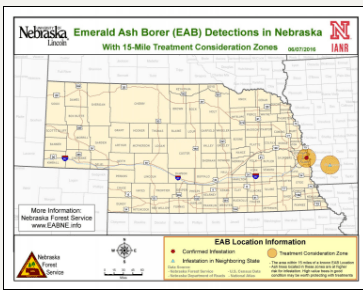
Deputy State Forester John Erixson reminds people that now is a good time for residents in and around Omaha—and municipalities throughout the state—to take proactive steps to deal with EAB as once EAB is found in an area, most ash trees are killed within 10-15 years. Residents with ash trees in the Omaha area may want to begin treatments. “The best candidates for treatments are healthy, high-value trees that are in a good location,” said Mark Harrell, Forest Health Program Leader with the Nebraska Forest Service. “Trees in poor condition or located under wires or too close to sidewalks or buildings generally should be removed rather than treated.”EAB 15miletreatment

Professionally applied trunk injections are the most effective treatments, especially for large trees. Their main drawback is the damage they cause to the tree and therefore are best applied by certified arborists well-trained in the procedure. The most common products available to the homeowner are soil applications, but they are somewhat less effective than injections and have a greater chance of harming beneficial insects, such as bees.

Treatments need to be applied every one to two years and must be done for the remaining life of the tree,” said Harrell. “For this reason, many trees will not be worth saving.” Owners of ash trees outside of the Omaha area may be anxious to begin treatments, but the recommendation is still to wait until EAB has been found within 15 miles of your trees. The chances that your tree will be the first one infested is very low, especially if it is being well cared for.

The current treatment consideration zone extends from Fort Calhoun to Plattsmouth and from Gretna to east of Council Bluffs. Municipalities and anyone else managing large numbers of ash trees even if they are outside of the Omaha area should take steps now to prepare for EAB. “Upwards of 80% of the ash trees will die within 8 years after EAB is found in a community if nothing is done to manage the pest,” said Eric Berg, Program Leader for Community Forestry and Sustainable Landscapes. “This can put a strain on city budgets and staff and create liability issues if dead trees are left standing. Nebraska municipalities need to be proactive in dealing with EAB.”

“Municipalities should gain an understanding of the number, locations, sizes and conditions of their ash trees and develop a management plan,” Berg added. “Removing poor quality trees in a community even before EAB is discovered will help spread removal costs over more years.” As trees are removed, they should be replaced with a diverse selection of trees, not just a few species. This will help avoid another significant loss of the urban tree canopy when the next serious pest arrives.

More information about the emerald ash borer, finding an arborist, and recommendations for municipalities can be found at www.eabne.info.

An educational program on Emerald Ash Borer program will be held June 30th at 5:30 p.m. free to the public. This will be held at the Fillmore County Extension Office in Geneva, Nebraska and taught by Extension Horticulturist, Nicole Stoner.

Horticulture, Uncategorized, Youth

Hands to Larger Service

“I give my head to clearer thinking, my heart to greater loyalty and my hands to larger service and my health to better living….” That is how the 4-H Pledge starts out and is just what Fillmore County 4-H’ers have done for five years in a row! In collaboration with the Farm Service Agency and Natural Resources Conversation Service offices in Geneva, 4-H’ers recently planted vegetables for those who might not otherwise have access to fresh produce.ComGardenGraphic16

Over the summer, 4-H’ers, FSA and NRCS staff will take turns caring for the garden, increasing their horticultural skills while learning responsibility, service and other important life skills. This has been a great project each year allowing youth to not only learn, but also fulfill the purpose of 4-H by using their hands for larger service.
IMG_5391Special thanks to Barbur Floral for donating the vegetable plants and Roddy Salmon for tilling the garden and residents at Pioneer Manor for assisting as well! If you or your organization is interested in contributing or participating in the Fillmore County Community Garden this year, please contact the Fillmore County Extension Office.

Crops, Horticulture, Irrigation, Livestock, Programming, Uncategorized, Youth

What is Extension?

Often times when I tell people I work at the “Extension Office” they have no idea what it is we do. It is so hard to describe without giving a plethora of information. One of our signature programs people often most often associate with is the 4-H program. While this is a large and very successful component of Extension, it is only one of many programs.ExtensionDifferencepic

Everyday, whether you know it or not, you have most likely been indirectly impacted by Extension programming. Extension essentially takes science and research-based information from the University Of Nebraska – Lincoln and delivers it into the hands of the public. We make UNL easily accessible to the public. For example, we provide services and resources to the agricultural community, but also sectors as diverse as nutrition, health care and technology. From border to border, Nebraska Extension is making an incredible impact on the success of our state – its youth, its families, its farms & ranches, its communities, its economy.

For example, as a result of our Learning Child Extension staff, approximately 24,000 children in Nebraska benefit from early childhood professionals and parents who have the essential skills and knowledge to support the healthy growth and development in the children in their care. Take the crops area: last year, Extension presented workshops in 94 locations to over 4,000 participants from 93 Nebraska counties, 9 U.S. states and 4 foreign countries. Our community vitality programming has engaged over 10,000 Nebraskans in Broadband planning and engaged over 2,500 people through the Entrepreneurial Community Activation Process which resulted in community-wide visions, a new economic development corporation being started, community web portal and a young professional network.

Nebraska Extension continues to evolve and is one of the leading Extension programs in the world. In doing so, Extension Educators are more focused in their area of expertise and able to provide clients with robust information. For example, Extension staff covers a specific region to ensure clients are being served well. Each county has access to a professional in the areas of:

  • Community environment (horticulture)
  • Food, Nutrition & Health
  • Crops & Water
  • The Learning Child
  • Community Vitality
  • Beef & Livestock Systems
  • 4-H Youth Development

This has been a very brief overview of Extension and next week we’ll discuss how this impacts our multi-disciplinary programming and Fillmore County.