Crops, Horticulture, Irrigation, Livestock, Programming, Uncategorized, Youth

What is Extension?

Often times when I tell people I work at the “Extension Office” they have no idea what it is we do. It is so hard to describe without giving a plethora of information. One of our signature programs people often most often associate with is the 4-H program. While this is a large and very successful component of Extension, it is only one of many programs.ExtensionDifferencepic

Everyday, whether you know it or not, you have most likely been indirectly impacted by Extension programming. Extension essentially takes science and research-based information from the University Of Nebraska – Lincoln and delivers it into the hands of the public. We make UNL easily accessible to the public. For example, we provide services and resources to the agricultural community, but also sectors as diverse as nutrition, health care and technology. From border to border, Nebraska Extension is making an incredible impact on the success of our state – its youth, its families, its farms & ranches, its communities, its economy.

For example, as a result of our Learning Child Extension staff, approximately 24,000 children in Nebraska benefit from early childhood professionals and parents who have the essential skills and knowledge to support the healthy growth and development in the children in their care. Take the crops area: last year, Extension presented workshops in 94 locations to over 4,000 participants from 93 Nebraska counties, 9 U.S. states and 4 foreign countries. Our community vitality programming has engaged over 10,000 Nebraskans in Broadband planning and engaged over 2,500 people through the Entrepreneurial Community Activation Process which resulted in community-wide visions, a new economic development corporation being started, community web portal and a young professional network.

Nebraska Extension continues to evolve and is one of the leading Extension programs in the world. In doing so, Extension Educators are more focused in their area of expertise and able to provide clients with robust information. For example, Extension staff covers a specific region to ensure clients are being served well. Each county has access to a professional in the areas of:

  • Community environment (horticulture)
  • Food, Nutrition & Health
  • Crops & Water
  • The Learning Child
  • Community Vitality
  • Beef & Livestock Systems
  • 4-H Youth Development

This has been a very brief overview of Extension and next week we’ll discuss how this impacts our multi-disciplinary programming and Fillmore County.
Crops, Horticulture, Uncategorized

Pesky Purple Weed

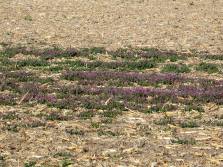
People have asked me about the purple weed that has emerged in fields and lawns. Most likely that flower is henbit that is an annual forb in Nebraska and a member of the mint family, which means it has a square stem. It has distinctive leaves with crenate and lobed leaf margins and purple to pink flowers. For control, this weed is a winter annual, which means the seed germinates in the fall and the small plants overwinter before growing aggressively in early spring. It flowers in April and May and dies in the hot, dry summer weather. Flowers can produce a lot of seed, which is one reason henbit infestations can increase each year.Henbit

Control of henbit this time of year is not recommended because the plant will die shortly. The best option for control is to hand pull the weed in lawns. This has the advantage of minimizing the amount of seed production for next fall. If henbit infestation becomes unacceptable, then apply a PRE herbicide in late summer to early fall. Finally, henbit that does germinate in the fall will be killed with the same POST herbicides that are used to control other pesky weeds like dandelions and creeping Charlie. Other management options for henbit control include, 1) maintaining a healthy and vigorously growing lawn or 2) adding a deep layer of mulch to landscape beds.

Horticulture, Uncategorized

Holiday Tree Preparation

With the Holiday season approaching, I thought it was appropriate to include some pointers that Kelly Feehan, UNL Extension Horticulturist provided on selecting a real Christmas tree. If you plan to use a live cut tree, buy a fresh tree. The best way to ensure freshness is to buy from a local grower. To locate area Christmas trees growers, refer to the Nebraska Christmas Tree Growers at nebraskachristmastreegrowers.com. There are 25 Christmas tree farms in the state, located across different areas in 16 counties so it shouldn’t be difficult to find a tree farm. Most of these farms, you can also select the live and harvest it so freshness is nchristmastreeot a concern.

When buying an already cut tree, check the tree closely for freshness. Do not buy a tree with brittle or shedding needles. Tap the base of the trunk on the ground and comb your fingers through branches to look for shedding needles. Bend a few needles in half to check for brittleness. After bringing the tree home, make a clean cut across the base of the trunk to better allow the tree to take up water. Keep the tree in a sturdy stand that holds at least one gallon of water. Check the stand daily as a fresh tree can take up one or more gallons of water each day. Selecting Nebraska grown trees and checking for freshness will help increase safety during the holidays.

Kelly also has tips for cutting holiday greenery. Cutting holiday greenery from your own landscape can help ensure freshness. Pine, fir and cedar are good to use for indoor decoration as they dry out slowly and hold their needles best at warm indoor temperatures. For safety, be aware the red berries of Japanese Yew are poisonous, as are the green needles. Avoid the use of this greenery or be sure to keep Japanese Yew greenery out of reach of children and pets, and do not discard it where cattle or horses might eat it. Cutting greenery is pruning so use clean, sharp cutters and well placed, evenly distributed cuts. This is not the ideal time to prune, so don’t harvest too much greenery and make discreet cuts. Keep greenery in a cool location out of sunlight with the cut ends in water until ready to use the greens. Crush the ends of woody stems to allow the cuttings to take in more water. Immerse greenery in water overnight just before arranging it. This will allow it to absorb moisture and remain fresh longer.

Horticulture

“Worm” Invasion in the Homes!

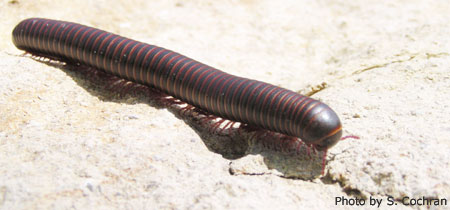
During this time of year I receive calls about worm-like, dark brown to black creatures that are invading people’s houses or garages. Most likely these are millipedes. Millipedes are not harmful in the yard, but can be a nuisance with the first spell of cool temperatures in fall. Millipedes will invade houses (sometimes in large numbers) to find warmth on concrete in and around garages and houses. At times, millipedes can become so abundant; they may constitute a “millipede invasion” entering homes and other buildings. Once they reach indoors, millipedes will die – no sprays are necessary.millipedex450

Millipedes (sometimes called “wireworms” which are the larval stage of a beetle that feeds on plants in farm fields) have two pairs of legs per body segment. They are usually brown to black in color with an elongated body that is round. Millipedes have no poison claws or legs. Once disturbed, they usually coil up to protect themselves. Once found in the home they usually die due to desiccation, although in moist basements they survive longer.

Millipedes live in organic matter such as leaves, mulch, and piles of wood or wood chips. Over mulching and/or watering in the garden can cause millipedes to attack vegetable plants. Reducing mulch thickness, reducing watering schedules, or pulling mulch away from plants and allowing them to dry will help reduce the potential for invading millipedes. To prevent millipedes from entering the home, be sure that screens are tight, that moisture-holding material in window wells is eliminated, and that mulches are at least 6-8 inches away from the foundation. Outdoors, you may wish to treat a 10-15 foot wide barrier strip with carbamate insecticide (Baygon, Ficam, Seven) because they are fast-acting. People and pets should stay off wet insecticides, but can safely walk on the yard once the insecticide is dry.

Once millipedes have entered the house, the safest way to control them is to vacuum or sweep them up. In damp hiding places, an indoor insecticide labeled for this use can be applied. As with any chemical, be sure to read and follow label directions when using any insecticides.

Horticulture

Fall Lawn & Garden Tips

I love the colors of fall that will soon be upon us, but there are a few gardening tasks to consider for lawn and landscape improvement next year.  While I am not a horticulturalist, I do love gardening and landscaping and have learned a lot from my horticultural colleagues which is why I’m featuring some great tips from them!Yard and Garden Green Logo

Most people ask about killing dandelions in the spring or summer, but actually the best time to control broadleaf perennial weeds such as dandelions, clover and violets starts September 15. During this time of year, more herbicide is likely to move into the plants’ roots as plants prepare for winter dormancy. This increases your success rate by killing the weeds, not just the foliage. Also, applications made now have less chance of affecting nearby trees and ornamentals, unlike spring applications made around non-target species that are just leafing out and/or blooming.

Nebraska Extension’s Hort Update also provided information on fall fertilization of cool season turfgrasses. Fall fertilization encourages production of new tillers and/or rhizomes and stolons that increase turf density. This fertilization encourages rooting and production of storage products that help plants survive the stresses of winter and next year’s growing season. Almost all turf areas should be fertilized with 1 lb N/1000 sq ft using a fertilizer with 25 to 50% of the nitrogen as slow release (sulfur or polymer coated urea, urea formaldehyde, or natural organics). The next most important fertilization is near the last mowing.

Fall is also a good time to divide some perennials such as peonies and irises. If you have herbs or other annuals you overwinter in the house, think about bringing them in the house now before frost warnings. You can start taking root cuttings form annual bedding plants such as begonias, coleus, geraniums and impatiens, which do well in a sunny window and can provide plants for next year’s garden.

For more information on horticultural topics, go to Nebraska Extension’s environment.unl.edu website. There you will find information from the Backyard Farmer show, turfgrass recommendations, acreage insights and subscribe to the HortUpdate newsletter.

Nebraska Extension Horticultural Blogs:
Husker Hort
Plants & Pests with Nicole

Horticulture

Lawn & Tree Tips

Nebraska Extension offers excellent resources on varying horticultural topics. One of those sources is an online, Horticultural Update newsletter at http://hortupdate.unl.edu/. The most recent articles had lots of great information, so I’ve highlighted two of those in this week’s column.

First, I’m sure you’ve noticed this has been perfect condition for weeds to take over landscapes and gardens in a hurry. The wet weather has also encouraged an increase in broadleaf weeds in turf. Control involves good management to promote a dense, vigorous turf that competes with weeds. Use a tall mowing height of three inches to reduce seed germination and to shade out weed seedlings.

September is the best month to control broadleaf perennial weeds with herbicides. If herbicides are used during summer, read label directions for temperature ranges within which to apply. Hot temperatures will increase damage potential to nontarget plants. Whenever used, spot applications are best as they result in the smallest amount of herbicide being used; saving money and protecting the environment. Read and follow label directions. Labels are the law and herbicides should not be used outside of recommended temperature ranges.

Another thing to watch for is bagworms hatching on evergreens trees. Monitor evergreens for young bagworms. At this time of year, they can be as small as one-fourth inch long. Bagworms are small, brown, triangular-shaped and covered with needles for camouflage.  At this size is the time when products like Bacillus thuringiensis will be most effective in controlling bagworms.

Finally, mosquitoes are awful this year! Public Health Solutions has brought us some mosquito dunks, which can reduce mosquito number by putting them in landscape ponds, livestock tanks and other sources of standing water. Standing water areas can be treated with a biological larvicide. Bacillus thruingiensis israelensis (Bti) or Bacillus sphaericus (Bs) are naturally occurring soil bacterium that control mosquito larvae by disrupting the gut receptors and causes the larvae to stop eating anddie. Biological larvicides are safe to use in water of livestock troughs. Stop in to pick up your free sample of mosquito dunk!

(Source: NE Extension HortUpdate, 2015)

Horticulture

Early Spring Horticultural Tasks

With the recent warm temperatures and nice weather we’ve been having, you might be itching to get outside and do some yard work or gardening. Just remember that based on 47 years of data from 1949-1995 for our area, the average spring freeze date is approximately April 30th. The average spring freeze (32° F) dates are a measure of when the average last spring frost will occur in a region. These dates are guidelines only. Freezing temperatures may occur after the dates predicted. Also remember that local microclimate conditions can springtaskssignificantly affect the occurrence of frost in your landscape.

Lawns
If you need to reseed your lawn, spring seeding of cool season turfgrass should take place as early as possible to take advantage of spring rains and cool temperatures, typically in April. Along with timing and use of quality seed, a key to success is seedbed preparation. Nebraska Extension has great publications on how to successfully seed your lawn, which can be found at turf.unl.edu. The ideal time to fertilize lawns and apply preemergent herbicides is about April 20 to May 5 in eastern Nebraska.

Trees
Emerald Ash Borer (EAB) has been and will continue to be in the news. While it has not yet been found in Nebraska, it could be found in the near future. To prepare for EAB, the Nebraska Forest Service has a number of resources for professionals and homeowners. Refer to this website for a listing EAB resources ranging from Identifying EAB to Frequently Asked Questions, Community Readiness, and Guidelines for Homeowners as well as Treatment Options.  For homeowners who choose to treat their ash tree, it is recommended to wait until EAB has been found within 15 miles. An alternative to treatment is to replant a dead ash tree with a new and different tree that adds diversity to landscapes and community forests.

As we have seen with elm trees, Scotch pine trees and now ash trees, species diversity is very important to ensure not loosing all trees when a disease or insect comes in. One of the goals of ReTree Nebraska is to increase species diversity in community forests across our state, so ReTree Nebraska has “Good Trees for the Good Life.” This list incReTreeNebraskaludes trees that grow well in Nebraska, but are often under-utilized. Starting in 2008, a tree species has been added each year to the previous selections until 2017 creating “Eight for 2008,” “Nine for 2009,”…”Seventeen for 2017.”



For this year, hackberry (Celtis occidentalis) and American Sycamore (Platanus occidentalis) are the tree species added to ReTree list of trees to plant in Nebraska to increase diversity in our tree plantings. For information on these trees and a list of other trees to plant, see the ReTree Nebraska website.

Source: For this and more information go to Nebraska Extension’s HortUpdate page

Horticulture

Holiday Tree Preparation

McKenzieTree09
My daughter McKenzie loved the Christmas tree, but luckily never knocked it over! Trees are an important part of the Holiday season and as she is six is already anxiously awaiting to decorate it. We’ll see how her sister, Meredith will fare with her first Christmas this year!

With the Holiday season approaching, I thought it was appropriate to include some pointers that Kelly Feehan, UNL Extension Horticulturist provided on selecting a real Christmas tree. If you plan to use a live cut tree, buy a fresh tree. The best way to ensure freshness is to buy from a local grower. To locate area Christmas trees growers, refer to the Nebraska Christmas Tree Growers list found on the Nebraska Department of Agriculture website. There are over 21 Christmas tree farms in the state, located across different areas in 16 counties so it shouldn’t be difficult to find a tree farm. Most of these farms, you can also select the live and harvest it so freshness is not a concern.

When buying an already cut tree, check the tree closely for freshness. Do not buy a tree with brittle or shedding needles. Tap the base of the trunk on the ground and comb your fingers through branches to look for shedding needles. Bend a few needles in half to check for brittleness. After bringing the tree home, make a clean cut across the base of the trunk to better allow the tree to take up water. Keep the tree in a sturdy stand that holds at least one gallon of water. Check the stand daily as a fresh tree can take up one or more gallons of water each day. Selecting Nebraska grown trees and checking for freshness will help increase safety during the holidays.

XmasTreeFact
Photo: NE Dept. of Agriculture

Kelly also has tips for cutting holiday greenery. Cutting holiday greenery from your own landscape can help ensure freshness. Pine, fir and cedar are good to use for indoor decoration as they dry out slowly and hold their needles best at warm indoor temperatures. For safety, be aware the red berries of Japanese Yew are poisonous, as are the green needles. Avoid the use of this greenery or be sure to keep Japanese Yew greenery out of reach of children and pets, and do not discard it where cattle or horses might eat it. Cutting greenery is pruning so use clean, sharp cutters and well placed, evenly distributed cuts. This is not the ideal time to prune, so don’t harvest too much greenery and make discreet cuts. Keep greenery in a cool location out of sunlight with the cut ends in water until ready to use the greens. Crush the ends of woody stems to allow the cuttings to take in more water. Immerse greenery in water overnight just before arranging it. This will allow it to absorb moisture and remain fresh longer.

Horticulture

Tree Recovery from Storms

Between the May 11 and June 3 storms, we’ve sure seen our fair share of severe weather already this year. The streets of Exeter were completely covered with leaves and branches with the aftermath of the June 3 storms. Trees that were pushed over at an angle should be cut down, as a portion of the roots on the windward side of the tree are know broken and a mature tree rarely survives and can be a hazard. Young trees planted less than four years ago may survive if they are gently pulled back into a vertical position and staked. Special care should be given to very gently press out any air spaces that may have form in the loosened soil and water the root system twice each week if dry through November.

This photo doesn't even do justice to the amount of damage to some areas from a recent storm. Some streets were covered with leaves and completely green. Time will tell how the trees will fare.
This photo doesn’t even do justice to the amount of damage to some areas from a recent storm. Some streets were covered with leaves and completely green. Time will tell how the trees will fare.

Most of the damage observed was broken or twisted branches. UNL extension horticulturalists remind homeowners that safety should be considered first and a certified arborist should be contacted to remove large branches or to work in tall trees. All loose or hanging branches should be removed as soon as possible. Branches that are cracked, split or twisted should be removed next. Branch stubs left by storm damage should be give a clean cut, using good technique so that stubs are eliminated but only branch wood is removed. This results in a smaller wound, allows the tree to seal the wound more effectively and minimizes the chance of entry by wood decay fungi into the trunk.

Trees split down the middle are very difficult to brace adequately, and should be removed by a professional arborist. Major damage includes the stripping of 50% or more of plant foliage, pocks or tears in tree bark with damage to the underlying xylem and phloem tissues, shearing of evergreen buds from branch terminals, death of evergreen buds due to impact damage, and broken tree or shrub branches.

In most cases, homeowners should take a “wait and see” attitude. Trees and shrubs should be kept well watered throughout summer and fall to avoid drought stress. Winter watering during warm periods when soil is not frozen is also recommended if winter conditions are dry. Keep plants well mulched to prevent secondary injury from mowers and string trimmers.

Secondary pests, such as borers and aphids, should be controlled to avoid additional stresses. Sphaeropsis tip blight can be a serious problem in Austian and Pondersosa pine trees the year following serious hail injury. Fungicide applications should be planned for next spring to keep infection to a minimum. Do not fertilize trees and shrubs to “help them recover.” Fertilizer is detrimental at this point. Never apply a wound dressing, pruning paint or “wrap” to any wounds, including hail wounds as this can interfere with the trees own response to closing the wound. Wait to begin pruning until after new growth begins, then prune away any dead or broken branches.

If you are interested in learning more about potential tree pests that might harm your tree, plan to attend UNL Extension’s “Tree Pest & Emerald Ash Borer Update” on June 24th at Heritage Crossings in Geneva. This FREE program will start at 6:00 p.m. Please RSVP to the Extension Office at 402-759-3712 by June 23rd for planning purposes. Elizabeth Killinger, Extension Educator will be the presenter and discuss tree pests and provide an emerald ash borer update.

(Source: UNL’s Backyard Farmer website at on Hail Damaged Plants)

Horticulture

Lawn Care Weed Control

As lawns continue to grow, Kelly Feehan, UNL Extension Educator in Platte County reminds us that dandelions and other broadleaf weeds may be growing in lawns now, but homeowner applications of herbicides for these weeds should be avoided. The risk to non-target plants like trees, shrubs, flowers and vegetables is simply too great. At temperatures higher than 80°F, many herbicides volatize and change into a gas. The herbicide then rises or moves on air currents and damages non-target plants. At this time of year, it is best to hand-dig weeds before they go to seed and avoid herbicide applications during summer. When temperatures moderate in early September into October, this is the ideal time to apply herbicides for broadleaf weeds like dandelion, clover, ground ivy and violets. This is the most effective time for treatment because more of the herbicide is translocated into roots at this time of the season for a higher percentage of weed kill.

Kelly’s recent news article also provided answers to questions I sometimes receive so I decided to share some of the home remedies people often ask about. Sometimes people think the household products are safer and more effective than using products that have been tested, labeled and sold for such uses. Some examples are applying bleach to control diseases in lawns, watering Epsom salts into the soil around tomatoes and peppers and using Borax to kill ground ivy in lawns.

Do not apply bleach to lawns to control disease. The bleach can damage the turfgrass. If the product is a brand that has an EPA pesticide registration number, such as Chlorox; then it is against pesticide laws to use the product since it is not labeled for use on lawns.

As for Epsom salts, this product contains magnesium, which is an important nutrient for fruits and vegetables. However, most soils have plenty of magnesium and the addition of more is not needed. Increasing and maintaining soil organic matter is more beneficial.

Research has shown that Borax can control ground ivy. Borax contains boron that can be toxic to plants. Ground ivy is more sensitive to boron than grass and small amounts can kill ground ivy. However, it can cause the grass to turn brown and if over applied, create soil issues that can prevent anything, even grass, from growing in the area for years. If this option is used to control ground ivy, the lawn should only be treated with borax once each spring for two years. Use this formula. Dissolve eight ounces of a product like Twenty Mule Team Borax into four ounces of warm water, and then dilute it in 2 1/2 gallons of water. Spray this amount evenly over 1,000 square feet of lawn, no more, no less.

For more answers to your lawn care questions, I would encourage you to check out UNL’s turf website.