Crops, Irrigation, Livestock, Programming

Farmers & Ranchers College 2018-19

nature-field-sun-agricultureThe Farmers & Ranchers College was formed in January 2000 with the purpose of providing high quality, dynamic, up to date educational workshops for area agricultural producers in south central Nebraska through a collaborative effort between business, industry and higher education leaders. Furthermore, the Farmers & Ranchers College will provide the tools necessary so that agricultural producers will be able to respond positively to these changes using a profitable decision making process.farmersrancherscollege1819dates
The Farmers and Ranchers College is a unique opportunity to educate agricultural producers in south central Nebraska. Approximately three hundred producers participated in the 2017-18 Farmers & Ranchers College programs. Producers attending these workshops managed over 155,000 acres and managed nearly 15,000 head of beef animals. Participants surveyed indicated an average of $6.00/acre of knowledge gained from participating for a potential impact of nearly $1 million. The seventeenth annual Partners in Progress- Beef Seminar featured a variety of industry, University and agricultural organization presenters. Ninety-five percent of participants surveyed were very satisfied or satisfied with the program quality and seventy-six percent indicated that previous programming improved their knowledge of making risk management decisions.

Contributions and support of area businesses allow participants to attend at no cost, however for programs that have meals, it is requested that people RSVP at least a week in advance for an accurate meal count by calling Fillmore County Extension at (402) 759-3712.

The Farmers and Ranchers College Committee consists of Fred Bruning of Bruning, Bryan Dohrman of Grafton, Sarah Miller of Carleton, Jennifer Engle of Fairmont, Ryne Norton of York, Jim Donovan of Geneva, Bryce Kassik of Geneva, Eric Kamler of Geneva, and Brandy VanDeWalle of Ohiowa.

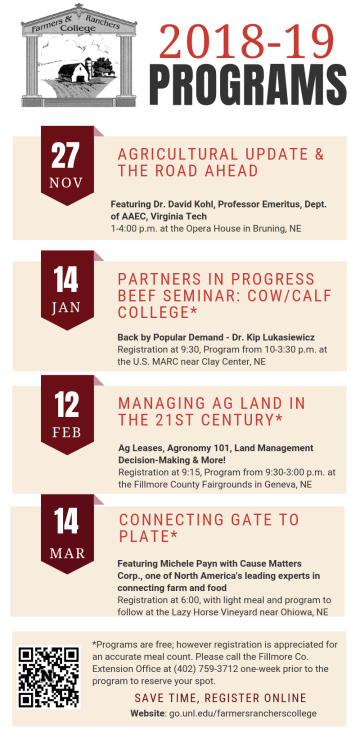
2018-2019 Program Schedule

  • November 27, 2018 – “Agricultural Update & The Road Ahead” w/ Dr. David Kohl, Professor Emeritus, Dept. of AAEC, VA TECH at the Opera House in Bruning, NE from 1-4:00 pm
  • January 14, 2019** – “Partners In Progress Beef Seminar” Cow/Calf College at U.S. MARC near Clay Center, NE from 10-3:30 a.m., Registration at 9:30
  • February 12, 2019** – “Managing Ag Land in the 21st Century” with Nebraska Extension Educators, Nebraska Extension at  the Fillmore Co. Fairgrounds- Geneva, NE from 9:30- 3:00 p.m., Registration at 9:15 a.m.
  • March 14, 2019** – “Connecting Gate to Plate” with Michele Payn with Cause Matters, Corp., one of North America’s leading experts in connecting farm and food at Lazy Horse Vineyard near Ohiowa, NE with registration at 6:00 p.m. Light meal and program to follow.

 ** Programs are free; however registration is appreciated for a meal count. Please call the Fillmore Co. Extension Office at (402) 759-3712 one-week prior to the program to reserve your spot.

Crops, Irrigation

Harvest Safety

It is hard to believe that harvest is starting and just as a reminder that with harvest comes more traffic on the county roads and other stresses for farmers. It never fails, that equipment can break, there can be delays at the elevator and those extra-long hours can all add extra stress to farmers. That being said, it is important to carefully slow down and realize the many hazards you are being exposed to during harvest.slow-down

An Iowa State Extension publication, Harvest Safety Yields Big Dividends points out that injuries can occur by taking shortcuts to perform routine tasks, not getting enough sleep or regular breaks, or failing to follow safety practices. Some injuries occur when operators are pulled into the intake area of harvesting machines, such as balers, combines, or corn pickers, and many injuries occur from slips or falls around these machines. Exposure to powerful machinery is highest during the harvest season. The equipment must be powerful to effectively handle large amounts of agricultural commodities. When equipment plugs, NEVER try to unplug it with live equipment, instead always disengage power and turn off the engine before trying to manually clear a plugged machine. Regular maintenance of these machines can also make harvest go smoother. Also, lots of accidents actually happen by the operator slipping and falling off equipment.

In the same publication listed above, there are several tips for reducing fall hazards:

  • Always keep all platforms free of tools or other objects.
  • Frequently clean the steps and other areas where workers stand to service, mount and dismount, or operate the machine.
  • Wear well-fitting, comfortable shoes with non-slip soles.
  • Use grab bars when mounting or dismounting machinery.
  • Be sure your position is stable before you work on a machine.
  • Recognize that fatigue, stress, drugs or alcohol, and age may affect stability.

Other helpful tips during harvest are to keep kids away from machinery. Tell them the dangers that can occur and not to play near the equipment, even when it is shut off; you never know when they will be playing in hidden areas of the equipment. Operators should double check where kids are before moving the equipment. Too many accidents can occur when youth are in the path of equipment out of the operator’s view. Operators of all equipment should check in regularly and let someone know where you are. Keep all guards on equipment; it is there for a reason! harvest.jpg

It is also important for the public to understand the increased traffic on public roads and be patient. The greatest threat raised between farm equipment and passenger vehicles is the difference in speed. Farm equipment runs at an average speed of 20 miles per hour while passenger vehicles average 60 miles per hour. If the motor vehicle overtakes a tractor, the impact is comparable to a passenger vehicle hitting a brick wall at 40 miles per hour. If the tractor and a car, mini-van or pickup collides head on, the impact is the same as hitting a brick wall at 60 miles per hour.

Farmers can reduce the chances of an accident by using warning lights, reflectors and reflective tape on their machinery to keep passenger vehicle operators aware of their presence on roads. Some farmers may choose to install supplemental lights to increase visibility. It also is a good idea for producers to keep off heavily traveled roads as much as possible and avoid moving equipment during the busiest part of the day.

Some farm equipment, such as combines, can take up more than half of the road. Even so, it is up to both drivers to be aware of their own limitations and adjust accordingly. Farmers should not take up more space than is needed, but other drivers should try to provide as much room as possible. It is a good idea for passenger vehicles to turn off onto side or field roads until larger machinery has passed. Whenever possible, farmers should use an escort vehicle such as a pickup to precede or follow large machinery and equipment on public roads. More than one escort may be necessary. Ideally, the escort vehicle would have extra warning lights and a sign indicating oversized or slow equipment ahead or following.

Have a safe harvest!

Crops, Irrigation, Programming

South Central Ag Lab Field Day

scal.png

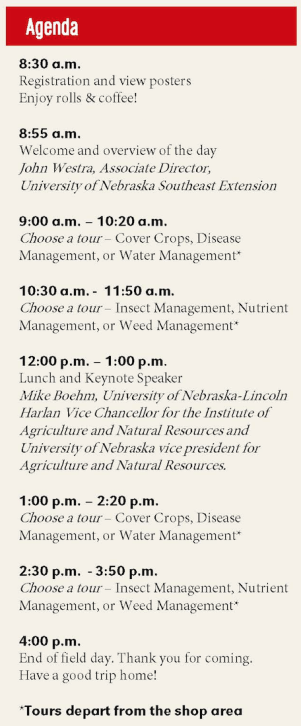
Wednesday, August 29th will be the South Central Ag Lab (SCAL)  Field Day with registration beginning at 8:30 a.m. and concluding at 4:00 p.m. Approximately 100 applied field research trials are conducted at SCAL annually by University of Nebraska-Lincoln faculty and the United States Department of Agriculture/Agricultural Research Service scientists. Trials are focused on irrigation and water management, soil fertility, entomology, weed science, cropping systems, disease management and crop variety testing. Field day speakers will share information about their research for improved crop production and profitability.

Specific topics and speakers include:

  • Cropping Systems: From cover crops to corn earissues – Roger Elmore, NE Extension Cropping Systems Agronomist; Katja Koehler- Cole, UNL Agronomy Post-Doctoral Research Associate, Justin McMechan, UNL Crop Protection & Cropping Systems Specialist; and Osler Ortez Amador, UNL PhD Grad Student
  • Insect Management: European corn borer, Corn rootworm & Western bean cutworm – Robert Wright – NE Extension Entomologistagenda.png
  • Weed Management: Opportunities & challenges for weed control in soybean – Amit Jhala, NE Extension Weed Management Specialist
  • From Inhibitors to Sensors: Nitrogen fertilizer management in irrigated corn – Leonardo Bastos, UNL PhD candidate in Soil fertility/precision ag, Brian Krienke, NE Soils Extension Educator and Joe Juck, NE Extension Precision Ag Specialist
  • Disease Management: Corn and Soybean disease updates – TamraJackson-Ziems, NE Extension Plant Pathologist
  • Water Management: Fundamentals of variable rate irrigation & fertigation in comparison to fixed rate irrigation & conventional fertilizer management & Imapct of cover crops on soil quality, Suat Irmak, Harold W. Eberhard Distinguished Professor of Biological Systems Engineering

Register online by August 26th for lunch planning purposes which can be done at https://go.unl.edu/2018scalfieldday. For more information, call the South Central Lab Office at (402)762-3536. CCA credits are available.

Crops, Irrigation, Livestock

Farm Service Agency County Committee

It is important for one to stand for what they believe in and takes an active role in one’s community. Effective leadership is crucial to any community or organization.  An effective leader understands the issues at-hand, is knowledgeable in his/her area, knows the proper ways to motivate others, embraces change, can work in a variety of settings and with a variety of personalities, and involves the group or followers in important decision-making. That being said, remember that a leader is not only a political figure or someone that is well known, but a leader can be a farmer, local businessmen/women, or anyone in a community or organization.  For those individuals desiring to take on leadership roles, consider serving on the FSA County Committee. Details for how to step into this role follow.

photo of green leaf plants
Photo by Nico Brüggeboes on Pexels.com

Fillmore County USDA Farm Service Agency (FSA) Executive Director Ryne Norton announced that the nomination period for local FSA county committees began on June 15, 2018. Nomination forms must be postmarked or received in the Fillmore County FSA Office by Aug. 1, 2018. Producers play a critical role in the day-to-day operations of FSA, making important decisions on programs dealing with disaster and conservation, emergencies, commodity loan price support, county office employment and other agricultural issues.

“County committees are unique to FSA and allow producers to have a voice on federal farm program implementation at the local level,” said CED Norton. “It is also important that committees are comprised of members who fairly represent the diverse demographics of production agriculture for their community. I encourage all producers, including women, minority and beginning farmers and ranchers, to participate in the nomination and election process.”

Producers can nominate themselves or others. Organizations, including those representing beginning, women and minority producers, may also nominate candidates to better serve their communities. To be eligible to serve on an FSA county committee, producers must participate or cooperate in an FSA program and reside in the area where the election is being held.

This year, nominations and elections for Fillmore County will be held in local administrative area 2, which includes Bennett, Geneva, Grafton, Momence and West Blue Townships. To be considered, a producer must sign an FSA-669A nomination form. The form and other information about FSA county committee elections are available at www.fsa.usda.gov/elections, or from the Fillmore County FSA office. Visit farmers.gov for more information.

Election ballots will be mailed to eligible voters beginning Nov. 5, 2018. Read more to learn about important election dates.

Crops, Irrigation

New Cropping Systems Educator

On behalf of the Clay County Extension staff, we’d like to welcome Michael Sindelar to the Extension Family as he is the new cropping and water systems educator based out of Clay Center in Clay County. Here is a little bit about Michael:

corn
Photo by Alejandro Barrón on Pexels.com

“I was born and raised in Lincoln, Nebraska. However, I was exposed to agriculture at a young age as my father would take me to the family farm located near Richland, Nebraska in Colfax county to “help” with the farm work. I joined the Navy in 2005 and served until 2010. I was a cryptologist collective (CTR) and worked in military intelligence. I was stationed out of Hawaii for my enlistment. I had the opportunity to see parts of the pacific and spent one year deployed in Afghanistan where I collected intelligence and conducted combat operations. After having fun for a couple of years I got my act together and earned a bachelor’s degree in Agronomy from the University of Nebraska. This spring I completed my master’s degree in Agronomy with a specialization in soil and water science from the University of Nebraska. I spent most of my master’s degree studying how changes in soil management affect soil water storage, recharge, and heat as storage and transfer through the soil. I look forward to starting my new position on Monday. I sign most of my emails using V/R which is a carryover from the military meaning very respectfully.”

His email address is msindelar2@unl.edu.

Crops, Irrigation

Irrigation Information

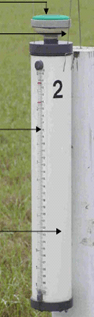
If you would like to participate in a dynamic irrigation program, called the Nebraska Ag Water Management Network, let me know and I’d be happy to help and get you started! If you are in the NAWMN, consider installing your ETgage soon and once done with planting, start the soaking/drying cycle on your Watermark sensors to be sure they work! It’s also important to replace the #54 alfalfa canvas covers and wafers on a regular basis at the start of each season. For more information, go to: https://nawmn.unl.edu/.

ETgage

I plan to report the weekly evapotranspiration (ET) in my weekly blog. The ETgage I check is in the center of the county, just south of Geneva; hopefully it will help others become aware or have an idea what the local ET is.

The ETgage I check outside of Geneva changed 2.0 inches for the week of May 25-June 1st. Corn in the V-4 stage has a coefficient of .18”. To calculate how much water, corn at V-4 stage used you simply multiply .18” x 2.0” for a weekly use of .36” or .05 inches/day. Corn approaching V-6 would have used .70”/week or .07” per day.  Fortunately, we received about 1.2” rain in this location as well.

For more information about ETgages and Watermark sensors, check out the NAWMN website https://nawmn.unl.edu/.

Crops, Irrigation

NE Ag Water Management Network

pexels-photo-347925.jpeg

It’s certainly proving to be a dry spring so far. One of the ways to better manage irrigation costs is through participation in the Nebraska Ag Water Management Network. In addition to saving costs and water, producers report a reduction in nutrient loss. Evaluation results have shown a one to two-inch savings of irrigation since its inception. The Network has been having significant impacts on both water and energy conservation due to farmers adopting information and implementing technologies in their irrigation management. The cost of applying an additional 2 inches of water is going to vary depending on your depth to water, system pressure, and equipment costs, but could easily run from $10 to $30 per acre.

To determine the actual cost, I recommend using the IrrigateCost app, developed by Nebraska Extension. The app, which is available for both Apple and Android products, allows users to input their specific information such as acres irrigated, pumping lift, system PSI, pump and pivot life, and inches applied as well as related costs such as for the well and engine, labor, energy, district fees, and taxes. The app then calculates total irrigation, total ownership, and total operating costs. It also breaks down costs by irrigation well, pump, gear head, pump base, diesel eirrigatecostngine and tank and system and calculates per acre annual cost and per acre-inch annual cost.
A couple of the tools the NAWMN uses are ETgages® or Atmometers which mimic crop evapotranspiration or ET and Watermark soil matrix sensors which measure soil matric potential or the energy required to remove water from the soil. These two tools have really worked well and have made irrigation management much easier than those gut feelings.  The more information you have the better decisions you can make!

ETgage

If you are in the NAWMN, and have not already installed your equipment, be sure to remember to start the soaking/drying cycle on your Watermark sensors to be sure they work! It’s also important to replace the #54 alfalfa canvas covers and wafers on a regular basis at the start of each season. For more information, go to: http://water.unl.edu/web/cropswater/nawmdn.

Once you have your ETgage out, I hope you will post your weekly readings to the Nebraska Ag Water Management Network (NAWMN) website. As a reminder, once you are on the main screen, you can login to your site by entering your site name and password and clicking on “Login.” Once you have logged in, you will be taken to your weekly data from past weeks, including last year. To enter your weekly data, click on the “Add new ETgage reading” link which will take you to the data entry page where you can enter your growth stage, rainfall, and ETgage change.

If you’ve forgotten your site name or password, please contact Aaron Nygren at anygren2@unl.edu or 402-352-3821.

Crops, Irrigation, Programming

Crop Scout Training

Have you ever thought about where crop scouts and agronomists receive some of their training? Nebraska Extension helps provide education for them and others; one opportunity will be coming up on May 9th. The course is from 8:55 a.m. to 5:10 p.m. with registration at 8:30 a.m. at the University of Nebraska’s Eastern Nebraska Research and Extension Center near Mead. The training course is scheduled for industry representatives and corn and soybean growers wanting to learn how to better manage corn and soybean pests.nature-field-sun-agriculture.jpg

Keith Glewen, extension educator who coordinates the program said, “The training is designed for entry-level scouts who are working for crop consultants, industry agronomists or farm service centers in Nebraska and neighboring states”. The training course is also ideal for growers who scout their own fields or are interested in improving productivity, as well as for students being employed by agribusinesses. The day-long event provides participants practical/working knowledge and better accuracy in field scouting. Topics include: corn and soybean insect Scouting, identification and management; crop diseases; identifying weeds – plant morphology, using a key to identify weed seedlings; nutrient deficiencies in corn and soybeans; and understanding corn and soybean growth and development.

The cost for the program is $165, which includes lunch, refreshment breaks, workshop materials and instruction manual. Updated reference materials are included in this year’s take-home instruction manual.  For those attending the day-long training without the resource book, the fee is $50. Attendees should preregister to reserve their seat and to ensure workshop materials are available the day of the training session.

Certified Crop Advisor continuing education credits are available with 6 in pest management, 1 in crop management and .5 in fertility/nutrient management.

For more information or to register, contact Nebraska Extension at (402) 624-8030, (800) 529-8030, e-mail Keith Glewen at kglewen1@unl.edu, or online at https://enre.unl.edu/crop.

Crops, Irrigation, Programming

Nebraska On-Farm Research Network Opportunities

The Nebraska On-Farm Research Network (NOFRN) is seeking growers who would like to conduct research trials in the 2018 crop season. NOFRN is designed to help growers test and answer questions they have about products or practices they’re considering implementing on their farm. The on-farm research studies provide a unique opportunity to collaborate with university and industry experts to design and conduct research suited to the farmer’s own operation.

A number of NOFRN research protocols are available for 2018 and even more can be customized to address specific farmer questions, said Laura Thompson, Extension educator and NOFRN co-coordinator with extension educator Keith Glewen. For more information, go to https://cropwatch.unl.edu/on-farm-research.onfarmapp

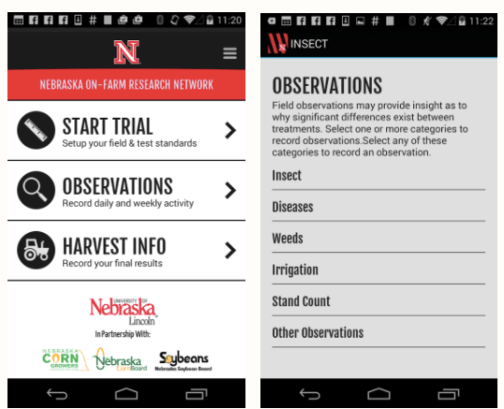
Accessing resources from the Nebraska On-Farm Research Network is available at your fingertips – in the field, in the tractor or truck, or wherever you want to use the research app.  The research app was launched in April 2015 is available for iPhone, iPad and Android users. The app enables users to create treatment strips in their own fields and develop a map of their research study. Once the field is created the user has the ability to enter periodic observations related to insects, diseases, weeds, irrigation totals, or other key observations, including photos. At the conclusion of the research trial, the user inputs the harvest results and exports them to an excel file.  The plot layout, observations, and yield data can all be emailed at any time as an excel file.  The data collected will be beneficial to both the app user and to those evaluating the data and results with the Nebraska On-Farm Research Network.

Crops, Irrigation, Programming

Crop Scouting Training

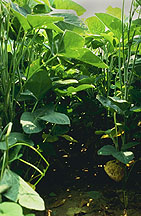
Industry representatives and corn and soybean growers wanting to learn how to better manage corn and soybean pests should plan to attend the Nebraska Extension crop scout training for pest managers program March 13 at the Eastern Nebraska Research and Extension Center near Mead.soybeans

Experts from the University of Nebraska–Lincoln will provide in-depth information on topics including: factors influencing the growth and development of corn and soybeans; corn and soybean insect management; weed control management; identifying weeds – plant morphology; using a key to identify weed seedlings; and crop diseases and quiz.

Certified Crop Advisor continuing education credits are available with 6 in pest management, 1 in crop management and .5 in fertility/nutrient management.

Registration begins at 8:30 a.m., and the workshop is from 9 a.m-5 p.m.

Cost for this training is $165 which includes a resource book. For participants attending the training only (no resource book) the fee is $50.  Fees include lunch, refreshment breaks, workshop materials and instruction manual. Registrants should preregister to reserve their seat and to ensure workshop materials are available the day of the training session. Updated reference materials are included in this year’s take- home instruction manual.

To register, visit https://enrec.unl.edu/crop. For more information, contact Nebraska Extension at (402) 624-8030, (800) 529-8030, or e-mail Keith Glewen at kglewen1@unl.edu.