Crops, Livestock, Programming

Ready, Set, Spread: Manure Application Workshops

Turning manure nutrients into better crop yields while protecting the environment will be the focus of ten Nebraska Extension Land Application Training workshops held across the state this February and March, with one held locally in Geneva on February 6th.

Land Application Training workshops focus on what fields should best utilize manure nutrients and other benefits. Each workshop will be highly participant-led with limited seating. Participants will be given a scenario and asked at the end of each activity to determine whether the field will benefit from manure application or whether there are considerations that make the field less desirable for manure application. Based on the activities, participants will then rank each field within the scenario to determine a priority ranking for the entire scenario. Activity topics will include manure nutrient value, transportation cost, soil health, water quality, neighbors, and odors. Regulations and record-keeping about manure storage and application will also be addressed during each workshop.

These manure workshops meet land application training certification needs for livestock producers that are required to do so, but they are open to anyone interested in using manure as a nutrient source on cropland as well. The Land Application Training events run from 9 am to 4 pm local time. I’ve only included some on the eastern side of the state; if you need others, go to water.unl.edu/lat.

Workshop sessions include:

  • Fillmore County Extension Office in Geneva on February 6
  • Madison County Extension Office in Norfolk on February 26
  • Nielsen Community Center in West Point on March 4
  • Rainforth Animal Health in Wisner (en Español) on March 6
  • Platte County Extension Office in Columbus on March 12

New this year, the UNL animal manure management team added two opportunities to take the workshop in Spanish. The content for the workshop will be the same in both languages, but hoping this will give Spanish speakers a chance to focus on the content of the workshop rather than the translation of English materials.

Because of limited seating and a meal provided during each workshop, registration is required and is requested 1 week ahead of each event. To ensure you can attend the location and date most convenient for you, register at water.unl.edu/lat. Workshops cost $75 per operation requiring certification or $25 per person with no expectation of certification. You can learn more about all things manure including these workshops at manure.unl.edu or by reaching out to Leslie Johnson at leslie.johnson@unl.edu.
Livestock, Programming

Cow/Calf College

Cow/Calf College Features Livestock Risk Management Workshop

The University of Nebraska-Lincoln’s Center for Agricultural Profitability and Nebraska Extension will host a risk management workshop in Clay Center to update livestock producers on the latest insurance options and risk management planning strategies. It will be held from 10:30 a.m. to 2 p.m., Jan. 21, at the U.S. Meat Animal Research Center, 844 Road 313.  

The workshop is sponsored by Nebraska Extension’s Cow-Calf College program. Sign-in begins at 10 a.m. In the event of inclement weather, the workshop will be held from 10:30 a.m. to 2 p.m. on Jan. 28 at the same location.  

Attendees will learn strategies designed to reduce risk exposure to achieve a profitable outcome in uncertain times. Current issues facing the cattle industry will be discussed to help producers to make more informed decisions. The goal of this program is to provide producers with the tools and resources needed to navigate the volatile livestock market and better manage risk through the creation of a risk management plan. 

Topics will include managing drought risk with USDA’s Pasture, Rangeland, and Forage (PRF) Insurance and managing price risk with USDA’s Livestock Risk Protection (LRP). PRF is an annual sign-up due on Dec. 1. LRP can be purchased most business days. The Weaned Calf Risk Protection Program, new this year, will also be discussed.  

The workshop is free, and snacks will be provided. Registration is required by Jan. 15 by calling Nebraska Extension in Fillmore County at 402-759-3712.  

This material is based upon work supported by USDA/NIFA under Award Number 2023-70027-40444. 

Livestock

Pork Month- October

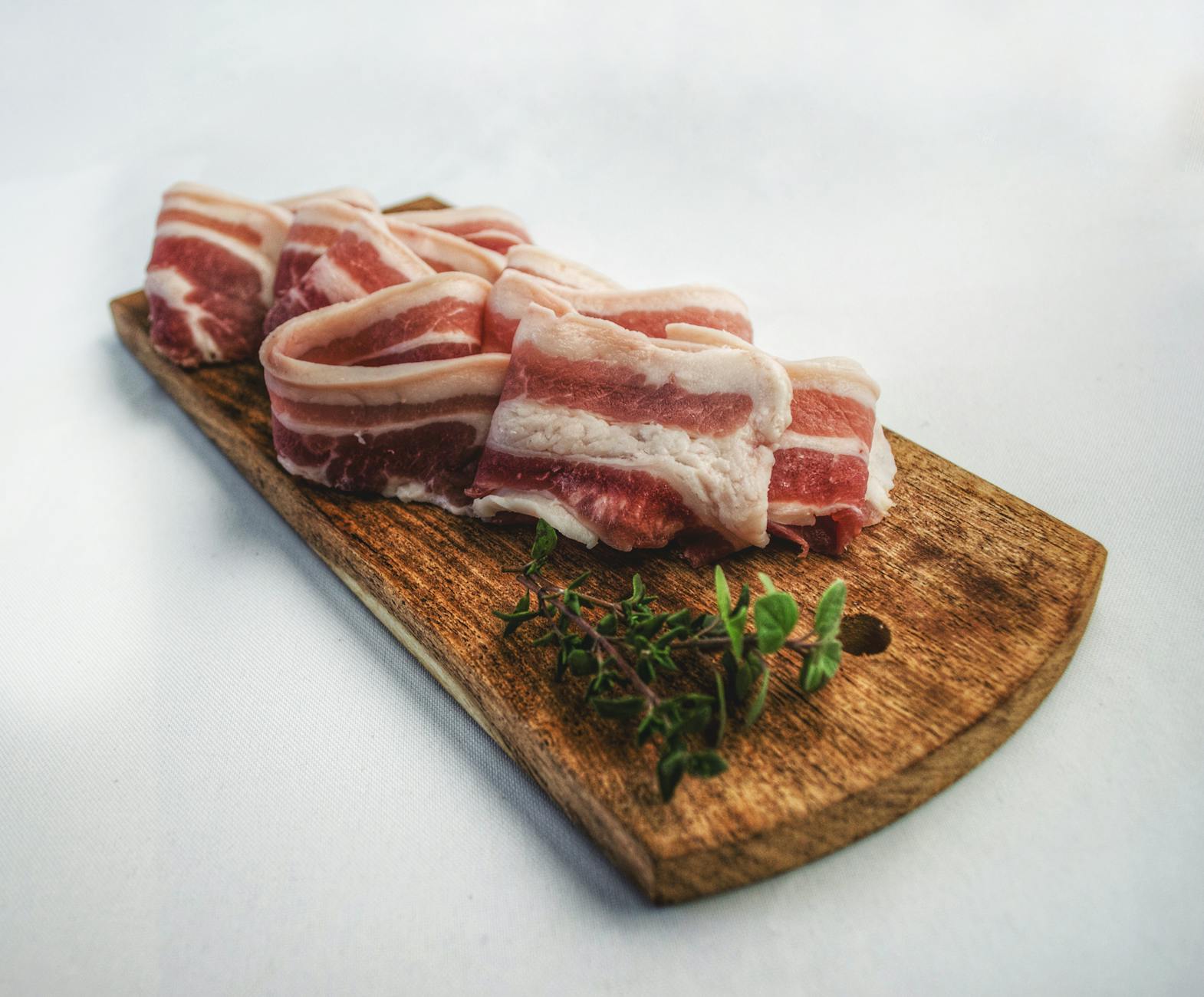
If you have recently enjoyed some juicy pork loin, pork chops, sausage, or my favorite – bacon, then you should thank a pork producer. In Nebraska, we grow nearly 7.8 million pigs each year from 1,230 family farms, making us the sixth-largest pork-producing state. These family farms have people who are locally involved in various community organizations, schools, churches, etc., and have families of their own to feed. This is just one of the reasons you know that pig farmers raise a safe, wholesome product that you can serve your family. According to the Nebraska Pork Producers Association, there are nearly 18,000 jobs involved in pork production and an economic impact of 1.66 billion dollars in Nebraska.

October is National Pork Month, and the Nebraska Pork Producers Association website has some fantastic recipes on their website which can be found at nepork.org. There are also some delicious recipes including an air fryer pork and apple burger and pork rice bowl recipes on Extension’s food.unl.edu website.

Photo by Nicolas Postiglioni on Pexels.com

Speaking of meat, did you know that pork carcasses are separated based on percent fat-free lean (%FFL), which estimates how many pounds of boneless, closely trimmed retail cuts (BCTRC) that animal will provide.  Let’s take an example hog that has a live weight of 275 lbs. If that animal had a dressing percentage (the amount of weight from the live animal that makes it to the carcass) of 75%, the carcass weight would be 210 lbs. With a percent fat-free lean of 57%, the boneless, closely trimmed retail cuts (BCTRC) of meat would be 120 lbs. A fun fact is that Americans on average eat around 18 pounds of bacon each year. That’s about 5.6 billion pounds for the entire United States.

Wholesale cuts are large meat cuts that the animal carcass is cut into for ease in handling and shipping. Some wholesale cuts are higher in value than others. In hogs, the wholesale cuts are the shoulder/“Boston butt”, shoulder/“picnic”, loin, belly, and leg/“ham”. These cuts are then broken down into retail cuts which is what most consumers will purchase at the grocery store. Some popular examples include sliced bacon and spare ribs from the side and country-style ribs, tenderloin, and center cut chops from the loin.

Often when any meat turns out dry, it is prepared and cooked incorrectly.  Using a meat thermometer is one of the best ways to ensure meat is not overcooked. For example, boneless pork chops and pork tenderloin only need an internal temperature of 145 degrees (Fahrenheit). Ground pork patties should reach an internal temperature of 160 degrees. For more tips on properly preparing pork, which include grilling pork, air frying pork, using an instant pot, roasting pork, and more, go to the National Pork Board’s website at pork.org. Happy National Pork Month!

Crops, Livestock, Programming, Uncategorized

Manure Management Programming

Turning manure nutrients into better crop yields while protecting the environment will be the focus of seven Nebraska Extension workshops being held across the state this February and March. Leslie Johnson, UNL animal manure management coordinator has announced that these workshops have traditionally focused on livestock producers because they’re required to attend manure training regularly, but efforts have been made to include crop farmers that are often recipients of the manure because the information shared is just as valuable to them and their bottom line. The workshops will still meet the educational requirements for permitted livestock operations laid out by the Nebraska Department of Environment and Energy’s title 130.

 The news release also states that participants who attend the day-long (9 a.m.–4 p.m.) event will receive NDEE land application training certification. The initial land application training certification requires participation in the full-day program, which includes lunch. Attendance at the afternoon session will meet minimum needs for recertification, but participants who only need recertification may choose to attend the full event if they wish for no additional charge. Sessions will include an update on regulations and discussions on how to best use manure on cropland. Anyone is welcome regardless of the need for certification. Crop farmers and livestock operations will learn useful information to apply to their operations.

Sessions will focus on what fields should be chosen to best utilize manure nutrients and other benefits. Each session will be highly participant-led with limited seating. Participants will be given a scenario and asked to determine the priority ranking of each field within the scenario. This ranking will be done at the end of each activity focused on manure nutrients, transportation cost, soil health, water quality, as well as neighbors and odors. Regulations and record-keeping about manure storage and application will also be addressed during each session.

Sessions include:

  • Feb. 12 — Columbus
  • Feb. 13 — Geneva
  • Feb. 19 — Scottsbluff
  • Feb. 20 — Lexington
  • Feb. 29 — Norfolk
  • March 5 — West Point
  • March 6 — Ord

Because of participation limits in each session, registration is required. If registration numbers exceed expectations, more sessions may be added. To ensure your attendance, register online. The cost of the sessions will be $75 per operation requiring certification or $25 per person with no expectation of certification.

The workshops are sponsored by the Nebraska Extension Animal Manure Management Team, which is dedicated to helping livestock and crop producers better utilize manure resources for agronomic and environmental benefits. For additional information on the workshops and other resources for managing manure nutrients, visit UNL Water or contact Leslie Johnson at 402-584-3818.

Register now

Livestock

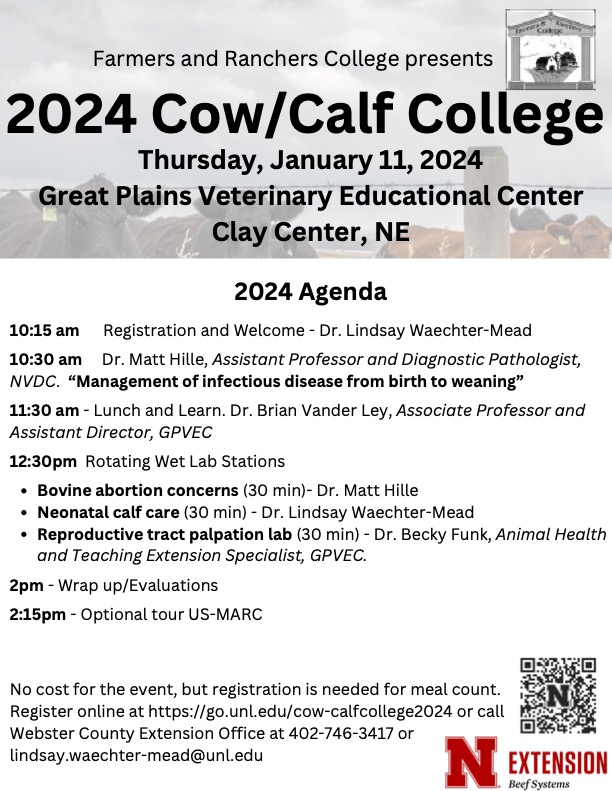
Cow/Calf College Jan. 11, 2024

Farmers and Ranchers College announces the 2024 Cow-Calf College is set for January 11, 2024 at the Great Plains Veterinary Educational Center, near Clay Center, Nebraska. Registration begins at 10:15 am with presentations scheduled from 10:30 am – 2:00 pm.

This year’s program is focused on strategies to enhance cow/calf health from birth to weaning. The hands-on format will allow participants to engage with specialists and peers throughout the day. Dr. Matt Hille, Assistant Professor and Diagnostic Pathologist at Nebraska Veterinary Diagnostic Center, will provide an in-depth look at common infectious diseases affecting calves. Topics include scour prevention and treatment techniques, and when it may be worthwhile to pursue diagnostics. Discussion will also include pinkeye disease background, treatment, and prevention strategies.

The afternoon will be comprised of three mini-workshops, where participants will dive further into neonatal calf health, including when and how to intervene in scour cases and tips to ensure newborn calf success. Dr. Becky Funk, GPVEC Extension Specialist will host a hands-on palpation wet lab utilizing bovine reproductive tracts and Dr. Hille will continue the cow health discussion with potential causes of abortion and when diagnostics are needed. Dr. Brian Vander Ley, Associate Professor and Assistant Director of GPVEC will provide an overview of activities at the Center while participants enjoy a catered lunch.

The program will conclude with an optional tour of US-Meat Animal Research Center (weather permitting). There is no cost for the event; however, registration is required due to limited space. Pre-registration can be made by calling the Webster County Extension office at 402-746-3417 or online at https://go.unl.edu/cow-calfcollege2024.

Crops, Irrigation, Livestock

Drought Impacts on People

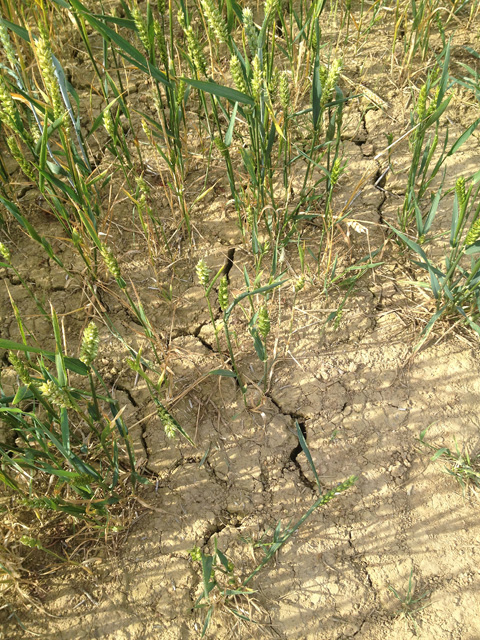
With the ongoing drought, I decided to examine how this not only impacts our crops, pastures, landscapes, and lawns, but the stress it causes communities and people. The National Drought Mitigation Center based out of the University of Nebraska, provides a summary of impacts drought has in our lives. We all need water for different things in our lives, from growing crops to washing dishes, doing laundry, and recreational uses.

Drought has a ripple effect throughout the community and economy. For example, if a farmer’s yields are way below average and have a larger cost of production because of the need to irrigation more frequently, that results in less income for that farmer. A ripple effect related to that might be less purchases at an implement dealer or other farm-related businesses. If enough farmers lose their crops, those businesses might feel the impacts, potentially causing more negative impacts in the community. The same can be said for livestock producers.

UNL’s Drought Mitigation Center also points out there are usually economic, environmental, and social impacts in drought conditions. Economic impacts of drought cost people and businesses money. In the example described above, when farmers and ranchers are struggling that usually creates economic stress for various businesses in the community. This could cause an issue with people having to pay more for food as well.

Environmental impacts can shrink food and drinking water supplies for fish and wildlife, lead to a migration of wildlife, an increase in wildfires, result in wind erosion of soils, create a loss of wetlands and cause an increase in disease within wild animals, because of food and water supplies. There will also be lower water levels in reservoirs, lakes, and ponds.

Photo by Pedro Figueras on Pexels.com

Social impacts of drought include public safety, health concerns, conflicts between people when there isn’t enough water to go around and changes in lifestyle. Drought can cause anxiety or depression about economic losses, health problems related to dust, a threat to public safety from an increased number of range fires, and reduced incomes. Fewer recreational activities might impact a family’s normal outings and if severe enough, people may have to move from farms to towns or from one town to another to be economically viable.

While there isn’t much we can do about drought, there are resources available on the Nebraska Department of Agriculture’s website at nda.nebraska.gov/drought. Some of the many resources included are the Hay & Forage Hotline, Farm Service Agency Emergency programs, etc. Nebraska also has the Rural Response Hotline which can assist with financial assistance, legal assistance, disaster relief and emotional support. It can be accessed at farmhotline.com or 800-464-0258. Nebraska Extension’s Rural Family Stress and Wellness Team promotes the health and wellness of all Nebraskans and has resources available at ruralwellness.unl.edu. As always, Nebraska Extension has resources to help with all your needs. 

Livestock, Programming

Cow/Calf College Beef Seminar

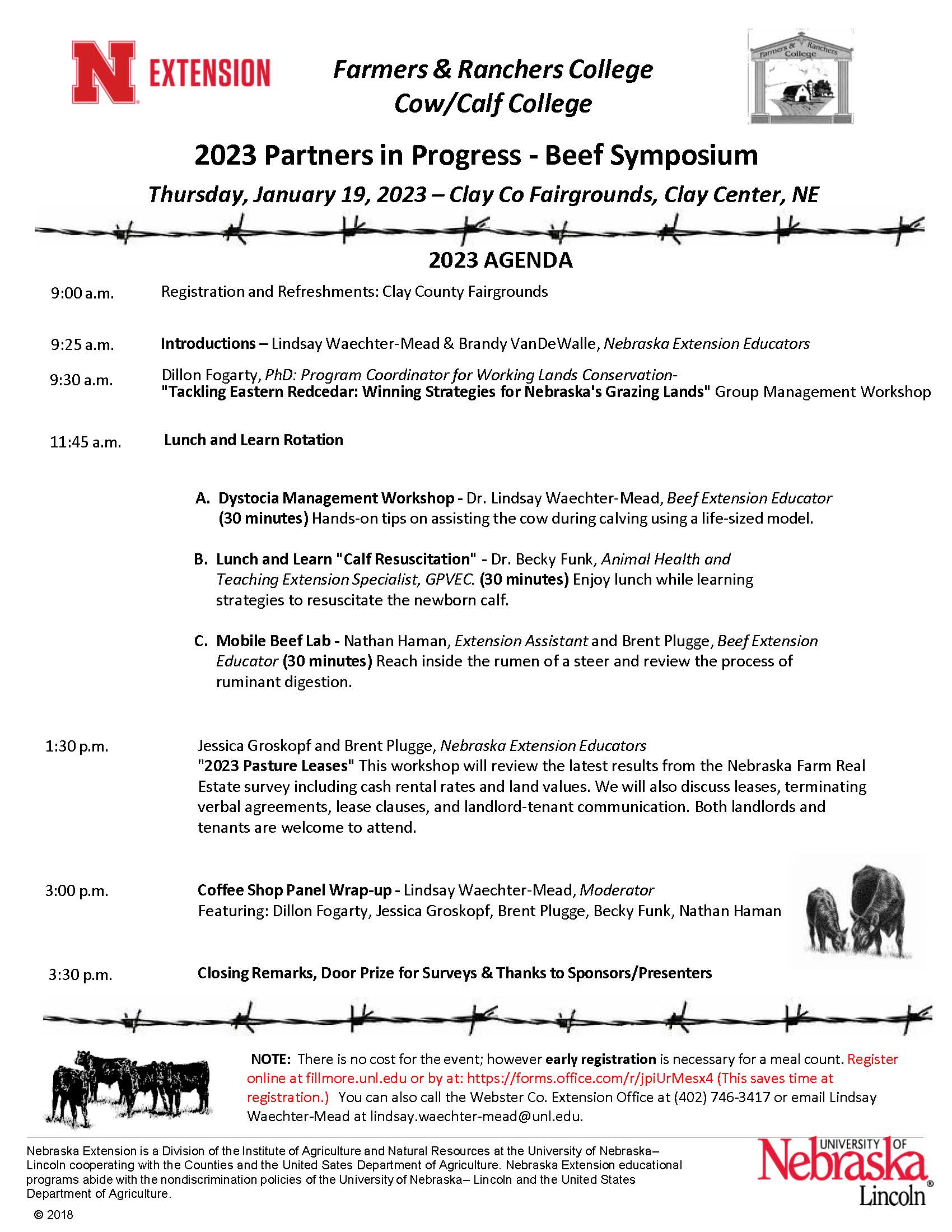
The 2023 Cow-Calf College Beef Seminar is set for January 19th at the Clay County Fairgrounds in the Activities Building. Registration starts at 9:00 am with programs scheduled from 9:30 am – 3:30 pm. This year’s program is focused on strategies to manage forage resources during drought, including eastern redcedar control and adjusting pasture stocking and rental rates. The hands-on format will allow participants to engage with specialists and peers throughout the day.

Dillon Fogarty, Program Coordinator for Working Lands Conservation will provide an in-depth look at eastern redcedar control and management. Woody plant encroachment by species like eastern redcedar threatens the productivity and profitability of Nebraska’s grasslands. Easter redcedar encroachment can result in up to a 75% reduction in forage production along with additional impacts to grassland resources. In the eastern redcedar control workshop, Dr. Fogarty will cover new guidelines for tackling woody plant encroachment. This will include the development of management plans, effective integration of management tools, and use of new rangeland monitoring platforms.

The afternoon workshop will be focused on 2023 Pasture Leases. Jessica Groskopf and Brent Plugge, Nebraska Extension Educators, will review the latest result from the Nebraska Farm Real Estate survey including cash rental rates and land values. They will also discuss leases, terminating verbal agreements, lease clauses, and landlord-tenant communication. Both landlords and tenants are encouraged to attend.

New this year: Lunch sessions will be comprised of three mini-workshops, including a Lunch and Learn with Dr. Becky Funk, GPVEC Extension Specialist, on calf resuscitation tips and an opportunity to practice assisting the cow during calving using a life-sized model. The Mobile Beef Lab will also be present, giving attendees the chance to reach inside the rumen of a fistulated steer and review the process of ruminant digestion.

A lunch will be provided to those who register, and the program will conclude with a coffee shop panel where participants can ask question directly to the specialists as well as the opportunity to win a variety of door prizes.

There is no cost for the event; however, early registration is highly encouraged to allow for proper planning. Pre-registration can be made by calling the Webster County Extension office at 402-746-3417 or online at go.unl.edu/frcollege.

Crops, Livestock

Ag Today: New Era of Prosperity or Temporary Opportunity

Recently at a Farmers & Ranchers College program, Dr. David Kohl emphasized the importance of maintaining working capital or cash for businesses and families, among other important business principles. As always, his global knowledge of events and how they impact U.S. agriculture is fascinating.

One of the mega-trends for producers to pay attention to is the increased focus on healthy soil and water. Healthy soil and water quality creates healthy plants, animals, humans, and environment. Likely there will be paid incentives for producers who excel in these areas. Continuing to reassure consumers where and how food is produced, processed, and distributed remains important. It is also crucial to know your cost of production to plan best, average, and worst-case scenarios. Kohl also recommends overestimating capital expenditures by 25%.

His “Rule of 78” caught the attention of a lot of participants. When most people reach 78 years of age, usually health starts to decline unless you practice 8 habits. Those eight habits to have a quality of life included taking care one oneself physically by drinking water, exercising regularly, eating healthy and getting enough sleep.  Mentally, people should have a support network, life purpose, engage in mental activities such as reading or meditating and practice your faith/spiritual life.  He emphasized the importance of allowing oneself 2 hours per day with no technology.

Farmers and ranchers should also manage things that can be controlled and manage around those that cannot be controlled. He reinforced the idea that for a successful operation, you must plan, strategize, execute, and monitor. Examine monthly or at least quarterly financials to ensure you are on track. Those with a written business plan are four times more profitable than those without a plan. Also, the mental health of those with a business plan have two times the mental health as those without a written plan.

Kohl reminded participants of his business IQ exercise that ANY business should forgo. The areas in the business IQ included cost of production knowledge, cost of production by enterprise, goals (business, family, personal), record keeping system, projected cash flow, financial sensitivity analysis, financial ratio/break evens, those who work with an advisory team/lender, those whom have a marketing plan and execute, those whom have a risk management plan and execute, modest lifestyle habits, strong people management plan, transition plan, those whom attend educational seminars, and their attitude.

To determine what your cost of production is, a hands-on training will be held at the Fillmore County Fairgrounds on Thursday, December 15th from 1-3:00 p.m. This program is free, but registration is preferred for planning. Register at cap.unl.edu/abc/training. Attendees are encouraged to bring their own laptop or tablet to the workshop.

Crops, Livestock

Breaking Down Anxiety: Tools to Help You Live a Less Anxious Life

This week, I’ve decided to share with you a two-part workshop on helping live a less anxious life which is provided by Nebraska Extension’s Women in Agriculture program. This two-part virtual workshop September will focus on managing and working through anxiety. “Breaking Down Anxiety: Tools to Help You Live a Less Anxious Life,” will hold its first session from 1 to 3 p.m. Central time on September 8. The second session is scheduled for 1 to 2 p.m. Central time on September 29.

Photo by Suzy Hazelwood on Pexels.com

It will be facilitated by Ashley Machado, a mental health consultant who works primarily with agricultural professionals and their families. “Sometimes anxiety can feel all-consuming, like you’re on a train you don’t want to be on and you don’t know how to get off. Other times it can feel like there’s a light at the end of the tunnel, but you keep getting stuck on a hamster wheel,” Machado said.

The workshop will discuss how anxiety shows up, why it can be a reaction to uncertainty, and offer advice for developing skills to manage anxiety and its effects. Machado is an advocate of rethinking the ways that we support mental health in the agriculture industry and specializes in breaking down big ideas and deep feelings into simple, actionable strategies. She applies 15 years of experience to helping individuals and organizations in agriculture to develop the tools they need to maintain good mental health and operate and live fully.

Machado holds a Bachelor’s Degree in Human Development and a Master’s in Social Work with an emphasis in clinical mental health. She grew up in the dairy industry and now lives in California with her husband, a rancher and almond farmer.

The workshop will be held via Zoom and participants should plan on attending both sessions. Registration is $20 per person and can be completed here: https://cvent.me/DWlYaO.

 This material is based upon work supported by USDA-NIFA under Award Number 2020-70028-32728.

Livestock

Cow-Calf College on January 25th

Cow-Calf College is gearing up to be hosted January 25th at the Clay County Fairgrounds from 9:30 am to 3:00 pm in the Activities Building. Registration starts at 9:00 a.m. This year’s program will be offered in a hybrid format through zoom & attendance in person. The focus of the 2022 Cow-Calf College will start with an in-depth look at easter redcedar control in the morning, an update by beef cow-calf specialist, Kacie McCarthy and a special presentation by Tom Field focusing on ways to engage youth in the beef industry.  

This year’s program provides plenty of flexibility as if you are only interested in learning about eastern redcedar control, come to the morning session and leave. If you are interested in bull management and strategies for transitioning the next generation of beef producers and professionals, you can attend the afternoon session. It will also be offered in-person and available via zoom.

Dillon Fogarty with UNL’s Department of Agronomy and Horticulture will provide an in-depth look at eastern redcedar control and management. Woody plant encroachment by species like eastern redcedar threatens the productivity and profitability of Nebraska’s grasslands. Eastern redcedar encroachment can result in up to a 75% reduction in forage production along with additional impacts to grassland resources. In the eastern redcedar control workshop, we will cover new guidelines for tackling woody plant encroachment. This will include the development of management plans, effective integration of management tools, and use of new rangeland monitoring platforms. 

Kicking off the afternoon will be Kacie McCarthy, UNL Beef Cow-Calf Specialist who will explain “Preparing your Bull Battery for the Breeding Season. Learn on maintaining body condition, nutritional needs, evaluating fertility, managing social dominance, providing proper female: bull ratios and more.  

The next decade will be characterized by the battle for talent – those industries and businesses that are successful at attracting, retaining, and growing human talent will have competitive advantage. Developing a talent plan is as important, if not more so, than any other area of focus for management.  The session will center on understanding the value of generational strengths, developing a succession plan, and developing a coaching culture. Tom Field, PhD serves the people of Nebraska as the Director of the Engler Agribusiness Entrepreneurship Program and holder of the Engler Chair in Entrepreneurship at the University of Nebraska – Lincoln.  An enthusiastic advocate for free enterprise, the potential of young people and opportunities in both agriculture and rural communities, Tom is an internationally recognized educator and innovator who can connect the dots between people, industries, and ideas. 

A lunch will be provided to those who register, and the program will conclude with a coffee shop panel where participants can ask questions directly to specialists as well as the opportunity to win a variety of door prizes.   

Pre-registration a week in advance is highly encouraged to allow for proper planning. Pre-registration can be made by calling the Fillmore County Extension Office at 402-759-3712 or Clay County Extension Office at 402-762-3644 or online at go.unl.edu/frcollege. To participate via zoom, register at go.unl.edu/onlinecowcalfcollege.