Crops, Horticulture, Irrigation, Livestock, Programming

Ag Offers Rewards, but can be Stressful Too

Recently I presented a webinar with my colleague, Glennis McClure that reminds us of daily stress in our lives, especially for farmers and ranchers. Agriculture is a stressful occupation and while it provides numerous rewards, it does not come without challenges. Too much stress can contribute to health issues and make us more accident prone.

close up composition conceptual creativity
Photo by Pedro Figueras on Pexels.com

The National Center for Farmer Health points out that stress is the human response to any change that is perceived as a challenge or a threat. Changes that cause worry, frustration or upheaval and seem beyond our control can cause stress. An example that hits close to home for Nebraska farmers and ranchers is the recent weather-related disasters. Attitudes, perceptions and meanings that people assign to events determine a large part of one’s stress levels.

There are many symptoms of stress that impact our body, mind and actions. For example, physical symptoms might include nausea, shortness of breath, shaky legs, headaches, and fatigue just to name a few. When under stress, some people may experience moodiness, frustration, anger, loneliness, anxiety or depression and even suicidal thoughts. Sleeping too much or too little, increased use of alcohol or drugs, withdrawal from others and exhibiting nervous behaviors are all examples of how our actions might change when stressed.

honeycrisp health illustration
Photo by rawpixel.com on Pexels.com

The good news is there are many ways to reduce stress. A summary of ways to decrease stress as compiled by Susan Harris-Broomfield, Nebraska extension educator includes:

  • Exercising ½ hour a day every day or every other day
  • Getting enough sleep to meet the demands of your body
  • Accepting that stress is a part of life and not dwelling on it
  • Learning to relax which could include taking deep breaths
  • Balance work and family time
  • Connect with sources of support
  • Eat a well-balanced diet
  • Talk with a friend or counselor
  • Don’t be afraid to ask for help.

If you recognize someone in distress, express your concern to them and ask about their situation. Do this in a non-judgmental way and actively listen to them. People in distress might turn to suicide and a majority of people who attempt suicide have given a clue or warning to someone. Don’t ignore indirect references to death or suicide. In fact it is a myth that talking about suicide with someone may give them the idea to carry it out. Asking someone about potential suicidal thoughts they may have or discussing it openly is one of the most helpful things you can do for someone who is suicidal. If someone indicates they are thinking of suicide, do not leave them alone. Call for help and/or take them to a hospital or health care provider. The National Suicide Prevention Lifeline can be reached at 1-800-273-TALK (8255). This hotline can be accessed day or night.

In keeping with the #NebraskaStrong idea, remember to be strong and seek out help as needed and assist others who may need help. In Nebraska, our Rural Response Hotline can be accessed at 1-800-464-0258. When a farmer, rancher, or rural resident calls the hotline and requests help with stress related issues, they are connected to an experienced staff person who is trained to help callers through the Counseling, Outreach and Mental Health Therapy program. Staff members are trained to work with individuals over the phone or in their home, providing confidential information and assistance.

A recording of the webinar, in addition to resources utilized for this program can be found at https://go.unl.edu/wellnessintoughtimes.  More resources, especially disaster-related resources can be accessed on the flood.unl.edu website. For more information, contact me at brandy.vandewalle@unl.edu or (402)759-3712.


Crops, Irrigation, Livestock, Programming

Nebraska LEAD Program

Eleven years ago I met twenty-nine talented individuals with a passion of agriculture through the Nebraska LEAD program. To date, I remain friends with many of them and the networking opportunities have been tremendous. The in-state seminars challenged me to think outside of the box and remain an advocate for agriculture. I could go on and on about the excellent opportunities the LEAD program has provided, but I challenge you to experience it yourself!Fruit Market pic

The Nebraska LEAD Program is dedicated to building future Nebraska leaders so that our food and fiber system is preserved and enhanced. If you would like to be a part of the leadership necessary to chart the course . . . now and in the future, and you are presently involved in production agriculture or agribusiness, there will never be a better time to make application to the Nebraska LEAD Program. Fellowship applications for Nebraska LEAD (Leadership Education/Action Development) Group 38 are now available for men and women involved in production agriculture or agribusiness and are due on June 15. Up to 30 motivated men and women with demonstrated leadership potential are selected annually for the Nebraska LEAD Program. Generally the program is for people between the ages of 25-55 years of age.

orange and and brown chess pieces
Photo by Markus Spiske temporausch.com on Pexels.com

In addition to monthly three-day seminars throughout Nebraska from mid-September through late March each year, Nebraska LEAD Fellows also participate in a 10-day National Study/Travel Seminar during the first year and a two week International Study/Travel Seminar during the second year.

Content essential to leadership focuses on public policy issues, natural resources, community development, interpersonal skill development, communications, education, economics, and social and cultural understanding. Soon beginning its 39th year, the program is operated by the Nebraska Agricultural Leadership Council, a nonprofit organization in collaboration with the University of Nebraska-Lincoln’s Institute of Agriculture and Natural Resources and in cooperation with Nebraska colleges and universities, business and industry, and individuals throughout the state.

Applications are due no later than June 15 and are available via e-mail from the Nebraska LEAD Program.  Please contact Shana at sgerdes2@unl.edu.   You may also request an application by calling (402) 472-6810.

Nebraska LEAD Program offices are in the Institute of Agriculture and Natural Resources at the University of Nebraska-Lincoln. If you are even thinking about applying, contact me and I’d be more than happy to share my experiences with you and visit with you about this life-changing opportunity!

Crops, Horticulture, Irrigation, Livestock, Programming

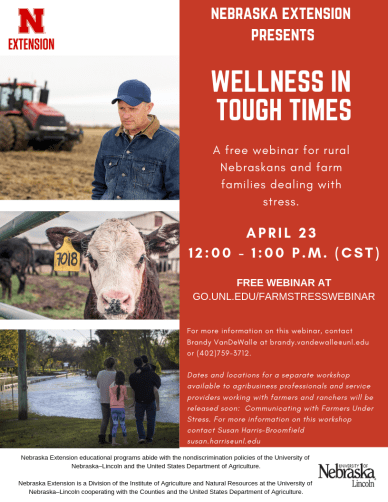
Wellness in Tough Times webinar

Farmers and ranchers have many stressors in their lives.  Weather challenges and disasters like many Nebraskans have recently experienced have led to uncertainty in their crop and livestock operations. Machinery breakdowns, debt loads, volatile markets, sleep deprivation, changing regulations, and the stress of holding onto a multi-generational farm/ranch all play a part of the stress and mental health of a farmer or rancher. Farmers and ranchers know the importance of planning and talking about their financial health to bankers, financial planners, spouses, etc. but might not realize how important it is to spend time on their mental health.

A free webinar will be offered April 23 via the web for farm and ranch families.  The webinar will take place at noon (CST) and can be accessed at go.unl.edu/farmstresswebinar.WellnessToughTime.png  Wellness in Tough Times will be presented by my colleague, Nebraska Extension Educator Glennis McClure and myself from 12:00 – 1:00 p.m. (CST). This free webinar is available for farm and ranch families to participate and will provide strategies for dealing with the stress of farming or ranching in today’s difficult economic environment.

Participants will learn: How to recognize the signs and symptoms of stress; understand the role stress plays in our lives; and strategies and resources to manage stress.

For more information, contact me at brandy.vandewalle@unl.edu or (402)759-3712. Dates and locations for a separate workshop available to agribusiness professionals and service providers working with farmers and ranchers will be released soon:  Communicating with Farmers Under Stress. For more information on this workshop contact Susan Harris-Broomfield susan.harris@unl.edu
 

Crops, Irrigation, Livestock, Uncategorized

Mental Health is Just as Important as Financial Health

Picture this. Someone is showing physical signs of stress – maybe it’s a heart attack or even a broken leg.  Who might arrive to the scene first?  It probably will be an EMT or other first responder. Their role is to keep the person alive or comfortable until that person reaches the hospital where doctors and other medical professionals will treat that patient. What happens if a person is showing signs of mental distress or even suicidal signs? There are classes available called, “Mental Health First Aid” which provides people the opportunity to properly help others receive professional help he/she might need. Things as simple as listening to the person non-judgmentally and encouraging them to seek professional help might just save that person’s life. Calling the suicide hotline with the person can also help that person realize that they can get through the crisis in their life.

board game business challenge chess
Photo by Pixabay on Pexels.com

Farmers and ranchers have many stressors in their life. Weather challenges and disasters like many Nebraskans have recently experienced have led to uncertainty in their crop and livestock operations. Machinery breakdowns, debt loads, volatile markets, long days with sleep deprivation, government regulations, and the stress of holding onto a multi-generational farm/ranch all play a part of the stress and mental health of a farmer or rancher. Farmers and ranchers know the importance of  planning and talking about their financial health to bankers, financial planners, spouses, etc. but might not realize how important it is to spend time on their mental health.

A North Dakota State University Extension publication reminds farmers that “just as farms need to be operated in a sustainable way that preserves resources for the long term, an individual’s life needs to be managed in a sustainable way for long-term well-being. Feeling overly tired, overwhelmed by stresses or under constant pressure is not a recipe for a sustainable lifestyle.” There are physical, mental, emotional/spiritual, personal/relational, work/professional and financial/practical strategies for coping with stress. For example, get at least 7-8 hours of restful sleep is one physical way to take care of yourself. Take 10 minutes and reflect on blessings in your life in as a mental strategy to dealing with stress. Emotional or spiritual coping strategies are to pray, do random acts of kindness and something as simple as eating a meal with a friend of loved one. A personal or relational coping strategy is to plan a small getaway with a family member or spend time playing games with family or friends. For a work strategy, talk to other farmers about their strategies or plan your next day at the end of a work day and set priorities ahead of time. Finally, financial/practical coping strategies are to schedule time to organize your records or finances monthly and create a family budget and live within your means.Assess for risk of suicide or harm. Listen non-judgmentally. Give re-assurance and information. Encourage appropriate professional help. Encourage self-help and other support strategies.

At the Mental Health First Aid workshop, an action plan to help others with potential mental health problems is referred to as “ALGEE.” The action plan is as follows:

  • Assess for risk of suicide or harm.
  • Listen non-judgmentally.
  • Give re-assurance and information.
  • Encourage appropriate professional help.
  • Encourage self-help and other support strategies.

If you or someone you know needs help, there are several resources. The Nebraska Family Helpline can be reached at 1-888-866-8660, the Nebraska Rural Response Hotline at 1-800-464-0258 or the National Suicide Prevention Lifeline at 1-800-273-TALK (8255).

Disaster Resources

Nebraska Extension is pushing out information to help.  Please use or share the website https://flood.unl.edu  It’s a key resource full of science-based information

Knowing the legal rights, benefits and resources available to low-income survivors of a disaster is crucial to recovery. Legal Aid of Nebraska can help. Apply online at disaster.legalaidofnebraska.org/apply, or call the Disaster Relief Hotline at 1-844-268-5627.

Crops, Horticulture, Irrigation, Livestock, Youth

Coping with Stress During a Crisis  

With the flooding and blizzard conditions affecting a large portion of the state, this week I looked up some Extension resources and decided to write some of the research ideas for dealing with stress and how to help the whole family cope. First of all, our Nebraska Extension publication, Effective Management of Stress & Crisis points out numerous tips that come from worldwide research on strong families. It involves research from more than 24,000 family members in 35 countries. While the publication identifies 18 ideas, I selected the top ten that interest me. For the remainder of the ideas, go online to the publication which can be accessed through our extension.unl.edu website and search for “Effective Management of Stress & Crisis.”

close up composition conceptual creativity
Photo by Pedro Figueras on Pexels.com

Ideas for coping with stress and crisis include:

  • Look for something positive to focus and focus on that positive element in a difficult situation.
  • Keep things in perspective. “These things too, shall pass.”
  • Pull together rather than apart. Don’t see the problem as an individual’s problem but as a challenge for the whole family.
  • Focus on what is most important and minimize fragmentation. Without focusing on the essentials, the details, details, details can get you edgy, even hysterical.
  • Go to the flow to some degree. Sometimes you are relatively powerless in the face of crisis. At this point it can be useful to simply tell yourself to “let it go.”
  • Know how to laugh and know how to cry, for both are essential to maintain an emotional balance in life.
  • Create a life full of meaning and purpose. All people face severe crises in life. You will not be able to avoid these challenges. Rather, your aim can be to live a useful life of service to your community. This brings richness and dignity to your life, in spite of the troubles you endure.
  • Realize that suffering can be a catalyst for positive growth. Crisis, by definition, is a difficult time in your life. However, it also can be a turning point, planting the seeds for a satisfying and successful future. This is hard to internalize but useful to remember.
  • Identify spiritually with the grand procession of life: Through good times and bad, we, as individuals, come and go, but life from whence we all spring is eternal. There is something satisfying and soothing about that thought.
  • Get help outside the nuclear family when needed. Seek help from extended family members, supportive friends, neighbors, colleagues, members of your religious community, professionals in the community, or others. In a manner of speaking, it takes a whole village to resolve a crisis.

    person wearing clear plastic raincoat and pair of yellow rainboots
    Photo by Valeria Boltneva on Pexels.com

While it might be “easier said than done” to follow the above strategies, giving every effort to embrace a positive approach to deal with a crisis will help you and your family more effectively handle the situation at hand. Disasters, whether natural or human-made leave today’s families facing difficult times. Our ranching and farming families have especially been impacted by the recent floods and blizzards. Let’s remember to pull together as a state and help our fellow Nebraskans through this difficult time, as the recovery and rebuilding process will take a long time.

Crops, Irrigation, Livestock, Programming, Youth

Celebrate Agriculture

UNADJUSTEDNONRAW_thumb_7b68.jpg
 It is a highlight for my girls to ride in the combine at harvest time; my girls have the opportunity to experience harvest with my Dad. 

Growing up on a small farm in Saline County, I appreciate the work of our farmers and ranchers. My dad still farms and my girls enjoy visiting the farm and I hope I can instill the same hard-working values and beliefs my parents instilled in my sister and I. This is part of the reason, my husband and I have starting raising a few chickens and have bucket calves for the girls to care for. With my husband as the Fillmore Central ag education instructor and myself as an extension educator for UNL, we hope to be teaching future generations the vast opportunities available in the agricultural industry. This week marks the time to celebrate agriculture so I have included some of the Agriculture Council of America’s press release in my column this week as well as some of Extension’s work in ag literacy2019AgDay 235x250.jpg

The Agriculture Council of America (ACA) will host National Agriculture Day on March 14, 2019. National Ag Day is celebrated in classrooms and communities across the country. The theme for National Ag Day 2019 is “Agriculture: Food For Life.”

On March 14, 2019, ACA will host major events in the nation’s capital including an event at the National Press Club as well as a Taste of Agriculture Celebration. Additionally, the ACA will bring approximately 100 college students to Washington to deliver the message of Ag Day. These events honor National Agriculture Day and mark a nationwide effort to tell the true story of American agriculture and remind citizens that agriculture is a part of all of us. A number of producers, agricultural associations, corporations, students and government organizations involved in agriculture are expected to participate

National Ag Day is organized by the Agriculture Council of America. ACA is a nonprofit organization composed of leaders in the agricultural, food and fiber community, dedicating its efforts to increasing the public’s awareness of agriculture’s role in modern society. The National Ag Day program encourages every American to:

  • Understand how food and fiber products are produced.
  • Appreciate the role agriculture plays in providing safe, abundant and affordable products.
  • Value the essential role of agriculture in maintaining a strong economy.
  • Acknowledge and consider career opportunities in the agriculture, food and fiber industry.

You might be glad to know that Nebraska Extension has a team of extension staff working on programming to educate consumers and youth about agriculture and tell the story of the American farmer and rancher. This is being done through agricultural literacy-focused festivals and programs, development of beef-booster curriculum, quality assurance programs and many others. Through 2018, over 51,000 Nebraska youth and adults statewide made changes and/or reinforced knowledge of food safety practices from when food is produced until food reaches consumers’ plates. Their actions will influence both the safety of food consumed by them and others.

Nebraska Extension’s team finalized and utilized five questions to evaluate youth programming focused on Consumer Confidence topics. Compiled results from youth who participated in three state-wide programs (Animals Inside & Out, AgCiting Science & Ag Festivals, which Fillmore & Clay County youth participated) for over 5400 elementary youth in 2018 showed: 97% of youth stated yes “I learned something new” as a result of the program, 97% of youth stated yes “I know farmers make good choices to keep our food safe”, 95% of youth stated yes “I can make healthy decisions about my food”, 95% of youth stated yes “I better understand where my food comes from” & 86% of youth stated yes “I will share with others about agriculture”. Forty-five certifications were provided in 2018 with 2,879 Beef Cattle Producers completed Beef Quality Assurance Certification which is valid for 3 years. In 2018, 9,189 Nebraska Youth participated in the Youth for Quality Care of Animals. This program trains youth of the Quality Assurance practices for all food animal species.

To see more of the impact Nebraska Extension’s programs had in 2018, go to https://extension.unl.edu/impact/.

Crops, Irrigation, Livestock, Programming

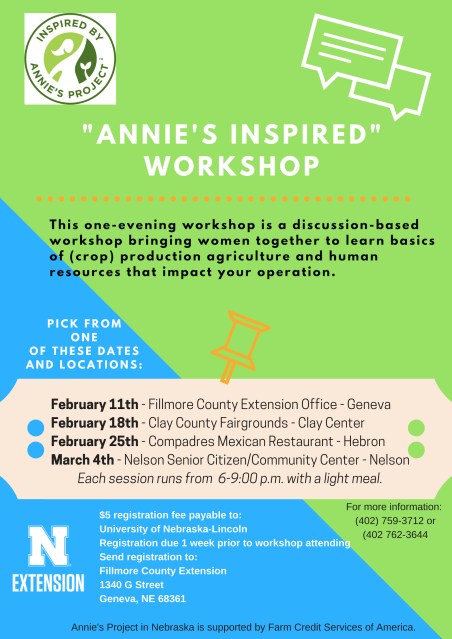
Annie’s Inspired – A Three Hour Session for Farm Women Involved in Agriculture 

Annies Inspired 2019.jpg

Farm and ranch women are generating a cultural tide in American agriculture that is moving management, assets and opportunities to a new wave of farmers across the country. At Annie’s Project workshops, farm women become empowered to be better business partners or sole operators through networks and by managing and organizing critical information. Whether you are a woman working full-time in the operation or have off-farm employment, Annie’s Project is for you.

A new “short-course”, titled Annie’s Inspired will be held in four different locations in South Central Nebraska. This one-evening workshop is being repeated in Fillmore, Clay, Nuckolls and Thayer Counties, all running from 6-9:00 p.m. with a light meal included. Registration is $5 per participant and due one week prior to the respective program date. Program dates and locations include:

  • February 11th – Fillmore County Extension Office – Geneva
  • February 18th – Clay County Fairgrounds – Clay Center
  • February 25th – Compadres Mexican Restaurant – Hebron
  • March 4th – Nelson Senior Citizen/Community Center – Nelson

The workshop is designed to be discussion-based, bringing women together to learn from experts in human resources, basic crop production issues, and other topics of interest to the group. There will be plenty of time for questions, sharing, reacting and connecting with presenters and fellow participants. The learning environment will be relaxed and fun, providing a dynamic way to learn, grow and meet other farm and ranch women.

To register, the $5 fee is payable to University of Nebraska-Lincoln due 1 week prior to the workshops attending and can be sent to: Fillmore County Extension, 1340 G Street, Geneva, NE 68361. Statewide program sponsor includes Farm Credit Services of America.  Annie’s Project courses have successfully reached more than 9,000 farm and ranch women in 33 states. Linda, an Annie’s Project alumna says, “I took the class to gain a better understanding about agribusiness and how financial decisions impact our farm operation. I have a better understanding of balance sheets and the futures market…this class has improved communication with my spouse on concerns he works with on a daily basis.”

Course size is limited, so please register by calling the Fillmore or Clay County Extension office at 402.759.3712 or 402.762.3644 or for more information, go to: https://wia.unl.edu/anniesproject.  For more information contact Brandy VanDeWalle at 402.759.3712 or brandy.vandewalle@unl.edu.

Crops, Irrigation, Livestock, Programming

Managing Agricultural Land for the 21st Century

Current and future landowners and tenants should make plans to attend a free land management workshop sponsored by the University of Nebraska-Lincoln Extension. “Managing Agricultural Land for the 21st Century” will cover current trends in cash rental rates, lease provisions, and crop and grazing land considerations.

sky clouds cloudy earth
Photo by Pixabay on Pexels.com

This meeting is being held in Geneva at the Fillmore County Fairgrounds on February 12, 2019.  Registration is at 9:15 a.m., program starting at 9:30 a.m., and ending by 3:00 p.m.  The meeting is free due to the generous contributions of the Farmers & Ranchers College donors. For an accurate meal count, please,  please register by calling (402) 759-3712 by February 5th.

Nebraska Extension Educators Allan Vyhnalek, Aaron Nygren, and Jim Jansen conduct research and outreach in land management, agronomy and beef production. They will address common agricultural landlord and tenant questions. What does an equitable rental rate look like for my land? How do I manage a farmland lease? What should I expect for communications between the landlord and tenant? What does a soil test tell me? I hear about organic or natural production; how does that vary from what my farmer is currently doing? If corn or soybeans are not making money, should something else be raised on my land? What are key pasture leasing considerations including stocking rates? Who is responsible for cedar tree removal from grazing land?

“Landlords and tenants often struggle with land management questions.” said Allan Vyhnalek, Extension Educator and workshop presenter. “Both are concerned with fair treatment but it can be difficult to keep up with the current trends. Our workshop will provide participants with up-to-date information so they can be confident about their lease arrangements.”

This program is free and open to the public with funding provided by the North Central Extension Risk Management Education Center and USDA National Institute of Food and Agriculture under award number 2015-49200-24226.

For more information or assistance, please contact me at 402-759-3712 at Fillmore County Extension, Allan Vyhnalek, Extension Educator, Farm Succession, at 402-472-1771 or e-mail avyhnalek2@unl.edu, or contact Jim Jansen, Extension Economist for eastern Nebraska at 402-261-7572 or e-mail jjansen4@unl.edu.

Livestock, Programming

Cow/Calf College – January 14th

The annual Farmers and Ranchers Cow/Calf College “Partners in Progress – Beef Seminar” will be held at the U.S. Meat Animal Research Center and Great Plains Veterinary Education Center near Clay Center on January 14, 2019 with registration, coffee and donuts starting at 9:30 a.m. The program will run from 9:55 a.m. until 3:30 p.m. This program is sponsored by Nebraska Extension’s Farmers and Ranchers College and will feature several outstanding speakers discussing issues and management strategies that can affect the profitability of all beef producers. There is no cost for the event and the public is invited. It does include a noon meal, which means that early registration is necessary to reserve materials and a meal.

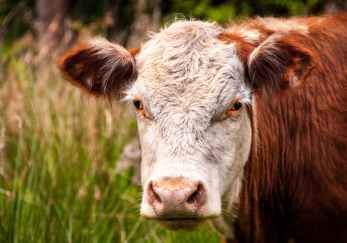
close up photo of white and brown cattle
Photo by James Wheeler on Pexels.com

The “Cow/Calf College” will begin at 10:00 a.m. with a welcome by Dr. Mark Boggess of USMARC and Dr. Dale Grotelueschen, Director of the Great Plains Veterinary Education Center. Mary Drewnoski, Nebraska Extension Beef Systems Specialist will kick off the presentations with “To Graze or Not to Graze?  Factors that Affect Risk Nitrate Toxicity in Annual Forages”.  Mary is a cattle nutritionist with expertise in growing calf and cow nutrition, currently focusing on use of cover crops and crop residues as forage sources.

Rick Funston, Nebraska Extension Reproductive Physiologist will present “Increasing Production Efficiency”. Rick has been honored for his beef and heifer management work and has helped provide ranchers new market options and reduced feed costs. He has been a leader in the concept of fetal programming, a concept in the livestock industry based on the notion that the nutrient status of gestating cows has various long-term implications on their offspring.

Lunch is provided and will be handled with a rotation system featuring a session on: “Family Farm Stress” from Nebraska Extension Educator, Brandy VanDeWalle. As margins continue to tighten, there is an additional amount of stress on producers and their families. Strategies for handling stress and open communication among family members is important to address.  

The afternoon session will start with Amy Schmidt, Associate Professor with Biological Systems Engineering and Animal Science with “Top 3 Environmental Considerations During Short-Term Cow-Calf Confinement”. Amy’s extension interests include manure management, nutrient management and water quality. Her areas of research and professional interest include nutrients fate and transport, pathogen fate and transport and water quality.Logo

Dr. Kip Lukasiewicz, Production Animal Consultation will lead you through “Animal Husbandry Strategies to Improve One’s Efficiency”.  Back by popular demand, Dr. Kip is sure to entertain you while being right on target to address some of critical information on cattle health, antibiotic use and also inform participants on effective animal husbandry and stockmanship techniques. Dr. Kip spends his days working with farmers and ranchers and teaches people to better understand our animals.

All presenters will then pull everything together, give their final thoughts and considerations and provide a coffee-shop style panel discussion during which cattlemen can ask questions and get answers on questions that came to them during the day’s sessions. A chance for door prizes will be awarded to those that stay for the entire event.

Preregistration is preferred by January 8th, to the Nebraska Extension Office in Fillmore County or call (402) 759-3712 to assure a seat and lunch. Walk-ins are accepted, but may not get a lunch. You may also complete your registration online on fillmore.unl.edu or http://go.unl.edu/farmersrancherscollege.  Remember, your contact information is required to be on the U.S. MARC property, so pre-registration is helpful and will save you time at the door!