Crops, Livestock, Programming

Farmers & Ranchers College

frcollege-logo-front-panel

The Farmers & Ranchers College was formed in January 2000 with the purpose of providing high quality, dynamic, up to date educational workshops for area agricultural producers in south central Nebraska through a collaborative effort between business, industry and higher education leaders. Furthermore, the Farmers & Ranchers College will provide the tools necessary so that agricultural producers will be able to respond positively to these changes using a profitable decision making process.

The Farmers and Ranchers College is a unique opportunity to educate agricultural producers in south central Nebraska. Approximately four hundred producers participated in the 2016-17 Farmers & Ranchers College programs. Producers attending these workshops managed over 170,500 acres. Participants surveyed indicated an average of $18.00/acre of knowledge gained from participating for a potential impact of $3 million.

IMG_7242.jpgThe sixteenth annual Partners in Progress- Beef Seminar featured a variety of industry, University and agricultural organization presenters. Participants managed over 8,500 head of cattle and indicated that on average the information presented will increase their profitability $17.50/head with a total potential impact of nearly $150,000.

Contributions and support of area businesses allow participants to attend at no cost, however for programs that have meals, it is requested that people RSVP at least a week in advance for an accurate meal count by calling Fillmore County Extension at (402) 759-3712.

The Farmers and Ranchers College Committee consists of Fred Bruning of Bruning, Bryan Dohrman of Grafton, Sarah Miller of Carleton, Jennifer Engle of Fairmont, Ryne Norton of York, Jim Donovan of Geneva, Bryce Kassik of Geneva, Eric Kamler of Geneva, and Brandy VanDeWalle of Ohiowa.

2017-18 Program Schedule:

December 7, 2017 – “Positioning for Success in the Economic Reset”” w/ Dr. David Kohl, Professor Emeritus, Dept. of AAEC, VA TECH at the Opera House in Bruning, NE from 1-4:00 pm

January 30, 2017** – “Partners In Progress Beef Seminar” Cow/Calf College at U.S. MARC near Clay Center, NE from 10-3:30 a.m., Registration at 9:30

February 23, 2017** – “Crop Insurance, Farm Bill Policy Update & More!” with Steve Johnson from Iowa State Extension and Brad Lubben, Nebraska Extension at  the Fillmore Co. Fairgrounds- Geneva, NE from 10- 3:00 p.m.,Registration at 9:30 a.m.

 ** Programs are free; however registration is appreciated for a meal count. Please call the Fillmore Co. Extension Office at (402) 759-3712 one-week prior to the program to reserve your spot.
Livestock, Programming

Cow-calf Management with Limited Pasture

Grazing Cover Crop Field Day.jpgIn a joint effort, Kansas and Nebraska Extension are hosting a 3-meeting series to address some possible options to help maintain cattle inventory with limited perennial pastures. Topics at these meeting will include confined cow feeding and management, usage of corn residue, cover crops and annual forages systems. All of the programs will start at 6:30 p.m. and the ones for us will be held on December 12, 2017 at the Helvering Center in Marysville, KS. Please RSVP to Anastasia Johnson at anastasia@ksu.edu or 785-562-3531. The second meeting will be held December 13, 2017 at the Blue Hill Community Center  in Blue Hill, NE. To attend, please RSVP to Brad Schick, brad.schick@unl.edu or 402-746-3417.

Dinner will be provided and there is no cost to attend; however please RSVP to the respective contacts by December 8, 2017 for an accurate meal count. Speakers for the event include extension specialists from Kansas State University and University of Nebraska.

Dr. Mary Drewnoski is a Beef Specialist with UNL based in Lincoln. She will be speaking about “Thinking outside the box: economical forage options”. Drewnoski is part of an interdisciplinary team evaluating Economical Systems for Integrated Crop and Livestock Production in Nebraska.

Dr. Jaymelynn Farney, Beef Systems Specialist with Kansas State University, will discuss “The dos and don’ts of cover crop (annual forages) grazing – from a livestock perspective”. Farney is housed in the Southeast Research and Extension Center in Parsons, KS where she spends her time working on research and outreach for practical cattle management.

“Confinement cow feeding – the science and the art” is the title of Dr. Karla Jenkins talk. Jenkins is a cow/calf specialist for UNL housed at the Panhandle Research and Extension Center in Scottsbluff, NE. Her research program includes finding more efficient and economical ways to produce beef cattle while sustaining the range resource.

Crops, Livestock, Programming, Youth

Food Label “Quiz”

With the holiday season upon us, many consumers will be preparing food for family and friends. When you go to the grocery store and select food, how well do you really know your food labels?  A survey of over 1,200 Nebraskans was conducted on how people think and feel about their food. Food labels were identified as the major information source by almost 64% of respondents. This work was done as a part of our Consumer Confidence team which works to find ways to inform people about food production. Are you an able food label reader? Do you know the answers to these questions? (Answers at the end of this article.)

Photo Credit: FDA
  1. A label box of cereal starts like this: “Ingredients: Whole wheat, brown sugar, molasses….”
    Which of these ingredients is present in the largest amount by weight in this food? a. Whole wheat      b. Brown sugar    c. Molasses     d. They are present in equal amounts
  2. Two chicken broths are labeled the following: Label 1: Real herbs, real flavor, sodium free chicken bouillon and Label 2: All natural, 100% chicken bouillon
    Which label does NOT have an approved “definition?” 
    a.  Label A     b. Label B
  3. A label says, “best if used by Dec., 27, 2019. Is a “Best If Used By” date a “safety” date?
    a. Yes     b. No
  4. Which of the following foods is “hormone free”?
    a. Meat     b.  Bread      c. Peas      d. None of them are “hormone free”
  5. Which animal is raised with “added” hormones?
    pig and chicken
    Photo Credit: Microsoft Powerpoint icons

    a. Pigs      b. Chicken      c. Both of them      d. Neither of them

  6. If “bananas-A” are labeled “GMO-Free” and “bananas-B” have no GMO labeling, which is a TRUE statement?
    a. Bananas-B are a GMO food      b. Neither of them are GMO foods       c. It’s impossible to tell if bananas-B are a GMO food

CHECK YOUR ANSWERS:

  1. a. Whole wheat. Ingredients are listed by their common or usual name in descending order by weight. For example: If “whole wheat” is listed first, that ingredient is found in the largest amount by weight in the product. The ingredient listed last contributes the least amount by weight.
  2. b. Label B. Currently, the U.S. Food and Drug Administration has not developed a definition for use of the term “natural.”
  3. a. No. A “Best If Used By” date describes product quality, where the product may not taste or perform as expected but is safe to use or consume.
  4. d. None of them are “hormone free.” Anything that is or has been alive contains hormones, including plants. There is no such thing as “hormone free” meat or animal product.
  5. d. Neither of them. Added hormones aren’t allowed by the U.S. Department of Agriculture in pork and poultry. A claim of “no hormones added” on pork or poultry must be followed by the statement, “Federal regulations prohibit the use of hormones.”  Be aware, the claim of “no hormones added” may be in much larger letters than the statement saying the use of hormones is prohibited.
  6. b. Neither of them are GMO foods. In today’s market place, you may find foods promoted as “GMO free” or “contains no GMOs.” Before you pay extra for this food, be aware it may not be made with any ingredients that contain GMOs in the first place. In other words, the same type of food without that label may also be free of GMO ingredients.

Neither banana is a GMO food and never has been! GMO foods currently available in the United States are: Corn (field and sweet), Soybeans, Cotton, Canola, Alfalfa, Sugar beets, Papaya (Hawaiian), Squash

NOTE: Not all versions of all these foods are genetically engineered. Artic apples will be available in some areas by 2017. Before being placed on the market, genetically modified foods must be approved by the U.S. Food and Drug Administration, the U.S. Department of Agriculture and the Environmental Protection Agency.

For more information or to view a self-paced slideshow on labeling, go to UNL’s food webpage.  

Crops, Irrigation, Programming

On-Farm Research

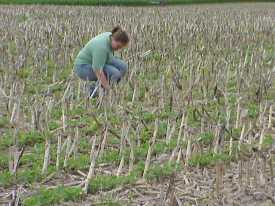
Nebraska Extension has a long history in on-farm research. In 1989, twenty Saunders County producers came together through Nebraska Extension to form the Nebraska Soybean and Feed Grains Profitability Project. This group began doing randomized, replicated research to answer questions that impacted the profitability of their farming operation. Due to the original group’s success, the idea spread to surrounding counties and in 1998 the Quad Counties research group was formed in Clay, Fillmore, Hamilton, and York Counties in south central Nebraska. Extension Educators and Specialists worked with 20 farmers to produce reliable, unbiased research. The Nebraska On-Farm Research Network builds upon the success of these two organizations, expanding on-farm research to a state-wide effort in 2012.SoybeanPopCount.JPG

On-Farm Research Brainstorming/Discussion Session:  You hear and read about various production practices and products that work for other farmers.  You may have questions regarding a specific practice or product working on your farm.  On-farm research is a way to answer this for yourself!  In the past, our area on-farm research cooperators met before the growing season to brainstorm ideas and discuss potential research topics together.  We are resurrecting this brainstorming/discussion session with it to be held on Monday, November 27th from 1:00-4:00 p.m. at the Fairgrounds (4-H Building) in Aurora.  We encourage farmers who have conducted on-farm research in the past or are considering/interested in on-farm research in the future to attend.  If you’re interested in attending, please RSVP to Steve Melvin at steve.melvin@unl.edu or Jenny Rees at jrees2@unl.edu.

Horticulture, Programming

Tree Grant

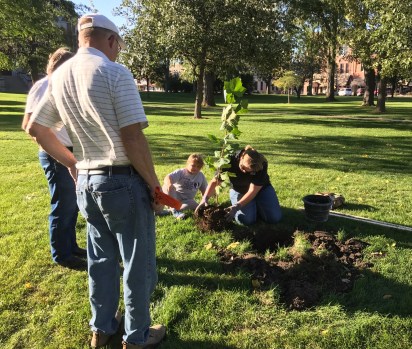
img_0203.jpgNebraska Extension- Fillmore County received a grant for ten free trees through the ReTree Nebraska program. This grant was funded by Trees for Nebraska Towns and the Sustainable Schoolyard Partnership programs by the Nebraska Statewide Arboretum and the Nebraska Environmental Trust and the Nebraska Forest Service’s Community Marketing of Trees grant funded by the U.S. Forest Service. As part of the grant, educational outreach to increase public awareness of the benefits of trees and proper tree care was done with a workshop conducted by Nicole Stoner, horticulture extension educator in which I assisted. Seven trees were planted at the courthouse lawn and three trees were planted at the Extension Office and Fillmore County East Building.

Horticulture, Programming

Tree Planting & Care Workshop

2017-10-06_1323

Need a new tree in your landscape? Then come to the tree planting workshop to learn how to properly plant it. Planting a Tree is essential to the life and health of the tree. Nebraska Extension Educator Nicole Stoner, from Gage County Extension will give a hands-on presentation of proper tree planting. The workshop will be held at 5:00 pm on Thursday, October 12th at the Fillmore County Courthouse in Geneva. Ten trees were donated to Fillmore County Extension from ReTree Nebraska to help renew the trees at the Courthouse and Extension Office. We will be planting these 10 trees at the workshop. The workshop will cover how to properly plant a tree, staking needs and methods, and general management for newly planted and established trees including watering, mulching, and winter protection. Registration is not required and the program is free.

If you have any additional questions you can contact Nicole Stoner at Gage County Extension (402)223-1384 or by email at nstoner2@unl.edu

Programming, Youth

State Fair Update

StateFairWebsite
Check out the State Fair website for the entire schedule!

The 148th Nebraska State Fair is underway and will run through Sept. 4 in Grand Island.  and celebrate the people, products and talent of the state. Thousands of youth who participate in Nebraska 4-H – sponsored by Nebraska Extension will share what they’ve learned throughout the year. Note this year some of the grand marshals in the parades are from our area. On Aug. 31, Dick and Deb Hoarty from Fillmore County will be serving as Grand Marshals. Deb is a long-time Fillmore County Fair Board member. Dewey Lienemann is the grand marshal for the Sept. 1st parade. Dewey is a long-time educator, both as an ag teacher and extension educator in Webster County. Congratulations to these local folks!

The static exhibits are already judged and on display. To review state fair results, go to http://www.nebraska4hresults.com/. Congratulations to all of the youth for the fine job they did with their exhibits! Good luck to all of the animal exhibitors Labor Day weekend!

Visitors can download the 4-H at Nebraska State Fair app to keep track of events, results and exhibit maps. The app can also be used to play the Seek and Scan game, which allows visitors to scan symbols on signs next to static exhibits to display videos.

For more information on the Nebraska State Fair, including schedules, visit http://4h.unl.edu or http://statefair.org.

Crops, Livestock, Uncategorized

Ag Land Management, Back to the Basics

Anyone who owns or leases farm ground or leases it to someone else will want to attend this day-long seminar providing information and education about that ownership.  Learn management strategies for this asset by attending this seminarnature-field-sun-agriculture.jpg at the Adams County Fairgrounds, 947 S. Baltimore Ave, Hastings, NE. The event will be held Thursday, August 31st with registration starting at 9:00 a.m., program starting at 9:30 and ending around 3:00 p.m.

Participants can use this seminar to learn about: Am I keeping the farm, or selling it? How do I manage a farm? If leasing, what are key lease provisions?  What legal considerations do I have with this decision? And, how do we manage family communications and expectations when other family is involved? What does a soil test tell me?  I hear about organic or natural production; how does that vary from what my farmer is currently doing?  If corn and soybeans aren’t making money why don’t we raise other crops? What should I expect for communications between the landlord and tenant?  What are key pasture leasing considerations?money bag.jpg

“I am contacted monthly from citizens who have had their parents pass away, and now they are managing a farm for the first time in their lives,” said Allan Vyhnalek, Extension Educator and event speaker.  “They may have even grown up there, but haven’t been around for 30 or 40 years, and need to understand that farming practices and management concepts have changed,” Vyhnalek continued.

The workshop is designed to provide primer education for those that haven’t been on the farm much, or on the farm much recently.  It is also designed to be a refresher course for those that would like to have the latest information on land management and rental.

Pre-registration is requested by Monday, August 28, 2017.  Registration fee is $20 per person or $30 per couple.  The fee covers handouts, refreshments and lunch.  Contact Twila Bankson at the Adams County Extension Office, P.O. Box 30, Hastings, NE 68901, twila.bankson@unl.edu, or 402-461-7209 to register.

The program is being provided by Allan Vyhnalek, Aaron Nygren, and Jim Jansen, Extension Educators from Nebraska Extension.  They provide the farm land management and agronomy education in eastern Nebraska.

Horticulture, Programming

Butterflies

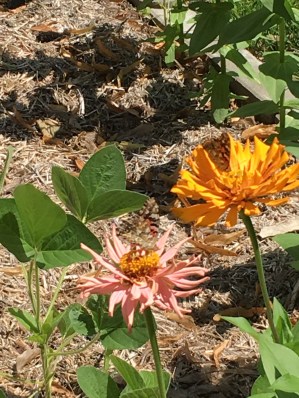
IMG_8962.jpgThe office has received numerous questions regarding the abundance of butterflies (most of what I’ve seen are Painted Lady butterflies) in the area.  An extension entomologist told me the following: “It is hard to pinpoint reasons these insects survive and flourish better in one year over another.  Painted Lady butterflies overwinter in southern areas of the country and migrate north in the spring.  They have a broad food host range which includes thistle plants.  If any of these food sources are abundant, the weather is favorable and natural enemy populations are minimal, the butterflies can grow and develop quite successfully.  This results in the high population that we are seeing now.” Hopefully this answers questions you might have. Butterfly information can be found at http://lancaster.unl.edu/pest/butterflies.shtml.