Recently I participated in an Engage workshop taught by the Center for Food Integrity. The overall goal of the workshop is to help those involved in the food production system engage with others of differing opinions, specifically those issues which can be controversial or sensitive in nature. Consumers are asking more questions now than ever regarding their food, including how it is produced.
In order to achieve this, we must first embrace consumers’ concerns and realize their concerns are real. Once we are able to recognize their concern, we should find what shared values we have. By finding a “common ground”, it is easier to establish a connection with that person and have a friendly conversation. Once you are able to see where that person is coming from and you share information about yourself, it is easier to start a conversation. It is important that you are committed to having a conversation and not just educate, defend or correct any misinformation that person might have. Keep your emotions in check; these conversations are important, but they may get uncomfortable.
The Center for Food Integrity provides three steps to have tough conversations. Following Stephen Covey’s, “Seek first to understand, then be understood” is important. The first step is to actively listen to the person, don’t interrupt or judge – rather try and understand where their concerns are coming from and what they value. Then ask questions to invite dialogue and clarify their perspective. In other words, acknowledge their concern; this shows you have heard them. Then ask questions that show you are trying to understand them better. The third step is to share your information. Focus on topics that you both agree on and then have a conversation guided by your values and sharing facts that guide your decisions. While you may both still disagree, recognize that is okay. It is important not to become defensive and admit when you don’t know an answer to their question. If we are to build trust among consumers, we must be transparent.
Other conversation from this workshop when discussing sensitive issues with consumers is to acknowledge that nothing is ever without fault. For example, while the pros might outweigh the cons of a particular food production system, recognize it is not perfect. The training provided an example how to start a conversation with a consumer concerned about animal care and modern farming. It might go like this:
“It is very disturbing to see a video of animal abuse. Animal abuse of any kind is never acceptable and those responsible should be held accountable. I assure you that animal care is a top priority for me and all of the farmers I know. While today’s farms look different than those of the 1950’s, technology allows us to take better care of our animals now than ever before.” This is allowing you to share your values with the person by letting them know you care about animals and an overwhelming majority of farmers do too. You are relating to the individual on a personal basis. Then it is okay to provide information or facts, but follow the KISS principle (Keep It Simple Stupid). Sharing too much technical information may confuse the person even more. In our example you could say, “We house our animals in climate-controlled buildings where they’re protected from the elements and where we can closely monitor their feed, water and health.” If we use the word, “rations” they might not know what we are talking about. Everyone can relate to feed or food.
Other tips for having successful conversations:
- Enter the conversation with an open mind.
- Admit when you don’t know.
- Be yourself and share your story.
- Know when to disengage.
- Foster a relationship or offer to connect with them beyond your initial conversation and offer them resources.
In conclusion, today it seems we have gone from a world of being able to compromise and accept differences in opinions to a culture of placing blame on others and seeking to “be right” and ostracize others when they don’t agree with us. That will only cause more divide among us. While it takes time and practice having these delicate conversations, the more we positively engage with consumers the better they will understand agriculture’s story. And to feed our rapidly growing population, it will take all types of production systems – conventional vs. organic farms and genetically modified crops vs. non-genetically modified crops.
 The Farmers & Ranchers College was formed in January 2000 with the purpose of providing high quality, dynamic, up to date educational workshops for area agricultural producers in south central Nebraska through a collaborative effort between business, industry and higher education leaders. Furthermore, the


 Growers, crop consultants and educators are encouraged to attend Nebraska Extension’s Weed Management Field Day from 8 a.m. to 1 p.m. June 29 at the South Central Agricultural Laboratory near Clay Center. The field day will include on-site demonstrations of new technology and new herbicides for corn, soybean and sorghum. An early morning tour will focus on weed management in soybeans followed by a tour of weed management in corn and sorghum. Field experiments will provide information for weed control options using several herbicide programs.
 Growers, crop consultants and educators interested in management of herbicide-resistant Palmer amaranth are encouraged to attend Nebraska Extension’s Field Day, supported by the Nebraska Corn Board, from 8:30 a.m. to 1:30 p.m. July 12 near Shickley. Palmer amaranth is a member of the pigweed family and is one of the most troublesome weeds in seed cornfields because of its resistance to atrazine and HPPD inhibitors. Greenhouse dose-response studies have confirmed resistance when atrazine and HPPD inhibitors were applied post-emergence. Palmer amaranth is of particular concern in south-central Nebraska because of its proximity to intense seed corn production, which is heavily reliant on these herbicides for weed.



 This list will continue to evolve over time as issues change, but currently consist of: Insect ecosystems (including pollinators), healthy lifestyles for children and youth, resistant & invasive pests, Nebraska leaders, college & career success, engaging underserved youth, climate variation, consumer confidence in food, children learning experiences, emerging technology for agriculture, efficient water use, ag producer economic viability, livable communities, STEM careers, water & soil protection, youth entrepreneurship food access and diversified ag production.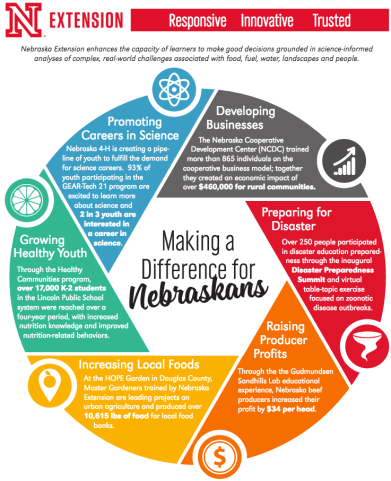

 Views from VanDeWalle