Crops, Livestock

Characteristics of a Successful Producer

A new year often brings a sense of hope for new opportunities and bright beginnings. For many Nebraskans, the year 2019 brought many challenges and hardships so a new year is welcomed. Last month, the Farmers & Ranchers College conducted a program with Dr. David Kohl titled “Agriculture Today: It Is What It Is… What Should We Do About It”. He provided many insights on key economic indicators that will impact agriculture. What I also appreciate about his message is how he points out key characteristics of what makes a farm or ranch successful. Goal setting is so important and also so under-utilized. I’ve heard and presented the importance of goal setting for years and it was refreshing to hear him emphasize some key points. Dr. Kohl pointed out that 80% of Americans don’t have any goals and of those who have goals, 4% that have written goals obtain more money and success than others who do not write their goals down.

marketing school business idea
Photo by Gerd Altmann on Pexels.com

In any business, it is important to be proactive rather than reactive. Those who pre-market their grain are generally more successful than those who do not. Kohl mentioned that the culture of a workplace or farm is also important. Many leadership development speakers and researchers emphasize the importance of culture in the workplace. For example, in her book, Dare to Lead, Brene Brown points out the importance of a daring leader to cultivate a culture of belonging, inclusivity and diverse perspectives. She states that, “Only when diverse perspectives are included, respected and valued can we start to get a full picture of the world: who we serve, what they need and how to successfully met people where they are.” For years, Dr. Kohl has pointed out that farmers and ranchers need their own advisory board that involves people who will challenge you and differ from your thinking. If we only hear from people who always agree with us, you won’t be challenged to improve your operation.

With a passion for leadership development, I appreciated Dr. Kohl’s message that interpersonal skills will continue to be critically important. He also noted the importance of having a positive attitude and the need to invest as much in human capital as in technology. Effective communication and being able to interpret data with critical thinking skills are also critically important for the future generation.

Finally, I’ve leave you with a checklist of business IQ management factors and critical questions for crucial conversations that Dr. Kohl has created. In the checklist, the most successful producers have the following written down: cost of production, cost of production by enterprise, goals (business, family & personal), record keeping system, projected cash flow, financial sensitivity analysis and understanding financial ratios and break evens. Also, those who regularly work with an advisory team and lender have strong management skills. Successful producers have a marketing plan written and execute it, in addition to a risk management plan. Successful managers have modest lifestyle habits and a family living budget. Progressive businesses also have a written plan for improvement with strong people management, have a transition plan, attend educational seminars such as extension programs and also have a proactive attitude.

For more information about the next Farmers & Ranchers College program which will be the Cow/Calf College on January 28th go to fillmore.unl.edu.

Crops, Horticulture, Irrigation, Livestock, Youth

New Year’s Resolutions

If you are like many nearly half of the American population, you probably have a New Year’s Resolution set for 2020, while 38% of Americans absolutely never make New Year’s Resolution according to research by University of Scranton, 2016. A majority of those resolutions are self-improvement or education related resolutions (47%), weight related (38%), money related (34%) or relationship related (31%).  University of Southern California’s John Monterosso who is an expert on psychology and neuroscience of self-control offers insight on how to achieve setting those resolutions.

pexels-photo-3401900.jpeg
Photo by cottonbro on Pexels.com

Monterosso suggests thinking of a resolution as a special kind of plan and visualizing your future-self. If you have already made that resolution or still working to tweak it, he suggested keeping the following in mind:

  • Failed resolutions are not harmless. Most people don’t like to fail; in fact it hurts our confidence and can actually lead to worse behavior. Keeping this in mind and accepting the fact that one might not have accomplished all that was planned is important. If you get off track, you can always start again and don’t have to wait until a new year.
  • Resolutions work by linking single decisions to a bigger picture. For example, if you have a goal of quitting smoking or eating unhealthy foods and let a craving lead to poor decisions, you might think, “it’s just one cigarette or just one meal of fried foods” which may or may not lead to the continuation of a bad habit. If one takes a resolution seriously, think about the health consequences and the potential “relapse” that could occur.
  • Consider being less ambitious in your resolutions. We tend to be overly confident when making a resolution and think we can change our behavior overnight. While it is good to be confident with your goals, be careful not to make overly ambitious goals. For example, if you plan to work out one hour/day every day of the week and have an already packed life with a career, community obligations and a family, consider starting at 20 minutes/day and work up to more minutes if time allows. Setting a good resolution requires being realistic.
  • Resolutions should not be vague. If you set a resolution of “eating healthier.” What does that mean?  Does it mean drinking 64 oz. of water/day?  Does it mean to include a fruit or vegetable at every meal?  Write down a SMART goal that is Specific, Measurable, Achievable, Realistic, and Time-based.
  • The New Year is a fresh start. Setting resolutions/goals at the first of the year helps us “clean the slate” and put past failures away. It gives us a sense of confidence and optimism. Capitalize on that.
  • Even successful resolutions can be mistakes. If you set restrict your diet to the point of starvation or over-exercise to the point of hurting yourself, you must be able to adapt, know yourself and use common sense and wisdom to correct the resolution.

In summary, Monterosso suggests that done correctly, “resolutions play a role in great human achievements.”

Extension’s Help with Resolutions

As stated above, almost half of resolutions made include education or self-improvement. If you need any educational resources or materials on nearly any subject, Extension has resources. Whether it is information on a website, talking with an extension professional, utilizing an app from your smart-phone, attending a face-to-face program, participation in a webinar or many other avenues, Extension works to solve complex problems for clients. If you haven’t been to Extension’s website recently, I encourage you to go to extension.unl.edu. There you will find an abundance of resources on topics such as food, nutrition and health, cropping & water systems, community vitality, community environment, learning child, beef systems and 4-H youth development. Consider attending a program or utilizing a resource to help you achieve a resolution or goal you may have.

For a list of extension programs in the area, visit our website or call our office at (402) 759-3712.

Uncategorized

New Year’s Resolutions

If you are like many nearly half of the American population, you probably have a New Year’s Resolution set for 2020, while 38% of Americans absolutely never make New Year’s Resolution according to research by University of Scranton, 2016. A majority of those resolutions are self-improvement or education related resolutions (47%), weight related (38%), money related (34%) or relationship related (31%).  University of Southern California’s John Monterosso who is an expert on psychology and neuroscience of self-control offers insight on how to achieve setting those resolutions.

Monterosso suggests thinking of a resolution as a special kind of plan and visualizing your future-self. If you have already made that resolution or still working to tweak it, he suggested keeping the following in mind:

Photo by Oleg Zaicev on Pexels.com
  • Failed resolutions are not harmless. Most people don’t like to fail; in fact, it hurts our confidence and can actually lead to worse behavior. Keeping this in mind and accepting the fact that one might not have accomplished all that was planned is important. If you get off track, you can always start again and don’t have to wait until a new year.
  • Resolutions work by linking single decisions to a bigger picture. For example, if you have a goal of quitting smoking or eating unhealthy foods and let a craving lead to poor decisions, you might think, “it’s just one cigarette or just one meal of fried foods” which may or may not lead to the continuation of a bad habit. If one takes a resolution seriously, think about the health consequences and the potential “relapse” that could occur.
  • Consider being less ambitious in your resolutions. We tend to be overly confident when making a resolution and think we can change our behavior overnight. While it is good to be confident with your goals, be careful not to make overly ambitious goals. For example, if you plan to work out one hour/day every day of the week and have an already packed life with a career, community obligations and a family, consider starting at 20 minutes/day and work up to more minutes if time allows. Setting a good resolution requires being realistic.
  • Resolutions should not be vague. If you set a resolution of “eating healthier.”  What does that mean?  Does it mean drinking 64 oz. of water/day?  Does it mean to include a fruit or vegetable at every meal?  Write down a SMART goal that is Specific, Measurable, Achievable, Realistic, and Time-based.
  • The New Year is a fresh start.Setting resolutions/goals at the first of the year helps us “clean the slate” and put past failures away. It gives us a sense of confidence and optimism. Capitalize on that.
  • Even successful resolutions can be mistakes. If youset restrict your diet to the point of starvation or over-exercise to the point of hurting yourself, you must be able to adapt, know yourself and use common sense and wisdom to correct the resolution.

In summary, Monterosso suggests that done correctly, “resolutions play a role in great human achievements.”

Extension’s Help with Resolutions

As stated above, almost half of resolutions made include education or self-improvement. If you need any educational resources or materials on nearly any subject, Extension has resources. Whether it is information on a website, talking with an extension professional, utilizing an app from your smart phone, attending a face-to-face program, participation in a webinar or many other avenues, Extension works to solve complex problems for clients. If you haven’t been to Extension’s website recently, I encourage you to go to extension.unl.edu. There you will find an abundance of resources on topics such as food, nutrition and health, cropping & water systems, community vitality, community environment, learning child, beef systems and 4-H youth development. Consider attending a program or utilizing a resource to help you achieve a resolution or goal you may have.

For a list of extension programs in the area, visit our website at fillmore.unl.edu or call our office at (402) 759-3712.

Crops, Irrigation, Livestock, Programming

Managing Stress During the Holidays

I love the holiday season! It is a great time for getting together with friends and family and a time to reflect on the year. Holiday baking, looking at Christmas lights, and showing appreciation to those in your life by giving gifts are just a few of the many things I enjoy.  While I enjoy many things and truly do love the holiday season, it can also be a stressful time. Situations may be challenging, especially if there are increased financial stressors.

selective focus photography of ceramic mug near candy cane
Photo by fotografierende on Pexels.com

For farm and ranch families, the stress is also very real – someone still has to break the ice and feed the livestock, manage financial recordkeeping, tax preparation, evaluate crop yields, and plan for the next growing season; there is lots to do. The downturn in the agricultural economy and weather-related disasters have only compounded the stress many agriculturalists have had to endure. This can make one’s situation seem hopeless. My colleague, Holly Hatton-Bowers shared an article that pointed out the American Psychological Association found that in the US people tend to feel more stressed around the holidays.

Before you become dragged down by negative feelings and stress, try to sprinkle your winter holiday with these seven tips compiled by my colleague, Dr. Holly Hatton Bowers. Doing these practices may help you manage your stress and even find some moments of joy during the holidays.

  1. Challenge Your Thinking – Often when we are faced with challenges, failures or even criticism, we begin to tell ourselves stories that lead to more stress. It can be helpful to ask yourself, “Is this True?” “Am I being Kind to Myself?” “What can I learn from this experience?” It can also be helpful to remember that feelings come and go. Acknowledge your feelings and also take note that they are not here to stay.
  2. Set Your Intentions to Eat for Gains, Sleep, and Move – During the Winter Holidays, many of us take joy in eating sweet, sugary and fatty foods. Sometimes our family and friends bake our favorite pies and cookies. Enjoy these foods in small amounts and also be intentional in eating foods that give you energy or a “net gain” for your wellbeing. Before drinking that next sugar filled coffee or soda, choose water. Choose a side of vegetables instead of French fries. It’s is also important to not skip meals which can lead to headaches, draining your energy and lead to you feeling more down. Set your intentions to get sleep. Turn-off technology an hour before bedtime and wake up at the same time each morning. Finally, set your intention to move your body. It is recommended to move your body every 20 minutes for at least two minutes.
  3. Reach Out and Connect with Your Support System– If you are feeling lonely, sad, or overwhelmed, you are not alone. Sometimes we need a friend or family member to listen or offer us support and help. Expressing your thoughts and feelings with those you trust may be helpful and deepen your relationships. Plan for difficult days by having an activity planned or by checking in with a relative or close friend. If you are having a lot of difficulty, reach out to a mental health expert. If you are feeling very isolated and having serious thoughts of self-harm or suicide call the National Suicide Prevention Lifeline at 1-800-273-8255.
  4. Plan and Budget Expenses – It may feel daunting to stick to a reasonable budget during the holidays. In the moment you may think, I can just charge this and pay it later. Often these impulsive buys can lead to more stress later. Miriam Caldwell in her “Get Tips on Making and Sticking to a Holiday Budget” suggests listing out your holiday expenses, stick to a spending limit, and making a shopping list so that you are less likely to overspend.
  5. Embrace the Messy – At time we may have expectations for how events and activities will go. We plan celebrations and expect them to be filled with complete joy and fun. Often these expectations may not go as planned. Let go and be ok when this happens. Stop and breathe. It can be helpful to breathe in for a count of 5 and breathe out for a count of 7. Practice this breathing a few times and then tell yourself to embrace the mess.
  6. Create a To-Do or a Done List – Write down four things you can accomplish and do it! If a to-do list sounds stressful, then try a DONE list. Write down the things that you have accomplished today.
  7. Cultivate Gratitude – Practicing gratitude can help you de-stress by focusing on what you have, and what you value. Make a list of 5 things/people/experiences you are grateful for.

What will you do to combat your stress during the Winter Holidays? Take time to be present and find ways to intentionally create holiday experiences that are less stressful and a little more pleasant and meaningful.

Programming

Keeping Stress Levels in Check

The holidays are a wonderful time of year. It’s a time of year to reflect on the many blessings in our life and reconnect with family members. It can also be a time of year to trigger many stressors and create anxiety for those dealing with added stress. For that reason, my colleague, Glennis and I have decided to provide a webinar for anyone in agriculture dealing with some extra stress this holiday season.nebraska extension12.17.19web

Farmers and ranchers have many stressors in their lives. Weather challenges and disasters like many Nebraskans have recently experienced have led to uncertainty in their crop and livestock operations. Machinery breakdowns, debt loads, volatile markets, sleep deprivation, changing regulations, and the stress of holding onto a multi-generational farm/ranch all play a part of the stress and mental health of a farmer or rancher. Farmers and ranchers know the importance of planning and talking about their financial health to bankers, financial planners, spouses, etc. but might not realize how important it is to spend time on their mental health.

A free webinar will be offered December 17 via the web for farm and ranch families.  The webinar will take place over the noon hour (12:30 p.m. CST) and can be accessed at go.unl.edu/stresswebinar.  “Keeping stress levels in check” will be presented by Nebraska Extension Educators Glennis McClure and Brandy VanDeWalle starting at 12:30 p.m. (CST). This free webinar is available for farm and ranch families to participate and will provide strategies for dealing with the stress of farming or ranching in today’s difficult economic environment.

Participants will learn: How to recognize the signs and symptoms of stress; understand the role stress plays in our lives; and strategies and resources to manage stress.

For more information, contact Brandy VanDeWalle at brandy.vandewalle@unl.edu or (402)759-3712.

A separate workshop available to agribusiness professionals and service providers working with farmers and ranchers titled, Communicating with Farmers Under Stress can also be taught face-to-face. For more information on this workshop contact Glennis McClure at gmcclure3@unl.edu or (402) 472-0661.

Horticulture

Holiday Greenery and Trees 

Deciding on an artificial versus real Christmas tree is a matter of personal preference. Growing up, we had an artificial tree mostly because my mom’s allergies were very sensitive to the smell of pines and our house was pretty small so having a small tree we knew would fit in our dining room was preferred. We did however one year have a pine tree that we cut out of our windbreak that needed to come down and I remember how big, beautiful and magical it was!  There are pros to cons for both. If you decide to go real, here are some tips to help you.

green christmas tree with string lights
Photo by Kristina Paukshtite on Pexels.com

Popular Christmas tree species include Frasier Fire, Balsam Fire, Douglas Fir, Scotch Pine, Black Hills Spruce (White Spruce variant) and Eastern White Pine. Firs have a strong and pleasant smell most people enjoy while spruces have a strong odor but many folks do not find it as pleasant. Also look at the needle sizes and branch strength depending on what type of ornaments you will place on the tree. Firs usually have short needles and strong branches, while pines often bend with the weight of heavy ornaments.

Once you make your tree selection, clean it thoroughly from needles lodged among the branches. Make a fresh straight cut across the trunk about an inch from the original cut which will open the stem for water intake. The Nebraska Christmas Tree Growers Association also recommends to keep the water level above the fresh cut; if the water level drops below the fresh cut a seal will form as it does on fresh flowers and a new cut will be necessary.  When purchasing a tree, you can drive to a “Choose and Cut” Tree Farm and pick out your own tree, or many retailers also sell them. Just be sure and find one that is fresh. To locate a “Choose and Cut” tree farm, the Nebraska Department of Agriculture’s website has a list of locations to choose.

If you don’t want a real tree, you can also make or purchase your own greenery from your own landscape. Nicole Stoner, extension horticulturist wrote a blog on “Holiday Plants” and provided suggestions for using greenery to bring a nice holiday scent inside the home. White pine, juniper, spruce, ivy and holly are all great choices of live greenery for your home this holiday season. You can take these directly from your landscape, just be careful when you prune these decorations off of your living plants. Don’t make all of cuts in the same location and try to make them far enough back in the plant that the other branches cover the cuts. Use a hand pruner to make good cuts that will not harm your tree or shrub. These can then be used in swags or wreaths. Several years ago, I even participated in a workshop that took real branches to make outdoor arrangements in pots when watered well.

Uncategorized, Youth

Happy Thanksgiving!

Let’s talk about the Thanksgiving meal, include some facts about Thanksgiving and examine reasons to be thankful. First of all, according to the USDA, about $670 million is the monetary value of turkeys consumed for Thanksgiving every year which is based on an estimated 46 million turkeys and 92 cent-per-pound. On average, it costs about $50 for a 10-person Thanksgiving meal. Included in the $50 meal is the turkey, bread stuffing, sweet potatoes, rolls with butter, peas, cranberries, a relish tray of carrots and celery, pumpkin pie with whipped cream and beverages of coffee and milk (Source: American Farm Bureau).  You can thank our American farmers and ranchers who are able to provide us the bounty of safe and affordable food we are able to consume.

2_thanksgiving_digital.jpgNow let’s talk trivia:

Q: Why are turkeys raised?   A: Because of their excellent quality of meat and eggs

Q: What is a male turkey called?  A:  Tom

Q: What is a female turkey called?  A:  A Hen

Q: What sound do turkeys make?  A: Only tom turkeys gobble; the female makes a clucking sound.

Q: How many feathers does a turkey have at maturity?  A:  3,500 feathers

Q: How long does it take a turkey to reach market size?   A: Hens usually grow for 16 weeks and is 8-16 lbs. when processed while tom usually takes 19 weeks to reach market weight and weighs 24 lbs. Large toms (24-40 lbs. are a few weeks older.

Regardless of what you do this Thanksgiving, remember to be thankful for what really matters

2_thanksgiving_digital.jpg

Crops, Programming

Landlord/tenant cash rent workshops

Nebraska Extension’s Landlord/Tenant Cash Rent Workshops for 2020 and Beyond will provide the latest leasing, real estate and management information to operators, tenants and landowners in Nebraska this winter.

photography of one us dollar banknotes
Photo by Burst on Pexels.com

The workshop is scheduled in 19 communities throughout the state, between Dec. 6, 2019, and March 18, 2020.

Extension educators Austin Duerfeldt, Jim Jansen and Allan Vyhnalek, all working in the Department of Agricultural Economics, have collaborated to develop a program that will address agricultural finance and the real estate market, negotiation skills and considerations for leases and strategies for farmland succession and communication.

“Austin, Jim and I have put together an excellent set of topics and have completely rewritten our land management curriculum for this set of workshops,” said Vyhnalek. “We encourage both landowners and farmers to attend to hear about land management in the next decade.

For the purpose of this column, I have included the workshops closest to us, including York and Clay Center. Registration for the free workshop is requested to ensure enough materials are available. Updated information is available at farm.unl.edu.

 Landlord/Tenant Cash Rent Workshops for 2020 and Beyond

Omaha
When: Dec. 17, 2019, 6-9 p.m. at Nebraska Extension in Douglas-Sarpy Counties
Address: 8015 W Center Road, Omaha, NE 68124
Registration: 402-444-7804

 Seward
When: Jan. 7, 2020, 1:30-4:30 p.m. at Nebraska Extension in Seward County office
Address: 322 S. 14th St., Seward, NE 68434
Registration: 402-643-2981

York
When: Jan. 8, 2020, 9 a.m.noon at York County Fairgrounds – 4-H Building
Address: 2345 N. Nebraska Ave., York, NE 68467
Registration: 402-362-5508

Clay Center
When: Jan. 15, 2020, 1-4 p.m. at Clay County Fairgrounds – 4-H Building
Address: 111 W. Fairfield St., Clay Center, NE 68933
Registration: 402-762-3644

Kearney
When: Feb. 24, 2020, 9 a.m.-noon at Nebraska Extension in Buffalo County office
Address: 1400 E. 34th St., Kearney, NE 68847
Registration: 308-236-1235

Programming

Agriculture Today: It is What It Is…What Should We Do About It

Those of us in agriculture are no stranger to risks involved with agriculture that are taken every day, whether it is financial, production, legal, price/market or human resource risks.  While we can’t control everything, there are measures that can be taken to protect one’s operation and reduce risk. Each year the Farmers & Ranchers College hosts Dr. David Kohl, Professor Emeritus from Virginia Tech who does an excellent job describing global risks which affect us locally and how those risks will affect the agricultural industry. Kohl19Flyer.jpg

The agricultural economic down turn is in the seventh year and counting.  Razor thin margins combined with increased volatility is the economic environment that most in the industry are facing.  The result is massive changes in the structure of agriculture and rural communities.  What is the state of the trade agreements and the short and long-term implications to the bottom line?  Where are interest rates, land values, and food trends leading the industry?  How can one adjust strategies and tactics to cope and survive in this environment? One must have the business intelligence and street smarts to be successful.  This session will discuss the assessment of management IQ that often places one in the top third or bottom third of profitability.  What are the financial and business management characteristics that one must focus on in planning, strategizing, executing and monitoring for 2019 and beyond?

This year, Dr. Kohl’s program is titled Agriculture Today: It is What It Is…What Should We Do About It?  The program will start at 1:00 p.m. on December 9, 2019 at the Opera House in Bruning, Nebraska. Contributions and support of area businesses allow participants to attend at no cost. To save time at the door, feel free to register online at go.unl.edu/farmersrancherscollege.

The Farmers and Ranchers College Committee consists of Fred Bruning of Bruning, Bryan Dohrman of Grafton, Sarah Miller of Carleton, Jennifer Engle of Fairmont, Ryne Norton of York, Jim Donovan of Geneva, Bryce Kassik of Geneva, Eric Kamler of Geneva, and Brandy VanDeWalle of Ohiowa.

2019-2020 Program Schedule

  • December 9, 2019 – Agriculture Today: It Is What It Is… What Should We Do About It, Featuring Dr. David Kohl at the Opera House in Bruning, NE from 1-4:00 p.m.
  • January 28, 2020** – “Partners In Progress Beef Seminar” Cow/Calf College at U.S. MARC near Clay Center, NE from 10-3:30 p.m., Registration at 9:30 a.m.
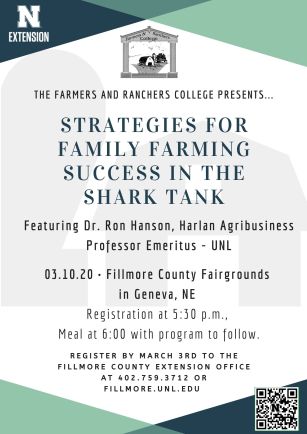
  • March 10, 2020** – “Strategies for Family Farming Success in the Shark Tank” with Dr. Ron Hanson, Harlan Agribusiness Professor Emeritus, UNL at the Fillmore Co. Fairgrounds- Geneva, NE with registration at 5:30 p.m. and the meal at 6:00 with program to follow.

** Programs are free; however registration is appreciated for a meal count. Please call the Fillmore Co. Extension Office at (402) 759-3712 one-week prior to the program to reserve your spot.

Programming

Women Managing Ag Land Conference

There are many women whether by choice or chance who manage agricultural land. For some, it is their livelihood and business. Other women might have inherited land from a family member and there are also women who just want to learn more about the agricultural business in partnership with a spouse or family member. No matter what the circumstance, Nebraska Extension will be providing a program to equip women with necessary management skills.

white laptop female hand note pen phone desk
Photo by Kaboompics .com on Pexels.com

A recent news release came out which shared that any female agriculture landowners, farmers, and ranchers looking to increase their business management skills are encouraged to register for the 2019 Women Managing Agricultural Land conference. The conference will be held Dec. 11 at Nebraska Innovation Campus, 2021 Transformation Drive in Lincoln.

The first-ever Women Managing Agricultural Land Conference will allow women to build relationships with each other, attend workshops and gain valuable knowledge. Three keynote speakers and 12 workshops will focus on helping Nebraska farmland owners and tenants navigate the challenges they face.

Participants will have the opportunity to hear from leading experts in land values, Nebraska property taxes, cash rental rates and cultivating landlord-tenant relationships. Jim Jansen, co-author of the Nebraska Farm Real Estate survey, will discuss trends in Nebraska land values. Mykel Taylor, of Kansas State University, will share resources related to negotiations and communication between landowners and tenants. Cathy Anderson, from the Nebraska USDA Farm Service Agency, will discuss the 2018 Farm Bill and its implications for Nebraska agriculture.

The full conference schedule and registration form are available at https://wia.unl.edu/wmal. A registration fee of $45 per person covers materials, meals, and breaks.

The conference is hosted by Nebraska Extension and is inspired by Annie’s Project. In Nebraska, Annie’s Project is supported by Farm Credit Services of America. For more information about the Women Managing Agriculture Land conference, go to wia.unl.edu.