Uncategorized

Resiliency: What is It?

Resiliency: what is it and why is it important?  In short, resiliency is the “ability to bounce back from challenges or hardships”. According to the Center on the Developing Child from Harvard University, “Reducing the effects of significant adversity on children’s healthy development is essential to the progress and prosperity of any society. Science tells us that some children develop resilience, or the ability to overcome serious hardship, while others do not. Understanding why some children do well despite adverse early experiences is crucial because it can inform more effective policies and programs that help more children reach their full potential.”

According to the Connect with Kids network, adapted from “Project Resilience”, there are

seven attributes that describe ways you can show resiliency when facing challenges. Keep in mind that you – like most people – may show some, but not all, of these attributes/strengths when faced with difficult situations.

  • INSIGHT—Having insight means asking questions of yourself, even when the questions are difficult. If you answer honestly, you can learn and move forward. Having insight helps you understand the problem and how to best solve it. Insight helps you analyze the situation from as many perspectives as you can.
  • INDEPENDENCE—Showing independence means keeping a healthy distance between yourself and other people so you can think things through and do what is best for you. It also means knowing how to step away from people who seem to cause trouble or make things worse by their words or actions.
  • RELATIONSHIPS—Building relationships means finding connections with people that are healthy for both of you and keeping those relationships growing.
  • INITIATIVE—Taking the initiative means taking control of the problem and working to solve it. It means asking questions of yourself and answering them as honestly as you can, so you can move past a sticky situation. Sometimes people who take initiative become the leaders in activities and teamwork.
  • CREATIVITY—Using creativity requires that you use your imagination or resourcefulness to express your feelings, thoughts, and plans in some unique way. Remember that when you make something happen, it shows resiliency of spirit and a positive attitude.
  • HUMOR—Humor is the ability to find something funny (especially yourself!) in a situation, even when things seem bad. Humor often gives you the perspective needed to relieve tension and make a situation better.
  • MORALITY— Being a person of morality means knowing the difference between right and wrong and being willing to choose and stand up for what is right.

In conclusion, it is important for both youth and parents to communicate ways how they can adapt to change, stress or problems and are able to take things in stride. The result of this bouncing back is a feeling of success and confidence.

Uncategorized

Hopeful Purpose

There are many distractions that adults and youth alike face in today’s ever-changing world. Finding something that provides oneself with a sense of purpose and hope can help one stay grounded. Today’s 4-H professionals continue to work in the positive youth development area by helping youth find their spark, which motivates youth to accomplish something and find a purpose in their lives.  

National 4-H used a model, called the 4-H Thriving Model, which has several social, emotional, and cognitive learning pieces that intentionally aim to help youth succeed or thrive. One of the indicators of a successful youth program is providing youth with a sense of “hopeful purpose”.  When youth have a hopeful purpose, they see themselves as being on the way to a happy and successful future.  

Research shows that youth with a sense of purpose are more goal-directed and have increased life satisfaction, better emotional well-being, and great positive affect. To help youth achieve a sense of hopeful purpose, program staff and volunteers should aim first at helping youth identify what interests a youth or “makes them tick”. This is known as a spark. Some youth may know what their spark is right away, while others may need to explore several areas to find their spark. An adult should work to actively facilitate the development of a young person’s spark. This could be done by inviting that youth to a series of workshops, connecting that youth to a mentor, or if appropriate, involving that youth in co-teaching a program.  Adults should encourage, and assist, youth in developing meaningful SMART goals. Following this, a caring adult should coach youth to achieve them. Which, in turn, shows youth a pathway to the future. 

Today’s youth have so much to offer, such as skills, ideas, and resources, which aid in developing future leaders. Some ways you can help facilitate a hopeful purpose in youth include creating youth development programs that empower youth voices and show how they can make a difference; helping youth work on a service project they are passionate about and help them succeed; helping youth identify their unique gifts and talents and courage them to understand how those strengths can be used to make the world a better place.   

In summary, thriving youth have a sense of hope and purpose, and see themselves on the way to a happy and successful future. 
4-H Thrive Model
Uncategorized

Returning to the Farm Program

Recently, I facilitated the “Leaving a Lasting Legacy” program conducted by the Women in Ag program. This four-part series was an eye-opening experience. Kicking off the program were two women in agriculture who both suffered the painful losses of a spouse, leaving them both young widows. This left them both as single parents to raise their children solo and the difficulty navigating all the difficult decisions involved in an agricultural operation. Working through the legality issues of property ownership, having access to accounts and so much more behind more of a burden than most can imagine. The program continued with strategies for creating a succession and transition plan, which are different. Working through family communication and relationship dynamics, decision-making, and understanding steps to take before the loss of a family member occurs were all key factors of the program.      

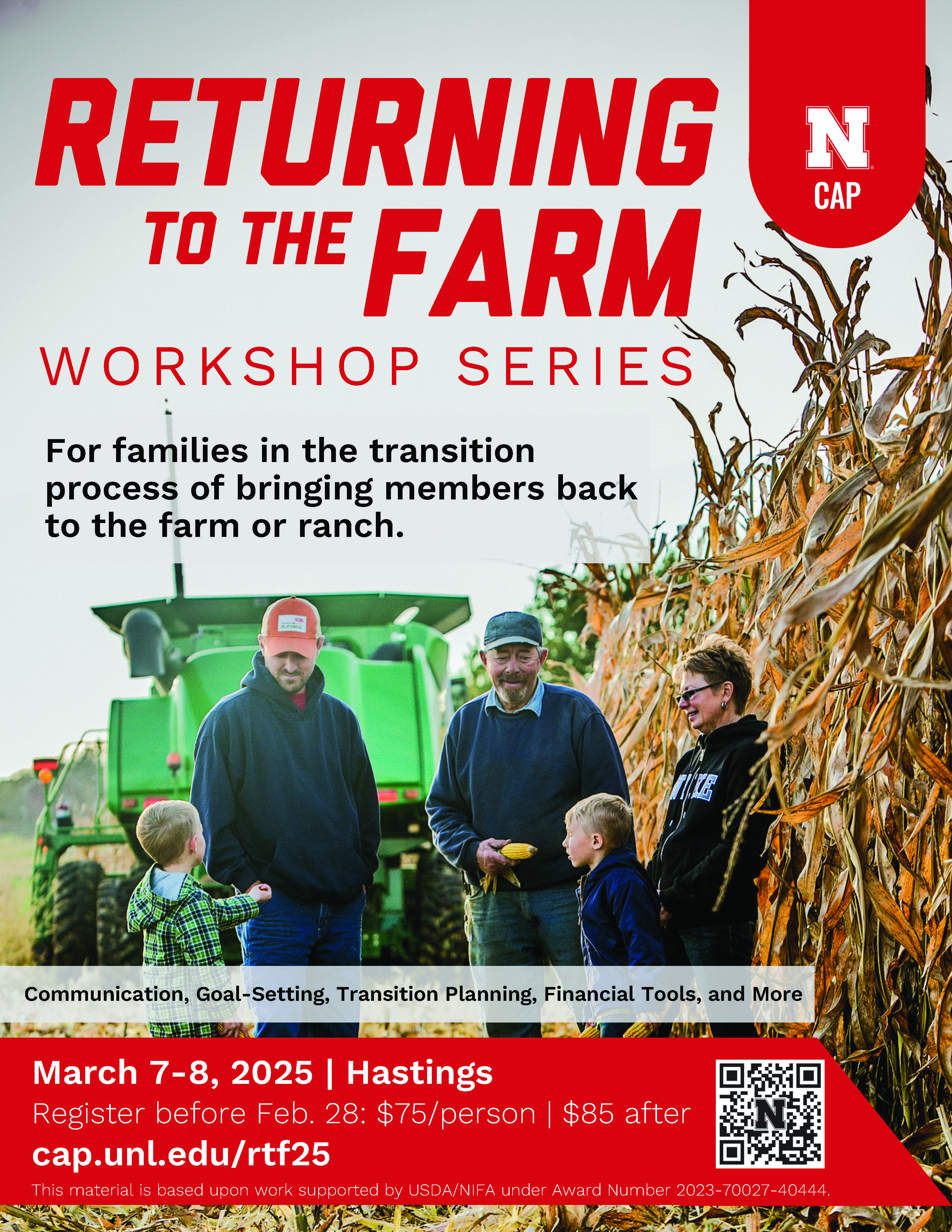
An intense program designed for families to attend together will be coming to Hastings soon which will dig even deeper into the above-mentioned topics. The Center for Agricultural Profitability at the University of Nebraska-Lincoln will present Returning to the Farm 2025, a workshop series for families who are in the transition process of bringing members back to the farm or ranch. It will begin with a two-day workshop for multi-generational families on March 7 and 8, at Central Community College in Hastings. The series also includes two follow-up workshops, to be held virtually after the in-person meetings. 

The series assists families and agricultural operations with developing financial plans and successful working arrangements to meet their unique needs. It will guide families in developing estate and transition plans, setting personal and professional goals, and improving the communication process between family members.

Presenters will include extension experts as well as agribusiness and legal professionals. During the program, participants will:

  • Learn communication strategies
  • Set both personal and professional goals
  • Develop a farm or ranch transition plan
  • Identify estate planning issues and develop effective strategies for planning
  • Review financial feasibility and financial tools

The workshop fee is $75 per person on or before Feb. 28. March 1, the fee increases to $85 per person. Registration includes dinner on March 7 and lunch on March 8. It also includes two follow-up workshops, to be held virtually March 18 & April 8, from 6:30 – 8:30 p.m. Central Time. Hotel accommodations are not included.

Crops, Youth

Innovative Youth Corn Challenge Update

A 13-year partnership with the NE Corn Board in the Innovative Youth Corn Challenge (IYCC), a youth on-farm research project has successfully engaged youth in agricultural, science-based learning. A long-term program evaluation shows that over 100 IYCC alumni have pursued agricultural or STEM careers, with nearly 300 youth participating. One Arlington FFA ag literacy video alone has nearly 1,000 views and 6 shares.

Latest evaluation results show that:

  • 100% of current IYCC participants enhanced their ability to 1) accurately identify pests, 2) understand crop scouting procedures, 3) set-up research plots, 4) determine profitability of practices and 5) evaluate new products/practices in the field.
  • “I enjoyed having a project last for a long duration and seeing the end results.” -Current Participant
  • As a result of this long-standing program, a former Innovative Youth Corn Challenge advisor reported that, “There have been numerous individuals that have gone into ag fields. Two have went to farming, one ag retail and one agronomy.”

As a result of this long-standing program, a former Innovative Youth Corn Challenge advisor reported that, “There have been numerous individuals that have gone into ag fields. Two have went to farming, one ag retail and one agronomy.”

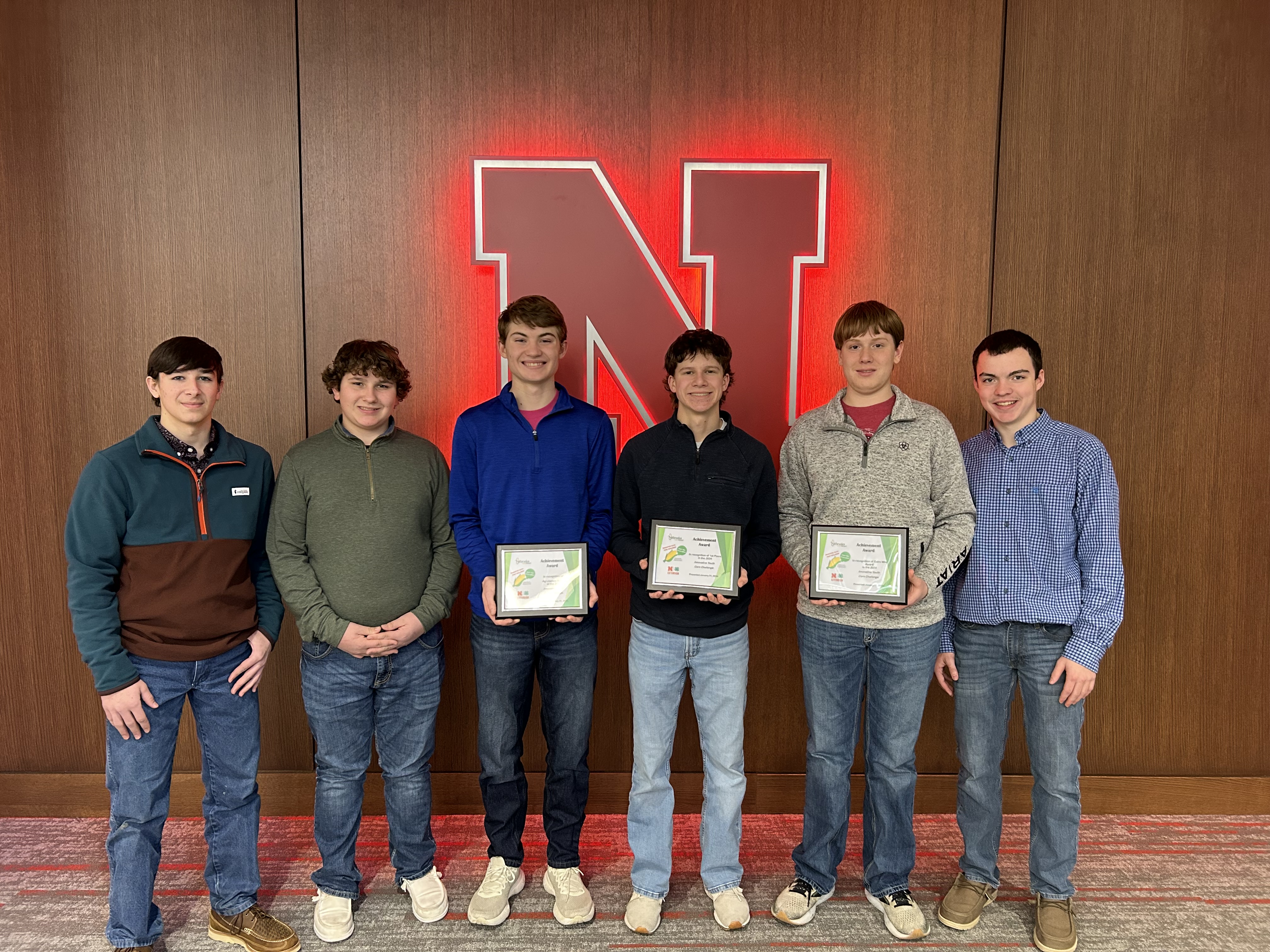
The winning team from the 2024 growing season was the Arlington FFA Chapter from Washington County consisting of Haydn Hegemann, Brock Lauristen, Luke Sharp, Wes Monke, Aaron Fuchs, & Ethan Hilgenkamp with Kali Agler as the team sponsor. The team decided to look at TerraMar, intended for foliar use in row crops which is intended to deliver increased nutrient uptake and enhanced stress mitigation, optimizing plant health and contributing to enhanced yield.

They planted the plot with two populations of 25K plants/acre and 30K plants/acre. On their challenge plots, they tested an application of TerraMar and a foliar fertilizer applied at the V6 growth stage and a drone application of TerraMar at the VT growth stage. Yields were the following:

  • Check Plots with 25K plants/acre yielded 178 bu/ac and 188 bu/acre at 30k plants/acre.
  • Challenge plot with 25K plants/acre with foliar fertilizer and TerraMar at V6 yielded 188 bu/acre.
  • Challenge plot with 30K plants/acre with foliar fertilizer and TerraMar at V6 yielded 199 bu/acre.
  • Challenge plot with 25K plants/acre with a V6 foliar fertilizer and TerraMar application and VT application of TerraMar yielded 188 bu/acre.
  • Challenge plot with 30K plants/acre with a V6 foliar fertilizer and TerraMar application and VT application of TerraMar yielded 203 bu/acre.

Considering all factors, the V6 application was the most efficient due in large part to the fact that application using a ground rig is less expensive than requiring a drone post-spray application. The team concluded that TerraMar did contribute to the plant health of the corn crop, reduce stress via lower canopy temperatures, and overall increased yields at both medium and higher planting rates, but due to the increased cost, not economically feasible at this time.

The Ag Literacy Award and Extra Mile Award was also presented to the Arlington FFA Chapter. This program is for youth aged to 8-18 as of January 1st in 2024. Prizes for participation in this project include 1st place – $1,000, 2nd place – $500, 3rd place -$250, “Extra Mile” Award $250, Ag Literacy Award $250 and $50 for completion of the project.  

In 2025, there is a NEW opportunity to increase involvement for youth with this program!  There will be two pathways for youth to select. The first pathway will be the traditional, “innovative” pathway in which participants choose their own treatments and manage their plots on their own.  The second pathway will be the business/industry pathway; this will include youth working with an industry representative to create a treatment and assist in the implementation of the plot protocol. This new and exciting twist to the Innovative Youth Corn Challenge program enables youth who might not otherwise have physical access to cropland or industry connections. When youth sign-up, they will select which pathway they intend to take.

For more information about this program and to register in 2025, go to https://cropwatch.unl.edu/youth/cornchallenge. Registration is due April 1st.

Contact Brandy VanDeWalle at brandy.vandewalle@unl.edu or (402) 759-3712 for details about this program. This program is possible due to the generous support of the Nebraska Corn Board.

Crops, Programming

Crop Insurance, FarmBill & Weather!

The Farmers & Ranchers College continues to offer high-quality programming to area producers and agribusiness professionals for the 2024-25 season. The college started with its traditional program featuring Dr. David Kohl, which drew nearly 140 attendees! The Cow/Calf College also provided an in-depth, hands-on program with strong learner engagement. The final program of the season is coming up soon.

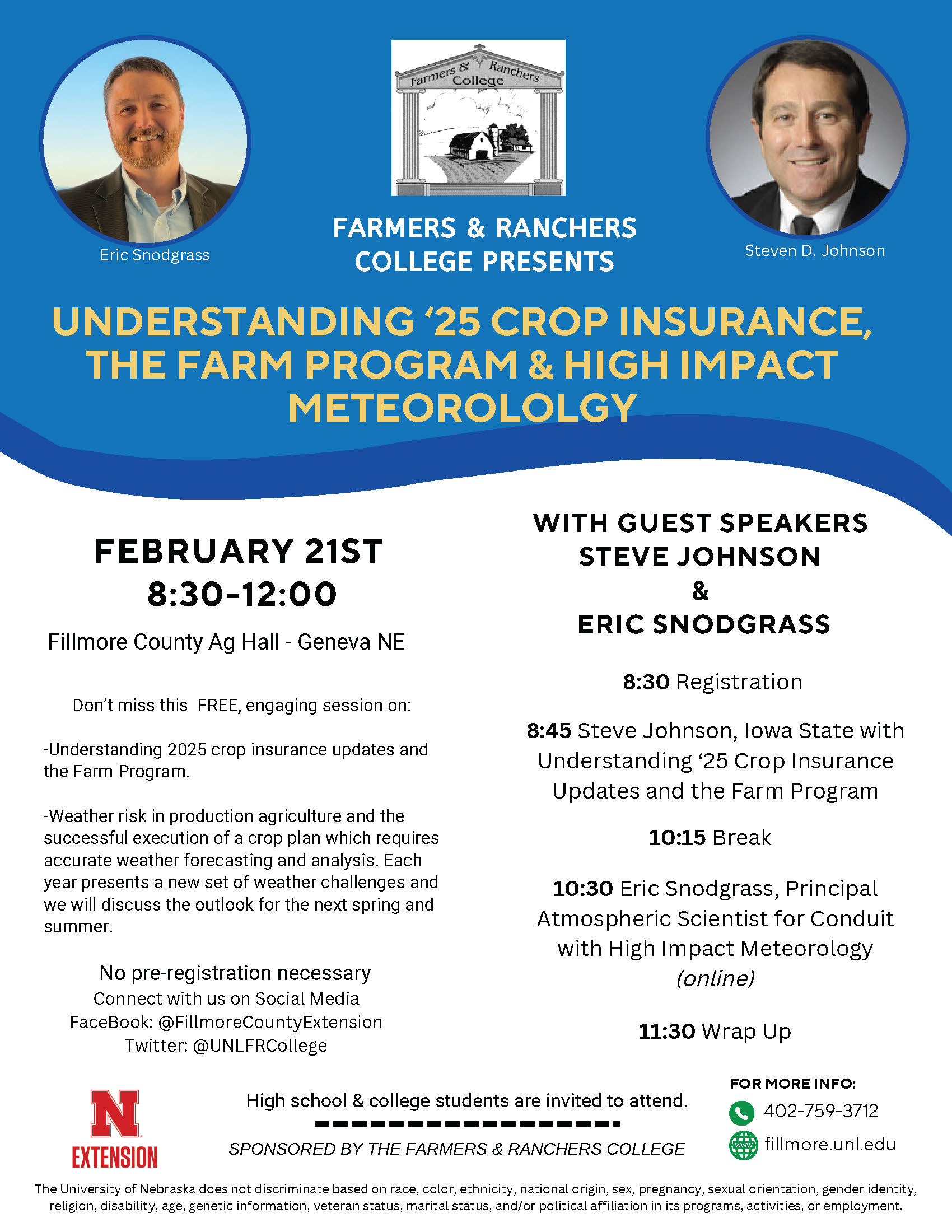
On February 21, 2025, the Farmers & Ranchers College will conclude with a comprehensive session covering crop revenue management and a 2025 weather outlook. Two nationally recognized experts will lead this program, which will be held at the Fillmore County Fairgrounds in Geneva, NE. Registration begins at 8:30 a.m., with the program starting promptly at 8:45 a.m. with Steve Johnson.

Steve Johnson served as the Farm Management Specialist in Central Iowa for Iowa State University Extension and Outreach for 21 years, retiring in early 2021. He now consults with private industry, farm organizations, commodity groups, ag media, and other agriculture-related clients, focusing on crop marketing, government farm programs, crop insurance, and crop risk management strategies. Steve has presented at winter meetings, workshops, seminars, webinars, and conferences across the Corn Belt, delivering his “Managing Crop Revenue & Market Price Risk” program. His session will address both 2024 and 2025 crop supply/demand, crop price outlooks, and strategies to manage crop insurance decisions and create a written marketing plan to capture higher futures prices.

Steve’s topics will include:

  • Latest USDA reports, highlighting 2024 & 2025 crop supply/demand and cash price projections
  • Pre-harvest marketing strategies and seasonal futures price trends
  • Projections for 2024 net farm income, plus crop costs and returns for 2024 & 2025
  • Five strategies for managing tight margins
  • How to develop crop marketing plans with price and time targets for 2024 & 2025 crops
  • Crop risk management resources and websites

Dr. Eric Snodgrass will also provide a weather update and how it relates to your operation. Weather risk is an inherent challenge in agriculture, and successful crop planning relies on accurate forecasting and analysis. We often base our operations on weather averages and recent experiences, but each year brings new challenges. In his session, Eric will discuss how to use the wealth of available weather data to stay ahead of disruptive weather events. He will cover the limits of predictability, resources for monitoring long-range forecasts, lessons learned from the previous growing season, and the risk of severe storms, particularly high winds, hail, and tornadoes. He’ll also discuss the impact of major seasonal drivers like El Niño and La Niña, as well as the outlook for the next growing season in South America, which directly competes with our crops.

Eric Snodgrass is a Principal Atmospheric Scientist for Conduit, where he develops predictive and analytical software solutions to manage weather risk in global agriculture. He provides frequent weather updates on how high-impact weather events affect global agricultural productivity. His research, which uses machine learning to assess field-level weather impacts on yields, helps improve long-range weather predictions. Eric is a sought-after speaker, presenting at over 100 conferences annually to farmers, commodity traders, and other stakeholders.

Pre-registration is not required, but it is appreciated. To register, please call the Fillmore County Extension Office at 402-759-3712 or go online at: go.unl.edu/frcollege.

Programming

Nebraska Extension: Part Two

Last week I shared about Nebraska Extension and some of my yearly impacts from 2024 and this week, I’ll share a few more. I am blessed to work with other talented Extension colleagues who create positive change every day. Some Extension impacts can be found online at https://extension.unl.edu/impact-nebraska/.

In 2024, I conducted the Nebraska Youth Crop Scouting Competition with 31 youth on 7 teams competing from 5 counties at ENREEC by Mead. Seven stations ranged from precision ag scouting to diseases, insects weed identification, etc. with judges from the Cropping Systems programming area. The Nebraska Soybean Board, Independent Crop Consultant Association, and UNL’s Doctor of Plant Health program sponsored this in-depth learning experience. 2024 survey results show that:

  • 80% of youth learned about a new career option
  • 93% of youth are more aware of degree opportunities at UNL & improved knowledge of accurately identifying pests as well as learning effective non-chemical control practices.
  • 97% of youth have an improved knowledge of crop scouting procedures.
  • I learned how to use aerial imagery to better diagnose a field.” – Participant

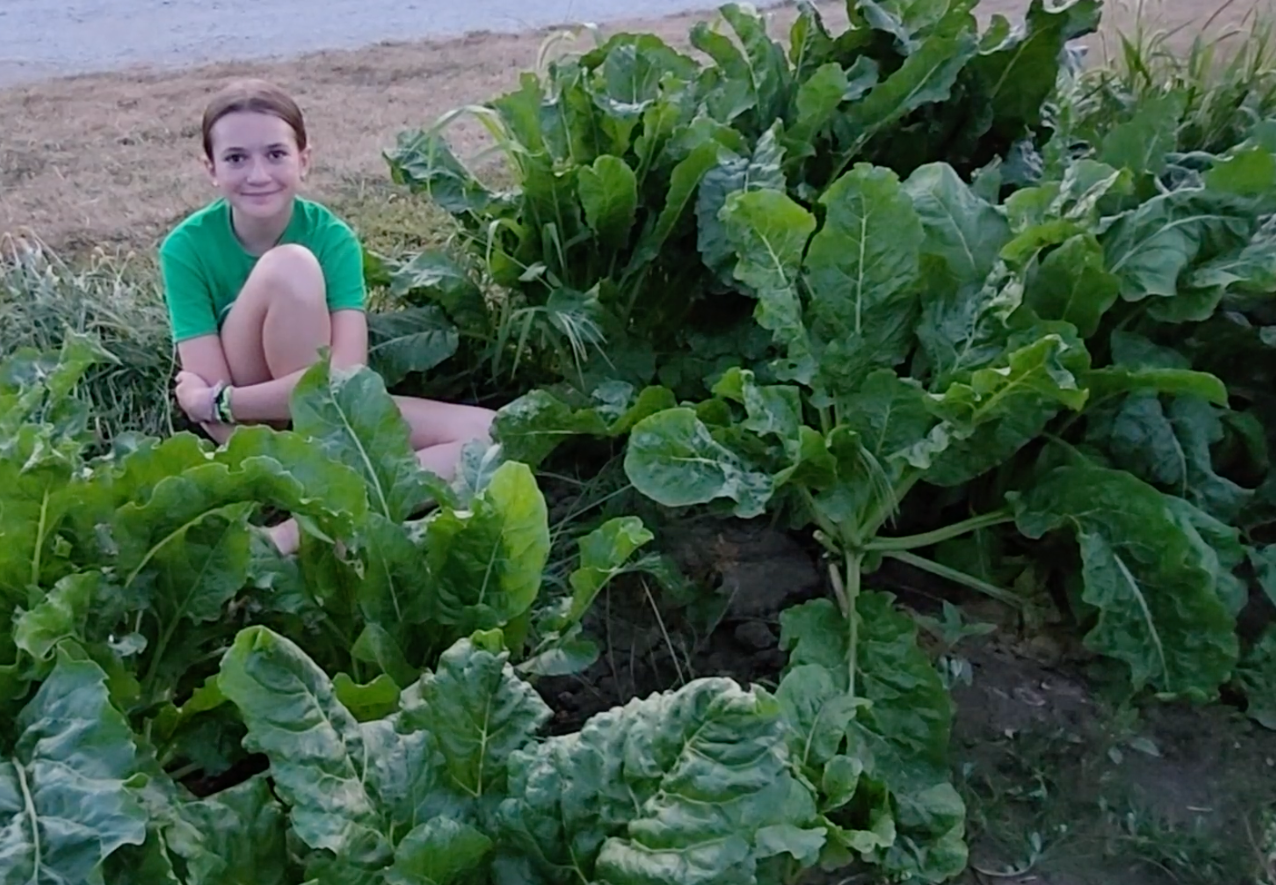
As state co-superintendent of 4-H Agronomy, I led the Special Agronomy Project (SAP) which delivered nearly 700 seed packets to NE youth. Eleven sugar beet projects were exhibited at the state fair.

  • 38% of participants who completed the evaluation said it was the first time they took an agronomy project to fair & 81% learned a skill that can be used in the future; 92% will enroll in the SAP next year.
  • This is a neat program, and I’d love for our whole club to do this next year.” – 4-H mom
  • This project made headlines on IANR news and was featured in a statewide booth by Western Sugar.

STEM Education – The Department of Defense projects that 80% of jobs will require STEM skills in the next decade, underscoring the need to engage students and educators in impactful STEM experiences. In 2024, I taught 1,619 STEM lessons to youth across 11 counties and 42 adults from the U.S. and a U.S. territory, covering topics from electricity and robotics to soil science and pollinator education.

I forged a new partnership with Nebraska EPSCoR through my ROOTED in Ag project. This led to an opportunity to organize a session at the National EPSCoR Conference. Alongside project members from Alaska and Hawaii, we delivered a cutting-edge workshop showcasing our agricultural science virtual reality field trips—demonstrating the power of technology in education. I developed a VR Robotic Dairy field trip and captured 360-degree images of cropping systems throughout the year, as well as drone footage and still images, all of which will be integrated into our group’s website and project. These immersive, high-tech field trips are slated for full implementation in 2025, promising to create lasting impacts on STEM education. Impacts from 18 direct teaching hours, representing a total of 64,110 direct learner hours taught in STEM-based.

Leadership Education– Investing in youth leadership development is a vital skill that contributes to both the personal success of young people and the overall well-being of our society. I taught both the Leadership Summit and Purple Ribbon Kid programs to 105 youth from 9 classrooms in 3 counties.

  • 100% of teachers who participated in the Purple Ribbon Kid program agreed/strongly agreed they have already witnessed positive behavior change in their students because of the lessons.
  • Because of the program, one youth said, “I will be more open to other people and their perspectives.” The teacher reported that the class “looks forward to using this knowledge as they continue throughout their lives” and 100% of youth now feel they can create positive change in their community.

Uncategorized

What is NE Extension?

As I approach my twentieth year in Extension later this year, there is one question that many people commonly ask, “What exactly is Extension and what do you do?” While I have a quick answer to that question, there is so much more I’d like to tell them about the great work my colleagues do across the state. Nebraska Extension brings the University of Nebraska’s expertise and research in 8 key impact areas directly to Nebraskans from all walks of life in the state’s 93 counties. Nebraskans turn to Nebraska Extension to strengthen their families, inspire their communities, empower young people, conserve and protect natural resources, and advance their farms, ranches, and businesses.

Every county in Nebraska is served by talented and dedicated Extension faculty and staff. Each county has an educator focused on one of the 8 key areas with accountability to other counties in their specific discipline. This ensures that every county has access to a subject matter expert to provide clients the best answer to any question that might arise, and each county is provided relevant programming in that topical area.

 Annually, Extension faculty complete a yearly report capturing the most important, impactful work completed during that year. As a youth development educator, the statewide goals I aim to accomplish are as follows: “Youth will be prepared to make decisions for today and the future, thrive in their careers, and become competent & connected members of their communities.” In the next two columns, I will share some excerpts from my report to explain some programming you may or may not be aware.

In 2024, I spearheaded state programming that engaged 795 youth in STEM education with a focus on crop science through the Innovative Youth Corn Challenge (IYCC), Youth Crop Scouting Competition (YCSC), and Special Agronomy Project. These efforts generated nearly $13,000 in revenue. I directly taught or facilitated programming for 2,250 youth, contributing 4,518 teaching hours. Through collaboration with Clay and Fillmore County staff, we successfully reached 82% of youth in Clay County and 66% in Fillmore County.

The Bureau of Labor Statistics projects 6% growth in agronomy jobs, with 2,100 new positions expected by 2032. Girdziute et al. (2002) found that youth are often reluctant to pursue agricultural careers due to factors like gender, location, and the belief that agriculture lacks opportunities for personal fulfillment. This emphasizes the need for the ag industry to actively engage youth in the workforce.

A 13-year partnership with the NE Corn Board in the Innovative Youth Corn Challenge (IYCC),a youth on-farm research project has successfully engaged youth in agricultural, science-based learning. A long-term program evaluation shows that over 100 IYCC alumni have pursued agricultural or STEM careers, with nearly 300 youth participating. In the last growing season, 5 teams (43 youth) harvested corn plots, and 2 teams (18 youth) took part in a drone field day, using Tello EDU drones for crop scouting and agricultural literacy projects. Two FFA Chapters created impactful videos of their projects, which were featured in CropWatch, Nebraska Corn Board publications, Nebraska Farmer magazine, and social media. The Arlington FFA video alone has nearly 1,000 views and 6 shares. During the last growing season, 6 participants reported a combined total of 288 hours working on their corn challenge plots. With 43 youth participating, and assuming each spent an average of 48 hours, the total time invested by youth could reach up to 2,064 hours.

  • 100% of current IYCC participants (n=12) enhanced their ability to 1) accurately identify pests, 2) understand crop scouting procedures, 3) set-up research plots, 4) determine profitability of practices and 5) evaluate new products/practices in the field.
  • I enjoyed having a project last for a long duration and seeing the end results.” -Current Participant
  • “There have been numerous individuals that have gone into ag fields. Two have went to farming, one ag retail and one agronomy.” – Former Innovative Youth Corn Challenge advisor

Next week, I’ll share more of how I strive to accomplish this and other goals.

Crops, Livestock, Programming

Ready, Set, Spread: Manure Application Workshops

Turning manure nutrients into better crop yields while protecting the environment will be the focus of ten Nebraska Extension Land Application Training workshops held across the state this February and March, with one held locally in Geneva on February 6th.

Land Application Training workshops focus on what fields should best utilize manure nutrients and other benefits. Each workshop will be highly participant-led with limited seating. Participants will be given a scenario and asked at the end of each activity to determine whether the field will benefit from manure application or whether there are considerations that make the field less desirable for manure application. Based on the activities, participants will then rank each field within the scenario to determine a priority ranking for the entire scenario. Activity topics will include manure nutrient value, transportation cost, soil health, water quality, neighbors, and odors. Regulations and record-keeping about manure storage and application will also be addressed during each workshop.

These manure workshops meet land application training certification needs for livestock producers that are required to do so, but they are open to anyone interested in using manure as a nutrient source on cropland as well. The Land Application Training events run from 9 am to 4 pm local time. I’ve only included some on the eastern side of the state; if you need others, go to water.unl.edu/lat.

Workshop sessions include:

  • Fillmore County Extension Office in Geneva on February 6
  • Madison County Extension Office in Norfolk on February 26
  • Nielsen Community Center in West Point on March 4
  • Rainforth Animal Health in Wisner (en Español) on March 6
  • Platte County Extension Office in Columbus on March 12

New this year, the UNL animal manure management team added two opportunities to take the workshop in Spanish. The content for the workshop will be the same in both languages, but hoping this will give Spanish speakers a chance to focus on the content of the workshop rather than the translation of English materials.

Because of limited seating and a meal provided during each workshop, registration is required and is requested 1 week ahead of each event. To ensure you can attend the location and date most convenient for you, register at water.unl.edu/lat. Workshops cost $75 per operation requiring certification or $25 per person with no expectation of certification. You can learn more about all things manure including these workshops at manure.unl.edu or by reaching out to Leslie Johnson at leslie.johnson@unl.edu.

Livestock, Programming

Cow/Calf College

Cow/Calf College Features Livestock Risk Management Workshop

The University of Nebraska-Lincoln’s Center for Agricultural Profitability and Nebraska Extension will host a risk management workshop in Clay Center to update livestock producers on the latest insurance options and risk management planning strategies. It will be held from 10:30 a.m. to 2 p.m., Jan. 21, at the U.S. Meat Animal Research Center, 844 Road 313.  

The workshop is sponsored by Nebraska Extension’s Cow-Calf College program. Sign-in begins at 10 a.m. In the event of inclement weather, the workshop will be held from 10:30 a.m. to 2 p.m. on Jan. 28 at the same location.  

Attendees will learn strategies designed to reduce risk exposure to achieve a profitable outcome in uncertain times. Current issues facing the cattle industry will be discussed to help producers to make more informed decisions. The goal of this program is to provide producers with the tools and resources needed to navigate the volatile livestock market and better manage risk through the creation of a risk management plan. 

Topics will include managing drought risk with USDA’s Pasture, Rangeland, and Forage (PRF) Insurance and managing price risk with USDA’s Livestock Risk Protection (LRP). PRF is an annual sign-up due on Dec. 1. LRP can be purchased most business days. The Weaned Calf Risk Protection Program, new this year, will also be discussed.  

The workshop is free, and snacks will be provided. Registration is required by Jan. 15 by calling Nebraska Extension in Fillmore County at 402-759-3712.  

This material is based upon work supported by USDA/NIFA under Award Number 2023-70027-40444.