

Managing for Difficult Times
According to the Nebraska Department of Agriculture, one in four jobs is related to agriculture in Nebraska. This signifies the importance of agriculture to Nebraska’s overall economy. Current market conditions are a challenge for many agricultural producers. In response to the economic downturn, Nebraska Extension has developed an initiative focused on strengthening Nebraska’s agricultural economy.
A new series of educational materials is featured on the Nebraska Extension CropWatch and Beef websites. Nebraska Extension specialists and educators from across multiple disciplines share research-based information to help producers reduce input costs, increase efficiencies, and improve profitability of farm and livestock operations. In planning for the coming season, consider how you can incorporate the strategies that best match your cropping systems, livestock operations, and management styles into your operation.
These educational materials will be available on CropWatch.unl.edu and on Beef.unl.edu. Find related information on Twitter at #StrongNebAg.
As this initiative is being developed, Fillmore County will be hosting a program, building off these same materials, titled Managing for Difficult Times on February 22nd starting at 9:30 a.m. at the Fillmore County Fairgrounds in Geneva, NE. During this program, Nebraska Extension faculty will present topics to help improve profitability such as cutting out production practices that are not economically feasible. Land leasing updates and strategies will be presented in addition to a review of basic financial recordkeeping. This program will equip farmers with strategies for reducing stress and keeping our families healthy during difficult times. Finally, tips on preparing for farm loan renewal time will be given.
A local update on the progress of the Fortigen fertilizer plant will be given. Nebraska AgrAbility resources will be shared as well. As always, all programs are free due to the generous support of Farmers and Ranchers College Sponsors. Registration is due February 16th for a meal count and can be done online through fillmore.unl.edu or by calling the office at (402) 759-3712.
The Farmers and Ranchers College Committee consists of Fred Bruning of Bruning, Bryan Dohrman of Grafton, Sarah Miller of Carleton, Jennifer Engle of Fairmont, Ryne Norton of York, Jim Donovan of Geneva, Bryce Kassik of Geneva, Eric Kamler of Geneva, and Brandy VanDeWalle of Ohiowa.
Next week’s post will provide details about the last Farmers and Ranchers College program of the season which is a special program for the ladies in agriculture and will be February 27, 2017 at Lazy Horse Vineyard near Ohiowa, NE with registration at 5:45 and program starting at 6:00 p.m.
4-H Enrollment – OPEN
Hello 4-H Families & anyone interested in learning more about 4-H! We are excited as we embark on a new 4-H programming year! All 4-H families will enroll in clubs and projects through 4HOnline at ne.4honline.com. 4HOnline is a web-based enrollment system that will allow families, parents, leaders and volunteers to enroll or re-enroll in 4-H on your personal computer, mobile device or at local enrollment events hosted in your county. You’ll be able to complete all of the information necessary to join 4-H online, including 4-H code of conduct forms and health forms. There will be no paper forms to submit for enrollment. 
The process is quite simple and the website is very user friendly. It is your responsibility to make sure youth in your family get enrolled by the April 1st deadline and (March 1st for Fillmore County Shooting Sports members). We are happy to assist you with your enrollments and please call our office if you have questions with enrolling.
Contact Information: Fillmore County Extension at (402) 759-3712 or Clay County Extension at (402) 762-3644
Windbreak Renovation Workshops
Windbreaks are an Integral part of area farms and acreages providing critical protection for farmsteads, livestock and crops. Unfortunately, many older windbreaks are losing their effectiveness due to age, poor health or neglect. In some cases, the windbreak no longer has the necessary density to provide winter protection.
Learn what to do about an old or new windbreak on your property. Nebraska Extension, Nebraska Forest Service and the Lower Big Blue Natural Resource District have teamed up to bring landowners the best and latest information on tree and shrub recommendations and how to renovate windbreaks. Steve Karloff, Forester who has made tree plans for many landowners in Southeast Nebraska will be the keynote speaker. The seminar will cover renovating old and damaged windbreaks, planting new windbreaks, NRD programs and cost share availability, tree health issues including tree recommendations, ash borer update and discovering the newly available root maker trees.
The program will be held in two locations as follows: Tuesday, February 14 at Saline Center (north of Western) in Saline County along highway 15 and a repeat session on Friday, February 17 at the Gage County Extension Office in Beatrice. Both programs will be held from 9 a.m. until noon with registration beginning at 8:30. Refreshments are provided and pre-registration is due February 10.
Register with the Gage County Extension Office at 402-223-1384 or the Saline County Extension Office at 402-821-2151. In the case of inclement weather, please check with either Extension Office or alerts on KWBE or KUTT radio stations.
If you have any additional questions you can contact Nicole Stoner at Gage County Extension (402) 223-1384 or by email at nstoner2@unl.edu.
Ice Storm Impact on Plants

As I drove into town this morning I saw three trucks hauling tree branches out of town. When the ice storm was over, we had lots of branches of our own at our house that fell down and have to deal with. I asked Nicole Stoner, Extension horticulturist covering our region on information impacting the trees, so this week I’ve included her information in my column.
Many people do not like winter due to cold weather and the bad driving conditions such as snow and ice. Our plants are not much different in this respect; snow and ice can cause problems to our plants. The recent ice storm we saw covered our trees and shrubs in a thick layer of ice.

As trees become covered with ice, problems can occur. The best way to avoid any problems from a heavy layer of snow or ice would be to let it melt naturally. Heavy snow or ice loads look damaging to the tree that makes people want to knock the ice off of the trees to help the plant. However, it is really better to leave it alone. The snow and ice will eventually melt off of the plants and they will spring back up to their normal form after a while. If you try to break ice off of a tree or shrub, it can break the branches or crack them, leaving them vulnerable to other problems. Again, the ice will eventually melt off of the tree or shrub and it will be fine.
Many tree branches broke after the weight of the ice from the last storm proved to be too much. The best management practice for helping a tree that has broken branches due to snow and ice would be to go out and trim those branches to make them a clean cut rather than a jagged cut. Leaving a break rather than having a clean cut will prevent the tree from naturally healing the wound and this opening will lead to decay in the tree. This is much more damaging to the tree so it is best to prune the tree between the break and the bark collar or hire a professional to do this for you. If your tree split down the middle or lost a great number of branches, it may be time to to think about replacing this tree. It would be best to call a certified arborist in this case to assess the damage and give recommendations on the next steps for your tree.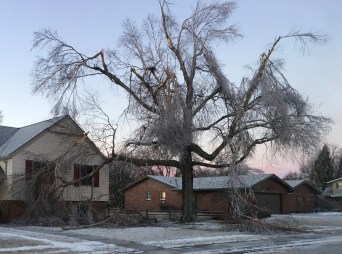
Deicers are another plant consideration in the winter. They can cause damage to concrete sidewalks and to plants growing beside them. Many deicing agents contain salt substances, such as sodium chloride and potassium chloride. Because of the salt content found in these products, it can cause severe damage to our plants if too much is piled on them too often. Typical plant symptoms of salt damage are desiccation (drying out), stunting, dieback, and leaf margin and tip damage that looks as though the leaves were burned by a chemical.
To avoid damage to concrete, remove the salt as soon as you can. Deicers are meant to make shoveling easier, not to completely melt away snow and ice. As soon a

s the salt melts through the ice and snow enough that it can be removed, go out and shovel it off of the concrete. When removing the snow, do it in a manner that protects the landscape plants growing in the yard. Do not pile the snow onto trees, shrubs, or flower gardens. If it has to be piled onto your landscape, move the salt onto the grass and try to do it in a manner that makes it more uniform on the grass surface. If too much salt continually gets piled up on the grass in one location, the turf can be harmed. If you are very concerned with the effect the deicers have on your plants, you can use alternate products for melting the ice, such as calcium magnesium acetate that contains no salt.
If you have any further questions please contact Nicole Stoner at (402) 223-1384.
Cow/Calf College on January 31
The annual Farmers and Ranchers Cow/Calf College “Partners in Progress – Beef Seminar” will be held at the U.S. Meat Animal Research Center and Great Plains Veterinary Education Center near Clay Center on January 31, 2017 with registration, coffee and donuts starting at 9:00 a.m. The program will run from 9:30 a.m. until 4:00 p.m. This program is sponsored by Nebraska Extension’s Farmers and Ranchers College and will feature several outstanding speakers discussing issues and management strategies that can affect the profitability of all beef producers. There is no cost for the event and the public is invited. It does include a noon meal, which means that early registration is necessary to reserve materials and a meal.
The “Cow/Calf College” will begin at 9:35 a.m. with a welcome by Dr. John Pollak, Director of USMARC and Dr. Dale Grotelueschen, Director of the Great Plains Veterinary Education Center. Mary Drewnoski, Nebraska Extension Specialist and Chad Engle, USMARC Livestock Operations Manager, will kick off the seminar with “Annual Forage Systems – A Pasture Alternative.” They will offer strategies for utilizing cover crops and other forages. Kate Brooks with UNL’s Department of Agricultural Economics will present an update on the “Cattle Market”. Kate will share latest trends with beef marketing to make a profit.
Lunch is provided and will be handled with a rotation system during two noon sessions featuring split sessions on: “Management Tips and Strategies” from a local producer and the 2015 Leopold Conservation Winner, Brian Shaw.
The afternoon session will start with Aaron Berger, Nebraska Extension Educator on “Strategic Ranch Management during an Economic Downturn”. With lower prices, it is imperative for producers to have a plan in place and follow through with it in order to remain viable in today’s rapidly changing global markets.
Dr. Kip Lukasiewicz, Sandhills Cattle Consultants Inc., will lead you through “The Veterinary Feed Directive Update”. Back from last year, Dr. Kip is sure to entertain you while being right on target to address some of critical health issues that face beef producers. For our beef producers Dr. Kip will also inform participants how to comply with the Veterinary Feed Directive (VFD) as well as other feed and vaccine protocols.
All presenters will then join pull everything together, give their final thoughts and considerations and provide a coffee-shop style panel discussion during which cattlemen can ask questions and get answers on questions that came to them during the day’s sessions. A chance for door prizes will be awarded to those that stay for the entire event.
Please pre-register by January 24th, to the Nebraska Extension Office in Fillmore County or call (402) 759-3712 to insure a seat and lunch. Walk-ins are accepted, but may not get a lunch. You may also complete your registration online on fillmore.unl.edu by going to the agricultural page and clicking on the “registration link”. Remember, your contact information is required, so pre-registration is helpful!
Financial Literacy Workshops
Financial Literacy Class for Farmers and Ranchers
Are you ready to renew your farm or ranch operating note? Learn about preparing the information your lenders need and how to develop a solid financial record keeping system at a Financial Health Check workshop. The workshop will be held January 19th, 9:00 a.m. to 12:30 p.m. at the Clay County Fairgrounds in Clay Center, NE. RSVP to Clay Co. Extension at (402) 762-3644 by Jan. 13th. The cost to attend this workshop is $20 per person. The ideal class size for the financial heath check class is 10-12 participants; classes will be limited to 15. 
This workshop is designed to help farmers and ranchers develop a financial plan for their operation during this period of low income. Upon completion of this program, participants will have a better understanding of how financial records can be used to make management decisions and confidently discuss their financial position with their family, business partners, and lenders.
Topics covered include:
- Basics of balance sheet construction and analysis
- Cash flow and keeping farm/ranch financial records
- Income statements for measuring profitability
Quicken Workshop for Farms & Ranches
Keep books for more than just your taxes! In this 2.5-hour class, you will learn to use Quicken (a minimum cost bookkeeping software) to keep farm/ranch financial records, as well as your household expenses. This “hands-on” training will help you understand how to set up categories & classes (for taxes & management), use the budget & loan features, and separate enterprise expenses. You will also learn where to find online Quicken help resources directly related to farm records.
This workshop will be held January 19th, 2:00 p.m. to 4:30 p.m. at the Clay County Fairgrounds in Clay Center, NE. RSVP to Clay Co. Extension at (402) 762-3644 by Jan. 13th. The cost to attend this workshop is $20 per person. The ideal class size for the Quicken workshop is 10-12 participants; classes will be limited to 15.
Extension’s Help with Resolutions
 As stated in my previous post, almost half of resolutions made include education or self-improvement. If you need any educational resources or materials on nearly any subject, Extension has resources. Whether it is information on a website, talking with an extension professional, utilizing an app from your smart-phone, attending a face-to-face program, participation in a webinar or many other avenues, Extension works to solve complex problems for clients. If you haven’t been to Extension’s website recently, I encourage you to go to extension.unl.edu. There you will find an abundance of resources on topics such as food, nutrition and health, cropping & water systems, community vitality, community environment, learning child, beef systems and 4-H youth development. Consider attending a program or utilizing a resource to help you achieve a resolution or goal you may have.
For a list of extension programs in the area, visit our website or call our office at (402) 759-3712.
New Year’s Resolutions
If you are like many nearly half of the American population, you probably have a New Year’s Resolution set for 2017, while 38% of Americans absolutely never make New Year’s Resolution according to research by University of Scranton, 2016. A majority of those resolutions are self-improvement or education related resolutions (47%), weight related (38%), money related (34%) or relationship related (31%). University of Southern California’s John Monterosso who is an expert on psychology and neuroscience of self-control offers insight on how to achieve setting those resolutions.
Monterosso suggests thinking of a resolution as a special kind of plan and visualizing your future-self. If you have already made that resolution or still working to tweak it, he suggested keeping the following in mind:
- Failed resolutions are not harmless. Most people don’t like to fail; in fact it hurts our confidence and can actually lead to worse behavior. Keeping this in mind and accepting the fact that one might not have accomplished all that was planned is important. If you get off track, you can always start again and don’t have to wait until a new year.
- Resolutions work by linking single decisions to a bigger picture. For example, if you have a goal of quitting smoking or eating unhealthy foods and let a craving lead to poor decisions, you might think, “it’s just one cigarette or just one meal of fried foods” which may or may not lead to the continuation of a bad habit. If one takes a resolution seriously, think about the health consequences and the potential “relapse” that could occur.
- Consider being less ambitious in your resolutions. We tend to be overly confident when making a resolution and think we can change our behavior overnight. While it is good to be confident with your goals, be careful not to make overly ambitious goals. For example, if you plan to work out one hour/day every day of the week and have an already packed life with a career, community obligations and a family, consider starting at 20 minutes/day and work up to more minutes if time allows. Setting a good resolution requires being realistic.
- Resolutions should not be vague. If you set a resolution of “eating healthier.” What does that mean? Does it mean drinking 64 oz. of water/day? Does it mean to include a fruit or vegetable at every meal? Write down a SMART goal that is Specific, Measurable, Achievable, Realistic, and Time-based.
- The New Year is a fresh start. Setting resolutions/goals at the first of the year helps us “clean the slate” and put past failures away. It gives us a sense of confidence and optimism. Capitalize on that.
- Even successful resolutions can be mistakes. If you set restrict your diet to the point of starvation or over-exercise to the point of hurting yourself, you must be able to adapt, know yourself and use common sense and wisdom to correct the resolution.
In summary, Monterosso suggests that done correctly, “resolutions play a role in great human achievements.”
Precision Ag Data Management Workshop
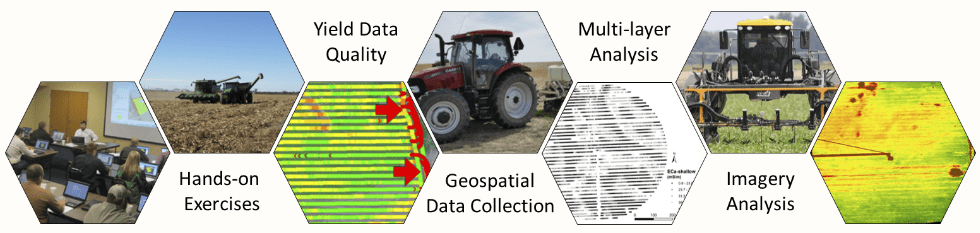 Production agriculture continues to evolve into a data-intensive system as producers and other agricultural professionals look for ways to gather more actionable information from their data. Topics for the 2017 Nebraska Extension Precision Ag Data Management Workshops were developed to provide hands-on data analysis instruction on how to apply variable rate technologies for improving crop production efficiency and on-farm economics. Sessions will teach attendees options for creating management zones within fields as well as how to create variable rate application maps (for planting) and evaluate planting studies using GPS-enabled yield monitor data. In addition, exercises will provide information related to creating profitability maps using different data layers collected during the growing season.
Four two-day workshops will be held in Lincoln, York, Norfolk, and North Platte during January and February. Interested individuals can register for one or both days.
Program Sites
Lincoln — Jan. 10-11
York — Jan. 12-13
North Platte — Jan. 26-27
Norfolk — Feb. 7-8
For more information, please visit the 2017 Nebraska Extension Precision Ag Data Management Workshop registration website at http://agronomy.unl.edu/precisionag
Please contact Joe Luck (402-472-1488 or jluck2@unl.edu) if you have questions related to the workshops.
 Views from VanDeWalle