Uncategorized

Harvest Safety

It is hard to believe that harvest has started for some. As a reminder with harvest comes more traffic on county roads and other stresses for farmers. It never fails, that equipment can break, there are delays at the elevator and extra-long hours can all add extra stress to farmers. It is important to carefully slow down and realize the many hazards you are being exposed to during harvest.

Photo by Tom Fisk on Pexels.com

An Iowa State Extension publication, Harvest Safety Yields Big Dividends points out that injuries can occur by taking shortcuts to perform routine tasks, not getting enough sleep or regular breaks, or failing to follow safety practices. Some injuries occur when operators are pulled into the intake area of harvesting machines, such as balers, combines, or corn pickers, and many injuries occur from slips or falls around these machines. Exposure to powerful machinery is highest during the harvest season. The equipment must be powerful to effectively handle large amounts of agricultural commodities. When equipment plugs, NEVER try to unplug it with live equipment, instead always disengage power and turn off the engine before trying to manually clear a plugged machine. Regular maintenance of these machines can also make harvest go smoother. Also, lots of accidents happen by the operator slipping and falling off equipment.

In the same publication listed above, there are several tips for reducing fall hazards: 

  • Always keep all platforms free of tools or other objects.
  • Frequently clean the steps and other areas where workers stand to service, mount, and dismount, or operate the machine.
  • Wear well-fitting, comfortable shoes with non-slip soles.
  • Use grab bars when mounting or dismounting machinery.
  • Be sure your position is stable before you work on a machine.
  • Recognize that fatigue, stress, drugs or alcohol, and age may affect stability.

Other helpful tips during harvest are to keep kids away from machinery. Tell them the dangers that can occur and not to play near the equipment, even when it is shut off; you never know when they will be playing in hidden areas of the equipment. Operators should double check where kids are before moving the equipment. Too many accidents can occur when youth are in the path of equipment out of the operator’s view. Operators of all equipment should check in regularly and let someone know where you are. Keep all guards on equipment; it is there for a reason! 

It is also important for the public to understand the increased traffic on public roads and be patient. The greatest threat raised between farm equipment and passenger vehicles is the difference in speed. Farm equipment runs at an average speed of 20 miles per hour while passenger vehicles average 60 miles per hour. If the motor vehicle overtakes a tractor, the impact is comparable to a passenger vehicle hitting a brick wall at 40 miles per hour. If the tractor and a car, mini-van or pickup collides head on, the impact is the same as hitting a brick wall at 60 miles per hour.

Farmers can reduce the chances of an accident by using warning lights, reflectors, and reflective tape on their machinery to keep passenger vehicle operators aware of their presence on roads. Some farmers may choose to install supplemental lights to increase visibility. It also is a good idea for producers to keep off heavily traveled roads as much as possible and avoid moving equipment during the busiest part of the day.

Some farm equipment, such as combines, can take up more than half of the road. Even so, it is up to both drivers to be aware of their own limitations and adjust accordingly. Farmers should not take up more space than is needed, but other drivers should try to provide as much room as possible. It is a good idea for passenger vehicles to turn off onto side or field roads until larger machinery has passed. Whenever possible, farmers should use an escort vehicle such as a pickup to precede or follow large machinery and equipment on public roads. More than one escort may be necessary. Ideally, the escort vehicle would have extra warning lights and a sign indicating oversized or slow equipment ahead or following.

Have a safe harvest!
Uncategorized

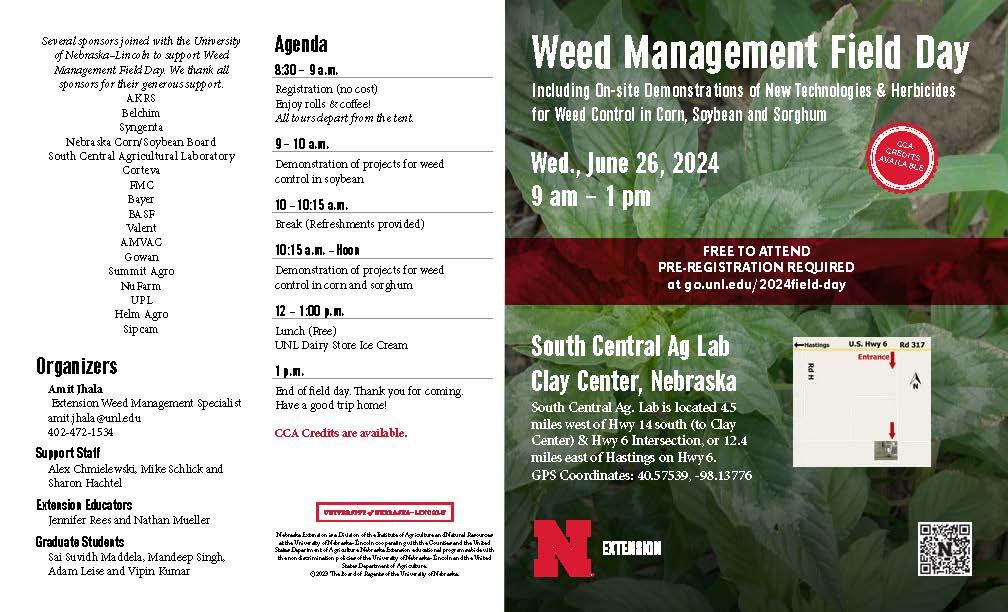
South Central Ag Lab Weed Management Field Day

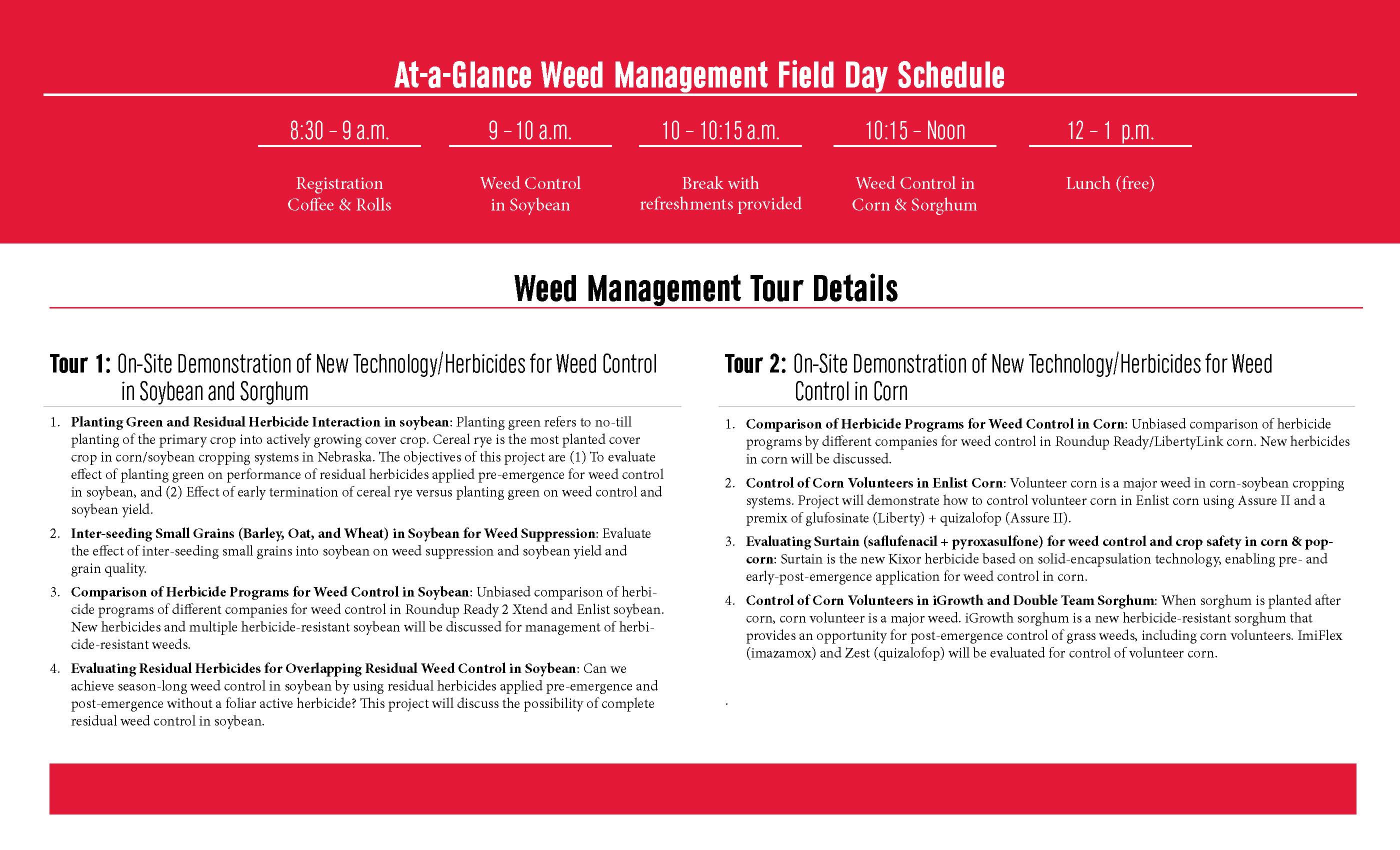
Those interested in learning the latest in weed management technologies and herbicides for weed control in corn, soybeans and sorghum are invited to attend Nebraska Extension Weed Management Field Day to be held on Wednesday June 26, 2024 from 9 am to 1 pm at South Central Ag Lab near Clay Center, NE. The Field Day is free to attend and lunch; UNL Dairy Store Ice cream will be provided. Register is required at https://agronomy.unl.edu/fieldday.

Tour one features onsite demonstrations of new technology/herbicides for weed control in soybeans in sorghum such as:

  • Planting Green and Residual Herbicide Interaction in soybean: Planting green refers to no-till planting of the primary crop into actively growing cover crop. Cereal rye is the most planted cover crop in corn/soybean cropping systems in Nebraska. The objectives of this project are (1) To evaluate effect of planting green on performance of residual herbicides applied pre-emergence for weed control in soybean, and (2) Effect of early termination of cereal rye versus planting green on weed control and soybean yield.
  • Inter-seeding Small Grains (Barley, Oat, and Wheat) in Soybean for Weed Suppression: Evaluate the effect of inter-seeding small grains into soybean on weed suppression and soybean yield and grain quality.
  • Comparison of Herbicide Programs for Weed Control in Soybean: Unbiased comparison of herbicide programs of different companies for weed control in Roundup Ready 2 Xtend and Enlist soybean. New herbicides and multiple herbicide-resistant soybean will be discussed for management of herbicide-resistant weeds.
  • Evaluating Residual Herbicides for Overlapping Residual Weed Control in Soybean: Can we achieve season-long weed control in soybean by using residual herbicides applied pre-emergence and post-emergence without a foliar active herbicide? This project will discuss the possibility of complete residual weed control in soybean.

Tour two features onsite demonstrations of new technology/herbicides for weed control in corn such as:

  • Comparison of Herbicide Programs for Weed Control in Corn: Unbiased comparison of herbicide programs by different companies for weed control in Roundup Ready/LibertyLink corn. New herbicides in corn will be discussed.
  • Control of Corn Volunteers in Enlist Corn: Volunteer corn is a major weed in corn-soybean cropping systems. Project will demonstrate how to control volunteer corn in Enlist corn using Assure II and a premix of glufosinate (Liberty) + quizalofop (Assure II).
  • Evaluating Surtain (saflufenacil + pyroxasulfone) for weed control and crop safety in corn & popcorn: Surtain is the new Kixor herbicide based on solid-encapsulation technology, enabling pre- and early-post-emergence application for weed control in corn.
  • Control of Corn Volunteers in iGrowth and Double Team Sorghum: When sorghum is planted after corn, corn volunteer is a major weed. iGrowth sorghum is a new herbicide-resistant sorghum that provides an opportunity for post-emergence control of grass weeds, including corn volunteers. ImiFlex (imazamox) and Zest (quizalofop) will be evaluated for control of volunteer corn.
Uncategorized

Youth Crop Scouting Competition – Connecting Youth with Crops

Looking for a fun club project? Want to unite your club members? Running out of ideas for club meetings?  If you answered, “yes” to any of these questions, help is on the way!  Nebraska Extension is pleased to present the 11th annual Crop Scouting Competition for Nebraska youth. Youth interested in crops can learn about crop growth & development and basic crop scouting principles. 

Don’t know a lot about crops?  Ask a local agronomist to assist by providing a short lesson on crop production. You can have the agronomist meet with the youth a little during each meeting or outside of the meeting. This is one way to engage those youth interested in crops. 

This contest will be held at the Eastern Nebraska Research & Extension Center near Mead, Nebraska on August 7, 2024. The event will include both indoor and outdoor events. Teams of junior high and high school students (those completing 5-12th grades) from across Nebraska are invited to participate. This event is limited to the first ten teams who sign up! 

            Clubs or other organizations may enter a team composed of three to five participants. An adult team leader must accompany each team of students. Team leaders could be FFA advisors, crop consultants, extension staff, coop employees, etc. 

Top-scoring teams win prizes: $500 for first, $250 for second, $100 for third place. The top two teams will be eligible for the regional competition held in Nebraska this year.

Teams will be expected to know the basics of scouting corn and soybean fields. This includes crop staging; looking for patterns of crop injury; disease, insect and weed seedling identification; etc. Other topics may include but are not limited to, pesticide safety, nutrient disorders, and herbicide injury. 

More information about the crop scouting competition and instructions on how to register a team are available online at cropwatch.unl.edu/youth. Register at: https://go.unl.edu/cropscoutingreg

Teams must be registered by July 15. This program is sponsored by Nebraska Independent Crop Consultant Association, Ward Laboratories, the Nebraska Soybean Board and Nebraska Extension.

Uncategorized

Emergency Preparedness Workshop Series for Rural Families

An upcoming four-part extension workshop for women in agriculture will focus on emergency preparedness for rural families. The program will be a four-part series, held at numerous locations across Nebraska and Indiana. The series will focus on farm and ranch emergency management, first aid, fire protection and hazardous materials. Workshops will be held from 5:30 to 8:30 p.m. Central time on March 5, 7, 12 and 14.

The program is a collaboration between extension women in agriculture programs at the University of Nebraska-Lincoln and Purdue University. According to the U.S. Bureau of Labor Statistics, agricultural occupations have high rates of work-related injuries and deaths. While not all emergencies result in bodily injury or death, they also may cost rural families in other ways.

“Women play a critical role in ensuring the safety of their homes and rural communities,” said Jessica Groskopf, director of the Nebraska Women in Agriculture program. “In many farm and ranch families, safety is an important topic, but it sometimes gets overlooked because it does not directly impact profitability.”

Each state’s workshop sites will be hosted by local extension personnel. Keynote speakers will be simulcast to each location, and each site will provide additional speakers and hands-on activities. Dinner will be included.

Groskopf said the program’s structure is intended to strengthen women’s networks in rural areas, which can provide opportunities for building trust and sharing information.“Connections are so important to rural women,” she said. “We have seen the benefits that come from knowing your peers, having a place to share difficulties, and mitigate the isolation that so many of us in agriculture often feel.”

The workshops seek to help participants initiate preventative practices, set up a plan to deal with emergencies before they occur and be more comfortable reacting to emergency situations. There is a registration fee of $50 per person before Tuesday, Feb. 20. The fee increases to $60 per person after Feb. 20. Participants should plan to attend each session. A virtual option is available for those unable to attend a workshop site, although in-person attendance is highly encouraged to better network with other attendees and interact with speakers. The virtual registration fee is $75 before Feb. 20, and $80 after Feb. 20. Registration may be completed on the Nebraska Women in Agriculture website.

This project was supported by a grant from NCRCRD through funding from USDA NIFA Award #2022-51150-38141. 

Nebraska Workshop Sites

  • Beatrice — Beatrice Fire and Rescue, 300 S. Sixth St.
  • Concord — Haskell Ag Lab, 57905 866 Rd.
  • Grand Island — Raising Nebraska, 501 E. Fonner Park Rd., Suite 100
  • O‘Neill — Holt County Courthouse Annex, 128 N. Sixth St.
Crops, Livestock, Programming, Uncategorized

Manure Management Programming

Turning manure nutrients into better crop yields while protecting the environment will be the focus of seven Nebraska Extension workshops being held across the state this February and March. Leslie Johnson, UNL animal manure management coordinator has announced that these workshops have traditionally focused on livestock producers because they’re required to attend manure training regularly, but efforts have been made to include crop farmers that are often recipients of the manure because the information shared is just as valuable to them and their bottom line. The workshops will still meet the educational requirements for permitted livestock operations laid out by the Nebraska Department of Environment and Energy’s title 130.

 The news release also states that participants who attend the day-long (9 a.m.–4 p.m.) event will receive NDEE land application training certification. The initial land application training certification requires participation in the full-day program, which includes lunch. Attendance at the afternoon session will meet minimum needs for recertification, but participants who only need recertification may choose to attend the full event if they wish for no additional charge. Sessions will include an update on regulations and discussions on how to best use manure on cropland. Anyone is welcome regardless of the need for certification. Crop farmers and livestock operations will learn useful information to apply to their operations.

Sessions will focus on what fields should be chosen to best utilize manure nutrients and other benefits. Each session will be highly participant-led with limited seating. Participants will be given a scenario and asked to determine the priority ranking of each field within the scenario. This ranking will be done at the end of each activity focused on manure nutrients, transportation cost, soil health, water quality, as well as neighbors and odors. Regulations and record-keeping about manure storage and application will also be addressed during each session.

Sessions include:

  • Feb. 12 — Columbus
  • Feb. 13 — Geneva
  • Feb. 19 — Scottsbluff
  • Feb. 20 — Lexington
  • Feb. 29 — Norfolk
  • March 5 — West Point
  • March 6 — Ord

Because of participation limits in each session, registration is required. If registration numbers exceed expectations, more sessions may be added. To ensure your attendance, register online. The cost of the sessions will be $75 per operation requiring certification or $25 per person with no expectation of certification.

The workshops are sponsored by the Nebraska Extension Animal Manure Management Team, which is dedicated to helping livestock and crop producers better utilize manure resources for agronomic and environmental benefits. For additional information on the workshops and other resources for managing manure nutrients, visit UNL Water or contact Leslie Johnson at 402-584-3818.

Register now

Crops, Programming

Leasing Workshop & Protecting Ag Program Offered

Landowner/Tenant Lease Workshop 

Lots of questions regarding leases and land values come into the office during this time of year. This is no “one magic” number that works for everyone, as there are so many variables that must be considered. A workshop has been designed to assist landowners, tenants and agri-business professionals with issues related to farmland ownership management, and leasing arrangements.  This workshop is planned for Wednesday evening March 21st from 6:30 to 9:00 p.m. at the York County 4-H Building on the Fairgrounds in York.   

Topics include:  Trend is farmland values and cash lease values, good lease communications, writing a good lease, and flexible cash leases. 

The Nebraska Soybean Board is sponsoring the workshop, so there is no cost to attend and receive the handouts, but please call 402-362-5508 or email Gary Zoubek at gzoubek1@unl.edu to reserve a spot and ensure adequate handouts will be prepared. This workshop is designed for both landlords and tenants.

 Protecting Nebraska Agriculture Topic of Sutton Chamber of Commerce

The Sutton Chamber of Commerce and Ag Committee will be conducting a meeting on Monday – March 12, 2012 at the Sutton Community Center at 200 South Saunders Ave, in Sutton, NE. The evening will start at 6:00 pm with a social time and evening meal. The meal will be the precursor to the informative seminar program which is entitled: “Protecting Nebraska Agriculture”. The meeting is sponsored by the Sutton Chamber of Commerce and Ag Committee as well as area Cattlemen Associations, Breeders & Feeders, and Ag Producer groups. Anyone who is interested is cordially invited to attend.  Pre-registration is requested in order to get a meal count. There may be a minimal cost to attend the symposium.

The purpose of this seminar is to inform and educate farmers, ranchers and the public about groups who are at work spreading misinformation; influencing consumers and our youth; and attacking conventional agriculture and it producers, even our 4-H & FFA exhibitors — and in particular, the animal agriculture industry. Several states have had legislation forced on them, creating regulations that have adversely affected animal agriculture, all compliments of extreme animal rights and other activist groups. Think it can’t happen in Nebraska?  Think again, they are already at work in this state! How can this affect you? What can you do? Find out what is happening and what we can, and need to do to Protect Nebraska’s Agriculture!

The guest speaker will be Duane (Dewey) Lienemann, from Blue Hill, NE who is an active member of the South Central Cattlemen Association, and is speaking as a beef producer and on behalf of the SC Cattlemen group. Sutton Chamber of Commerce & Ag Committee; Area Cattlemen Associations, Breeders & Feeders, and Ag Producer groups encourages anyone interested in the preservation of Nebraska agriculture to attend this conference. You will learn the facts about the issues facing animal agriculture in Nebraska, and the detrimental effects that efforts of animal rights and other activist groups could have on consumers, society, youth, our local and state economy, and even our choice of foods and the prices we pay for them. It doesn’t just affect our farmers and ranchers it affects our whole state – including you as a consumer.

Pre-registration is requested for a meal count. To register or for more information please contact: Tory Duncan at 402-773-5576 or email ccntory@gmail.com or Todd Mau at 402-773-5224 or email todd@toddstrailers.com

Uncategorized

Agricultural Leadership – LEAD Program

As a LEAD 27 participant, our class traveled to China, South Korea & Hong Kong!

 LEAD Application Deadline is June 15

As the number of individuals involved in agriculture continues to decrease—and the challenges continue to increase—the need for highly trained, effective and articulate spokespersons and leaders in the agricultural industry becomes even more critical. If you would like to be a part of the leadership necessary to chart the course . . . now and in the future, and you are presently involved in production agriculture or agribusiness, there will never be a better time to make application to the Nebraska LEAD Program.

Fellowship applications for Nebraska LEAD (Leadership Education/Action Development) Group XXXI (31) are now available for men and women involved in production agriculture or agribusiness and are due on June 15. Up to 30 motivated men and women who are passionate about our industry will be selected from five geographic areas of the state.

In addition to monthly three-day seminars throughout Nebraska from mid-September through early April each year, Nebraska LEAD Fellows also participate in a 10-day National Study/Travel Seminar to Kansas City, Washington, D.C. and Chicago during the first year, and a two week International Study/Travel Seminar during the second year.

Seminar themes include leadership assessment and potential, natural resources and energy, agricultural policy, leadership through communication, our political process, global perspectives, nuclear energy, social issues, understanding and developing leadership skills, agribusiness and marketing, advances in health care, and the resources and people of Nebraska’s Panhandle.

The Nebraska LEAD Program is designed to prepare the spokespersons, problem-solvers and decision makers for Nebraska and its agricultural industry. In its 30th year, the program is operated by the Nebraska Agricultural Leadership Council, a nonprofit organization, in collaboration with the University of Nebraska-Lincoln’s Institute of Agriculture and Natural Resources and in cooperation with Nebraska colleges and universities, business and industry, and individuals throughout the state.

Applications are due no later than June 15 and are available via e-mail from the Nebraska LEAD Program. Application materials can be requested by contacting Shana at sgerdes2@unl.edu, by calling (402) 472-6810, or by writing Room 318 Biochemistry Hall, University of Nebraska-Lincoln, 68583-0763.

As a graduate of LEAD XXVII, I would highly recommend anyone even thinking about applying to visit with me and I’ll share more personal insights on this excellent program. I can attest to the high quality and how its helped improve my leadership skills and confidence and made me more aware of important issues and opportunities to continually improve myself and knowledge.