Uncategorized

Youth Crop Scouting Competition – Connecting Youth with Crops

Looking for a fun club project? Want to unite your club members? Running out of ideas for club meetings?  If you answered, “yes” to any of these questions, help is on the way!  Nebraska Extension is pleased to present the 12th annual Crop Scouting Competition for Nebraska youth. Youth interested in crops can learn about crop growth & development and basic crop scouting principles. 

Don’t know a lot about crops?  Ask a local agronomist to assist by providing a short lesson on crop production. You can have the agronomist meet with youth a little during each meeting or outside of the meeting. This is one way to engage those youth interested in crops. 

This contest will be held at the Eastern Nebraska Research & Extension Center near Mead, Nebraska on August 5, 2025. The event will include both indoor and outdoor events. Teams of junior high and high school students (those completing 5-12th grades) from across Nebraska are invited to participate. This event is limited to the first ten teams who sign-up! 

Clubs or other organizations may enter a team composed of three to five participants. An adult team leader must accompany each team of students. Team leaders could be FFA advisors, crop consultants, extension staff, coop employees, etc. 

Top-scoring teams win prizes: $500 for first, $250 for second, $100 for third place. Top two teams will be eligible for regional competition held in Iowa this year.

Teams will be expected to know the basics of scouting corn and soybean fields. This includes crop staging; looking for patterns of crop injury; disease, insect and weed seedling identification; etc. Other topics many include but are not limited to, pesticide safety, nutrient disorders, and herbicide injury. 

More information about the crop scouting competition and instructions on how to register a team are available online at cropwatch.unl.edu/youth. Register at: https://go.unl.edu/cropscoutingreg

Teams must be registered by July 15. This program is sponsored by Nebraska Independent Crop Consultant Association, Ward Laboratories, the Nebraska Soybean Board and Nebraska Extension.

Uncategorized

Hopeful Purpose

There are many distractions that adults and youth alike face in today’s ever-changing world. Finding something that provides oneself with a sense of purpose and hope can help one stay grounded. Today’s 4-H professionals continue to work in the positive youth development area by helping youth find their spark, which motivates youth to accomplish something and find a purpose in their lives.  

National 4-H used a model, called the 4-H Thriving Model, which has several social, emotional, and cognitive learning pieces that intentionally aim to help youth succeed or thrive. One of the indicators of a successful youth program is providing youth with a sense of “hopeful purpose”.  When youth have a hopeful purpose, they see themselves as being on the way to a happy and successful future.  

Research shows that youth with a sense of purpose are more goal-directed and have increased life satisfaction, better emotional well-being, and great positive affect. To help youth achieve a sense of hopeful purpose, program staff and volunteers should aim first at helping youth identify what interests a youth or “makes them tick”. This is known as a spark. Some youth may know what their spark is right away, while others may need to explore several areas to find their spark. An adult should work to actively facilitate the development of a young person’s spark. This could be done by inviting that youth to a series of workshops, connecting that youth to a mentor, or if appropriate, involving that youth in co-teaching a program.  Adults should encourage, and assist, youth in developing meaningful SMART goals. Following this, a caring adult should coach youth to achieve them. Which, in turn, shows youth a pathway to the future. 

Today’s youth have so much to offer, such as skills, ideas, and resources, which aid in developing future leaders. Some ways you can help facilitate a hopeful purpose in youth include creating youth development programs that empower youth voices and show how they can make a difference; helping youth work on a service project they are passionate about and help them succeed; helping youth identify their unique gifts and talents and courage them to understand how those strengths can be used to make the world a better place.   

In summary, thriving youth have a sense of hope and purpose, and see themselves on the way to a happy and successful future. 
4-H Thrive Model
Youth

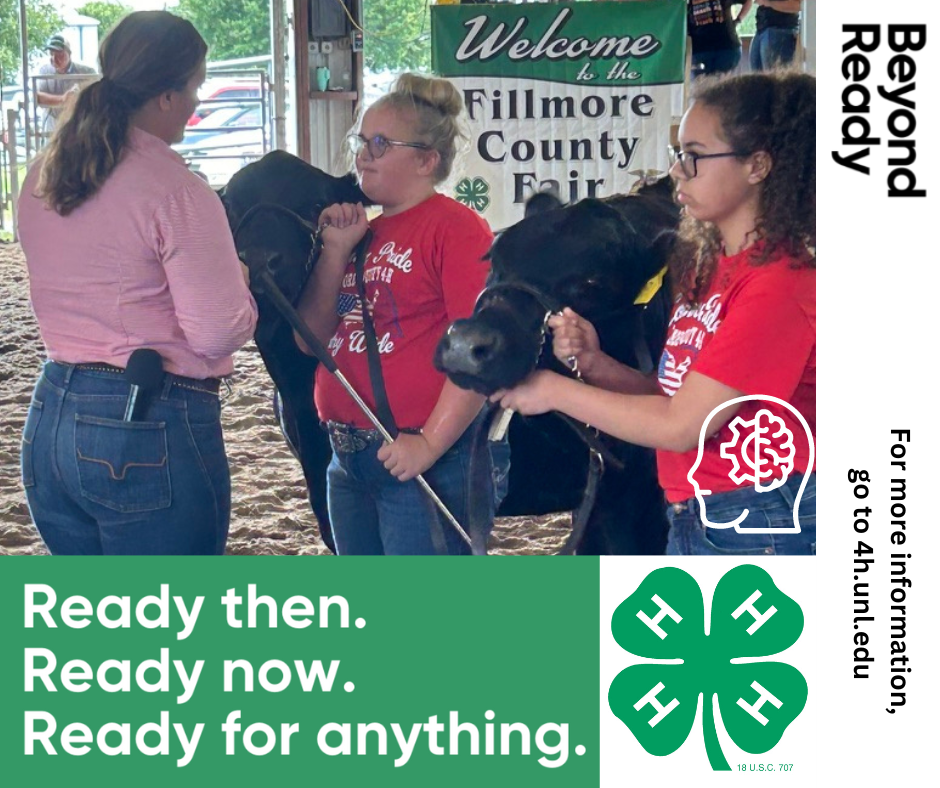
Ready then. Ready now. Ready for anything.  

Celebrate National 4-H Week!

Nebraska 4-H is building a ready generation in a world of change. Today’s youth are growing up in a unique moment where the world is rapidly changing – life following a pandemic, and artificial intelligence are just a few factors affecting mental health, confidence, and the ability to find contentment in life. 

Since its beginning more than 120 years ago, 4-H has become the nation’s largest youth development organization. Nationally, 4-H serves over 6 million youth, ages 5-19, in rural, urban, and suburban communities in every state across the nation. In Nebraska, 4-H reaches one out of three who are age-eligible.  Young people need positive youth development experiences more now than ever. 4-H equips youth with skills for the future while meeting them where they are today. 4-H provides opportunities and experiences that shape young people into their full, authentic selves, enabling them to shine both now and in the future.  

The citizens of our state have helped shape the educational priorities for the Nebraska 4-H program. These programs incorporate quality learning experiences and science literacy, which are delivered through clubs, camps, school enrichment, afterschool, and special interest opportunities. Everything offered by Nebraska 4-H Youth Development is built around positive youth development (https://4h.unl.edu/pyd) as a way of preparing young people who are engaged, healthy, productive, and beyond ready for their future. 

Engaged, Healthy, and Productive Youth 

4-H embraces diversity in people, careers, and perspectives. Every child is valuable and deserves the support and freedom to choose their own path. 4-H believes in the potential of all youth and strives to let their talents flourish. 

Nebraska 4-H fosters youths’ commitment to their communities and growing future leaders. Through community development programs, youth develop and exercise leadership skills, gain a greater awareness of their civic responsibilities, and participate in service projects. They also provide youth voice to community decision bodies and are engaged, well-informed citizens who are active in their local and global communities.   

4-H has proven to instill confidence and resiliency. Dedicated to empowering youth in both body and mind, we rely on scientifically-backed studies and programming that drive youth forward so they can be prepared for anything.  

Nebraska 4-H educates youth about making healthy and safe decisions in their daily lives. Through healthy living programs, youth gain knowledge and develop skills for making healthy and safe decisions in their daily lives, acquire an understanding of what positive relationships look like, practice healthy and safe decision-making, and exhibit increased resiliency.  

4-H equips youth with skills for the future while meeting them where they are today. Through 4-H, opportunities and experiences are offered that shape youth into their full, authentic selves, enabling them to shine both now and in the future. Through College and Career Success programs, 4-H youth develop the knowledge, skills, and mindsets through experiential learning opportunities to explore potential postsecondary education and career options. Nebraska 4-H prepares youth to make informed decisions about their careers and college paths. Programs assist young people with developing skills that will lead to greater persistence in college and employability.  

To learn more about how you can get involved, visit 4h.unl.edu.

Uncategorized

Collaboration and Teamwork

After wrapping up another county fair and heading back into other extension programming, it’s good to reflect on the county fair experience as this is one of the capstone experiences for 4-H youth. This marks nearly my nineteenth year in Extension & eighteenth fair which is hard to imagine! I am still amazed and blessed to have so many excellent and caring volunteers to make the fair a positive experience for our youth. The countless hours spent preparing beforehand allows for a much smoother week during the fair. I’d like to give a lot of credit to the entire staff of Fillmore and Clay Counties. Weeks before the fair, data is entered into the computer system, stall assignments are created, awards are ordered, reminders are sent to exhibitors about completing quality assurance, registration deadlines, etc.

Without collaboration, fair would not occur. Also, there is a lot of time spent from volunteers such as Council members and superintendents. From helping with winter/spring weigh-ins to helping answer questions and attend meetings, volunteers are engaged year-round to make the program the best it can be.

An article adapted from Belgrad, W., Fisher, K., & Rayner, S. (1995) best summarizes that “collaboration and teamwork require a mix of interpersonal, problem-solving, and communication skills needed for a group to work together towards a common goal.” The best teams I have worked with put their own agenda aside and work toward the greater good of the team. This article also provides tips for how to develop a collaborative team environment. There are five themes that must be present.

The first is trust. Being honest with the team helps each other develop respect within a team. Give team members the benefit of the doubt and work to eliminate conflicts of interest. The second is to clarify roles. When each team member knows their key roles, they can perform more effectively and can figure out ways to help each other. Next, it is important to communicate openly and effectively. Work to clear up misunderstandings quickly and accurately. It’s best to over-communicate, rather than not communicate. Learn to be a good listener and recognize team member efforts. Fourth is to appreciate the diversity of ideas. Be open-minded and evaluate each new idea and remember that it is okay to disagree with one another but learn how to reach a consensus. Often, much is learned from those who differ from you.  Finally, balance the team’s focus. Regularly review and evaluate the effectiveness of the team. Assign team members specific tasks to evaluate and provide praise to other team members for achieving results.

I’d like to thank the 4-H Council members who have so freely given of their time to make the fair a success. Of course, livestock superintendents put in a large amount of time during the fair with check-in, the show, loading animals, etc. Special thanks to the fair board for their support of the 4-H program and the countless hours they spend setting up for events, etc. Businesses and financial donors help provide youth with incentives for their projects. There are so many other individuals and businesses who are helpful and do things without any recognition and to all of you, thank you! 

Congratulations Clay and Fillmore County 4-H and FFA members on a great county fair!

Source: Belgrad, W., Fisher, K., & Rayner, S. (1995). Tips for Teams: a Ready Reference for Solving Common Team Problems. McGraw-Hill: New York.

Uncategorized

4-H Builds Friendships

As we approach this county fair season, it is important to remember how important it is to focus on the importance of the life skills being taught. As adults, we need to be role models to youth and help them have a positive experience. It’s not the ribbon placing or the trophy that matters but rather the experience one has from participation in activities such as the county fair. 

When I ask 4-H members the question, “What do you like most about 4-H?” they often respond with “the friendships!” 4-H’ers have the unique opportunity to meet and interact with youth from across the county, the state and even the country. 4-H brings together youth with similar interests and you never forget the people you meet through the program.

Friends are vital to school-age youth’s healthy development. Friendships provide youth with more than just fun playmates. Friendships help them develop emotionally and morally. In interacting with friends, youth learn many social skills, such as how to communicate, cooperate, and solve problems. They practice controlling their emotions and responding to the emotions of others. They develop the ability to think through and negotiate different situations that arise in their relationships. Having friends even affects school performance. Youth tend to have better attitudes about school and learning when they have friends there.

Friendships help youth develop emotionally and morally and help them to learn critical life skills such as social skills, communication, cooperation, problem-solving, and many more.  Part of being a good friend is learning how to deal with conflict. There are several strategies to teach youth to resolve problems they have with other youth. 

Strategies for Conflict Resolution

  • When angry, separate yourself from the situation and take time to cool off.
  • Attack the problem, not the person. Start with a compliment.
  • Communicate your feelings assertively, NOT aggressively. Express them without blaming them.
  • Focus on the issue, NOT your position about the issue.
  • Accept and respect that individual opinions may differ. Don’t try to force compliance; work to develop a common agreement.
  • Do not view the situation as a competition in which one person has to win and one has to lose. Work toward a solution that will enable both parties to have some of their needs met.
  • Focus on areas of common interest and agreement, instead of areas of disagreement and opposition.
  • NEVER jump to conclusions or make assumptions about what another person is feeling or thinking.
  • Listen without interrupting. Ask for feedback, if needed, to ensure a clear understanding of the issue.
  • Remember, when only one person’s needs are satisfied in a conflict, it is NOT resolved and will continue.
  • Forget the past and stay in the present.
  • Build “power with” NOT “power over” others.
  • Thank the person for listening.

Find out more about this topic by visiting the Nebraska Extension child and youth development website at http://child.unl.edu/child-care-professionals and click on Expanded Learning Opportunities.

County Fair Schedules

You can find the events for the Clay and Fillmore County Fairs on each extension website or social media. Locally, go to fillmore.unl.edu or clay.unl.edu.     

Uncategorized

4-H Helps Youth Thrive Series

The next several articles I will be sharing will focus on the 4-H Thrive Model which focuses on ensuring high-quality 4-H programs for youth and positive youth development. In the 4-H Thriving Model, this process of positive youth development is described by seven indicators of thriving: openness to challenge and discover, growth mindset, hopeful purpose, pro-social orientation, transcendent awareness, positive emotionality, and self-regulation through goal setting and management. This first article focuses on volunteers who are the heart of a high-quality 4-H program.

4-H Volunteers Help Youth Thrive   

Volunteers have been the long-time champions for the 4-H program, delivering 4-H experiences to youth across the nation for decades. Volunteers bring invaluable skills and resources to their role, dedicating hours to teaching youth new skills and helping them grow as leaders. It is certainly not difficult to visibly see a volunteer’s impact in this way.  

However, there are many other ways in which volunteers help youth thrive that are not as easy to visibly see. Volunteers, specifically 4-H club leaders, undoubtedly are a key part of the 4-H program and the impact on youth for years to come. But, how? This happens through developmental relationships, which are close connections through which young people discover who they are, cultivate abilities to shape their own lives and learn how to engage with and contribute to the world around them.   

Developmental relationships between youth and adults are important aspect of the 4-H program. Research shows that the relational quality between the 4-H leader, volunteer and member is connected to positive youth development. 4-H volunteers foster a developmental relationship with youth when they express care, challenge growth, provide, support, share power and expand possibilities.  

Some of the ways 4-H volunteers build a developmental relationship with youth is through a variety of visible approaches. Examples include, but are not limited to, showing youth they enjoyed spending time together, making youth feel known and valued, being someone, youth can trust and praising youth for their efforts and achievements. Implementing these approaches to having a developmental relationship with youth encourages youth to know their 4-H club leader cares about them and their success.  

Healthy developmental relationships grow over time to move past a mainly adult-driven relationship to shifting the power to the youth. In addition, as the relationship between the 4-H leader and the youth continues to grow and foster a deeper connection, the impact on the youth deepens as well.  

Thank you, 4-H volunteers, for creating 4-H experiences for youth to experience new skills and helping them grow as leaders, and ultimately finding their spark in life!  

This article was written by Jill Goedeken, Nebraska Extension Educator.

Uncategorized

Emergency Preparedness Workshop Series for Rural Families

An upcoming four-part extension workshop for women in agriculture will focus on emergency preparedness for rural families. The program will be a four-part series, held at numerous locations across Nebraska and Indiana. The series will focus on farm and ranch emergency management, first aid, fire protection and hazardous materials. Workshops will be held from 5:30 to 8:30 p.m. Central time on March 5, 7, 12 and 14.

The program is a collaboration between extension women in agriculture programs at the University of Nebraska-Lincoln and Purdue University. According to the U.S. Bureau of Labor Statistics, agricultural occupations have high rates of work-related injuries and deaths. While not all emergencies result in bodily injury or death, they also may cost rural families in other ways.

“Women play a critical role in ensuring the safety of their homes and rural communities,” said Jessica Groskopf, director of the Nebraska Women in Agriculture program. “In many farm and ranch families, safety is an important topic, but it sometimes gets overlooked because it does not directly impact profitability.”

Each state’s workshop sites will be hosted by local extension personnel. Keynote speakers will be simulcast to each location, and each site will provide additional speakers and hands-on activities. Dinner will be included.

Groskopf said the program’s structure is intended to strengthen women’s networks in rural areas, which can provide opportunities for building trust and sharing information.“Connections are so important to rural women,” she said. “We have seen the benefits that come from knowing your peers, having a place to share difficulties, and mitigate the isolation that so many of us in agriculture often feel.”

The workshops seek to help participants initiate preventative practices, set up a plan to deal with emergencies before they occur and be more comfortable reacting to emergency situations. There is a registration fee of $50 per person before Tuesday, Feb. 20. The fee increases to $60 per person after Feb. 20. Participants should plan to attend each session. A virtual option is available for those unable to attend a workshop site, although in-person attendance is highly encouraged to better network with other attendees and interact with speakers. The virtual registration fee is $75 before Feb. 20, and $80 after Feb. 20. Registration may be completed on the Nebraska Women in Agriculture website.

This project was supported by a grant from NCRCRD through funding from USDA NIFA Award #2022-51150-38141. 

Nebraska Workshop Sites

  • Beatrice — Beatrice Fire and Rescue, 300 S. Sixth St.
  • Concord — Haskell Ag Lab, 57905 866 Rd.
  • Grand Island — Raising Nebraska, 501 E. Fonner Park Rd., Suite 100
  • O‘Neill — Holt County Courthouse Annex, 128 N. Sixth St.