
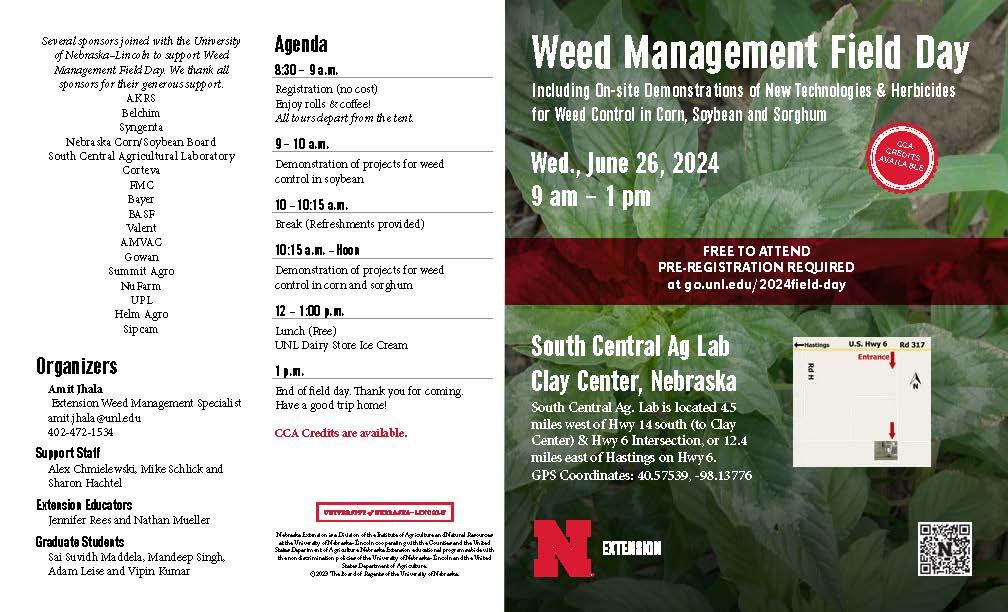
Those interested in learning the latest in weed management technologies and herbicides for weed control in corn, soybeans and sorghum are invited to attend Nebraska Extension Weed Management Field Day to be held on Wednesday June 26, 2024 from 9 am to 1 pm at South Central Ag Lab near Clay Center, NE. The Field Day is free to attend and lunch; UNL Dairy Store Ice cream will be provided. Register is required at https://agronomy.unl.edu/fieldday.
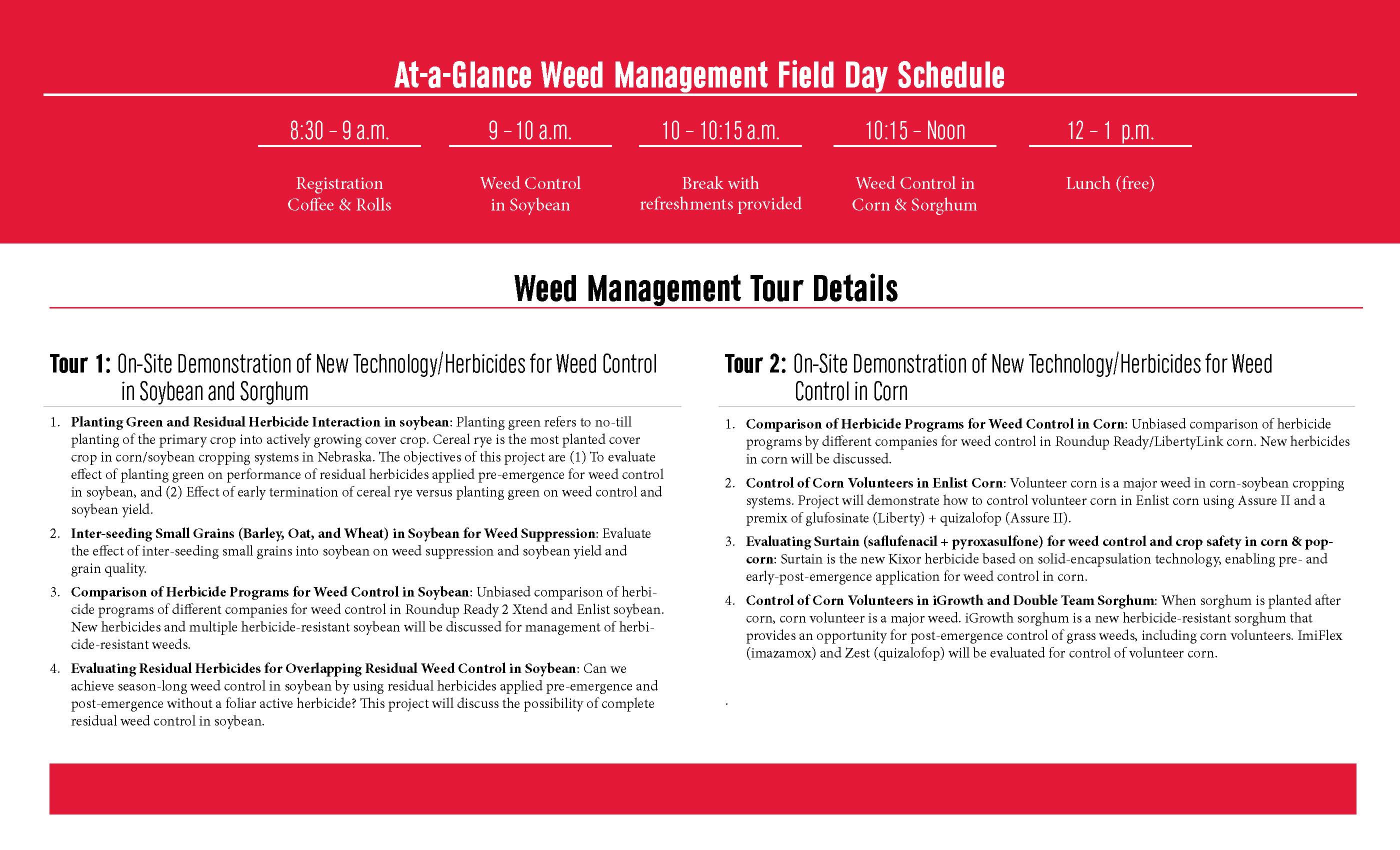
Tour one features onsite demonstrations of new technology/herbicides for weed control in soybeans in sorghum such as:
- Planting Green and Residual Herbicide Interaction in soybean: Planting green refers to no-till planting of the primary crop into actively growing cover crop. Cereal rye is the most planted cover crop in corn/soybean cropping systems in Nebraska. The objectives of this project are (1) To evaluate effect of planting green on performance of residual herbicides applied pre-emergence for weed control in soybean, and (2) Effect of early termination of cereal rye versus planting green on weed control and soybean yield.
- Inter-seeding Small Grains (Barley, Oat, and Wheat) in Soybean for Weed Suppression: Evaluate the effect of inter-seeding small grains into soybean on weed suppression and soybean yield and grain quality.
- Comparison of Herbicide Programs for Weed Control in Soybean: Unbiased comparison of herbicide programs of different companies for weed control in Roundup Ready 2 Xtend and Enlist soybean. New herbicides and multiple herbicide-resistant soybean will be discussed for management of herbicide-resistant weeds.
- Evaluating Residual Herbicides for Overlapping Residual Weed Control in Soybean: Can we achieve season-long weed control in soybean by using residual herbicides applied pre-emergence and post-emergence without a foliar active herbicide? This project will discuss the possibility of complete residual weed control in soybean.
Tour two features onsite demonstrations of new technology/herbicides for weed control in corn such as:
- Comparison of Herbicide Programs for Weed Control in Corn: Unbiased comparison of herbicide programs by different companies for weed control in Roundup Ready/LibertyLink corn. New herbicides in corn will be discussed.
- Control of Corn Volunteers in Enlist Corn: Volunteer corn is a major weed in corn-soybean cropping systems. Project will demonstrate how to control volunteer corn in Enlist corn using Assure II and a premix of glufosinate (Liberty) + quizalofop (Assure II).
- Evaluating Surtain (saflufenacil + pyroxasulfone) for weed control and crop safety in corn & popcorn: Surtain is the new Kixor herbicide based on solid-encapsulation technology, enabling pre- and early-post-emergence application for weed control in corn.
- Control of Corn Volunteers in iGrowth and Double Team Sorghum: When sorghum is planted after corn, corn volunteer is a major weed. iGrowth sorghum is a new herbicide-resistant sorghum that provides an opportunity for post-emergence control of grass weeds, including corn volunteers. ImiFlex (imazamox) and Zest (quizalofop) will be evaluated for control of volunteer corn.
 Views from VanDeWalle