Uncategorized

Christmas Trees

With Christmas around the corner, I am including an article by Nicole Stoner, Nebraska Extension Educator on Christmas trees.

According to the University of Illinois Extension, Christmas Trees came to the United States in 1747, when people in Pennsylvania decorated wooded pyramids with evergreen branches and candles. By 1850, decorated Christmas trees were a widely used tradition in America. The first Christmas tree farm was planted in 1901 by W.V. McGalliard, in response to the growing concern of over harvesting natural evergreen tree stands. Today, for every live Christmas tree that is harvested 1-3 seedlings are planted the following spring to replace those that were harvested and to account for early demise due to insect and disease issues. It is best to get a tree from a local grower to help with the local economy, but the top Christmas tree producing states are Oregon, North Carolina, Michigan, Pennsylvania, Wisconsin and Washington. This information comes from Sarah Browning, Lancaster County Extension Educator.

Photo by Vladislav Murashko on Pexels.com

Tree Selection

The most common tree species used for Christmas trees include Balsam Fir, Douglas Fir, Fraser Fir, Noble Fir, Scotch Pine, Virginia Pine and White Pine. If you have a lot of heavy ornaments, look for a Fraser Fir, Scotch pine, blue spruce or Black Hills spruce because they have stiff branches that will hold ornaments better. Balsam Fir is the choice for those looking for a Christmas tree scent. White pines can be used for areas where you prefer softer needles.

When choosing your tree, assess the tree condition. Walk around the tree to look for holes in the branching. Slightly tug on the needles that are on the tree to ensure they are tightly attached to the tree and have some flexibility. If the needles fall off with limited tugging, they are not going to last long in your home. Also, give the tree a good shake, if green needles fall off or if it has a lighter green color that is not a fresh tree. Brown needles will naturally fall from the interior of the tree, that doesn’t mean there is a problem with it.

Home Care

When you take your tree home, make a new cut on the stump of the tree to ensure a flat surface to sit on and to open pores at the base of the cut stump allowing water to flow through the tree. After cutting, be sure to place the tree into a bucket of water or into the stand with water immediately. If you do not plan to put your Christmas tree up in the home right away, place it in a cool, dark location, out of sunlight until you are able to put it in your home. Place the tree in a stand that holds at least 1 gallon of water and be sure to add water daily.

There are a lot of myths about adding things like sprite or aspirin to the water for your Christmas tree, however, research shows that just plain water works the best to ensure longevity for your tree. Just ensure that you maintain water in the tree stand at all times, once the tree runs out of water, those pores can start to clog again, and this will reduce the life of your tree in your home for the holidays.

Uncategorized

Poinsettias

With Christmas nearly here, I decided to share an article from our Extension Horticulturalist, Nicole Stoner on poinsettias.

Photo by Becerra Govea Photo on Pexels.com

A common holiday gift is the Poinsettia. If you receive one for Christmas this year, do you know how to care for it? Poinsettias are a staple for the Christmas season, but they don’t have to be a short-lived gift that is thrown away at the beginning of the year.  Typically, poinsettias are most commonly found in red, but the color range is constantly expanding. They can now be found in white, pink, green, peach, yellow, or marbled or speckled colors. On an old-fashioned poinsettia, the red-colored portion of the poinsettia is not the flower of the plant. The colored, leaf-like structures are called bracts, which are just modified leaves. The true flower of a poinsettia is the yellow center of the colored bracts.

Poinsettias need to be cared for during transport in addition to regular care. When you first purchase a poinsettia, you need to protect it as you transport it. Wrap it in a plastic bag when you take it outside to protect the plant from the cold, windy outdoor conditions. This should be done when you leave the store when you move it from your car to your home, and if you take it to another house as a gift. Remove that plastic bag each time it gets to the house. Once in its permanent location, remove the decorative foil wrapping from the pot of the plant. This foil can hold onto water for the plant but in a bad way. It can make it so that the plant roots are constantly wet and root rot can occur.

The care of a poinsettia can be easy. Water the plant when the soil becomes dry to the touch, but don’t wait until the plant wilts prior to watering again either. Place poinsettias where they will get indirect light for 6 hours a day. Keep the plant away from cold drafts and keep them from touching a window. This plant prefers temperatures of 60-70 degrees F during the day and 55 degrees F overnight. Avoid fertilization during the flowering period but fertilize monthly with a houseplant fertilizer during the rest of the growing season.

You can keep poinsettias year-round rather than discarding at the end of the Holiday season. After Christmas, grow the poinsettia like you would any other houseplant. Keep it evenly moist and in bright, indirect light. In February or March, cut back the plant to 4-6 inches in height. In May, repot into a larger pot. It can be placed outdoors in spring after frost. In the fall, bring the poinsettia indoors before night temperatures drop below 55-60 degrees F.

Poinsettias will flower after being induced by a photoperiod, like Christmas Cactus. It takes at least 12 hours of darkness per night to initiate flowering. Starting at the end of September, place the poinsettia in a closet or cover it with a box to keep it in total darkness from 5pm until 8am daily. Even the lights in our homes can interfere with the flowering cycle, so it needs to be completely dark around the plant. Once flowering begins, in mid-December, you may discontinue the daily dark period. It will help if you continue this until the bracts are fully expanded. Then, you can enjoy your poinsettia through the holiday season for years to come.

Wishing you and yours a Happy Holiday season!

Uncategorized

Happy Thanksgiving!

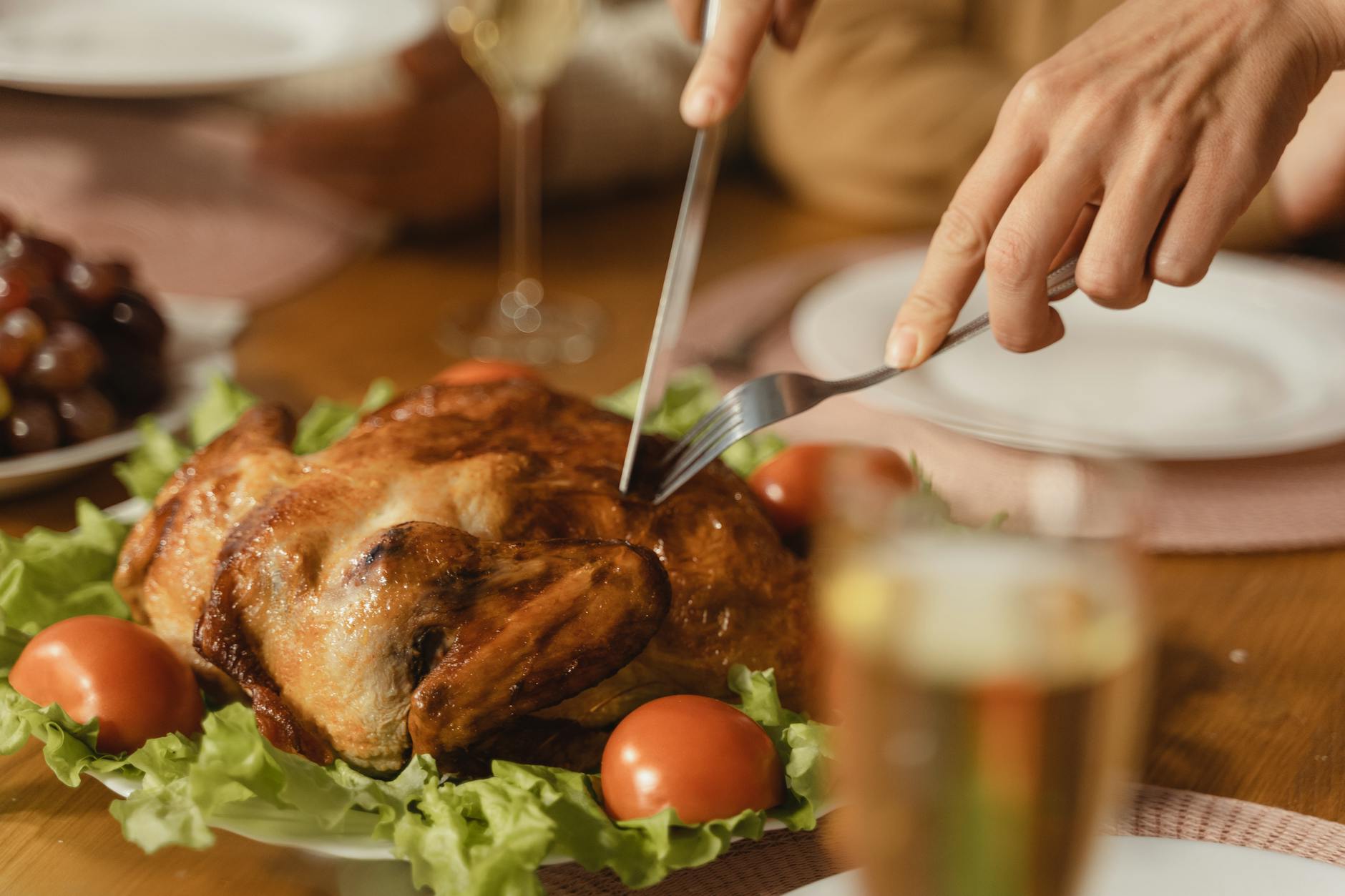
The American Farm Bureau Federation annually calculates the cost of a Thanksgiving meal to serve 10 people with plenty of leftovers. This year, with a traditional Thanksgiving meal, Farm Bureau estimated a meal total of $58.08 which is a slight decrease from $61.17 last year. This is a 5% decrease in last year’s cost. The turkey price is about $1.60 per pound compared to last year which is a 6% decrease from last year due to a decrease in demand. Included in the meal is a 16-lb. turkey, bread stuffing, sweet potatoes, rolls with butter, peas, cranberries, a relish tray of carrots and celery, pumpkin pie with whipped cream, and beverages of coffee and milk. While the decline in this year’s Thanksgiving meal costs offers some relief to Americans, this year’s meal is still 19% more expensive than the pre-pandemic levels of 2019. 

Photo by Tima Miroshnichenko on Pexels.com

You can thank our American farmers and ranchers who are able to provide us the bounty of safe and affordable food. Another interesting fact about Thanksgiving is that 88% of Americans are expected to be feasting on turkey for Thanksgiving this year (National Turkey Federation). The top turkey-producing states are: Minnesota, North Carolina, Arkansas, Indiana, Missouri, Virginia, Iowa, and California. The United States is the world’s largest turkey producer and largest exporter of turkey products.

Now let’s talk trivia:

Q: Why are turkeys raised?   A: Because of their excellent quality of meat and eggs

Q: What is a male turkey called?  A:  Tom

Q: What is a female turkey called?  A:  A Hen

Q: What sound do turkeys make?  A: Only tom turkeys gobble; the female makes a clucking sound.

Q: How many feathers does a turkey have at maturity?  A:  3,500 feathers

Q: How big was the heaviest turkey ever raised?  A: 86 pounds, about the size of a large dog

Q: Which gender of turkeys are usually consumed whole?  A: Hens (females) are usually sold as whole birds. Toms (males) are processed into turkey sausage, turkey franks, tenderloins, cutlets and deli meats.

Q: How long does it take a turkey to reach market size?   A: Hens usually grow for 16 weeks and is 8-16 lbs. when processed while tom usually takes 19 weeks to reach market weight and weighs 24 lbs. Large toms (24-40 lbs. are a few weeks older.

Regardless of what you do this Thanksgiving, remember to be thankful for what really matters.

If you need tips or resources to help you prepare a turkey or any other food for Thanksgiving, go to Nebraska Extension’s Food Website at https://food.unl.edu/article/thanksgiving-central.

Thanksgiving Food Safety

Interesting fact, the day after Thanksgiving is the biggest food borne-illness day of the year. Nebraska Extension continues to do their part to help our clientele remain heathy and have good food safety practices. The following are from Extension Educator Cindy Brison and our Food Safety Team.

One of the most frequently asked questions around Thanksgiving is “How do I thaw a frozen turkey?”…including on Thanksgiving morning! The answer to this question is an important step in meal prep for food safety. Unsafe handling and undercooking the turkey can cause foodborne illness. For information on thawing your turkey and more: https://food.unl.edu/how-thaw-turkey 

Do not wash or rinse your raw turkey! Avoid washing or rinsing a turkey (or any eggs, meat or poultry products for that matter) before cooking. Juices can transfer bacteria onto kitchen surfaces, other foods and utensils. If you must wash or rinse your turkey because of brining or other marinating processes, be sure to thoroughly clean and then sanitize all kitchen surfaces to eliminate the risk of cross-contamination. For more safety tips: https://go.unl.edu/washingturkey