Crops, Irrigation, Programming

On-Farm Research

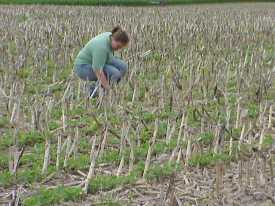
Nebraska Extension has a long history in on-farm research. In 1989, twenty Saunders County producers came together through Nebraska Extension to form the Nebraska Soybean and Feed Grains Profitability Project. This group began doing randomized, replicated research to answer questions that impacted the profitability of their farming operation. Due to the original group’s success, the idea spread to surrounding counties and in 1998 the Quad Counties research group was formed in Clay, Fillmore, Hamilton, and York Counties in south central Nebraska. Extension Educators and Specialists worked with 20 farmers to produce reliable, unbiased research. The Nebraska On-Farm Research Network builds upon the success of these two organizations, expanding on-farm research to a state-wide effort in 2012.SoybeanPopCount.JPG

On-Farm Research Brainstorming/Discussion Session:  You hear and read about various production practices and products that work for other farmers.  You may have questions regarding a specific practice or product working on your farm.  On-farm research is a way to answer this for yourself!  In the past, our area on-farm research cooperators met before the growing season to brainstorm ideas and discuss potential research topics together.  We are resurrecting this brainstorming/discussion session with it to be held on Monday, November 27th from 1:00-4:00 p.m. at the Fairgrounds (4-H Building) in Aurora.  We encourage farmers who have conducted on-farm research in the past or are considering/interested in on-farm research in the future to attend.  If you’re interested in attending, please RSVP to Steve Melvin at steve.melvin@unl.edu or Jenny Rees at jrees2@unl.edu.

Crops, Uncategorized

Consider On Farm Research

As margins get tighter in 2016, it will be important for producers to cut their costs. With so many products on the market today, it can be hard to know if they will actually increase yields as they claim, but also if it is economically feasible. The Nebraska On-Farm Research Network can help producers do just that – test products and/or production practices to determine their economic feasibility. With planting season just around the corner, consider joining the Network to evaluate products/production practices which can increase your profitability, while gaining access to Extension specialists and educators who will help you set up your research and guide you through the process. In addition, participants benefit from networking with other farmers and being part of this innovative group.

On-farm research has many variants and approaches. It is research that you do on your field(s) using your equipment and normal production practices. This means the research is directly applicable to your operation. The Nebraska On-Farm Research Network approaches topics that are critical farmer production, profitability and natural resources questions, such as:becker-beans-7-7-08.jpg

  • Nutrient management
  • Pest control
  • Irrigation Strategies
  • Conservation programs
  • New technologies
  • Soil amendments
  • Cultural practices
  • Hybrid and variety selection

Comparisons are identified and designed to answer producers’ production questions. Project protocols are developed first and foremost to meet individual cooperator needs. Only projects that are randomized, replicated and harvested accordingly are reported. Multiple year comparisons are encouraged.

In 2015 alone, 80 on-farm research studies were completed with 66 producers participating in studies. Results were presented to 250 people at update meetings in North Platte, Grand Island, Norfolk, and the ARDC near Mead in February. Planning for 2016 projects is underway. More information about project opportunities will be coming soon. If you have interest in conducting an on-farm research study, let Laura Thompson know (laura.thompson@unl.edu) or myself (brandy.vandewalle@unl.edu)!

Access to the 2015 growing season results can be found on the CropWatch website.

Crops

Nebraska On-Farm Research Network’s Projects

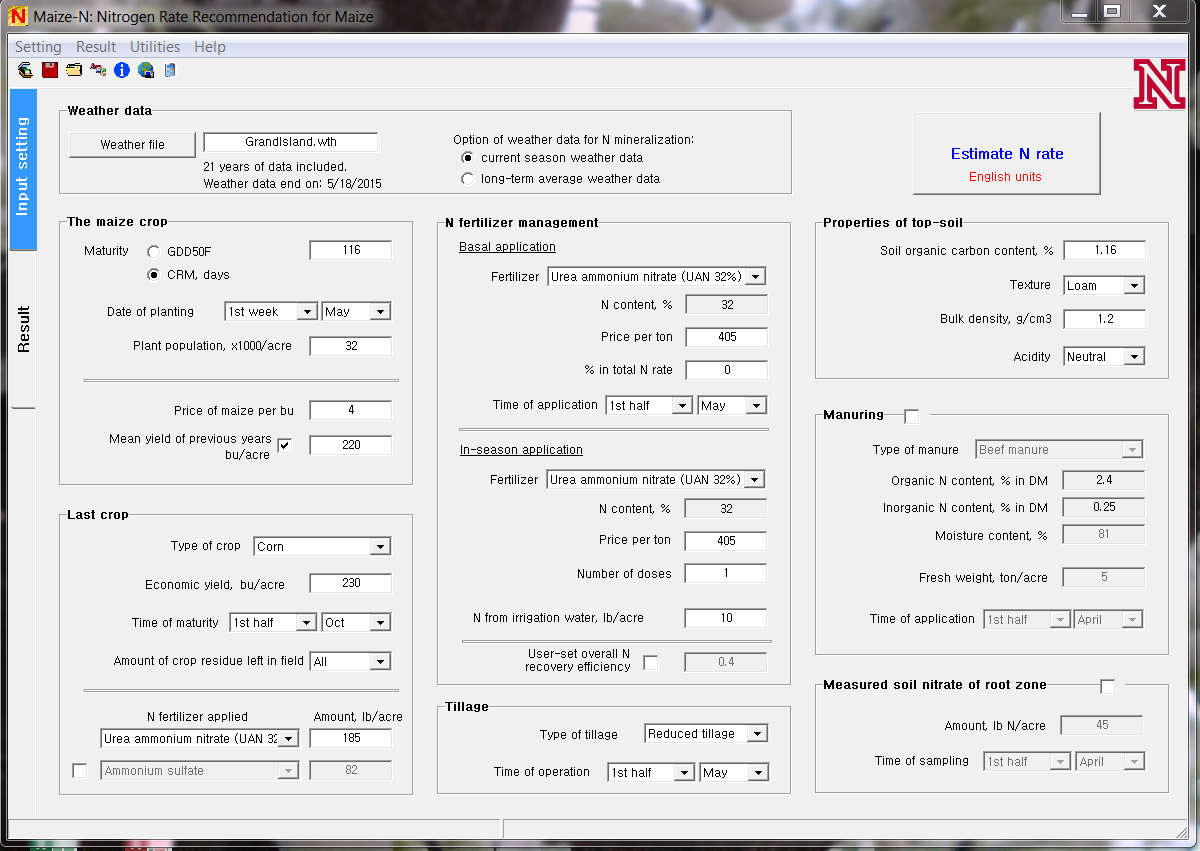
Growers who are interested in side dressing a portion of fertilizer nitrogen are encouraged to take a look at Maize-N, a decision support tool for N recommendation. Nitrogen management for corn may be improved by applying a portion of N during the growing season. This allows N fertilizer availability to more closely synchronize with the time when the crop is rapidly up-taking nitrogen.

Maize-N is a computer program developed at UNL that simulates fertilizer requirement for corn. The estimation of N fertilizer requirement in Maize-N is based on user input information on the current corn crop, last season’s crop, tillage, crop residue management, basic soil properties, fertilizer management, and long-term weather data of the field. The program first simulates corn yield potential and its year-to-year variation. It then estimates the economically optimal N rate of fertilizer to apply.Maize N input.PNG
This year, the Nebraska On-Farm Research Network is working with a number of growers to evaluate Maize-N. The study involves 2 treatments: producer’s sidedress nitrogen rate and the Maize-N sidedress nitrogen rate.

There is still time to get involved with this project and evaluate this tool for nitrogen management. You can schedule a meeting to go through the Maize-N tool to generate the nitrogen recommendation for your field. Contact Laura Thompson at 402-624-8033 or laura.thompson@unl.edu. More information about the Maize-N study is available at http://go.unl.edu/MaizeN.

Another project that growers can participate in is a late-planted soybean population research project. With consistent rain events in portions of the state, many producers still have soybeans to plant. Producers and agronomists question whether they should increase soybean seeding rates when planting soybeans late in the season due to weather delays or replant situations. Late planted soybeans form fewer nodes per plant resulting in fewer places to set pods. The thinking is that increasing seeding rates will compensate for this as well as increase canopy cover and capture more sunlight.

Most universities have suggested increasing seeding rates when planting soybeans in June. However, research done in Iowa showed that soybean seeding rates don’t need to be increased as planting is delayed to early June. Previous on-farm research conducted in Nebraska on soybean seeding rates was conducted in April and May. The results suggest that seeding rates greater than 120,000 seeds per acre (with a final stand of 100,000 plants per acre) rarely increase yield. Is the same true of soybeans planted in June? The protocol is available at go.unl.edu/latesoybean.

Finally, the Nebraska On-Farm Research Network is partnering with industry to research several products available to farmers. The studies are designed using randomization and replication so that the effect due to the treatment being studied can be evaluated. The products being studied include: seed treatment for Sudden Death Syndrome (soybean), growth promoter (corn), growth stimulator (corn and popcorn), and fertilizer Additive (corn).

For more information and to view detailed study protocols on these topics and more, visit http://cropwatch.unl.edu/farmresearch/protocols

If you have interest in conducting a study or would like more information, contact me, Keith Glewen, kglewen1@unl.edu, 402-624-8005 or Laura Thompson, laura.thompson@unl.edu, 402-624-8033.