Programming, Uncategorized

Extension’s Robust Programming

Last week I briefly highlighted areas Nebraska Extension is involved. This week’s article will touch on some of the key issues Extension focuses, based on stakeholder input. Nebraska faces critical issues we must address to make our world a better place. Many of these issues are complex, multidisciplinary, and challenging, yet they present us with great opportunities to help shape a future that is promising for our state and nation (NE Extension, 2016).” With this in mind, in order for Extension to help clients be successful, Extension faculty and staff are highly focused on specific issues in interdisciplinary teams, called Issue Teams.

IssueTeamThis list will continue to evolve over time as issues change, but currently consist of: Insect ecosystems (including pollinators), healthy lifestyles for children and youth, resistant & invasive pests, Nebraska leaders, college & career success, engaging underserved youth, climate variation, consumer confidence in food, children learning experiences, emerging technology for agriculture, efficient water use, ag producer economic viability, livable communities, STEM careers, water & soil protection, youth entrepreneurship food access and diversified ag production.

With my background in agricultural education, I will be moving towards more youth development programming related to crops and agricultural education. I am able to reciprocate youth crop/ag programming with my colleagues, as they provide programming in their expertise area in Fillmore County. This week I’d like to introduce you to my Extension colleagues serving Fillmore County and their respective regions.

Food, Nutrition & Health – Kayla Colgrove, Gage County
Beef (& Livestock) Systems – Duane Lienemann, Webster County
The Learning Child – Leanne Manning, Saline County
Community Environment (Horticulture) – Nicole Stoner, Gage County
Crops & Water – Me as I transition into more youth development; it will be the new educator in Clay County when hired.
4-H Youth Development – Me! I will also serve Clay County as I move towards more youth programming.

You might wonder how this will impact the service you receive, when in fact Extension always has had a network of faculty in these disciplines. The biggest advantage with this structure change is that faculty is more focused in their respective disciplines, thus providing clients better service and programs. It also helps clientele establish improved relationships with Extension faculty as we serve our accountability regions. Even if you do not physically go into an Extension office or use our web tools, apps or publications, it is likely the information a farmer received from a crop consultant or salesman came from UNL research or Extension programming. Food handlers at restaurants were probably trained by Nebraska Extension’s Serve Safe program and parents going through a divorce take a course taught by, you guessed it – Nebraska Extension faculty! We are sometimes referred to as the ‘best kept secret’ which is why I’m taking some time this week to share just a couple examples of programs you might not be familiar.

As it says on our Extension website, the University of Nebraska-Lincoln Extension is a nationally respected educational leader. We work in a rapidly changing world, yet one familiar phrase seems most appropriate for Extension’s future: “The future is what we choose to make.” We have a responsibility to our clientele and colleagues to maintain high quality educational programs and a relevant and responsive organization.
Crops, Horticulture, Irrigation, Livestock, Programming, Uncategorized, Youth

What is Extension?

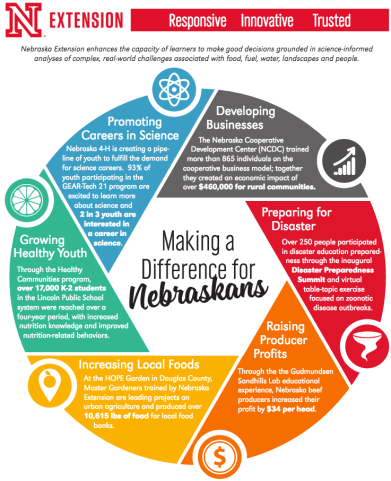
Often times when I tell people I work at the “Extension Office” they have no idea what it is we do. It is so hard to describe without giving a plethora of information. One of our signature programs people often most often associate with is the 4-H program. While this is a large and very successful component of Extension, it is only one of many programs.ExtensionDifferencepic

Everyday, whether you know it or not, you have most likely been indirectly impacted by Extension programming. Extension essentially takes science and research-based information from the University Of Nebraska – Lincoln and delivers it into the hands of the public. We make UNL easily accessible to the public. For example, we provide services and resources to the agricultural community, but also sectors as diverse as nutrition, health care and technology. From border to border, Nebraska Extension is making an incredible impact on the success of our state – its youth, its families, its farms & ranches, its communities, its economy.

For example, as a result of our Learning Child Extension staff, approximately 24,000 children in Nebraska benefit from early childhood professionals and parents who have the essential skills and knowledge to support the healthy growth and development in the children in their care. Take the crops area: last year, Extension presented workshops in 94 locations to over 4,000 participants from 93 Nebraska counties, 9 U.S. states and 4 foreign countries. Our community vitality programming has engaged over 10,000 Nebraskans in Broadband planning and engaged over 2,500 people through the Entrepreneurial Community Activation Process which resulted in community-wide visions, a new economic development corporation being started, community web portal and a young professional network.

Nebraska Extension continues to evolve and is one of the leading Extension programs in the world. In doing so, Extension Educators are more focused in their area of expertise and able to provide clients with robust information. For example, Extension staff covers a specific region to ensure clients are being served well. Each county has access to a professional in the areas of:

  • Community environment (horticulture)
  • Food, Nutrition & Health
  • Crops & Water
  • The Learning Child
  • Community Vitality
  • Beef & Livestock Systems
  • 4-H Youth Development

This has been a very brief overview of Extension and next week we’ll discuss how this impacts our multi-disciplinary programming and Fillmore County.

Programming, Uncategorized, Youth

Extension Tractor Safety Courses

Nebraska Extension Tractor Safety/Hazardous Occupations Courses will be offered at seven locations in Nebraska during May and June. Any 14 or 15-year-old teen that plans to work on a farm other than his/her parents’ should plan to attend. Federal law prohibits youth less than 16 years of age from working on a farm for anyone other than his or her parents or guardian.   Certification through the course grants an exemption to the law allowing 14- and 15-year-olds to drive a tractor and to do field work with mechanized equipment.tractorsafety

The most common cause of death in agriculture accidents in Nebraska is overturn from tractors and all-terrain-vehicles (ATVs), according to farm fatality surveillance data. Tractor and ATV overturn prevention are featured in the class work. Instilling an attitude of ‘safety first’ is a primary goal of the course, according to class instructors, where youth have the chance to learn respect for agricultural jobs and the tools involved.

Classes consist of two days of instruction plus homework assignments. Classes are from 8 a.m. – 5 p.m. each day. Class dates and locations closest for our area include:

— May 23-24, Fairgrounds, Kearney
— June 20-21, Fairgrounds, Wayne
— June 23-24, College Park, Grand Island

Pre-registration is strongly encouraged at least one week before a location’s start date to the Extension Office at the course site. Cost is $60, which includes educational materials, testing, supplies, lunches and breaks. For more information, contact Aaron Yoder at (402) 552-7240, aaron.yoder@unmc.edu or Ellen Duysen at (402) 552-3394, ellen.duysen@unmc.edu.

The first day of class will consist of intensive classroom instruction with hands-on demonstrations, concluding with a written test that must be completed satisfactorily before students may continue driving tests the next day.  Classroom instruction will cover the required elements of the National Safe Tractor and Machinery Operation Program. Homework will be assigned to turn in the next day.

The second day will include testing, driving and operating machinery. Students must demonstrate competence in hitching equipment and driving a tractor and trailer through a standardized course as well as hitching PTO and hydraulic systems.

Crops, Horticulture, Uncategorized

Pesky Purple Weed

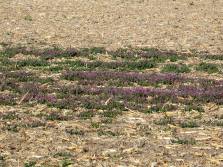
People have asked me about the purple weed that has emerged in fields and lawns. Most likely that flower is henbit that is an annual forb in Nebraska and a member of the mint family, which means it has a square stem. It has distinctive leaves with crenate and lobed leaf margins and purple to pink flowers. For control, this weed is a winter annual, which means the seed germinates in the fall and the small plants overwinter before growing aggressively in early spring. It flowers in April and May and dies in the hot, dry summer weather. Flowers can produce a lot of seed, which is one reason henbit infestations can increase each year.Henbit

Control of henbit this time of year is not recommended because the plant will die shortly. The best option for control is to hand pull the weed in lawns. This has the advantage of minimizing the amount of seed production for next fall. If henbit infestation becomes unacceptable, then apply a PRE herbicide in late summer to early fall. Finally, henbit that does germinate in the fall will be killed with the same POST herbicides that are used to control other pesky weeds like dandelions and creeping Charlie. Other management options for henbit control include, 1) maintaining a healthy and vigorously growing lawn or 2) adding a deep layer of mulch to landscape beds.

Programming, Uncategorized, Youth

Progressive Ag Safety Day

Statistics from those impacted by a farm-related injury or death are sobering. Many know someone who was impacted by a farm accident that in many cases could have been prevented. This is why I feel so passionately about conducting the Annual Progressive Safety Day each year. The Progressive Agriculture Foundation provides safety and health information to rural communities that need it, which is why I’ve teamed up with them. The mission of Progressive Agriculture Days is simple – to provide education, training, and resources to make farm and ranch life safer and healthier for children and their communities.Safety_Day

During the program’s first year, a total of 2,800 participants and volunteers were reached throughout the South and Midwest and now the program impacts close to 110,000 annually. To date, the program has impacted more than 1.3 million children and adults.

Current 1st through 6th graders are invited to attend Progressive Agriculture Safety Day on Thursday, May 26, 2016 at the Fillmore County Fairgrounds. Youth will participate in a variety of events designed to help them be aware of safety in potentially hazardous situations such as bike riding, agricultural settings, electrical safety and others. This year, youth will walk away with an emergency disaster kit to use in the case of storms and other emergencies. Registration and consent form is REQUIRED by all youth who participate. This can be found on the Fillmore County Extension website.

April 28th is early bird registration at only $3 per child that includes a t-shirt, lunch, snack and goodie bag. After April 28th registration increases to $5 per youth in order to participate.

This event is hosted by Nebraska Extension in Fillmore County, Shickley and Fillmore Central FFA chapters, 4-H and W.I.F.E. For more info or to register, call 402-759-3712 or email brandy.vandewalle@unl.edu.

Uncategorized, Youth

4-H Shout Out Campaign

One of the most impactful programs I participated as a youth was 4-H. I learned responsibility, leadership skills, life skills that help me today and confidence. Recently, National 4-H launched a national campaign to highlight the accomplishments of our young people. Details of this campaign are highlighted and it is encouraged to take part and share those accomplishments through social media.

TrueLeader

Every day, millions of kids across America are leading positive changes — large and small — in their lives, schools and communities. But today’s youth don’t get credit often enough for the progress they are making or the good things they are doing.

Nebraska 4-H Youth Development within the University of Nebraska—Lincoln believes that every child has valuable strengths and given the chance, can grow into confident, responsible and compassionate young people who have the power to realize their dreams and lead change… who learn and lead by doing… True Leaders.

This week, 4-H is launched a national campaign focused on highlighting the accomplishments of young people. In the community, you may see the campaign in action through television and radio public service announcements, special events, social media advertising, and more.

It is also strongly encouraged to participate in this special campaign by taking time this week to “Shout Out” through social media the amazing and unique things that your 4-H youth are accomplishing in your community. Here are a few simple steps to follow to help you recognize youth:

1) Create social media posts on Facebook, Twitter, or Instagram. Share in your post a photo or video of youth. Tag others pictured if possible.
2) Add Hashtags. Be sure to add the hashtags #TrueLeaders AND #NE4H (specific to Nebraska) to your post.
3) Post and Post Often!

More information can be found on the Nebraska 4-H web site. Our goal is to inspire 100,000 shout outs for kids across the country. For every Shout Out, there’s one more person being a champion on behalf of a young person, and one more kid being recognized for the great thing they are doing.

Thank you for helping 4-H “Shout Out” true leaders! Your support here in Nebraska is greatly appreciated!

Uncategorized, Youth

Get Involved!

One of the many great things about the 4-H Youth Development program is the family time that often occurs. Whether it is working on a project, attending club meetings together, working at 4-H events or learning more about their projects, the opportunity for family involvement is huge! As a youth myself, I remember countless hours of my Dad helping me with my 4-H calves and lots of hours of time spent on sewing, gardening and craft projects with my mom. My grandma4H family wordle taught me so much about baking and that is where I developed my love of making yeast breads and rolls. At the time, I thought I was just learning about projects to take to the fair, but I was actually learning life skills that have benefitted me even now. My colleague, Eric Stehlik from Saline County shared with me information on more benefits youth obtain from family involvement with their activities.

Becoming involved in children’s 4-H activities is a great way for families to grow and develop. Whether parents are attending club meetings or teaching their children about animal care, rocketry or entrepreneurship, they are helping to build stronger relationships and families.

Research shows that young people need caring relationships with adults to help them grow and develop positively. Parents can build these relationships by becoming involved in their children’s activities. Grandparents, aunts, uncles and other extended family members should become involved too because they also play important roles in the lives of children.

4-H’ers participate in a variety of individual and group projects, and family members can be a part of these learning experiences. If a participant is enrolled in foods and nutrition, a family member can teach them proper food safety. This can then easily become a part of daily life. Just interacting and communicating can help family members learn more about each other and grow closer.

Families can also benefit from participating in 4-H community service projects. They can help with a food drive by donating supplies from their own cupboards, asking neighbors for a donation or making a cash donation to the local food pantry. What matters is that families do these activities together. Not only will family members have fun, but also they will help their community and grow closer together, all at little or no cost!

Uncategorized

Fun Food Facts

Did you know? 

Easter candy facts include:

  • As many as 5 million Marshmallow Peeps, bunnies, and other shapes are made each day in preparation for Easter.
  • In 1953, it took 27 hours to create a Marshmallow Peep. Today it takes six minutes.
  • Yellow PeEASTEReps are the most popular, followed by pink, lavender, blue, and white.
  • Adults prefer milk chocolate (65%), to dark chocolate (27%).
  • Americans consume 16 billion jellybeans at Easter, many of them hidden in baskets. If all the Easter jellybeans were lined end to end, they would circle the globe nearly three times.
    (Source: National Confectioners Association)


Egg Facts 

  • Laying eggs is hard work! In fact, it takes 24-26 hours to complete the process, according to research from the University of Illinois-Urbana. Even the best brood hens cannot lay more than one egg a day.
  • If you lay all of the *PAAS® wire dippers end-to-end, they would equal the height of 6,628 Washington Monuments.
  • Today, Americans purchase more than 10 million PAAS® Easter Egg Color Kits during the Easter season, and use them to decorate as many as 180 million eggs!
    (Source: PAAS®)

*Note: Extension does not endorse use of any product over the other.

Programming, Uncategorized, Youth

NE Extension Tractor Safety Courses

With planting season right around the corner, there will be a lot of tractors out on the roadways. As a reminder, any 14 or 15 year old who plans to work on a farm other than his/her parents’ needs to participate in Nebraska Extension’s Tractor Safety/Hazardous Occupations Course. This course will be offered at seven locations in Nebraska during May and June.

Federal law prohibits youth less than 16 years of age from working on a farm for anyone other than his or her parents or guardian. Certification through the course grants an exemption to the law allowing 14- and 15-year-olds to drive a tractor and to do field work with mechanized equipment.TractorCourse

The most common cause of death in agriculture accidents in Nebraska is overturn from tractors and all-terrain-vehicles (ATVs), according to farm fatality surveillance data. Tractor and ATV overturn prevention are featured in the class work. Instilling an attitude of ‘safety first’ is a primary goal of the course, according to class instructors, where youth have the chance to learn respect for agricultural jobs and the tools involved.

Classes consist of two days of instruction plus homework assignments. Classes are from 8 a.m. – 5 p.m. each day. Dates and locations include:

— May 23-24, Fairgrounds, Kearney
— May 26-27, Fairgrounds, McCook
— June 2-3, Fairgrounds, Valentine
— June 13-14, West Central Research and Extension Center, North Platte
— June 16-17, Legacy of the Plains Museum, Gering
— June 20-21, Fairgrounds, Wayne
— June 23-24, College Park, Grand Island
— July 6-7, Fairgrounds, Gordon

Pre-registration is strongly encouraged at least one week before a location’s start date to the Extension Office at the course site. Cost is $60, which includes educational materials, testing, supplies, lunches and breaks. For more information, contact Aaron Yoder at (402) 552-7240, aaron.yoder@unmc.edu or Ellen Duysen at (402) 552-3394, ellen.duysen@unmc.edu.

The first day of class will consist of intensive classroom instruction with hands-on demonstrations, concluding with a written test that must be completed satisfactorily before students may continue driving tests the next day.  Classroom instruction will cover the required elements of the National Safe Tractor and Machinery Operation Program. Homework will be assigned to turn in the next day.

The second day will include testing, driving and operating machinery. Students must demonstrate competence in hitching equipment and driving a tractor and trailer through a standardized course as well as hitching PTO and hydraulic systems.

Crops, Livestock, Programming, Uncategorized

Passing the Farm to the Next Generation

At our final Farmers & Ranchers College program for the programming year, Dr. Ron Hanson from the University Of Nebraska – Lincoln Ag Economics Department spoke on the Importance of Family Farm Succession. This is never an easy task, yet essential for the farm to be passed on and able to financially operate. Most importantly, it is important to maintain relationships with family members and honor the wishes of the parents who intended for assets to be transferred a certain way.IMG_4969

Hanson had eleven challenges families face in order to being this process.

  1. First consider “Who is family” and is entitled to owning the farm. Are in-laws considered family? Usually excluding in-laws will backfire and cause hard feelings.
  2. It is difficult for parents to not play favorites with their adult kids. Parents should be fair and equitable, which is different than equal. Unfortunately, there are adult kids who are greedy and plan to retire on their parents’ assets, which is not an acceptable retirement plan. Parents should consider who has always taken care of them and which kids will care for them in end of life situations.
  3. Controlling parents need to give control of the farm/ranch to the adult kid who is farming. Serve as mentors and hand over responsibility to the future owner.
  4. Consider when farm ownership will happen. How will those changes occur?
  5. Think about if it is possible to keep the farm in the family. Are there kids who actually want to farm?
  6. Too often families don’t talk about the “what-ifs”. If a parent or adult kid were to tragically die tomorrow, are you prepared for that?
  7. If parents don’t agree on how to transfer assets, more than likely nothing will get done.
  8. Some children feel they are entitled. Children should RESPECT their parents and agree to their parents’ decision. Your parents don’t owe you anything.
  9. Greed has become a curse of family wealth and assets. Wealth can destroy family relationships and end a family legacy. No farm is worth losing family relationships!
  10. Families that don’t communicate openly about the parents plans are more likely to be unsuccessful with a succession plan. Parents must talk openly and honestly to all children – preferably at the same time. Parents should ask their children:
    1. Have we as parents done anything to make you not get along as a family when we are no longer here? If so, please tell me. Then apologize.
    2. Is there any reason you kids can’t get along as a family?
  11. Each family farm/ranch should have a vision. Family members should share this vision.

Family farm succession is time consuming, complicated and emotionally draining, but essential! After all, consider all of the hard work you have done to keep it going through rough economic times; why wouldn’t you put a plan together to protect it?