Crops, Programming

From Farms to Families Program

A program designed to empower women in agriculture through education.


Today’s agriculture is constantly changing, making it important for producers and their families to stay knowledgeable of current issues. Risk management is more important now than ever for agricultural producers, so to address some of the issues producers face, a program was developed by UNL Extension.  From Farms to Families is a program designed to empower women in agriculture with a better understanding of the issues that affect their operation’s profitability.

 This exciting program for women will be held on February 2nd and 16th from 6:00 to 8:30 p.m. at the Opera House in Bruning, NE. During the first session, participants will learn how to develop their green thumb, become a more informed citizen about animal welfare policies and learn a quick and easy healthy meal that can be prepared in a crock-pot.  The second session focuses on canning and food preservation, learning about some basic animal health issues and learning another healthy meal option that can be prepared quickly and conveniently.  

Cost of the program is $25 for one session or $45 for both sessions. The price includes all materials and a light meal.  Deadline to register for the February 2nd session is January 26th and February 9th for the February 16th session.

To register, call UNL Extension offices in the following counties: Fillmore 759-3712, Nuckolls 225-2381 or Thayer 768-7212.

 Pesticide Safety Education Programs

Those needing to renew their Private Pesticide Applicators License or to be licensed for the first time may do so by attending a PSEP training session.  I will be holding sessions in Fillmore County:

February 8th, 2:00 p.m., Ag Hall – Fillmore County Fairgrounds, Geneva
February 9th, 2:00 p.m., Courthouse Clubroom – Thayer County Courthouse, Hebron
February 9th, 6:00 p.m., Courthouse Clubroom – Thayer County Courthouse, Hebron
February 21st, 6:00 p.m., Ag Hall – Fillmore County Fairgrounds, Geneva

The sessions last approximately 3 hours.  In addition to the core requirements concerning pesticide safety, I will present agronomy information that is pertinent to the area, on-farm research results and other UNL research updates.  The UNL Extension program fee is $30.00 for this session.  A complete list of locations across Nebraska accessed at this website . If you are unable to attend in Fillmore County, you may attend a session in a different county or by home study, which costs $60.00.

Livestock, Programming, Uncategorized

Farmers and Ranchers Cow/Calf College on January 17

The annual Farmers and Ranchers Cow/Calf College “Partners in Progress – Beef Seminar” will be held at the U.S. Meat Animal Research Center and Great Plains Veterinary Education Center near Clay Center on January 17, 2012 with registration, coffee and donuts starting at 9:00 a.m. and going till 9:45 a.m.  The program will run from 9:50 a.m. until approximately 3:45 p.m. This program is sponsored by the University of Nebraska-Lincoln Extension’s Farmers and Ranchers College and will feature several outstanding speakers discussing issues and management strategies that can affect the profitability of all beef producers. There is no cost for the event and the public is invited. It does include a noon meal which means that early registration is necessary to reserve a plate. 

The “Cow/Calf College” will kick off at 9:50 a.m. with a welcome by Dr. John Pollak, Director of USMARC. He will also give a short overview on research that is happening at the Meat Animal Research Center. He will be followed by the first speaker, Ross Baker, with the Nebraska Department of Agriculture, who will present “ADTS – New Regulations for Cattle Crossing State Lines”.  Kelsi Wehrman, Farm Bill Wildlife Biologist with the USDA-NRCS will then explain “Prescribed Burning to Control Cedars & Increase Forage Quality”. 

Lunch will be provided and will be handled with a rotation system during three noon sessions featuring the return of area cattlemen, Ken and Zach Herz, who will provide sessions on a“Follow-up on Packed Manure Bed Beef Barn – One Year Later”.  As the title suggests, they will give the results of their first year in the large 200’ by 100’ barn that was built for confined beef management. It is one of the first in Nebraska and is located near Lawrence, NE. Also in the rotation will be a chance to see and hear about the “UNL Beef Mobile Lab” which takes “Hands-on Animal Science” on the road. UNL Extension Educators Brent Plugge and Bob Meduna will explain what they are doing, and you can actually see and experience the mobile lab.

We are, and will be in the unforeseeable future, facing a plethora of issues that affect animal agriculture, learn what they are. The afternoon session will start with Jordan Dux, National Affairs Coordinator with the Nebraska Farm Bureau who will give us an “Update on Federal & State Ag Issues” that are likely to affect cattlemen and the agriculture industry.

This year’s capstone address will be delivered by Dr. Ronnie Green, UNL Vice-President and IANR Harlan Vice Chancellor, who will present “Feeding the Global Future with Red Meat Innovation”. There is no doubt that agriculture faces a challenge with the impending explosion of population world-wide and the need for protein for each of those people. Where is red meat production positioned to help face those challenges?

All presenters will then join on stage to pull everything together, give their final thoughts and considerations and then avail themselves for a coffee-shop style panel discussion during which cattlemen can ask questions and get answers on topic questions that came to them during the day’s sessions. A chance for door prizes will be awarded to those that stay for the entire event.

Any interested individual should pre-register by January 12th, 2012, by calling (402) 746-3417 to insure a seat and lunch. Walk-ins are accepted, but may not get a lunch. You may also email your registration to Dewey Lienemann at:  dlienemann2@unl.edu

Livestock, Programming

Animal Welfare and Industry Issues Program for Livestock Producers

As the world population continues to grow; safe and wholesome food production remains a top priority. It is essential that livestock producers make themselves familiar with the perceptions and perspectives of animal welfare in relation to consumers, retailers, and advocacy groups.

 Four educational programs for livestock producers will be held across Nebraska to address these issues. In addition, these educational programs will provide information on the most current industry issues. Dates and locations for the educational programs are as follows: February 6, 2012: West Point; February 7, 2012: Lincoln; February 8, 2012: Kearney; and February 9, 2012: Gering; registration is at 9:30 am and the program is 10:00 am to 5:00 pm.

The educational programs are designed to give livestock producers the knowledge needed to continue to do what they do best—feed the world. Early bird registration (before February 1, 2012) is $50 per person and $25 for each person from the same operation; registration at the door is $60 per person, and $30 for each additional person from the same operation. Price includes meal, break, and proceedings. These educational programs are being sponsored by the University of Nebraska – Lincoln.

Speakers include: Dr. Candace Croney, Purdue University; Dr. Dan Tompson and Dr. Glynn Tonsor, both from Kansas State University; and Mr. Jim Robb from the Livestock Marketing Information Center.

For more information please contact one of the following Extension Educators, or visit their county website for the program brochure: Lindsay Chichester, Richardson County, 402-245-4324, richardson.unl.edu; Denny Bauer, BKR Counties, 800-634-8951, bkr.unl.edu; or Troy Walz, Custer County, 308-872-6831, custer.unl.edu.

CropWatch Survey

 Please take a few minutes to complete the CropWatch survey which asks readers who use the newsletter, how you use mobile and social media, what you like about CropWatch and suggestions for it. Understanding reader needs and preferences will help us fine-tune what we provide and what we develop for further mobile uses.

 The survey completion deadline has been extended to Dec. 30 to provide further time for responses. Your assistance in providing input would be greatly appreciated. Go to the survey.

Crops, Irrigation, Programming

Farmers Overcoming Challenges to Increase Profit

 This week, I’m highlighting an article from Daryl Andersen from the Little Blue NRD promoting an upcoming event. Producers deal with challenges every day from weather concerns, plant conditions and fertilizer applications and costs. Today’s technology and current knowledge can help in easing these concerns. Representatives from UNL or the NRD are always available to assist producers in utilizing the technology and gaining the knowledge to increase the producer’s bottom line.

On January 4, 2012 the Little Blue NRD will be hosting a Soil and Water Conference in Davenport, NE. at the Community Building from 10 am to 3 pm. This is the second year of this type of conference in which producers can learn new ideas from presenters and also get a chance to talk to local exhibitor’s booths set up for the day. This conference is designed for everyone from rural to urban residents and attendance is strongly encouraged, as topics could affect everyone’s way of life.

A presenter from the EPA will talk about fertilizer applications on lawns and cropland and why this is becoming a national issue. Knowledge of these topics is necessary as what we do here does have a major effect on the river systems and groundwater. Learning how to cope with these topics will help in improving best management practices, gain knowledge on how weather patterns are affecting your farming practices and what you can do to protect yourself.

Other topics include predicting your corn yield with UNL Hybrid-Maize and interpreting the soil sample. Producers are always wondering what their corn yield will be and with this computer program this can be done during the season. Ever wondered how the fertilizer recommendations are formulated or what micro-nutrients should I be soil sampling for? Presenters will be explaining what is needed and what could be unnecessary tests.

Come see the map on a recently completed water study conducted by JEO for the Little Blue NRD. The LBNRD Board has changed the rules on well permitting utilizing these maps and a risk analysis point system is being used on each well permit. Staff will show how the point system works and you can even get your property analyzed.

The NRD and UNL-Extension have been working with cooperators within the area to improve irrigation management. Producers have been using crop ET (evaporation-transpiration) information, soil moisture sensors and data loggers to assist in making timely irrigation decisions. Information and cost-share sheets will be available at this conference.

Everyone is invited and a free lunch will be served. If you plan on attending, it is requested that you RSVP to the NRD office at 402-364-2145 or email dandersen@littlebluenrd.org by December 27, 2011 for a meal count. If you are interested in exhibiting your products at this conference, you can get more information by contacting the Little Blue NRD.

Crops, Programming

Crop Production Clinics

Pesticide resistance, crop production updates, and what’s new in pest management will be among the topics presented at this year’s Crop Production Clinics. The clinics, which will be held at nine sites across the state in January, also include provisions for pesticide applicator recertification.

Other topics being presented by Extension specialists and educators include:soil fertility

  • soil water and irrigation management,
  • ag business management & policy
  • pesticide safety
  • and disease, insect and weed pest management.

Representatives from the Nebraska Department of Agriculture will be present to verify attendance for pesticide applicator recertification. For commercial and noncommercial pesticide applicator, this will be the primary venue for you to renew your license in any of the following categories: Ag Plant (01), Regulatory (REG),  and Demonstration/Research (D/R).  For private pesticide applicators the Crop Production Clinics will serve as a venue for you to renew your license.

Certified Crop Advisors may earn CEUs in the following categories:

  • Integrated Pest Management (6 CEUs)
  • Soil and Water (2 CEUs),
  • Nutrient Management (1 CEU), and
  • Crop Production (3 CEUs).

Attendees can earn a maximum of 6 CEUs at a location. Certified Crop Advisors are required to bring their CCA number to apply for CEU credits.

For further information on pesticide applicator recertification costs, visit the Crop Production Clinic website.

            The annual Crop Production Clinics will be held at nine locations across Nebraska in January 2012. The Clinics will provide valuable information to help crop producers and agribusiness professionals improve their profitability and safety.  Closest locations to us include:

            Jan. 4th – Beatrice – Classic’s (Beatrice Country Club)
            Jan. 5th – York – The Auditorium
            Jan. 10th – Hastings – Adams County Fairgrounds

Uncategorized

Interconnectedness of Events

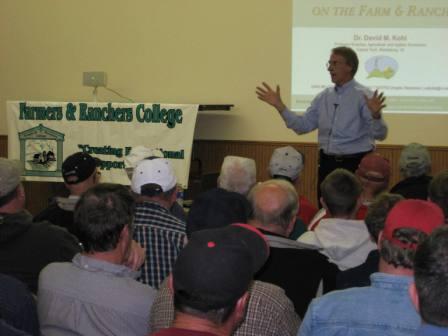
Last week we kicked off the 2011-2012 Farmers & Ranchers College series with Dr. David Kohl from Virginia Tech with “Global Economic Impacts on the Farm & Ranch”. Over 150 participants heard Kohl describe how events across the world affect our farms and ranches more than ever. He emphasized that words to remember are “interconnectedness of events”. What happens in the BRICS (Brazil, Russia, India, China, South Africa) will ultimately affect U.S. farm and ranch profitability, as these countries continue to demand more food, fiber and fuel. As these countries gain momentum in global competiveness, Kohl stated, “The long term viability of these nations will be defined by the way they handle adversity.” A defining moment in each country will either make or break them, such as a change in leadership, social unrest, etc.

As an economist, Kohl provided lots of key numbers to watch for, but reminded us that usually a grain and row crop “super cycle” lasts for only 2-3 years, but we are in an 8 year super cycle, so what does that mean? No one can know for sure. One thing for producers to note is that unlike the 1980’s when the debt to income ratio was 14:1, the 2011 projected debt to income ratio is 2.35:1, meaning agriculture is not in a credit bubble, but rather in an asset bubble.

When deciding whether to acquire land or expand one’s operation, Kohl has a simple checklist to consider:

  • Have you been profitable in the last three years?
  • Will the land/expansion results in greater than 50% equity?
  • Do you have working capital to revenue of 33% or more after expansion?
  • Will overall profitability after expansion exceed interest rates?
  • Will overall profitability after expansion result in return exceeding inflation?
  • Will overall profitability after expansion result in return exceeding w.c.c.?

Obviously if the answer to most of these questions is “no”, then you probably shouldn’t consider acquiring more land or expanding.

In order to position oneself for the wild world of global economics, you must have a strategic plan and consider different scenarios and consequences of each. Meet with your lender who understands agriculture and your industry and will ask you those, “what if” questions. Set benchmarks for your business and see how they compare. Two things Kohl has mentioned time and time again continue to be interdependent rather than independent. It takes a team or group for you to succeed, so align yourself with those who will challenge you and make you a better business person.

Kohl also stresses the importance of being a lifelong learner. Those in attendance, Kohl credited for continually seeking knowledge and ways to improve them. Lifelong learning is what Extension provides. Kohl reminded participants that the premise of the cooperative extension system is teaching people how to improve their lives, businesses, etc. UNL Extension’s mission is “we teach”. Even though it is tempting to be in the field or find other things to do instead of attending educational programs, producers must find time to increase their knowledge of their business. Whether it is attending educational programs provided by extension, reading research-based articles, completing continuing education classes, etc., those who continue their education and implement changes will likely be more successful than those who remain stagnate. “If you’re going to lead, you’ve got to read.”

In conclusion, several philosophies Dr. Kohl provided for the second decade included:

  • It is the good years that present the difficult times
  • If things grow too fast, then it is a weed
  • The best crop you will grow will be the younger generation
  • And think globally, but act locally – convergence & interconnections.

Dr. David Kohl has a column with the Corn and Soybean Digest which you can read for more information.

Crops

Aids to Selecting Soybean Varieties to Manage SCN

Soybean cyst nematodes
Courtesy of ISU Extension

An earlier CropWatch article by Loren Giesler and John Wilson, UNL Extension faculty focused on soybean cyst nematodes which I want to highlight this week:

Soybean producers and farm managers have several great resources available to help with variety selection for fields infested with soybean cyst nematode (SCN). In 2010, the Nebraska Soybean Board funded a project to provide a standard evaluation platform for the most common soybean varieties grown in Nebraska in SCN infested fields. The goal of this project is to help producers identify soybean varieties that yield well, yet do not allow significant reproduction of SCN. That’s right — even though soybean varieties are marketed as resistant; they can vary in their effects on SCN populations by influencing reproduction differently. The 2010 results from this Nebraska program are available and the 2011 data will be available by the end of the year.

If you’re not sure whether you have SCN and your soybean yields were lower than expected, please take advantage of the free soil testing service that is being funded through the Nebraska Soybean Board. Soil bags for this program can be picked up at your local UNL extension office. SCN continues to be the most yield robbing disease of soybean in Nebraska, costing producers an average of 5-6 bu/ac when susceptible soybeans are grown on infested fields.

Now is the time of year that UNL Extension’s Horticultural update reminds us of the following winter questions I often receive.

Mulching and cutting back roses– Pruning is not needed during fall for shrub and hybrid tea roses unless some pruning is needed for a rose to fit beneath a winter protection method, such as a rose cone. Wait until April and then prune to remove winter killed wood. Do not add winter protection to roses until the soil begins to freeze or night temperatures are consistently dropping into the 20s at night. A good mulching method is the encircle the rose with a chicken wire cage staked to hold it in place, then fill the cage with coarse leaves.

Pruning deciduous trees and shrubs is best done once plants are dormant. Use sharp, clean pruners. Make well-placed cuts being sure to leave the branch collar and branch bark ridge on trees. Avoid leaving branch stubs and do not make pruning cuts flush with tree trunks or large branches. Do not treat pruning wounds with a wound dressing or pruning paint. When pruning shrubs, use a combination of heading back cuts and thinning cuts that remove entire stems near the ground or back to another stem. Most multi-stemmed shrubs can also be pruned by cutting the entire plant near the ground. This severe of pruning is typically done with overgrown shrubs.

Crops

Returning to the Farm

 Bringing a young person into a farm/ranch operation presents challenges. However, the business operation can accomplish numerous goals by helping the young person get a solid start in the operation, keeping the farm/ranch in the family, and ensuring a comfortable retirement for all involved. However, success does not come automatically; it requires effort. Blending a variety of talents and personalities into one farming or ranching operation takes planning, communication, and management.

The Returning to the Farm program is designed to assist families and operations in developing a financial plan and successful working arrangements that will meet the needs of multiple families. During the program participants will:

  • Review financial feasibility, balance sheets and trend sheets
  • Identify estate planning issues
  • Develop a farm/ranch transition plan
  • Set both personal and professional goals
  • Look at the communication process between family members

 It is strongly recommend that all members of the management team attend all four days of sessions. Each day will build on material from the previous sessions. The registration deadline is November 30; registrations received after the Nov. 30 deadline will be charged an additional $25. Registration is limited to the first 15 families with paid registrations.

 The cost of the conference is $300 for the first 4 family members, plus $35 for each family member after the first 4. This fee covers instruction, handout materials, meeting room costs, refreshment breaks, Saturday continental breakfast and most meals. Program dates are: December 9 & 10th and January 6 & 7th To register or for more details, call Sandy Sterkel at 800-535-3456 or email her at ssterkel1@unl.edu.

Uncategorized

Feeding the Growing World

Last week, Extension faculty and staff from across Nebraska met at the annual state extension conference for professional improvement opportunities, networking and envisioning programming for the future that will make a significant impact on many lives. One of my favorite professional development sessions was “Cancer with Joy” featuring a stage four, thirty-three year old woman who defeated all odds. In her presentation she emphasized the important of facing things with positivity. While most of us know this already, it was an excellent reminder for everyone to face life with positive energy.  She discussed how research shows that people who are happier usually live longer and can battle health challenges better.  

Another major item discussed was the challenges UNL Extension has in contributing to meeting the food demands for the world’s growing population. According to the United Nations, the world’s population hit seven billion on October 31, 2011. The United Nations is projecting the world population to reach 9.3 billion by 2050. As co-leader of the Crops for the Future Extension group, worked on how our programming efforts can help lead the charge in not only making producers more profitability, but the larger goal at hand, being to feed the world. The Institute of Agriculture and Natural Resources at UNL have prestigious faculty such as Stephen Baenziger working to solve this problem and Extension will bring that research to the forefront of producers.

Wrapping up the conference, faculty were able to watch UNL’s month Heuermann Lecture which featured Stephen Baenziger, a small grains breeder in the Department of Agronomy and Horticulture at UNL. Baenziger said that not only will the population reach a over 9 billion, but a wealthier population, will eat the equivalent of what would feed 12 billion today which is causing agricultural scientists to race the clock to produce enough food. His resume was just as impressive as his presentation! The Heuermann Lecture series focuses on providing security in the areas of food, natural resources, and renewable energy for people, as well as on securing the sustainability of rural communities where the vital work of producing food and renewable energy occurs. Learn more about his presentation and past lectures.

Through the Heuermann Lectures, Nebraskans and others can participate in conversations with diverse leaders in various walks of life who are working to meet the world’s food and food-related challenges. The next lecture will be “Conflict & Resolution on the Missouri River” with Bob Kerry on December 12, 2011 at 4:00 p.m. at Hardin Hall in Lincoln or through the web. The 2011 flooding of the Missouri River spawned what is just the latest in a series of conflicts that stretch back to European settlement of land influenced by the river, notes Bob Kerrey, former Nebraska governor and U.S. senator. Kerrey’s Heuermann Lecture focuses on three critical moments when the resolution of conflicts regarding the Missouri River produced federal and/or state laws that continue to affect lives today.

Crops

Farm Service Agency Updates

Below are some items for producers to take notice from Fillmore County FSA Director, Ryne Norton.

Nebraska FSA to Implement GovDelivery

To manage budget constraints, Nebraska FSA will be implementing GovDelivery in FY2012 to distribute newsletters and program information electronically.  Information that is participant or farm specific will continue to be distributed by hard copy mailings.

Producers who choose to participate in GovDelivery will need to fill out Form AD-2047 with their local FSA Office.  The AD-2047 form authorizes us to provide information to customers electronically.  The collection of the AD-2047 is a requirement set by the Office of External Affairs for all email addresses loaded for GovDelivery.

Producers who do not elect to participate in GovDelivery, may not receive future newsletters and program reminders in the mail. 

 USDA Announces Disaster Assistance Sign up for 2010 Crop Losses

USDA Farm Service Agency (FSA) recently announced that the Supplemental Revenue Assistance Payments (SURE) program enrollment for 2010 crop year losses begins November 14, 2011.

Producers across the state experienced several natural disasters during the 2010 crop year that caused hardship and financial losses to many agricultural operations.  According to Ryne Norton, Fillmore County FSA director, “The SURE program provides assistance to producers when disaster strikes, it is encouraged that any producers with 2010 crop losses contact the Fillmore County FSA office to learn more about the program.”

To qualify for a SURE payment, at the 10 percent production loss level the producer’s operation must be located in a county that was declared a disaster for 2010.

Fillmore County did not receive a disaster designation for 2010 therefore producers are eligible for SURE benefits if they had a production loss greater or equal to 50 percent of the normal production for a single crop on the farm.  The definition of a farm for SURE is all crops in which the producer has an interest for the given year.

To meet program eligibility requirements, producers must have obtained a policy or plan of insurance for all insurable crops through the Federal Crop Insurance Corporation and obtained Noninsured Crop Disaster Assistance Program (NAP) coverage on non-insurable crops, if available, from FSA. Eligible farmers and ranchers who meet the definition of a socially disadvantaged, limited resource or beginning farmer or rancher do not have to meet this requirement. Forage crops intended for grazing are not eligible for SURE benefits.

For more information on SURE program eligibility requirements contact the Fillmore County FSA office at 402-759-4463 or visit the website.