Uncategorized

Poinsettias

With Christmas nearly here, this week I decided to share an article from our Extension Horticulturalist, Nicole Stoner on poinsettias.

A common holiday gift is the Poinsettia. If you receive one for Christmas this year, do you know how to care for it? Poinsettias are a staple for the Christmas season, but they don’t have to be a short-lived gift that is thrown away at the beginning of the year.  Typically, poinsettias are most commonly found in red, but the color range is constantly expanding. They can now be found in white, pink, green, peach, yellow or marbled or speckled colors. On an old-fashioned poinsettia, the red colored portion of the poinsettia is not the flower of the plant. The colored, leaf-like structures are called bracts, which are just modified leaves. The true flower of a poinsettia is the yellow center of the colored bracts.

Photo by Nika Benedictova on Pexels.com

Poinsettias need to be cared for during transport in addition to regular care. When you first purchase a poinsettia, you need to protect it as you transport it. Wrap it in a plastic bag when you take it outside to protect the plant from the cold, windy outdoor conditions. This should be done when you leave the store, when you move it from your car to your home, and if you take it to another house as a gift. Remove that plastic bag each time it gets to the house. Once in its permanent location, remove the decorative foil wrapping from the pot of the plant. This foil can hold onto water for the plant, but in a bad way. It can make it so that the plant roots are constantly wet and root rot can occur.

The care of a poinsettia can be fairly easy. Water the plant when the soil becomes dry to the touch, but don’t wait until the plant wilts prior to watering again either. Place poinsettias where they will get indirect light for 6 hours a day. Keep the plant away from cold drafts and keep them from touching a window. This plant prefers temperatures of 60-70 degrees F during the day and 55 degrees F overnight. Avoid fertilization during the flowering period but fertilize monthly with a houseplant fertilizer during the rest of the growing season.

You can keep poinsettias year-round rather than discarding at the end of the Holiday season. After Christmas, grow the poinsettia like you would any other houseplant. Keep it evenly moist and in bright, indirect light. In February or March, cut back the plant to 4-6 inches in height. In May, repot into a larger pot. It can be placed outdoors in spring after frost. In the fall, bring the poinsettia indoors before night temperatures drop below 55-60 degrees F.

Poinsettias will flower after being induced by a photoperiod, like Christmas Cactus. It takes at least 12 hours of darkness per night to initiate flowering. Starting at the end of September, place the poinsettia in a closet or cover it with a box to keep it in total darkness from 5pm until 8am daily. Even the lights in our homes can interfere with the flowering cycle, so it needs to be completely dark around the plant. Once flowering begins, in mid-December, you may discontinue the daily dark period. It will help if you continue this until the bracts are fully expanded. Then, you can enjoy your poinsettia through the holiday season for years to come.

Wishing you and yours a Happy Holiday season!

Uncategorized

2024 Crop Production Clinics

Beginning Wednesday, Jan. 3, the 2024 Nebraska Crop Production Clinics will feature live presentations and present research updates and information tailored to regional crop issues and grower interests. Sponsored by Nebraska Extension, the programs will be held on eight days throughout January, with the final clinic offered on Tuesday, Jan. 23. The clinic on Jan. 23 will be in partnership with the Nebraska Agribusiness Association Expo and will include free admission to the Expo tradeshow.

Photo by Tom Fisk on Pexels.com

2024 Clinic Dates and Locations:

  • Jan. 3 — Gering Civic Center, Gering
  • Jan. 4 — West Central Research Extension and Education Center (WCREEC), North Platte
  • Jan. 9 — Northeast Community College, Norfolk
  • Jan. 10 — Eastern Nebraska Research, Extension and Education Center (ENREEC), Mead
  • Jan. 11 — Holiday Inn Express, Beatrice
  • Jan. 17 — Lochland Country Club, Hastings
  • Jan. 19 — Holthus Convention Center, York
  • Jan. 23 — Crowne Plaza and Younes Conference Center, Kearney at the Nebraska Agribusiness Association Expo

Individual clinics will be customized to address topics specific to that area of the state, allowing attendees to engage with research-based information on the issues that may be faced locally.

Visit the Crop Production Clinics 2024 website for the most up-to-date information.

Registration is available online for each location. Pre-registration is required and costs $95.

Certified Crop Advisor credits will be available in crop production, nutrient management, integrated pest management, soil, and water management.

The clinics will offer commercial and non-commercial pesticide applicators an opportunity to renew their licenses in the general standards, ag plant, and demonstration/research categories.

The clinics are also a venue for private pesticide applicators to renew their licenses.

For more information, contact Chris Proctor, clinics coordinator and extension educator, at 402-472-5411. Registration questions can be directed to Connie Hansen, 402-472-8747. Register at https://agronomy.unl.edu/cpc.

Uncategorized

Christmas Tree Selection

Extension horticulturist, Nicole Stoner shared some tips on selecting the perfect live Christmas tree. If you have heavy ornaments, consider a Fraser Fir, Scotch pine, blue spruce or Black Hills spruce because they have stiff branches that hold ornaments better. If you’d like a Christmas tree scent, consider a Balsam Fir. If you prefer softer needles, go with a White pine.

Photo by Gantas Vaiu010diulu0117nas on Pexels.com

Stoner also said, when choosing your tree, assess the tree condition. Walk around the tree to look for holes in the branching. Slightly tug on the needles that are on the tree to ensure they are tightly attached to the tree and have some flexibility. Also, give the tree a good shake, if green needles fall off or if it has a lighter green color that is not a fresh tree, choose another. Brown needles will naturally fall from the interior of the tree, that doesn’t mean there is a problem with it.

Finally, she provides some tips for home care of a real tree. When you take your tree home, place it immediately into the tree stand with plenty of water. If the tree was cut within the past 12 hours it doesn’t need to be recut but if it has to sit longer than 12 hours prior to placing it in the stand, it will need to be recut to improve water uptake. Place the tree in a stand that holds at least 1 gallon of water and be sure to add water daily. Research has shown that additives and water alternatives are not as effective as plain water in maintaining a tree through the holiday season.

Keep the tree away from sources of heat to reduce water consumption and help reduce fire hazards. Christmas trees rarely start fires in our homes, but they need to be watered to help them retain their color and keep your floor from getting too messy from fallen needles.

Uncategorized

Happy Thanksgiving!

The American Farm Bureau Federation annually calculates the cost of a Thanksgiving meal to serve 10 people with plenty for leftovers. This year, with a traditional Thanksgiving meal, Farm Bureau estimated a meal total of $61.17 which is a slight decrease from $64.05 last year. This is a 4.5% decrease in last year’s cost. The turkey price is about $1.71 per pound compared to last year which is a 5.6% decrease from last year. Included in the meal is a 16-lb. turkey, bread stuffing, sweet potatoes, rolls with butter, peas, cranberries, a relish tray of carrots and celery, pumpkin pie with whipped cream and beverages of coffee and milk. You can thank our American farmers and ranchers who are able to provide us the bounty of safe and affordable food. Another interesting fact about Thanksgiving include that 88% of Americans are expected to be feasting on turkey for Thanksgiving this year (National Turkey Federation). The top turkey producing states are: Minnesota, North Carolina, Arkansas, Indiana, Maine, Virginia, Iowa and California.

Photo by fauxels on Pexels.com

Now let’s talk trivia:

Q: Why are turkeys raised?   A: Because of their excellent quality of meat and eggs

Q: What is a male turkey called?  A:  Tom

Q: What is a female turkey called?  A:  A Hen

Q: What sound do turkeys make?  A: Only tom turkeys gobble; the female makes a clucking sound.

Q: How many feathers does a turkey have at maturity?  A:  3,500 feathers

Q: How big was the heaviest turkey ever raised?  A: 86 pounds, about the size of a large dog

Q: Which gender of turkeys are usually consumed whole?  A: Hens (females) are usually sold as whole birds. Toms (males) are processed into turkey sausage, turkey franks, tenderloins, cutlets and deli meats.

Q: How long does it take a turkey to reach market size?   A: Hens usually grow for 16 weeks and is 8-16 lbs. when processed while tom usually takes 19 weeks to reach market weight and weighs 24 lbs. Large toms (24-40 lbs. are a few weeks older.

Regardless of what you do this Thanksgiving, remember to be thankful for what really matters.

If you need tips or resources to help you prepare a turkey or any other food for Thanksgiving, go to Nebraska Extension’s Food Website at https://food.unl.edu/article/thanksgiving-central.

Uncategorized

Family Harmony Through Transition Planning

A recent UNL Extension CropWatch article featured an upcoming program on strategies to creating family harmony through transition planning which I’ve decided to share in this week’s column. This is such an important topic in our rural areas and needs to be addressed.

According to census data, 70% of U.S. farmland will transfer to the next generation in the next 20 years, but today many families struggle to keep those farm operations in the family.

When it comes to transition planning, there is a close relationship between how well a family communicates and the probability of success. Good communication provides a good foundation to work from. It helps define what the issues are; it can validate or invalidate assumptions; and it minimizes misunderstanding, clarifies expectations, and develops understanding. It is critical to discover the expectations of all family members as each individual needs to think about and share with the others what they would like to see happen regarding the future ownership and management of the business. Family and business decisions should not be based on assumptions.

In a Center for Ag Profitability webinar which can be found at cap.unl.edu, Lisa Quist will share with tips for successful communication and best practices, which can help make the transition of our farms and ranches smoother, with the end goal of all the children still celebrating holidays together after the transition has taken place.

Lisa Quist is the central regional vice president for Nationwide’s Land As Your Legacy® program, a division of the Nationwide Retirement Institute®. Along with her team in Ohio, Lisa helps farmers, ranchers and other ag business owners build transition plans with the goal of keeping their family’s operation intact and suited to transition to the next generation.

This webinar is presented in partnership with the Nebraska Women in Agriculture program.

Programming

Farmers & Ranchers College 

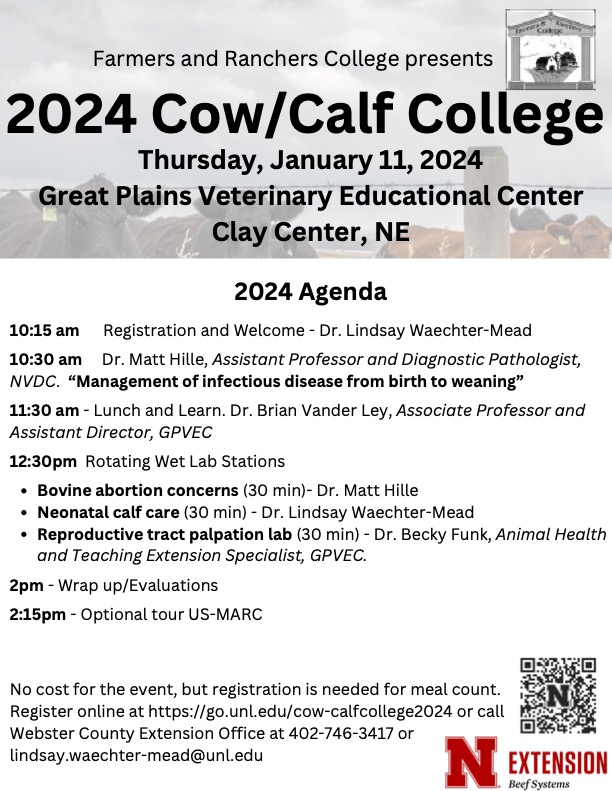
I’m excited to announce that the Farmers & Ranchers College committee continues to provide high-quality programming to area producers and agribusiness professionals with 2023-24 programming. Farmers & Ranchers College will kick off with its traditional program featuring Dr. David Kohl. The committee will continue the annual Cow/Calf College in January and end with a family farm succession program in March.

This year Farmers & Ranchers College will kick off December 7th featuring Dr. David Kohl Registration will start at 12:45 p.m. and the program will start at 1:00 p.m. at the Opera House in Bruning, NE. The program is titled, “Economic Shockwaves: Challenges & Opportunities.” The business and economic landscape of agriculture can be described in one word as “anxious.”  Economic shockwaves have become a fact of life in managing businesses and financials in the agricultural industry. Disruptors such as inflation of energy and other prices and increasing interest rates along with consumer and societal trends must be incorporated into the strategic game plan.

This program is designed to look into the future, challenge the status quo, and see how macroeconomic trends impact everyday decisions. The business and financial practices that will place the odds of success in your favor despite extremes in volatility will be a focus. Dr. Kohl’s decades of experience work as an academic, speaker, writer, business owner, and coach will provide wisdom and perspectives in an economic environment where uncertainty and opportunity coexist in the decade of the 2020s.

Many to the area are very familiar with Dr. Kohl, but if you are not, here are some details about him. Dr. Dave Kohl is an academic Hall of Famer in the College of Agriculture at Virginia Tech, Blacksburg, VA.  Dr. Kohl has keen insight into the agriculture industry gained through extensive travel, research, and involvement in ag businesses.  He has traveled nearly 10 million miles; conducted more than 6,500 presentations; and published more than 2,250 articles in his career. Dr. Kohl’s wisdom and engagement with all levels of the industry provide a unique perspective into future trends.

In 2024, the Partners in Progress –Beef Seminar (Cow/Calf College) will be at U.S. Meat Animal Research Center near Clay Center on January 11th. More details will follow as the date nears. Finally, in March, Farmers & Ranchers College will host land succession program

Questions on the Farmers & Ranchers College can be directed to the Fillmore County Extension Office at (402) 759-3712. To participate and register, go to the website: go.unl.edu/farmersrancherscollege.

Youth

Gratitude Improves Health & Well-Being

During the month of November, many people think about Thanksgiving. The word “thanksgiving” means the act of expressing or feeling thankfulness. If you are a parent like me, how many times do you tell your children to “say thank you” after receiving something from someone?  When my kids automatically say, “thank you”, it brings joy to my heart. By teaching youth to automatically say those two small words, my hopes are that it will lead to writing thank you notes and expressing warm words of gratitude to those around them.

Photo by wewe yang on Pexels.com

The art and practice of handwriting “thank you notes” can sometimes get lost with all the electronic methods of communication.  When I receive a hand-written thank you that really brings gladness to my heart, I put those in a special file folder in my desk.  Some of those thank you notes are from 4-H’ers, 4-H Alumni, interns, coworkers, etc.  As I write this, I even have a thank you note displayed on my desk from a summer adult 4-H volunteer. As the receiver of a thank you note, I can say it is nice to receive meaningful mail, rather than bills or advertising, but writing thank you notes also brings happiness to my heart. 

Two researchers from Indiana University, Drs. Brown and Wong (2017) researched an authored an article that provides the following psychological benefits of practicing gratitude.

  1. Gratitude unshackles us from toxic emotions. When you write about how grateful you are to others and how much other people have blessed your life, it might become considerably harder for you to ruminate on your negative experiences.
  2. Gratitude helps even if you don’t share it. The mere act of writing a thank you letter can help you appreciate the people in your life and shift your focus away from negative feelings and thoughts.
  3. Gratitude benefits take time. If you participate in a gratitude writing activity, don’t be too surprised if you don’t feel dramatically better immediately after the writing. You might have that quick “rush” of feeling thankful, however the bigger benefits of gratitude might take time to kick in weeks after your gratitude activity.
  4. Gratitude has lasting effects on the brain. Their research suggested that brain activity was distinct for those who felt more grateful, than those who only performed an act of gratitude related to guilt. Those who were more grateful showed greater activation in their medial prefrontal cortex.

University of Southern California (2019) also found evidence that gratitude can have profound health benefits and provided suggestions on how to practice gratitude. Some of the most effective approaches include maintaining a gratitude journal, writing personal thank-you notes and regularly expressing gratitude to others in person. One might also practice guided meditation, call someone to express thanks or write a note to a friend.

It can be easy to get down with all the negativity on social media, the news or being around negative people, but reminding oneself of the many things one should be thankful for can help improve one’s wellbeing.  I am thankful for all of you who read my weekly column and support Nebraska Extension!  


Upcoming Area Ag Programs:

December 7, 2023 – Dr. Kohl Presents Agriculture Today: Economic Shockwaves: Challenges & Opportunities, 1-4:00 p.m. at the Opera House in Bruning, NE. This Farmers & Ranchers College program is free. For more information, call the Fillmore County Extension office at 402.759.3712.
January 11, 2023 – Cow/Calf College… Details to Follow


Youth

Tips for a Healthier Halloween

For many, autumn events like Halloween are a time to wear costumes, go trick-or-treating, go to parties with friends, and eat sweet treats. Celebrations such as Halloween are a chance to not only have fun, but also provide healthy snack options and be physically active with friends and family. Make your Halloween season healthier this year by getting plenty of physical activity to balance food intake and help children choose wisely and eat their treats in moderation. Below are tips to make your Halloween healthier for trick-or-treaters and guests.

Photo by Kristina Paukshtite on Pexels.com

Hand out healthier treats. 

  • Give out healthier treats for trick-or-treaters and party guests this year. The calories in all those bite-size treats can add up quickly. There are lots of options when it comes to healthier food treats.
  • Examples include cereal bars, packages of dried fruit, baked pretzels, trail mix, animal crackers, mini boxes of raisins, graham crackers, sugar-free gum or hard candy, snack-sized pudding containers, individual applesauce containers or squeeze pouches, sugar-free hot chocolate or apple cider packets, individual juice boxes (100% juice), or fig cookies.

Try out non-food treats. 

  • If you want to steer away from handing out food this year, children will also enjoy non-food treats, such as things you would put in birthday goodie bags. Some non-food items are suitable for all ages, but small items should be limited to kids over age three.
  • Examples include small toys, pocket-sized games, plastic costume jewelry, glow sticks, tiny decks of cards, pencils, pencil toppers, fancy erasers, stickers (including reflective safety stickers), bookmarks, bottles of bubbles, whistles, coloring books, or small packages of crayons.

Promote physical activity.

  • Use party games and trick-or-treat time as a way to fit in 60 minutes of physical activity for kids. You can encourage and pump up the enthusiasm for being more active by providing small and inexpensive toys that promote activity.
  • Items could include a bouncy ball, jump rope, sidewalk chalk for a game of hopscotch or foursquare, or a beanbag for hacky sack.

Moderation is key.

  • Halloween is a great time to discuss and demonstrate the importance of moderation. Keep track of children’s candy so they don’t go overboard in one sitting. Let them pick out a few treats on Halloween night and then let them have a few pieces each day after that.
  • Show kids treats can fit into a healthy eating plan in small amounts. Combine a treat, such as fun-size candy, with a healthy snack like a piece of fruit. Be sure they eat the fruit first, so they don’t fill up on the candy.

Survive sweet treats at work.

  • Snack- or fun-size candies are small and easy to eat but eating several throughout the day can add up to extra calories. Keep the wrappers where you can see them, so they don’t accidentally pile up.
  • If you can’t just eat a few treats at work, start bringing healthier alternatives with you. Stock your snack bag or desk drawer with fruit cups, dried fruit, lightly sweetened whole grain cereal, graham crackers, low-fat pudding cups, popcorn, or granola bars.
  • Remember that friends or co-workers may also be struggling to stay motivated to make healthy changes. Lean on each other and be there when others need encouragement. This year make an effort to bring healthier treat options to work.

Find recipes and learn more at https://food.unl.edu.

Uncategorized

National Pork Month

If you have recently enjoyed some juicy pork loin, pork chops, sausage, or my favorite – bacon, they you should thank a pork producer. In Nebraska, we grow nearly 7.8 million pigs each year from 1,230 family farms, making us the sixth-largest pork-producing state. These family farms have people who are locally involved in various community organizations, schools, churches, etc. and have families of their own to feed. This is just one of the reasons you can know that pig farmers raise a safe, wholesome product that you can serve your family. According to the Nebraska Pork Producers Association, there are nearly 18,000 jobs involved in pork production and an economic impact of 1.66 billion dollars in Nebraska.

October is National Pork Month, and the Nebraska Pork Producers Association website has some fantastic recipes on their website which can be found at nepork.org. There are also some delicious recipes including an air fryer pork and apple burger and pork rice bowl recipes on Extension’s food.unl.edu website.

Speaking of meat, did you know that pork carcasses are separated based on percent fat free lean (%FFL), which estimate how many pounds of boneless, closely trimmed retail cuts (BCTRC) that animal will provide.  Let’s take an example hog that has a live weight of 275 lbs. If that animal had a dressing percentage (the amount of weight from the live animal that makes it to the carcass) of 75%, the carcass weight would be 210 lbs. With a percent fat free lean of 57%, the boneless, closely trimmed retail cuts (BCTRC) of meat would be 120 lbs.   

Wholesale cuts are large meat cuts that the animal carcass is cut into for ease in handling and shipping. Some wholesale cuts are higher in value than others. In hogs, the wholesale cuts are the shoulder/“Boston butt”, shoulder/“picnic”, loin, belly, and leg/“ham”. These cuts are then broken down into retail cuts which is what most consumers will purchase at the grocery store. Some popular examples include sliced bacon and spareribs from the side and country style ribs, tenderloin and center cut chops from the loin.

Often when any meat turns out dry, it is often prepared and cooked incorrectly.  Using a meat thermometer is one of the best ways to ensure meat it not overcooked. For example, boneless pork chops and pork tenderloin only need an internal temperature of 145 degrees (Fahrenheit). Ground pork patties should reach an internal temperature of 160 degrees. For more tips on properly preparing pork, which include grilling pork, air frying pork, using an instant pot, roasting pork and more, go to the National Pork Board’s website at pork.org. Happy National Pork Month!

Crops, Youth

Future Agronomists at Work

In 2013, I had the opportunity to observe a crop scouting competition conducted by Iowa State University and was fortunate to garner financial and organizational support to bring the program to Nebraska in 2014. Since that time, a group of states including Iowa, Nebraska, Indiana, Kentucky, Minnesota, and Illinois have hosted contests and have been able to allow youth to experience crop production in other states. 

The purpose of the competition is to provide students an opportunity to learn crop scouting and principles of integrated pest management (IPM) for corn and soybeans in Nebraska, to obtain knowledge and skills that will be helpful in future careers and to demonstrate newer crop scouting technologies.

On September 18, 2023, five states competed at the eighth annual Regional Youth Crop Scouting Competition at the Eastern Nebraska Research, Extension and Education Center near Mead, Nebraska. Teams of youth participated by completing nine crop scouting exercises in field plots. This educational, hands-on program provided students an opportunity to learn crop scouting and principles of integrated pest management (IPM) for corn and soybeans, obtain knowledge and skills that will be helpful in future careers and to demonstrate newer crop scouting technologies.

The top two teams from Nebraska, Iowa, Illinois, Minnesota and Indiana qualified for the competition. Extension faculty from Nebraska, Iowa, Minnesota and Illinois served as judges for the program and tested the teams’ knowledge on the basics of scouting corn and soybean fields. This included crop staging; looking for patterns of crop injury; disease, insect and weed identification; precision ag exercise; cover crops, etc.

Results from the 2023 competition were as follows:

  • First place — Iowa team Clayton County #1: Ben Gibson, Amelya Weigand, Keaton Klingman and Jacob Schilling.
  • Second place — Nebraska team Colfax County #2: Callen Jedlicka, Cody Jedlicka, Daphne Jedlicka and Justin Eisennman.
  • Third place — Indiana team Cascade FFA: Will Thompson, Zach Benter, Adryanah Hendershot, Ethan Tames and Evan Fishel.
  • Fourth place (tie) — Nebraska team Colfax County #1: Josh Eisenmann, Rylan Nelson and Hayden Bailey; and Iowa team Clayton County #2: Mindy Keehner, Henry Reimber, Cora Keehner and Carter Hillers

Also participating was the Indiana team of Heritage Hills FFA Chapter with Megan Steinmetz, Riley Steinmetz, Dani Beier, Trenten VanHorn and Owen Foertsch. From Illinois was Wesclin FFA with Camren Ferri, Michael Anderscavage, Lilly Biggs, Cole Friederich and Carson Richter, and Pontiac FFA with Jared Bressner, Brock Clement, Chancey Haas, Cole Rapp and Landen Wilson. Rice/Dakota County from Minnesota consisted of Nick Bayer, Molly Albers, Garrett Ostermann and Lucas Deplazes, and Sebeka FFA with Mindy Keehner, Henry Reimber, Cora Keehner and Carter Hillers.

More information about the crop scouting competition is available online at CropWatch. Click on the link “Crop Scouting Competition”.

This program was sponsored by the Nebraska Independent Crop Consultant Association, Nebraska Soybean Board, Ward Laboratories and UNL’s Doctor of Plant Health Program in collaboration with Nebraska Extension. For more information about the program, please contact Brandy VanDeWalle, Nebraska Extension educator, at (402) 759-3712.