Crops, Livestock, Programming

Farmers & Ranchers College

frcollege-logo-front-panel

The Farmers & Ranchers College was formed in January 2000 with the purpose of providing high quality, dynamic, up to date educational workshops for area agricultural producers in south central Nebraska through a collaborative effort between business, industry and higher education leaders. Furthermore, the Farmers & Ranchers College will provide the tools necessary so that agricultural producers will be able to respond positively to these changes using a profitable decision making process.

The Farmers and Ranchers College is a unique opportunity to educate agricultural producers in south central Nebraska. Approximately four hundred producers participated in the 2016-17 Farmers & Ranchers College programs. Producers attending these workshops managed over 170,500 acres. Participants surveyed indicated an average of $18.00/acre of knowledge gained from participating for a potential impact of $3 million.

IMG_7242.jpgThe sixteenth annual Partners in Progress- Beef Seminar featured a variety of industry, University and agricultural organization presenters. Participants managed over 8,500 head of cattle and indicated that on average the information presented will increase their profitability $17.50/head with a total potential impact of nearly $150,000.

Contributions and support of area businesses allow participants to attend at no cost, however for programs that have meals, it is requested that people RSVP at least a week in advance for an accurate meal count by calling Fillmore County Extension at (402) 759-3712.

The Farmers and Ranchers College Committee consists of Fred Bruning of Bruning, Bryan Dohrman of Grafton, Sarah Miller of Carleton, Jennifer Engle of Fairmont, Ryne Norton of York, Jim Donovan of Geneva, Bryce Kassik of Geneva, Eric Kamler of Geneva, and Brandy VanDeWalle of Ohiowa.

2017-18 Program Schedule:

December 7, 2017 – “Positioning for Success in the Economic Reset”” w/ Dr. David Kohl, Professor Emeritus, Dept. of AAEC, VA TECH at the Opera House in Bruning, NE from 1-4:00 pm

January 30, 2017** – “Partners In Progress Beef Seminar” Cow/Calf College at U.S. MARC near Clay Center, NE from 10-3:30 a.m., Registration at 9:30

February 23, 2017** – “Crop Insurance, Farm Bill Policy Update & More!” with Steve Johnson from Iowa State Extension and Brad Lubben, Nebraska Extension at  the Fillmore Co. Fairgrounds- Geneva, NE from 10- 3:00 p.m.,Registration at 9:30 a.m.

 ** Programs are free; however registration is appreciated for a meal count. Please call the Fillmore Co. Extension Office at (402) 759-3712 one-week prior to the program to reserve your spot.


Crops, Livestock, Programming, Youth

Food Label “Quiz”

With the holiday season upon us, many consumers will be preparing food for family and friends. When you go to the grocery store and select food, how well do you really know your food labels?  A survey of over 1,200 Nebraskans was conducted on how people think and feel about their food. Food labels were identified as the major information source by almost 64% of respondents. This work was done as a part of our Consumer Confidence team which works to find ways to inform people about food production. Are you an able food label reader? Do you know the answers to these questions? (Answers at the end of this article.)

Photo Credit: FDA
  1. A label box of cereal starts like this: “Ingredients: Whole wheat, brown sugar, molasses….”
    Which of these ingredients is present in the largest amount by weight in this food? a. Whole wheat      b. Brown sugar    c. Molasses     d. They are present in equal amounts
  2. Two chicken broths are labeled the following: Label 1: Real herbs, real flavor, sodium free chicken bouillon and Label 2: All natural, 100% chicken bouillon
    Which label does NOT have an approved “definition?” 
    a.  Label A     b. Label B
  3. A label says, “best if used by Dec., 27, 2019. Is a “Best If Used By” date a “safety” date?
    a. Yes     b. No
  4. Which of the following foods is “hormone free”?
    a. Meat     b.  Bread      c. Peas      d. None of them are “hormone free”
  5. Which animal is raised with “added” hormones?
    pig and chicken
    Photo Credit: Microsoft Powerpoint icons

    a. Pigs      b. Chicken      c. Both of them      d. Neither of them

  6. If “bananas-A” are labeled “GMO-Free” and “bananas-B” have no GMO labeling, which is a TRUE statement?
    a. Bananas-B are a GMO food      b. Neither of them are GMO foods       c. It’s impossible to tell if bananas-B are a GMO food

CHECK YOUR ANSWERS:

  1. a. Whole wheat. Ingredients are listed by their common or usual name in descending order by weight. For example: If “whole wheat” is listed first, that ingredient is found in the largest amount by weight in the product. The ingredient listed last contributes the least amount by weight.
  2. b. Label B. Currently, the U.S. Food and Drug Administration has not developed a definition for use of the term “natural.”
  3. a. No. A “Best If Used By” date describes product quality, where the product may not taste or perform as expected but is safe to use or consume.
  4. d. None of them are “hormone free.” Anything that is or has been alive contains hormones, including plants. There is no such thing as “hormone free” meat or animal product.
  5. d. Neither of them. Added hormones aren’t allowed by the U.S. Department of Agriculture in pork and poultry. A claim of “no hormones added” on pork or poultry must be followed by the statement, “Federal regulations prohibit the use of hormones.”  Be aware, the claim of “no hormones added” may be in much larger letters than the statement saying the use of hormones is prohibited.
  6. b. Neither of them are GMO foods. In today’s market place, you may find foods promoted as “GMO free” or “contains no GMOs.” Before you pay extra for this food, be aware it may not be made with any ingredients that contain GMOs in the first place. In other words, the same type of food without that label may also be free of GMO ingredients.

Neither banana is a GMO food and never has been! GMO foods currently available in the United States are: Corn (field and sweet), Soybeans, Cotton, Canola, Alfalfa, Sugar beets, Papaya (Hawaiian), Squash

NOTE: Not all versions of all these foods are genetically engineered. Artic apples will be available in some areas by 2017. Before being placed on the market, genetically modified foods must be approved by the U.S. Food and Drug Administration, the U.S. Department of Agriculture and the Environmental Protection Agency.

For more information or to view a self-paced slideshow on labeling, go to UNL’s food webpage.  

Crops, Irrigation, Programming

On-Farm Research

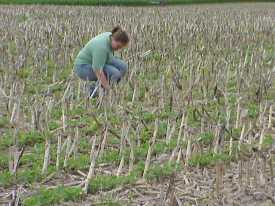
Nebraska Extension has a long history in on-farm research. In 1989, twenty Saunders County producers came together through Nebraska Extension to form the Nebraska Soybean and Feed Grains Profitability Project. This group began doing randomized, replicated research to answer questions that impacted the profitability of their farming operation. Due to the original group’s success, the idea spread to surrounding counties and in 1998 the Quad Counties research group was formed in Clay, Fillmore, Hamilton, and York Counties in south central Nebraska. Extension Educators and Specialists worked with 20 farmers to produce reliable, unbiased research. The Nebraska On-Farm Research Network builds upon the success of these two organizations, expanding on-farm research to a state-wide effort in 2012.SoybeanPopCount.JPG

On-Farm Research Brainstorming/Discussion Session:  You hear and read about various production practices and products that work for other farmers.  You may have questions regarding a specific practice or product working on your farm.  On-farm research is a way to answer this for yourself!  In the past, our area on-farm research cooperators met before the growing season to brainstorm ideas and discuss potential research topics together.  We are resurrecting this brainstorming/discussion session with it to be held on Monday, November 27th from 1:00-4:00 p.m. at the Fairgrounds (4-H Building) in Aurora.  We encourage farmers who have conducted on-farm research in the past or are considering/interested in on-farm research in the future to attend.  If you’re interested in attending, please RSVP to Steve Melvin at steve.melvin@unl.edu or Jenny Rees at jrees2@unl.edu.

Crops

Harvest Safety

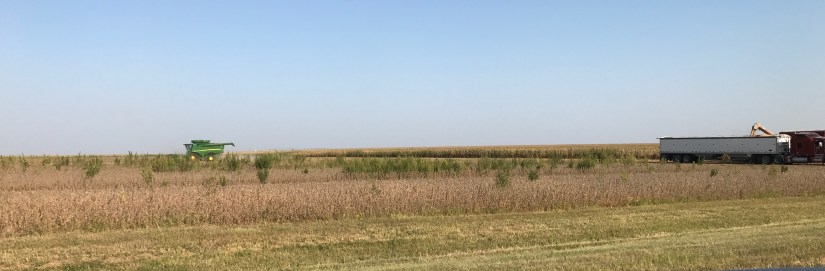
It is hard to believe that harvest is starting and just as a reminder that with harvest comes more traffic on the county roads and other stresses for farmers. It never fails, that equipment can break, there can be delays at the elevator and those extra-long hours can all add extra stress to farmers. That being said, it is important to carefully slow down and realize the many hazards you are being exposed to during harvest.

IMG_9973.jpgAn Iowa State Extension publication, Harvest Safety Yields Big Dividends points out that injuries can occur by taking shortcuts to perform routine tasks, not getting enough sleep or regular breaks, or failing to follow safety practices. Some injuries occur when operators are pulled into the intake area of harvesting machines, such as balers, combines, or corn pickers, and many injuries occur from slips or falls around these machines. Exposure to powerful machinery is highest during the harvest season. The equipment must be powerful to effectively handle large amounts of agricultural commodities. When equipment plugs, NEVER try to unplug it with live equipment, instead always disengage power and turn off the engine before trying to manually clear a plugged machine. Regular maintenance of these machines can also make harvest go smoother. Also, lots of accidents actually happen by the operator slipping and falling off equipment.
In the same publication listed above, there are several tips for reducing fall hazards:

  • Always keep all platforms free of tools or other objects.
  • Frequently clean the steps and other areas where workers stand to service, mount and dismount, or operate the machine.
  • Wear well-fitting, comfortable shoes with non-slip soles.
  • Use grab bars when mounting or dismounting machinery.
  • Be sure your position is stable before you work on a machine.
  • Recognize that fatigue, stress, drugs or alcohol, and age may affect stability.

Slow Down.png

Other helpful tips during harvest are to keep kids away from machinery. Tell them the dangers that can occur and not to play near the equipment, even when it is shut off; you never know when they will be playing in hidden areas of the equipment. Operators should double check where kids are before moving the equipment. Too many accidents can occur when youth are in the path of equipment out of the operator’s view. Operators of all equipment should check in regularly and let someone know where you are. Keep all guards on equipment; it is there for a reason!

It is also important for the public to understand the increased traffic on public roads and be patient. The greatest threat raised between farm equipment and passenger vehicles is the difference in speed. Farm equipment runs at an average speed of 20 miles per hour while passenger vehicles average 60 miles per hour. If the motor vehicle overtakes a tractor, the impact is comparable to a passenger vehicle hitting a brick wall at 40 miles per hour. If the tractor and a car, mini-van or pickup collides head on, the impact is the same as hitting a brick wall at 60 miles per hour.

Farmers can reduce the chances of an accident by using warning lights, reflectors and reflective tape on their machinery to keep passenger vehicle operators aware of their presence on roads. Some farmers may choose to install supplemental lights to increase visibility. It also is a good idea for producers to keep off heavily traveled roads as much as possible and avoid moving equipment during the busiest part of the day.

Some farm equipment, such as combines, can take up more than half of the road. Even so, it is up to both drivers to be aware of their own limitations and adjust accordingly. Farmers should not take up more space than is needed, but other drivers should try to provide as much room as possible. It is a good idea for passenger vehicles to turn off onto side or field roads until larger machinery has passed. Whenever possible, farmers should use an escort vehicle such as a pickup to precede or follow large machinery and equipment on public roads. More than one escort may be necessary. Ideally, the escort vehicle would have extra warning lights and a sign indicating oversized or slow equipment ahead or following.

Have a safe harvest!

Crops, Youth

Making One Agronomist at a Time

IMG_9476
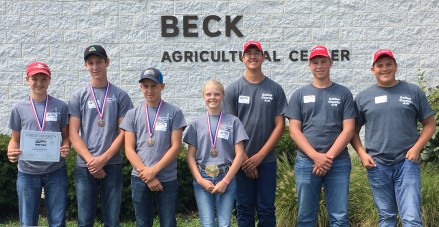
Kornhusker Kids 4-H Club of Cuming County and Colfax County 4-H represented Nebraska in the regional youth crop scouting competition on August 28, 2017.

IMG_9468.jpg

In late August, seven Nebraska youth traveled to Indiana to participate in the 2nd Annual Regional Youth Crop Scouting Competition held at Purdue University’s Beck Ag Center near West Lafayette, Indiana.  These youths scouted six fields for diseases, insects, abiotic/biotic disorders, weed identification and crop growth stage and development. Teams from Iowa and Indiana also competed. Nebraska teams ranked 3rd and 6th respectably. Between all three state competitions, 195 youth competed from Nebraska, Iowa and Indiana. Top two teams from each state competed at the regional competition. Congrats to all of the youth who not only networked with agronomic professionals, but also gained the most by improving life skills related to a potential career path. Next year’s regional competition will be hosted by Nebraska Extension.

While this is one program, which impacts a very small percentage of youth, it is very important to start training the next generation of ag leaders to feed our growing population. In fact, globally there is an effort to encourage youth in agricultural positions. According to the U.N. International Labor Organization (a specialized agency of the United Nations), globally there will be about 74.2 million unemployed young people (ages 15-24) in 2017 which is an increase of 3.8 million since 2007. While it is troublesome that those graduating high school and/or college are unemployed, this could present an opportunity for those in the agricultural industry. If we can create programs which spark an interest in agriculture, there is potential to attract youth to the agricultural industry.

Getting over the stigma that agriculture is a back-breaking with little room for advancement, while in fact it is quite the opposite. As educators, we should be promoting agricultural careers as “intellectually stimulating and economically sustainable” according to foodtank.com. Programs designed to encourage young people into agriculture are in numerous countries across the world including the New Entry Sustainable Farming Project in the U.S., a variety of USDA initiatives and programs like Farm Africa for youth in Ethiopia, Kenya, South Sudan, Tanzania and Uganda or the International Fund for Agricultural Development Rural Youth Talents Program in South America. If you know of a young person undecided in his/her career path or a youth who is passionate about agriculture, let them know of the bright future and opportunities available in agriculture.

For more information on how to engage youth in crops, visit our UNL CropWatch site at http://cropwatch.unl.edu/cropwatch-youth.

Crops, Irrigation, Livestock

Husker Harvest Days

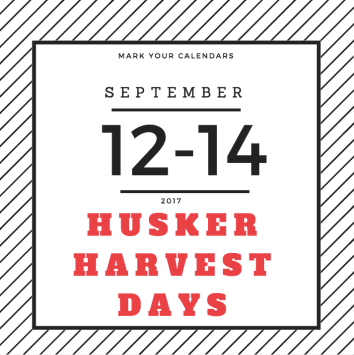
Don’t forget to visit the University of Nebraska-Lincoln’s IANR building at Husker Harvest Days! “Small Changes, Big Payback: Strengthening Nebraska’s Agricultural Economy” is the theme for the Institute of Agriculture and Natural Resources exhibits at the farm show Sept. 12-14 near Grand Island.HDD17

Exhibits inside IANR’s Husker Red building will provide information on:

  • Strategies for managing family budgets during challenging economic times;
  • The relationship between cost, nutritional value and impact of various feed sources for cow/calf operations;
  • Understanding the county-by-county differences in the risk factors that affect crop insurance rates and how they impact profitability and management decisions;
  • How farmers can better utilize the Farm Bill safety net;
  • Benchmarking the costs of pumping irrigation water to better control input costs and make decisions related to pump efficiency and energy usage;
  • Crop production strategies that can have a positive impact on cost per acre and profit margin;
  • Using crop budgets to analyze the operating costs for a farm to become a low-cost producer;
  • The university’s annual survey of agricultural land value and rental rates in Nebraska.
Crops, Livestock, Youth

Hurricane Harvey’s Impact on Agriculture

TXhelp

If you are connected with social media, you might have seen the video or pictures of cattle being moved by horses down the streets of Texas to higher ground. You might have seen pictures of destroyed cotton crops, grain bins and flooded farm houses. Prior to Hurricane Harvey, farmers worked around the clock to harvest their cotton and ranchers worked to move livestock to safety. For many cotton farmers, they were looking at record yields and Texas A&M AgriLife Extensionreported that at least 1.2 million beef cows graze in the 54 counties on the disaster list as of this article. Texas rice producers had already harvested about 75 percent of their rice, but wind and water likely damaged storage bins leading to more crop losses.

Of course, time will tell how the actual economic impact of this storm, not to mention the impact of fuel prices. The great thing about the agricultural community is that we stick together and help one another during these difficult times. Many local people gave money to assist our Kansas neighbors following widespread fires. Now, farmers and ranchers in Texas could use assistance. There will be a lot of fence to repair, buildings, bins, and just help restore these farm and ranch family’s lives. So how can you help?  There are many options. A close and local option is to give blood!  Some other ways to help include:

Texas A&M AgriLife Extension agents have set up the following Animal Supply Points and are requesting square bale horse quality hay, various types of hay for cattle in round or square bales, all-stock feed and range cubes/protein supplements at this time. They are not currently taking donations for fencing supplies. Before collecting or delivering donations, contact the AgriLife Animal Supply Point Hotline at 979-845-7800 to confirm needs and delivery.

A New Day: Texas Agricultural Education Disaster Relief Fund 

This fund will help FFA chapters and agricultural education programs rebuild following natural disasters such as Hurricane Harvey. Donations to this fund will be dispersed via an application process directly to the programs and chapters affected by the storm. More more information, go to https://www.texasffa.org/NewDay.

Texas 4-H Relief Support Campaign for 4-H Programs Affected by Hurricane Harvey

The Texas 4-H Youth Development Program and the Texas 4-H Youth Development Foundation are facilitating a monetary campaign to directly support 4-H clubs and county programs in the hurricane zone. The website is https://texas4hfoundation.org/.
4HsupportsTX

STAR Fund

The STAR Fund is used to assist farmers and ranchers in rebuilding fences, restoring operations and paying for other agricultural disaster relief. If you’d like to help farmers and ranchers impacted by floods, wildfires, tornadoes or other natural disasters. To donate to the STAR Fund, go to https://www.texasagriculture.gov and search for the STAR fund.

Of course, there are many other organizations and ways to help. This will take a long time for all of the victims to rebuild their lives. Keep them in your thoughts and do what you can to make a difference.

Crops, Livestock, Uncategorized

Ag Land Management, Back to the Basics

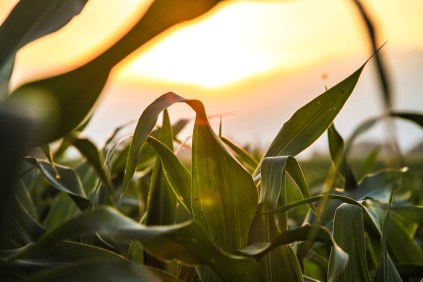
Anyone who owns or leases farm ground or leases it to someone else will want to attend this day-long seminar providing information and education about that ownership.  Learn management strategies for this asset by attending this seminarnature-field-sun-agriculture.jpg at the Adams County Fairgrounds, 947 S. Baltimore Ave, Hastings, NE. The event will be held Thursday, August 31st with registration starting at 9:00 a.m., program starting at 9:30 and ending around 3:00 p.m.

Participants can use this seminar to learn about: Am I keeping the farm, or selling it? How do I manage a farm? If leasing, what are key lease provisions?  What legal considerations do I have with this decision? And, how do we manage family communications and expectations when other family is involved? What does a soil test tell me?  I hear about organic or natural production; how does that vary from what my farmer is currently doing?  If corn and soybeans aren’t making money why don’t we raise other crops? What should I expect for communications between the landlord and tenant?  What are key pasture leasing considerations?money bag.jpg

“I am contacted monthly from citizens who have had their parents pass away, and now they are managing a farm for the first time in their lives,” said Allan Vyhnalek, Extension Educator and event speaker.  “They may have even grown up there, but haven’t been around for 30 or 40 years, and need to understand that farming practices and management concepts have changed,” Vyhnalek continued.

The workshop is designed to provide primer education for those that haven’t been on the farm much, or on the farm much recently.  It is also designed to be a refresher course for those that would like to have the latest information on land management and rental.

Pre-registration is requested by Monday, August 28, 2017.  Registration fee is $20 per person or $30 per couple.  The fee covers handouts, refreshments and lunch.  Contact Twila Bankson at the Adams County Extension Office, P.O. Box 30, Hastings, NE 68901, twila.bankson@unl.edu, or 402-461-7209 to register.

The program is being provided by Allan Vyhnalek, Aaron Nygren, and Jim Jansen, Extension Educators from Nebraska Extension.  They provide the farm land management and agronomy education in eastern Nebraska.

Crops, Livestock

The Great American Eclipse & Agritourism

Some of my summer has been spent creating lessons to accompany the solar eclipse event which will occur August 21, 2017. Over 200 Nebraska communities fall within path of totality, or the path of the shadow where observers will see the moon completely over the sun for roughly two and a half minutes.  During the total solar eclipse, the moon’s umbral shadow will fly across the United States from Oregon to South Carolina, in a little over 90 minutes. This is the first eclipse through the contiguous United States since 1979, according to NASA records.

eclipse area.png
Photo Credit: NASA

An eclipse will only occur in the same spot once every 375 years and we are fortunate to be in the area of totality. With thousands of tourists expected to visit Nebraska to visit the eclipse, I’ve heard of people as far from Japan and Sweden coming to our area to view this amazing event. There may even be a few rural landowners wanting to capitalize on this economic development opportunity. There are a few things that David Aiken, Extension Agricultural Law Specialist has pointed out to be aware. Landowners have legal protection against tourist personal injury liability if they do not charge a fee to campers or eclipse viewers. If they do charge a fee, they must meet 2015 Nebraska agritourism legal requirements in order to reduce their injury liability risk.

In short, if you are charging people to camp on your land, you could be liable of that person gets hurt. There are ways Nebraska landowners can obtain limited agritourism liability protection such as posting your property with the specified agritourism liability signs and include the same language in any agritourism activity contract like a camping lease. The landowner must also exercise reasonable care to guard against unusual dangers associated with the property, maintain the property, facilities and equipment, train and properly supervise any employees and comply with any related state or local legal requirements (i.e. capping an abandoned well). There are other legal options as detailed in a recent University of Nebraska news release, “Great Plains’ ecotourism initiative produces liability study”.

Aiken suggests contacting your insurance agent regarding whether your current liability insurance will cover any eclipse-related incidents. Your attorney can advise you regarding agritourism liability, agritourism leases, and agritourism liability waivers.

Crops, Youth

Bacterial Leaf Streak

nature-field-sun-agriculture.jpg

My colleague from York County, Jenny Rees provided a quick summary of bacterial leaf streak (BLS) which has been confirmed in corn in various parts of the state.  Lesions can look similar to other diseases such as gray leaf spot (GLS). The major difference between BLS and GLS is that the lesion margins of bacterial leaf streak are wavy whereas they are blunt in gray leaf spot.  It’s important to tell the difference between the two since fungicides will not control bacterial diseases.  On CropWatch at http://cropwatch.unl.edu, there is an article showing a number of corn diseases and how to identify them.  Be sure to check it out and when in doubt, you can always get a sample to your local Extension educator or the plant and pest diagnostic lab.

Tamra Jackson-Ziems also has a Youth BLS Survey and competition with cash prizes for BLS envelopeFFA Chapters, 4-H Clubs, or other youth groups that submit the most POSITIVE samples from different fields.  Groups submitting 3 or more positive samples also get a certificate identifying them as “Certified Crop Disease Detectives!”  Youth packets can be be obtained from Tamra directly by emailing her at:  tjackson3@unl.edu