Crops, Programming

Moving Forward in Agriculture

Those of us in agriculture are no stranger to risks involved with agriculture that are taken every day, whether it is financial, production, legal, price/market or human resources risks.  While we can’t control everything, there are measures that can be taken to protect one’s operation and reduce risk. Each year the Farmers & Ranchers College hosts Dr. David Kohl, Professor Emeritus from Virginia Tech who does an excellent job describing global risks which affect us locally and how those risks will affect the agricultural industry. In my seventh year of Extension, there are several key messages he largely emphasizes which I’ve summarized below.

First of all, “bigger is not better”, rather “better is better”. In other words improve the efficiency of your operation first before expanding. Also, to be successful (in anything really), be proactive and use the “HUT” principle: hear, understand and take action. While attending educational programs and undergoing professional development, unless you use the information and take action, you won’t fully succeed.

Kohl described common characteristics that the last four super cycles of the century possess: each had a rapid global real growth, conflict/geopolitical uncertainty, inflation, significant infrastructure investment, etc. Currently, we are in the longest of those super cycles (2003 – 2012), but one thing that is bound to happen is a crash. Be sure to have an exit strategy when this current super cycle crashes!

As the population increasingly grows more urban based disconnected to today’s production agriculture, there are many misconceptions of agriculture. There will also be a huge transfer of land in the coming years. Kohl warned of the spoiled brats emerging who want a “piece of their parents’ legacy”, thus invoking conflict among families, etc. When I attended Elaine Froese’s presentation she referred to baby-boomers as “waiters”, meaning they are waiting for their parents to collect inheritance because they haven’t prepared for their own retirement and feel entitled. In fact, there is a 500:1 odd that a business will make it to the 5th generation. Transition planning is increasingly important in order to beat the odds!

Kohl described what a “cut above super producer” possess. Among other things, they should follow the 60-30-10 profit plan, where 60% of profit focuses on efficiency first, and then growth. Thirty percent of one’s profit should build working capital and the last 10% is for you to do what you want with it – enjoy life!  Remember to not live above your means.

Finally, he ended with reasons to be optimistic about agriculture. By 2050, we will need 100% more food, fuel and fiber, thus the career opportunities for youth are enormous! One in six jobs is related to agriculture in some way; students taking college courses should remember to not only take the technical classes, but classes in business, science and communication. We need to “think globally and act locally”.

I encourage you to reflect on this past year and create/enhance your business plan for 2013. I wish you all a happy and joyous holiday season!

Crops, Youth

Innovative Youth Corn Challenge Banquet

Today’s agricultural world faces several challenges, one of them being the decline of our most valuable resource, the future workforce. Rural communities, including agricultural producers, can benefit from expanding youth into leadership opportunities, therefore mentoring youth leaders.   With this in mind, the Innovative Youth Corn Challenge was born which involves 4-H or FFA members, challenging them to produce the most economical, highest yielding corn. The team with the highest percent yield increase over their local county average is eligible for cash awards to further their 4-H or FFA plant science or leadership based programs. Both irrigated and dryland fields are eligible and will be scored accordingly. In addition awards are given to the team who has completed excellent production and economic records and an innovation award.

The Innovative Corn Challenge is designed to encourage youth to pursue an agricultural career and return to rural Nebraska. This program is implemented through UNL Extension with financial assistance from the Nebraska Corn Board. Extension faculty, agriculture education instructors and crop consultants may serve as harvest supervisors and assist with data collection.

 In 2012, the pilot year, ten teams signed up with six completing the project proposal and five completing the program.  Each team received $50 for their efforts and a copy of the Hybrid Maize CD, which is a computer program that simulates the growth of a corn crop under non-limiting or water-limited (rainfed or irrigated) conditions based on daily weather data.

The participants and their sponsors are listed below:

Banquet12WebPic

Super Strong H’s from Osceola consisted of Rob Buhl and Bennett Nelson with Tim Pallas as their supervisor. This team focused on planting populations in dryland conditions with populations at 26K and 30K. Yields of 49.05 bushels/acre with 30K and 52.65 bushels with the 26K respectively. This team did well on explaining the importance of increased yield to feed our growing population and also explained the important role of drought tolerant hybrid technology.

Humphrey FFA members, Spencer Beller and Lynn Slama tested strip till with a starter and nitrogen in the furrow vs. a perplant application of starter and nitrogen 15” from the row. They exceled with crop scouting records and their rainfall report. Their challenge plot yield was 217.5 bushels. Their project sponsor was Robyn Graham, FFA Advisor.

The Wranglers 4-H Club from Platte County tested the use of a foliar fungicide to early-stage corn (V5) to help corn reach its yield potential by protecting the corn plant from early-season diseases. Their challenge plot using Headline was 250 bushels and without was 254.8 bushels. Detailed crop scouting reports were completed with production information and a very complete budget. Their sponsor was Alex Labenz.

Austin Tatro and Trevor Birky, members of the Strang 4-Bar-H club in Fillmore County tested planting populations. On irrigated

ground they tested 34K and 30K per acre compared to a check plot of 32K seeds per acre. Their economic analysis was complete and showed the difference in costs between treatments. Planting population at 30K yielded 223 bushels, while 34K yielded 216 bushels and their check was 226 bushels/acre. Project sponsor was Brandy VanDeWalle.

The Pioneers 4-H Club from Madison County consisted of Kaylyn Kucera, Sidney Kucera, and Andy Zessin. They tested a higher population (30 vs. 38K), increased nitrogen rate (200 vs. 250# N) and a biological growth enhancer. Their challenge plot yielded 249.1 bushels while their check yielded 237.5 bushels. In addition to great production records, they documented visual differences in their report. Regan Kucera was their sponsor.

AWARDS

The data completion award was awarded to the team who demonstrated excellent record-keeping. The 2012 Data completion award went to the Strang 4-Bar-H club from Fillmore County with Austin Tatro and Trevor Birky. They received $200 for their efforts.

The Innovation Award was given to the team with the most innovative challenge plot and thorough explanation why it was innovative. This team also received $200 and went to the Super Strong H’s 4-H Club of Polk County with Rob Buhl and Bennett Nelson.

The teams with the highest percent yield increase over their local county average were the winners of the 1st, 2nd and 3rd place awards. The winning teams also completed their harvest report form and were presented to:

1st Place Corn Challenge Team receiving $1,000 was the Wrangler’s 4-H Club from Platte County with Elizabeth Blaser & Reid Fullner.
2nd Place Corn Challenge and receiving $500 was the Pioneers 4-H Club of Madison County with Sidney Kucera, Kaylyn Kucera, and Andy Zessin3rd Place Corn Challenge with $250 was Humphrey FFA with Spencer Beller & Lynn Slama

Project coordinators were Brandy VanDeWalle and Aaron Nygren, UNL Extension Educators. The 2nd Annual Innovative Youth Corn Challenge is planned for 2013 with the addition of another award. The limited resources award will be given to the team that achieved the highest yield per inch of water. Entry forms to participate in this program  are due March 1st. For more information, contact Brandy VanDeWalle at brandy.vandewalle@unl.edu or (402)759-3712.

Crops, Programming

Agriculture: What’s Around the Corner & Down the Road?

Back by popular demand is Dr. Dave Kohl, Professor Emeritis from Agricultural and Applied Economics at Virginia Tech.  He will speak on “Agriculture: What’s Around the Corner & Down the Road” from 1:00-4:00 p.m. at the Opera House in Bruning, NE on December 10th. Focusing on the wild world of global and domestic economics, Dr. Kohl will highlight the unusual events around every corn and discuss the “black swans” and how they impact agricultural businesses and producers. He will discuss the major game changers influencing the agriculture landscape along with a quick tour of the economics of the world and how it is influencing land values, commodities, and input costs.  Is agriculture in an asset or credit bubble?  What can you do financially in this business environment to capitalize on the economic volatility?  Dr. Kohl will give tips on management practices that will help you think globally but act locally in strategic and everyday decision making. Logo

The Farmers & Ranchers College was formed in January, 2000 with the purpose of providing high quality, dynamic, up to date educational workshops for area agricultural producers in south central Nebraska through a collaborative effort between business, industry and higher education leaders.  The Farmers and Ranchers College Committee consists of Fred Bruning of Bruning, Bryan Dohrman of Grafton, Sarah Miller of Carleton, Eric Milton of Milligan, Jim Donovan of Geneva, Bryce Kassik of Geneva, Gordy Nuss of Sutton, and Brandy VanDeWalle of Ohiowa.

For more information on the various Farmers & Ranchers College programs, please go to the Fillmore Co. website or call the Fillmore County Extension office at (402) 759-3712.

Crops

Thank a Farmer

Growing up on a small corn/soybean farm and raising cattle, I often take for granted the opportunities I had being actively involved in production agriculture. My dad is still a farmer and I enjoy being able to take my daughter to Grandpa’s for a ride in the tractor, etc.  My husband also grew up on a farm with livestock, so my daughter has an equal opportunity to be around agriculture as well. Sometimes it is easy to consider farming the norm, especially living in a rural community. The point I’m trying to make is that too often farming and ranching is considered just another job. We forget the risks they take every day.

According to the National Institute for Occupational Safety and Health, farming continues to be one of the most dangerous occupations in the United States. In 2008, 623 people died and 60,000 people suffered from permanently disabling injuries on farms and ranches in the United States. Agriculture has a death rate of 29 per 100,000 workers, which is higher than the death rate in mining (National Safety Council, 2010).

In addition to the physical danger of the equipment itself, the economic and market conditions change regularly, so profits are uncertain, creating emotional distress. Some people still have the farm pictured as it was in the 1940 & 1950’s which was a much simpler time. Although the physical demands were more, technology didn’t change as quickly as it does today and the knowledge needed to manage agricultural operations is greater. It used to be that young people would graduate from high school and return straight to the farm which was usually sufficient to be successful. In today’s agricultural setting, youth need to further their education, at the minimum, an associate’s degree, but preferred a bachelor’s degree. It is also essential to remain a lifelong leaner from attending other non-formal educational opportunities such as extension programming, etc.

Today’s producers not only need to have a knowledge of basic cropping practices, but risk management knowledge, farm policy and regulatory requirements, sufficient knowledge of today’s modern technology and the list goes on. In addition, as consumers become increasingly disconnected where their food comes from, they must educate consumers how food is produced or product marketing skills, whether it is through social media or day-to-day communication.

With the expected increase in the global population to reach 9 billion by 2050, current food production will need to almost double, therefore farmers and ranchers are extremely important people. More land gets consumed everyday by industrial uses, so those in the agricultural industry will need to continue improving the efficiency of production with less land. Youth unsure of a career path should consider agriculture!  The opportunities in agriculture are abundant and exciting! It’s not just cows, plows and sows, but science, technology, and innovation!

As families gather for Thanksgiving, not only should you give thanks for family & friends, health, and the many other blessings we have in our life, but give thanks for farmers and ranchers who prepare a wholesome, nutritious and safe meal for you every day! Happy Thanksgiving!

Turkey Tidbits

  • The National Turkey Federation (NTF) estimates that approximately 45 million turkeys are eaten at Thanksgiving, 22 million at Christmas, and 19 million at Easter.
  • Ninety-one percent of Americans surveyed by the NTF eat turkey at Thanksgiving. The average weight of turkeys purchased for Thanksgiving is 15 pounds; that’s about 675 million pounds of turkey consumed in the United States on Thanksgiving Day.
Crops

Innovative Youth Corn Challenge Banquet Approaching

When I first came into Extension I sought for ways to incorporate my agricultural education teaching experience with the adult crops programming.  Last year, I was able to get a project up and rolling which I’ve been involved and is approaching its one year completion which is exciting to see my two passions – youth and agriculture come together.

The University of Nebraska-Lincoln Extension and the Nebraska Corn Board have teamed up to offer the First Annual Innovative Youth Corn Challenge contest. This contest was open to 4-H members or FFA members and challenged them to create an innovative, yet economical way to increase yields in their own corn plot. As a team youth were challenged to implement a production practice different than normal to determine if they increased their yield.  Yields, cropping history, and production information is being gathered by participants.

Six teams completed proposals and projects in this pilot year. Teams are the Super Strong H’s 4-H club from Polk County, Humphrey FFA, Wrangler’s 4-H Club from Platte County, Fillmore Central FFA, David City FFA, and the Pioneers 4-H Club from Madison County.

Cash prizes and plaques will be given to the first, second, and third place teams at the Corn Yield Challenge Banquet set for December 5, 2012 at UNL’s East Campus.

Youth interested in participating next year should go to cropwatch.unl.edu/youth/ website. For more information, contact myself at brandy.vandewalle@unl.edu.

Crops

Cropping Fertilizer Update

Producers are now thinking about soil fertility needs for next growing season. It is always important to soil sample to ensure you are applying the correct amounts of fertilizer, but with this past season’s drought it’s even more important!  Soil nitrates may be higher than normal this fall, especially in rain fed fields. Take soil samples and determine residual soil nitrate levels before deciding on fertilizer N application rates. Remember that soil temperature.    As I write this, soil temperatures are between 44-45 degrees in Fillmore County.)

If you have collected soil samples, you can go UNL CropWatch’s Soils page to calculate fertilizer recommendations based on your soil test results.

My colleague, Gary Zoubek reminds producers that timing is important when applying nitrogen, ideally it’s best to apply the nitrogen near the time the crop will be using it, and thus, split applications are often are the best!  You don’t want to apply it all in the fall, plan to sidedress or chemigate some on.  Often conditions are not always ideal in the spring or you do not have enough time, so we understand why some producers make applications in the fall.  We also know that if we don’t get excessive rains, we won’t move the nitrogen that’s been applied, but we’re all hoping for above normal precipitation this fall, winter and spring.

In addition, we’re always looking for producers interested in conducting On-Farm Research.  If you you’re planning to make fall anhydrous ammonia applications and would consider doing a timing study comparing fall vs. spring or sidedress,  email me at brandy.vandewalle@unl.edu.   I would be glad to work with you.

 UNL Extension’s Hort Update

The latest horticulture update explained that late October, average soil temperatures across the state ranged from 50 to 59 degrees F. Even with freezing air temperatures, root and rhizome growth can continue until soil temperatures drop below 40 degrees. Fall root growth aids drought recovery but only if adequate soil oxygen and moisture is available. Continue to provide moisture in the absence of rainfall without overwatering so soil oxygen levels are lowered due to saturated soils. Planting of deciduous trees and shrubs can also continue.

 Landlord/Tenant Workshop in Fairmont!   

This free workshop is sponsored by the Nebraska Soybean Board and the North Central Risk Management Agency in collaboration with our local Famers & Ranchers College committee.  A meal and handouts are included. Handouts and materials will be available on a first-come, first-serve basis. This program will be on November 13, 2012 at the Fairmont Legion from 11-3:00 p.m. with registration at 10:30 a.m. Please RSVP by November 6th via email at brandy.vandewalle@unl.edu.      

Crops, Programming

Landlord/Tenant Workshop & Returning to the Farm Program

Developing farm cash leases that meet the needs of both landlord and tenant, while maintaining a positive relationship, is the goal of these workshops.  Both tenants and the landlord are encouraged to attend!  A team of UNL Extension Educators will be on hand to discuss these topics and provide common sense tips during the presentation.  Managing the 2012 drought and implications for 2013 will also be discussed.

Session presenter Al Vyhnalek points out that “Putting together the right lease isn’t about what is being discussed at the coffee shop, or what a university survey of cash lease rates says; it is about what fits both the landlord and tenant for their circumstance and situation. Attending this presentation will provide a set of ideas to work from as those specifics are discussed.”

Topics include:  Expectations from the lease, including goal setting for the rental property; Lease communication, determining appropriate information sharing for both the tenant and landlord; Tips for farm leases that include relatives; Alternative cash lease arrangements, flexible provision considerations for your situation; How the 2012 drought affects leases, irrigation systems, grain bin rental, and other topics related to leases will be discussed as time allows.ing this presentation will provide a set of ideas to work from as those specifics are discussed.”

This free workshop is sponsored by the Nebraska Soybean Board and the North Central Risk Management Agency in collaboration with our local Famers & Ranchers College committee.  A meal and handouts are included. Handouts and materials will be available on a first-come, first-serve basis. This program will be on November 13, 2012 at theFairmont Legion from 11-3:00 p.m. with registration at 10:30 a.m. Please RSVP by November 6th. To register, contact our office at (402)759-3712 or via email at brandy.vandewalle@unl.edu.

 Returning to the Farm Workshop Planned

The past several years our UNL Agricultural Economic Department has conducted “Returning to the Farm Workshops” designed for farm families transitioning their operation.  This year the sessions will be held Friday Dec. 7th from 2:00 – 9:00 p.m. & Saturday Dec. 8th from 8:30 a.m. to 3:30 p.m. and Friday Jan. 11th from 2:00 – 9:00 p.m. and Sat. 12th from 8:30 a.m. to 3:30 p.m. in Lincoln at the Holiday Inn Downtown.

The cost of the conference is $350 for the first 4 family members, plus $40 for each family member after the first 4. This fee covers instruction, handout materials, meeting room costs, refreshment breaks, Saturday continental breakfast and most meals.  The registration deadline is November 30, 2012 and it’s limited to the first 15 families with paid registrations.

Crops, Programming

Farmers & Ranchers College Year Planned

The Farmers & Ranchers College was formed in January, 2000 with the purpose of providing high quality, dynamic, up to date educational workshops for area agricultural producers in south central Nebraska through a collaborative effort between business, industry and higher education leaders. Furthermore, the Farmers & Ranchers College will provide the tools necessary so that agricultural producers will be able to respond positively to these changes using a profitable decision making process.

The Farmers and Ranchers College is a unique opportunity to educate agricultural producers in south central Nebraska. Four hundred producers from twenty counties and three states participated in the 2011-2012 Farmers & Ranchers College programs. Producers attending these workshops managed over 284,000 acres. Participants surveyed indicated an average of $12.12/acre of knowledge gained from participating for a potential impact of $3.4 million.

Contributions and support of area businesses allow participants to attend at no cost, however for programs that have meals, it is requested that people RSVP at least a week in advance for an accurate meal count by calling Fillmore County Extension at (402) 759-3712.

The Farmers and Ranchers College Committee consists of Fred Bruning of Bruning, Bryan Dohrman of Grafton, Sarah Miller of Carleton, Eric Milton of Milligan, Jim Donovan of Geneva, Bryce Kassik of Geneva, Gordy Nuss of Sutton, and Brandy VanDeWalle of Ohiowa.

2012 -2013 Farmers & Ranchers College Programming

  • November 13, 2012 – Landowner/Tenant Lease Workshop – Fairmont Legion, 11-3:00, registration at 10:30 a.m.*
  • December 10, 2012 – “Agriculture: What’s Around the Corner & Down the RoadFeaturing Dr. David Kohl Professor Emeritus, Dept. of AAEC, VA TECH at the Bruning Opera House – Bruning, NE at 1:00 p.m.
  • January 22, 2013 – “Partners In Progress – Beef Seminar” at the U.S. Meat Animal  Research Center near Clay Center from 10:00 a.m. to 3:30 p.m., registration at 9:30 a.m.*
  • March 14,2013 – Keeping Your Farm in the Family for the Next Generation” Featuring Ron Hanson, UNL at Evening with Friends in Milligan with meal at 6:00 p.m. and program to follow.*

* Programs are provided at no cost to the public, but registration is appreciated for a meal count. Please call the Fillmore Co. Extension Office at (402) 759-3712 one week prior to the program.

Crops, Livestock

Grazing Corn Stalks in No-till Fields

The drought this year has left many cattle producers in a bind. Hay prices are high and pastures are burnt up which leaves corn stalks as an excellent grazing option. While many producers annually graze cornstalks, this year it will be of even more importance. Cattle are already in stalks and there are lots of corn fields being baled for forage.

A recent UNL CropWatch article by Charles Wortmann, Terry Klopfenstein, and Aaron Stalker showed that in a corn-soybean rotation study conducted from 1996 to 2011, the effects on yields of the following crop were determined for fall-winter grazing (November to February) and spring grazing (February to mid-April, the time of greatest concern of compaction by animal traffic on thawed and wet soil). The field was irrigated and had three treatments (fall/winter grazed, spring grazed, and ungrazed) which have been maintained in the same area since 1996. The stocking rate was with yearlings at 2.5 times the normal level since 2000. On average, yield of the following soybean crop was increased by about 2 bu/ac with fall-winter grazing, and 1.3 bu/ac with spring grazing, compared with no grazing of corn stalks. Yield of corn as the second crop after grazing was not significantly affected. There is ongoing research which will be reported in the 2013 Nebraska Beef Cattle Report which include a dryland trial.

The article concluded that grazing corn stalks is compatible with no-till management in eastern Nebraska and probably is for irrigated fields throughout the state with no loss in average grain yield expected. With wet soil conditions in the spring, consider removing cattle from the field or taking other steps management steps to minimize the effect of compaction.

Crops

Grain Storage

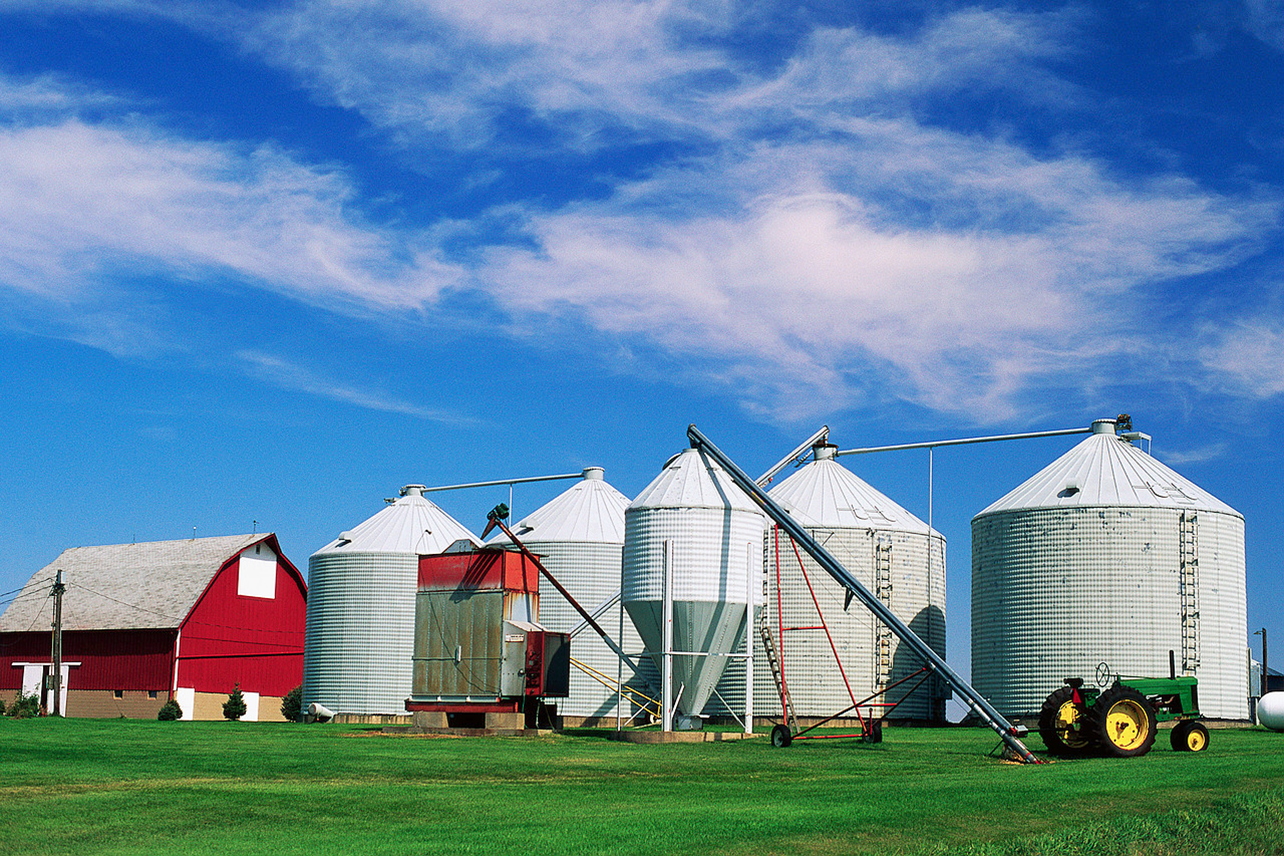
With harvest well underway, it is always important to ensure proper grain storage, especially as farmers build larger grain bins than in the past. This week, I’ve decided to share an article written by my Extension colleague, Tom Dorn in Lancaster County which was featured on UNL Extension’s CropWatch website, Managing Large Grain Bins for Potential Mycotoxin Contamination. Dorn points out that a typical on-farm grain bin traditionally was 27 to 36 feet in diameter and would hold 18 to 22 feet of grain depth. Now it is common on many farms to build 42- to 48-foot diameter bins that can hold 28 to 32 feet of grain depth.

Photo courtesy from http://sdcornblog.org/archives/tag/grain-bin

These large bins work well for storing dry grain and regulating grain temperature. The low airflow rates that are good for controlling grain temperature require relatively low static pressure to move the air through the grain mass. Generally, fans intended for temperature control are sized to produce 0.2 to 0.3 cubic feet of air per minute per bushel (cfm/bu) through the grain. Many fan manufacturers produce a 10 horsepower axial-flow fan capable of producing 0.3 cfm/bu in a 48-foot diameter bin with 30 feet of corn depth.

Using a 48-foot diameter bin for drying corn is a much different situation. The minimum airflow recommended for drying corn in Nebraska is 1.0 cfm/bushel. An even higher airflow is required for grain that has, or even might have storage molds that could continue to grow and produce mycotoxins in storage. The higher airflow will dry the grain more quickly. Drying time is proportional to the airflow, cfm/bu, and the airflow a fan can produce is affected by the grain depth. Therefore, Dorn recommends reducing grain depth to provide higher airflow (1.25 cfm/bu or higher) and shorter drying times.

Remember, while a minimum of 1.25 cfm/bu is recommended, providing more airflow is better. Drying time is inversely proportional to the airflow (cfm/bu). An airflow of 2 cfm/bu will dry corn in half the time as an airflow of 1 cfm/bu.

To achieve the recommended 1.25 cfm/bu in a 48-foot diameter bin using only one 40 hph fan, grain depth would need to be limited to 8 feet or less. If two 40 hp fans are used, grain depth needs to be 15 feet or less to achieve the recommended airflow.

If mycotoxins are suspected in corn, grain depths in large bins may need to be adjusted to facilitate quick drying. For more information on grain bin storage visit the Lancaster County Extension site.