Crops

Soybean Grain Storage

With all of the moisture we’ve been receiving and producers needing to return to the fields, there has been lots of questions and issues regarding grain storage. North Dakota Extension Agricultural engineer and professor, Kenneth Hellevang recently wrote an article that provides valuable information on soybean drying advice which I’ve decided to include in this week’s column. I am not an expert in this area so further questions can be directly to Dr. Hellevang by accessing his website at https://www.ag.ndsu.edu/extension-aben.IMG_3695

Soybeans at 11 percent moisture have similar storage characteristics to wheat or corn at about 13.5 percent moisture, so 16% moisture soybeans might be expected to store similar to about 19% moisture corn. If is important to be able to aerate the soybeans to keep them cool. The amount of natural air drying that will occur in late October and early November is limited. The equilibrium moisture content of soybeans for air at 40 degrees and 70 percent relative humidity is about 12 percent, so drying of soybeans above 12 percent would be expected with this air condition. However, the drying rate will be slow at typical in-bin drying airflow rates. An airflow rate of 1 cubic foot per minute per bushel (cfm/bu.) is expected to dry 18 percent moisture soybeans in about 60 days. With an airflow rate of 1.5 cfm/bu the drying time is reduced to about 40 days. The drying time for 16% moisture soybeans is slightly less. The drying time of 16% moisture soybeans is about 50 days. Adding supplemental heat to raise the air temperature by 3 to 5 degrees will permit drying the soybeans to about 11 percent moisture in about 40 to 45 days. Increasing the airflow rate proportionally reduces the drying time.

The moisture holding capacity of air is reduced at lower air temperatures. As average air temperatures approach 35 degrees, natural air drying becomes inefficient and not economical. Adding heat would cause the beans on the bottom of the bin to be dried to a lower moisture content and it would increase drying speed only slightly. Cool the soybeans to between 20 and 30 degrees for winter storage and complete drying in the spring. Hellevang recommends starting drying in the spring when outdoor temperatures are averaging about 40 degrees.

The type of fan greatly affects the airflow provided per horsepower, so use a fan selection software program such as the one developed by the University of Minnesota. It is available on the NDSU grain drying and storage Web site.

Soybeans can be dried in a high-temperature dryer, but the plenum temperature needs to be limited to minimize damage to the beans. Refer to the manufacturer’s recommendations for maximum drying temperature. Typically the maximum drying temperature for nonfood soybeans is about 130 degrees. Even at that temperature, some skins and beans will be cracked.IMG_3697.jpg

One study found that with a dryer temperature of 130 degrees, 50 to 90 percent of the skins were cracked and 20 to 70 percent of the beans were cracked. Another study found that 30 percent of the seed coats were cracked if the drying air relative humidity was 30 percent. Roughly with each 20 degree increase in drying temperature, the air relative humidity is reduced to one-half. Air at 50 degrees and 80 percent relative humidity will have a relative humidity of about 40 percent when heated to 70 degrees. Monitor the soybean seeds coming from the dryer and manage the dryer temperature based on the amount of damage occurring.

There is a risk of fires when drying soybeans. Soybean pods and other trash can accumulate in the dryer and become combustible. Assure that there is not an accumulation of trash in the dryer that becomes combustible. Also, assure that the soybean continue to flow in all sections of the dryer. Monitor the dryer continuously to limit fire potential. Clean the dryer frequently to reduce the potential for debris becoming combustible.

Author Credit: Kenneth Hellevang, Ph.D., PE, Extension Engineer, Professor at the Agricultural & Biosystems Engineering Department, North Dakota State University Extension
Crops, Irrigation, Livestock, Programming, Youth

National Farmer’s Day

Combining2011Web
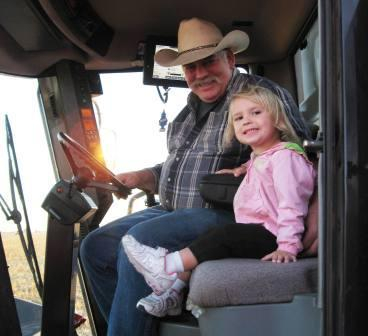
Here is my favorite farmer. Taken a few years ago, my oldest daughter enjoyed riding with “Grandpa Beek” (my Dad) in the combine. So thankful I grew up on a farm!

There are so many “days” such as “national ice cream day”, “national punctuation day”, etc. which I quite honestly don’t pay attention. Today, however I noticed that it is National Farmer’s Day and felt like that is something to spend a little bit of time recognizing. October 12th is a day for us to pay tribute to farmers throughout our great nation.

Have you thanked a farmer lately?  Farmers work long and hard hours and there is no guarantee of good yields. As is the case lately, farmers are at the mercy of the weather and waiting to return to harvest due to wet conditions.

Agriculture and farmers are the backbone of our society and economy!  Thank you to all of the farmers who feed and clothe us!

#NationalFarmersDay

Crops, Irrigation, Livestock, Programming

Farmers & Ranchers College 2018-19

nature-field-sun-agricultureThe Farmers & Ranchers College was formed in January 2000 with the purpose of providing high quality, dynamic, up to date educational workshops for area agricultural producers in south central Nebraska through a collaborative effort between business, industry and higher education leaders. Furthermore, the Farmers & Ranchers College will provide the tools necessary so that agricultural producers will be able to respond positively to these changes using a profitable decision making process.farmersrancherscollege1819dates
The Farmers and Ranchers College is a unique opportunity to educate agricultural producers in south central Nebraska. Approximately three hundred producers participated in the 2017-18 Farmers & Ranchers College programs. Producers attending these workshops managed over 155,000 acres and managed nearly 15,000 head of beef animals. Participants surveyed indicated an average of $6.00/acre of knowledge gained from participating for a potential impact of nearly $1 million. The seventeenth annual Partners in Progress- Beef Seminar featured a variety of industry, University and agricultural organization presenters. Ninety-five percent of participants surveyed were very satisfied or satisfied with the program quality and seventy-six percent indicated that previous programming improved their knowledge of making risk management decisions.

Contributions and support of area businesses allow participants to attend at no cost, however for programs that have meals, it is requested that people RSVP at least a week in advance for an accurate meal count by calling Fillmore County Extension at (402) 759-3712.

The Farmers and Ranchers College Committee consists of Fred Bruning of Bruning, Bryan Dohrman of Grafton, Sarah Miller of Carleton, Jennifer Engle of Fairmont, Ryne Norton of York, Jim Donovan of Geneva, Bryce Kassik of Geneva, Eric Kamler of Geneva, and Brandy VanDeWalle of Ohiowa.

2018-2019 Program Schedule

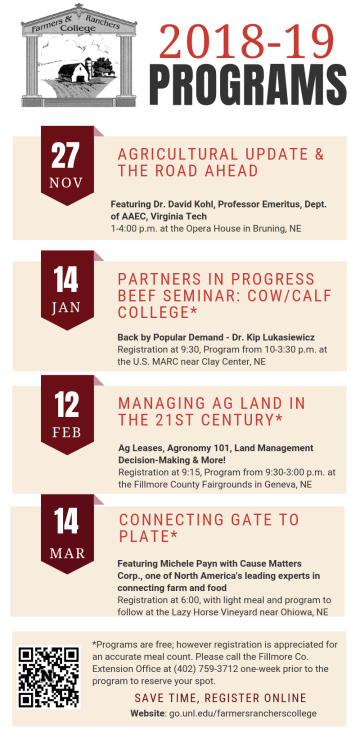
  • November 27, 2018 – “Agricultural Update & The Road Ahead” w/ Dr. David Kohl, Professor Emeritus, Dept. of AAEC, VA TECH at the Opera House in Bruning, NE from 1-4:00 pm
  • January 14, 2019** – “Partners In Progress Beef Seminar” Cow/Calf College at U.S. MARC near Clay Center, NE from 10-3:30 a.m., Registration at 9:30
  • February 12, 2019** – “Managing Ag Land in the 21st Century” with Nebraska Extension Educators, Nebraska Extension at  the Fillmore Co. Fairgrounds- Geneva, NE from 9:30- 3:00 p.m., Registration at 9:15 a.m.
  • March 14, 2019** – “Connecting Gate to Plate” with Michele Payn with Cause Matters, Corp., one of North America’s leading experts in connecting farm and food at Lazy Horse Vineyard near Ohiowa, NE with registration at 6:00 p.m. Light meal and program to follow.

 ** Programs are free; however registration is appreciated for a meal count. Please call the Fillmore Co. Extension Office at (402) 759-3712 one-week prior to the program to reserve your spot.

Crops, Irrigation

Harvest Safety

It is hard to believe that harvest is starting and just as a reminder that with harvest comes more traffic on the county roads and other stresses for farmers. It never fails, that equipment can break, there can be delays at the elevator and those extra-long hours can all add extra stress to farmers. That being said, it is important to carefully slow down and realize the many hazards you are being exposed to during harvest.slow-down

An Iowa State Extension publication, Harvest Safety Yields Big Dividends points out that injuries can occur by taking shortcuts to perform routine tasks, not getting enough sleep or regular breaks, or failing to follow safety practices. Some injuries occur when operators are pulled into the intake area of harvesting machines, such as balers, combines, or corn pickers, and many injuries occur from slips or falls around these machines. Exposure to powerful machinery is highest during the harvest season. The equipment must be powerful to effectively handle large amounts of agricultural commodities. When equipment plugs, NEVER try to unplug it with live equipment, instead always disengage power and turn off the engine before trying to manually clear a plugged machine. Regular maintenance of these machines can also make harvest go smoother. Also, lots of accidents actually happen by the operator slipping and falling off equipment.

In the same publication listed above, there are several tips for reducing fall hazards:

  • Always keep all platforms free of tools or other objects.
  • Frequently clean the steps and other areas where workers stand to service, mount and dismount, or operate the machine.
  • Wear well-fitting, comfortable shoes with non-slip soles.
  • Use grab bars when mounting or dismounting machinery.
  • Be sure your position is stable before you work on a machine.
  • Recognize that fatigue, stress, drugs or alcohol, and age may affect stability.

Other helpful tips during harvest are to keep kids away from machinery. Tell them the dangers that can occur and not to play near the equipment, even when it is shut off; you never know when they will be playing in hidden areas of the equipment. Operators should double check where kids are before moving the equipment. Too many accidents can occur when youth are in the path of equipment out of the operator’s view. Operators of all equipment should check in regularly and let someone know where you are. Keep all guards on equipment; it is there for a reason! harvest.jpg

It is also important for the public to understand the increased traffic on public roads and be patient. The greatest threat raised between farm equipment and passenger vehicles is the difference in speed. Farm equipment runs at an average speed of 20 miles per hour while passenger vehicles average 60 miles per hour. If the motor vehicle overtakes a tractor, the impact is comparable to a passenger vehicle hitting a brick wall at 40 miles per hour. If the tractor and a car, mini-van or pickup collides head on, the impact is the same as hitting a brick wall at 60 miles per hour.

Farmers can reduce the chances of an accident by using warning lights, reflectors and reflective tape on their machinery to keep passenger vehicle operators aware of their presence on roads. Some farmers may choose to install supplemental lights to increase visibility. It also is a good idea for producers to keep off heavily traveled roads as much as possible and avoid moving equipment during the busiest part of the day.

Some farm equipment, such as combines, can take up more than half of the road. Even so, it is up to both drivers to be aware of their own limitations and adjust accordingly. Farmers should not take up more space than is needed, but other drivers should try to provide as much room as possible. It is a good idea for passenger vehicles to turn off onto side or field roads until larger machinery has passed. Whenever possible, farmers should use an escort vehicle such as a pickup to precede or follow large machinery and equipment on public roads. More than one escort may be necessary. Ideally, the escort vehicle would have extra warning lights and a sign indicating oversized or slow equipment ahead or following.

Have a safe harvest!

Crops, Programming, Youth

Future Agronomists at Work

IMG_3598Three states competed at the 3rd Annual Regional Youth Crop Scouting Competition on August 27, 2018 at the Eastern Nebraska Research and Extension Center near Mead, Nebras­­ka. Teams of youth participated by completing six crop scouting exercises in field plots.  This educational, hands-on program provided students an opportunity to learn crop scouting and principles of integrated pest management (IPM) for corn and soybeans, obtain knowledge and skills that will be helpful in future careers and to demonstrate newer crop scouting technologies.

IMG_3546.jpg
Youth worked in teams of 4-5 to create a solution or answer to the crop scouting exercise. 

The top two teams from Nebraska, Iowa and Indiana qualified for the competition. Extension faculty from Nebraska served as judges for the program and tested the teams’ knowledge on the basics of scouting corn and soybean fields. This included crop staging; looking for patterns of crop injury; disease, insect and weed seedling identification; etc.
Results from the 2018 competition were as follows:

  • First place- Nebraska Team, Colfax County 4-H (Logan Nelson, Brad Kratochvil, Austin Steffensmeier & Korbin Kudera)

    IMG_3573
    Colfax County 4-H received top honors as the 2018 Regional Crop Scouting Competition Champion.
  • Second place – Indiana Team, Heritage Hills FFA (Sydney Hassfurther, Bryce Peter, Gabe Gogel, Alex Gehlhausen and Luke Rahman
  • Third place (Tie) – Nebraska Team of Kornhusker Kids 4-H Club of Cuming County (Payton & Levi Schiller, Matthew & James Rolf and Kaleb Hasenkamp) and Iowa Team from Clayton County (Team #1) consisting of Andre Shirbroun, Max Gibson, Matt Whittle, Cassidy Penrod and Cole Deitchier.

Also participating was Indiana Team, Eastern Hancock FFA with Jackson Beaudry, Ryan Kohlstrum, Loren Matlock, Zach Sickle and Brent Sorrell and Iowa Team from Clayton County (Team #2) which consisted of Mia Gibson, Jon Whittle, Tom Whittle, Laci Orr and Macy Weigand.

IMG_3569.jpg

More information about the crop scouting competition are available online at cropwatch.unl.edu/youth.

This program was sponsored by DuPont Pioneer, the Nebraska Independent Crop Consultant Association and Farm Credit Services of America in collaboration with Nebraska Extension. If you know of a company or you would are interested in sponsoring the 2019 program, please contact me at brandy.vandewalle@unl.edu.

Crops, Irrigation, Programming

South Central Ag Lab Field Day

scal.png

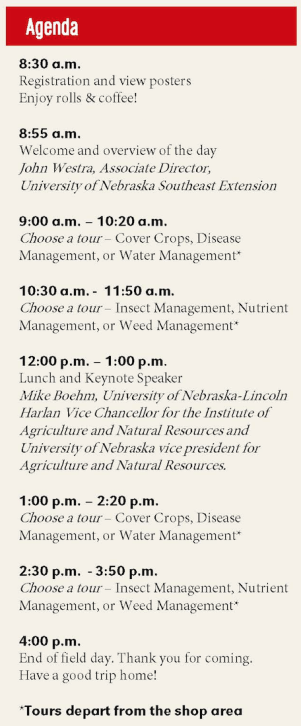
Wednesday, August 29th will be the South Central Ag Lab (SCAL)  Field Day with registration beginning at 8:30 a.m. and concluding at 4:00 p.m. Approximately 100 applied field research trials are conducted at SCAL annually by University of Nebraska-Lincoln faculty and the United States Department of Agriculture/Agricultural Research Service scientists. Trials are focused on irrigation and water management, soil fertility, entomology, weed science, cropping systems, disease management and crop variety testing. Field day speakers will share information about their research for improved crop production and profitability.

Specific topics and speakers include:

  • Cropping Systems: From cover crops to corn earissues – Roger Elmore, NE Extension Cropping Systems Agronomist; Katja Koehler- Cole, UNL Agronomy Post-Doctoral Research Associate, Justin McMechan, UNL Crop Protection & Cropping Systems Specialist; and Osler Ortez Amador, UNL PhD Grad Student
  • Insect Management: European corn borer, Corn rootworm & Western bean cutworm – Robert Wright – NE Extension Entomologistagenda.png
  • Weed Management: Opportunities & challenges for weed control in soybean – Amit Jhala, NE Extension Weed Management Specialist
  • From Inhibitors to Sensors: Nitrogen fertilizer management in irrigated corn – Leonardo Bastos, UNL PhD candidate in Soil fertility/precision ag, Brian Krienke, NE Soils Extension Educator and Joe Juck, NE Extension Precision Ag Specialist
  • Disease Management: Corn and Soybean disease updates – TamraJackson-Ziems, NE Extension Plant Pathologist
  • Water Management: Fundamentals of variable rate irrigation & fertigation in comparison to fixed rate irrigation & conventional fertilizer management & Imapct of cover crops on soil quality, Suat Irmak, Harold W. Eberhard Distinguished Professor of Biological Systems Engineering

Register online by August 26th for lunch planning purposes which can be done at https://go.unl.edu/2018scalfieldday. For more information, call the South Central Lab Office at (402)762-3536. CCA credits are available.

Crops, Horticulture

Sustainable Agriculture Tour Recap

To define sustainable agriculture is quite the task, as many organizations and individuals view what is defined as “sustainable” in different ways. For the purpose of this column, I’ll use the definition that was addressed by Congress in the 1990 “Farm Bill” by USDA. Under that law, “the term sustainable agriculture means an integrated system of plant and animal production practices having a site-specific application that will, over the long term:

  • Satisfy human food and fiber needs;
  • Enhance environmental quality and the natural resource base upon which the agricultural economy depends;
  • Make the most efficient use of nonrenewable resources and on-farm resources and integrate, where appropriate, natural biological cycles and controls;
  • Sustain the economic viability of farm operations; and
  • Enhance the quality of life for farmers and society as a whole.”
IMG_3413.jpg
Lazy Horse Vineyard & Brewing 

This week, Fillmore County was the stop for an annual Sustainable Agriculture tour my colleague Gary Lesoing coordinates so I participated in the Fillmore County stops and decided to share some of what I learned in this week’s column. First the tour went to Lazy Horse Vineyard and Brewing near Ohiowa. For those unfamiliar with Lazy Horse, they grow their own grapes and have a large outdoor porch where guest can enjoy being outside and watch the horses graze the pasture or sit in the gorgeous tasting room, watching the wood fired oven bake delicious pizzas. It’s safe to say, the participants enjoyed their time here.

IMG_3418.jpg
Slezak Ag & Natural Resources can take removed trees and turn them into usable products such as lumber. 

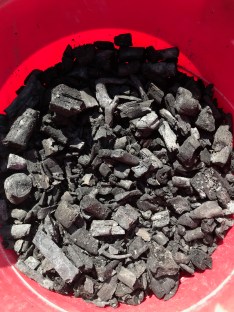
The second and final stop of the tour was Slezak Ag & Natural Resources. They provide “Trees2Products” and sawmill services in addition to creating biochar. Their philosophy is that if someone has a tree coming down, why not utilize it by turning it into somethings useful? For example, rather than burning or burying trees coming down, one can take the logs to Slezak Ag and have it milled and turned into lumber which can create amazing furniture or other creations. One of the other products they are working to produce is biochar. If you haven’t heard of biochar, the USDA’s definition is as follows, “black carbon produced from biomass sources (i.e. woodchips, plant residues, manure or other agricultural waste products) for the purpose of transforming the biomass carbon into a more stable form (carbon sequestration).” Biochar can be used as a soil amendment  that builds soil quality, increases crop yields and sequesters carbon in soils for years to come.

IMG_3421.jpg
Here are samples of biochar. 

For more information on sustainable agriculture projects or to apply for funding on a project, go to https://www.sare.org which is the Sustainable Agriculture Research & Education website. Nebraska’s coordinator, Gary Lesoing is very helpful in helping others learn more about sustainable agriculture practices or opportunities.

Crops, Programming, Uncategorized, Youth

Youth Learn Crop Scouting Skills

At the end of the July I coordinated the fifth annual Crop Scouting Competition for Nebraska youth in which four teams from across Nebraska competed. It was held in at the Eastern Nebraska Research and Extension Center near Mead, Nebraska on July 26, 2018. Teams of students (those completing 5-12th grades) participated by completing a written knowledge test and seven crop scouting exercises in field plots.

IMG_3113.jpg

The purpose of the competition was to provide students an opportunity to learn crop scouting and principles of integrated pest management (IPM) for corn and soybeans in Nebraska, to obtain knowledge and skills that will be helpful in future careers and to demonstrate newer crop scouting technologies.

Results from the 2018 competition were as follows:

First place- Colfax County 4-H (Logan Nelson, Brad Kratochvil, Austin Steffensmeier & Korbin Kudera)

Second place – Kornhusker Kids 4-H Club of Cuming County (Payton & Levi Schiller, Matthew & James Rolf and Kaleb Hasenkamp)

Third place – Humphrey FFA Team #2 (Mikayla Martensen, Bryce Classen Jacob Brandl and Wyatt Wegener)

Also participating was IMG_3144.jpgFillmore Central FFA with Carson & Brock Tatro, KayLynn Sieber, Kaylea Geiser and Gunner Gewecke.

Top-scoring teams won prizes: $500 for first, $250 for second, $100 for third place. The top two teams will represent Nebraska at the regional competition held in Nebraska on August 27, 2018.

Teams were expected to know the basics of scouting corn and soybean fields. This included crop staging; looking for patterns of crop injury; disease, insect and weed seedling identification; etc.

More information about the crop scouting competition are available online at cropwatch.unl.edu/youth. Click on the link that says, “Crop Scouting Competition”.

This program was sponsored by DuPont Pioneer, the Nebraska Independent Crop Consultant Association and Farm Credit Services of America in collaboration with Nebraska Extension. If you know of a company or you would are interested in sponsoring the 2019 program, please contact me at brandy.vandewalle@unl.edu.


Crops, Irrigation, Livestock

Farm Service Agency County Committee

It is important for one to stand for what they believe in and takes an active role in one’s community. Effective leadership is crucial to any community or organization.  An effective leader understands the issues at-hand, is knowledgeable in his/her area, knows the proper ways to motivate others, embraces change, can work in a variety of settings and with a variety of personalities, and involves the group or followers in important decision-making. That being said, remember that a leader is not only a political figure or someone that is well known, but a leader can be a farmer, local businessmen/women, or anyone in a community or organization.  For those individuals desiring to take on leadership roles, consider serving on the FSA County Committee. Details for how to step into this role follow.

photo of green leaf plants
Photo by Nico Brüggeboes on Pexels.com

Fillmore County USDA Farm Service Agency (FSA) Executive Director Ryne Norton announced that the nomination period for local FSA county committees began on June 15, 2018. Nomination forms must be postmarked or received in the Fillmore County FSA Office by Aug. 1, 2018. Producers play a critical role in the day-to-day operations of FSA, making important decisions on programs dealing with disaster and conservation, emergencies, commodity loan price support, county office employment and other agricultural issues.

“County committees are unique to FSA and allow producers to have a voice on federal farm program implementation at the local level,” said CED Norton. “It is also important that committees are comprised of members who fairly represent the diverse demographics of production agriculture for their community. I encourage all producers, including women, minority and beginning farmers and ranchers, to participate in the nomination and election process.”

Producers can nominate themselves or others. Organizations, including those representing beginning, women and minority producers, may also nominate candidates to better serve their communities. To be eligible to serve on an FSA county committee, producers must participate or cooperate in an FSA program and reside in the area where the election is being held.

This year, nominations and elections for Fillmore County will be held in local administrative area 2, which includes Bennett, Geneva, Grafton, Momence and West Blue Townships. To be considered, a producer must sign an FSA-669A nomination form. The form and other information about FSA county committee elections are available at www.fsa.usda.gov/elections, or from the Fillmore County FSA office. Visit farmers.gov for more information.

Election ballots will be mailed to eligible voters beginning Nov. 5, 2018. Read more to learn about important election dates.

Crops, Irrigation

New Cropping Systems Educator

On behalf of the Clay County Extension staff, we’d like to welcome Michael Sindelar to the Extension Family as he is the new cropping and water systems educator based out of Clay Center in Clay County. Here is a little bit about Michael:

corn
Photo by Alejandro Barrón on Pexels.com

“I was born and raised in Lincoln, Nebraska. However, I was exposed to agriculture at a young age as my father would take me to the family farm located near Richland, Nebraska in Colfax county to “help” with the farm work. I joined the Navy in 2005 and served until 2010. I was a cryptologist collective (CTR) and worked in military intelligence. I was stationed out of Hawaii for my enlistment. I had the opportunity to see parts of the pacific and spent one year deployed in Afghanistan where I collected intelligence and conducted combat operations. After having fun for a couple of years I got my act together and earned a bachelor’s degree in Agronomy from the University of Nebraska. This spring I completed my master’s degree in Agronomy with a specialization in soil and water science from the University of Nebraska. I spent most of my master’s degree studying how changes in soil management affect soil water storage, recharge, and heat as storage and transfer through the soil. I look forward to starting my new position on Monday. I sign most of my emails using V/R which is a carryover from the military meaning very respectfully.”

His email address is msindelar2@unl.edu.