Horticulture

Emerald Ash Borer Update

This week, I’ve decided to take an excerpt from our UNL Extension Hort Update on a pest I receive questions about from time to time – the emerald ash borer.  I highly encourage you to subscribe to this update if you are a horticultural enthusiast!

By now many homeowners have heard of emerald ash borer (EAB) and are concerned about their ash trees.  Now EAB is found in 22 states from Massachusetts south to Georgia, and west to Minnesota and Missouri.  Closest to home, EAB was confirmed in Missouri 2008, Iowa 2010, Kansas 2012 and Colorado 2013.  The nearest confirmed sites are Kansas City, MO, Boulder, CO and Creston, IA.  It is inevitable that EAB will eventually make its way into Nebraska, probably within the next few years.

Now federal Animal and Plant Health Inspection Service (APHIS) quarantines apply to all of Iowa and Missouri.  In Colorado, Boulder County and portions of Jefferson, Larimer, and Weld Counties are quarantined. This means interstate movement of EAB-host wood and wood products are regulated, including firewood of all hardwood species, nursery stock, green lumber, waste, compost, and chips of ash species.

Below are recommendations from the Nebraska Forest Service and the University of Nebraska-Lincoln Extension:

  • Treatment is recommended when EAB is known to be within 15 miles of a location.
  • Treating trees beyond 15 miles will likely provide little or no benefit to the trees and will result in unnecessary exposure of the environment to pesticides.
  • State and federal agencies monitor EAB infestations and will provide updates on infestations in Nebraska.

Visit the Nebraska Forest Service for information about when to begin treatments.

For people concerned EAB might already be here, but has gone undetected, it is important to know that trees already infested with EAB are treatable if the damage is not yet severe.

(Source: UNL Extension HortUpdate)

Horticulture, Youth

Hands to Larger Service

 “I give my head to clearer thinking, my heart to greater loyalty and my hands to larger service and my health to better living….” That is how the 4-H

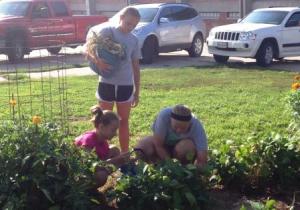
picking2websitePledge starts out and is just what Fillmore County 4-H’ers have done for three years in a row! In collaboration with the Farm Service Agency and Natural Resources Conversation Service offices in Geneva, 4-H’ers planted, cared for and harvested vegetables for those who might not otherwise have access to fresh produce.

Last year, over 260 pounds of produce was harvested! This year has been a little challenging with the garden due to pests and weather, but we still have harvested approximately 75 pounds of produce with more still to come.  Since the small garden was established three years ago, it has yielded over approximately 400 pounds of produce. Several 4-H youth continued to express an interest this year, so the garden was planted with produce going to the Geneva Senior Center programs.

GardenHarvest13web

Over the summer, 4-H’ers, FSA and NRCS staff took turns caring for the garden, increasing their horticultural skills while learning responsibility, service and other important life skills. This has been a great project allowing youth to not only learn, but fulfill the purpose of 4-H by using their hands for larger service.

If you are interested in contributing or participating in the Fillmore County Community Garden in the future, please contact the Fillmore County Extension Office at 402-759-3712.

Crops, Horticulture

2,4-D Amine vs. Ester Formulations

The other day I got a question from a client regarding the different formulations of 2,4-D, a very common herbicide used widely by gardeners and farmers. I found a great fact sheet from Purdue University which described the differences and is summarized below. It starts out by saying that the amine and ester of 2,4-D are both formulations of one of the oldest and widely used herbicide families, as they were developed in the mid-1940’s by the military for vegetation control. It works as a growth regulator herbicide which induces unorganized growth in the plant which can therefore crush the vascular system of the plant, blocking it off from nutrients, sugar and water.

Used to control annual, biennial, and perennial broadleaf weeds, 2,4-D has little effect on grasses, thus making it the most popular herbicide used in lawns. While it is effective if applied at the correct time, drift can easily occur in non-targeted broadleaf plants due to the result of 2,4-D volatility, its ability to turn into a vapor and move off site. This is how the amine and ester formulations can differ.

Purdue’s publication goes on to summarize that the ester formulation of 2,4-D have higher vapor pressures and tend to volatilize more than amines, therefore one should use an amine formulation when volatilization is a concern with sensitive plants. I always caution people who use 2,4-D that volatility increases in hot, dry weather. When temperatures are above 85 degrees F, only the amine formulations should be used. Ester formulation is more effective at penetrating the leaf cuticle, so amine use rates are usually higher than ester rates to compensate for reduced absorption.

WeedGuide

One weed I’ve been receiving several questions on is the purple flower growing in lawns – most likely henbit. It definitely flourished with last year’s drought, but for best control, apply a broadleaf herbicide in the fall. To achieve 90% control of henbit, apply a post emergent herbicide such as Trimec when in the early growth stage. There are several formulations of Trimec which uses 2,4-D as an active ingredient.

In summary, know which formulation you are working with, apply during the most effective time for your target species and adjust rates accordingly. As always, follow label directions and take the proper safety precautions to protect your health. For more helpful information on which herbicides to apply and when, go to UNL Extension’s Weed Guide.

Horticulture

Holiday Tree Preparation

With the Holiday season approaching, I thought it was appropriate to include some pointers that Kelly Feehan, UNL Extension Horticulturist provided on selecting a real Christmas tree. If you plan to use a live cut tree, buy a fresh tree. The best way to ensure freshness is to buy from a local grower. To locate area Christmas trees growers, refer to the Nebraska Christmas Tree Growers list found on the Nebraska Department of Agriculture website. There are over 22 Christmas tree farms in the state, located across different areas in 17 counties so it shouldn’t be difficult to find a tree farm. Most of these farms, you can also select the live and harvest it so freshness is not a concern.

When buying an already cut tree, check the tree closely for freshness. Do not buy a tree with brittle or shedding needles. Tap the base of the trunk on the ground and comb your fingers through branches to look for shedding needles. Bend a few needles in half to check for brittleness. After bringing the tree home, make a clean cut across the base of the trunk to better allow the tree to take up water. Keep the tree in a sturdy stand that holds at least one gallon of water. Check the stand daily as a fresh tree can take up one or more gallons of water each day. Selecting Nebraska grown trees and checking for freshness will help increase safety during the holidays.

Kelly also has tips for cutting holiday greenery. Cutting holiday greenery from your own landscape can help ensure freshness. Pine, fir and cedar are good to use for indoor decoration as they dry out slowly and hold their needles best at warm indoor temperatures. For safety, be aware the red berries of Japanese Yew are poisonous, as are the green needles. Avoid the use of this greenery or be sure to keep Japanese Yew greenery out of reach of children and pets, and do not discard it where cattle or horses might eat it. Cutting greenery is pruning so use clean, sharp cutters and well placed, evenly distributed cuts. This is not the ideal time to prune, so don’t harvest too much greenery and make discreet cuts. Keep greenery in a cool location out of sunlight with the cut ends in water until ready to use the greens. Crush the ends of woody stems to allow the cuttings to take in more water. Immerse greenery in water overnight just before arranging it. This will allow it to absorb moisture and remain fresh longer.

More horticultural tips, including holiday greenery tips can be found on UNL Extension’s Environmental website.

Crops, Horticulture, Irrigation

Crop ET Weekly Report

The ETgage I check outside of Geneva changed 2.1 inches for the week of June 1-8th. Corn in the V-6 stage has a coefficient of .36”. To calculate how much water, corn at V-6 stage used you simply multiply .36” x 2.1” for a weekly use of .75” or .11 inches/day. Corn at V-8 would have used 1.07”/week or .15” per day.

I did not estimate the crop use for soybeans, since for our area; we typically don’t recommend irrigating them until they reach R3 stage.  Watering too early causes taller beans that use more water but don’t yield more, so it’s important to hold off and apply it when it is need! For more information about ETgages and Watermark sensors, check out the NAWMN website.  

 Alfalfa Update

I’ve been wondering how alfalfa fields are holding up with the lack of moisture we’ve received and noticing alfalfa blooming already without a lot of growth. Just in time, Bruce Anderson, UNL Forage Specialist sent his news article answering some of my questions with the following information.
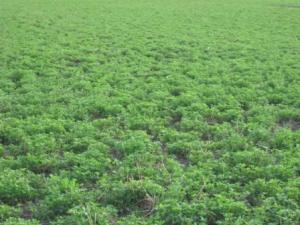
If you grow dryland hay you probably are hoping and praying for rain.  Let’s talk about this year’s hay crop and moisture in a moment.  Bruce reports he’s heard a lot lately about folks cutting alfalfa once, sometimes twice and then not getting hardly any regrowth.  What does come back isn’t very vigorous but it starts blooming in just a few weeks.  What’s going on?

Here’s what Bruce believes happened: it’s a combination of temperatures last winter and spring and moisture.  Winter temperatures were mild, to say the least.  So mild, in fact, that he doesn’t think alfalfa ever went fully dormant.  So all winter long its root system slowly depleted the nutrient reserves it had accumulated during fall winterization.  At the same time, unfrozen soil was slowly drying out.

All this didn’t hurt – at first.  Then the super early warm spring started alfalfa to grow rapidly, which left root reserves at lower than usual levels following first cutting.  That’s why some noticed that regrowth wasn’t as vigorous as expected.

Then he adds the final piece of the puzzle.  Dryland alfalfa fields more than about three years old have extracted most of their available subsoil moisture.  With winter drying out the surface soil, high early season water use to support the first growth, and relatively little spring rain, these fields are becoming exhausted for moisture needed to support growth, which also is needed to replenish nutrient reserves in the roots.  As a result, these fields may struggle to produce much more hay all year, even if they receive average summer precipitation. The take home message Bruce offers is that hay production could be short this year.  Get what you can, while you can.

 Horticultural Updates

Kelly Feehan, UNL Extension horticulturalist reported that if a number of small fruit suddenly drop from healthy fruit trees in June, this is most likely a natural thinning or due to poor pollination. Fruit trees sometimes produce more fruit than the tree can mature. Weather conditions may allow production of more fruit than a tree can support. For example, if late spring frosts that often damage flower buds do not occur, the tree may produce an over-abundance; and a number of tiny fruit may drop in June. This is referred to as natural thinning. Poor pollination can result in fruit drop. If a flower is not pollinated or only partially pollinated, fruit may develop to a pea sized or slightly larger and then drop. In either case, healthy fruit trees usually retain enough fruit to mature to a good size crop. Natural thinning also prevents fruit trees from going into alternate year bearing, where one year the tree has a heavy crop and the next year there is little or no fruit.

I’ve also received questions about chrysanthemums responding to our early season and unusual weather by already developing flower buds. If it is preferred that mums bloom later in the season, early blooming can be delayed by cutting mums back now. This will not harm Chrysanthemums and it will result in bushier plants with more flowers later this summer. Not only this year, when mums are setting buds early; but in all years it is recommended to pinch mums by removing the top two to three inches of grow one to three times early in the growing season. Pinching needs to stop by late June, or blooming of mums could be delayed too late into the season and increase the risk of frost damage this fall. Mums are pinched by snipping off the top two to three inches of each stem. Use your fingers or a snipping shears. Try to make the cut right above a leaf to eliminate a brown stub forming

Horticulture

Early Spring Hort. Updates

I continue to get more interest and question about the March 15th “Discuss the UndiscussaBull” program since greed and emotions can easily get in the way of fair (not always “equal” but fair) decision-making, whether a family has a farm or not! Just a reminder, for more information on family farm transitioning from Elaine Froese can be found on her website. No farm (or any estate) is worth the price of losing a family; start those tough conversations now!  I’d like to thank all of the sponsors of the Farmers & Ranchers College for allowing us to pay for Elaine’s program; even if it saves one or two families that is a huge impact on those individual’s lives!

 Horticultural Updates!

 Now, for all of you green thumbs out there; it might seem like the end of April, but remember as I write this column, it is only still the end of March!  Recent warm weather has more than likely left many planning summer flower and vegetable gardens.  Keep in mind that the average date of the last spring freeze is still about a month away for many locations across central Nebraska.   According to the National Weather Service out of Hastings, NE, even though the spring season (April-May-June) outlook leaves our region with a better than equal chance for a warm spring this year…your chances of not having to replant delicate outdoor plants will be best if you hold out for the average last-freeze date. As I write this, our soils are above 50 degrees, but, the average date for the last spring freeze is April 22nd for Geneva, NE. 

UNL Extension’s popular Backyard Farmer show returns Thursday April 5, 2012, live on NET1 at 7 pm CST.  Join them kicking off their 60th season of answering your lawn & garden questions.  Until then, you can check out their archived videos on YouTube or interact with the team on Facebook.

            Several questions that have already come into the office (and are also featured on UNL Extension’s Hort Update newsletter) include:

  • Winter annual weeds include speedwell and henbit. These annual weeds germinated last fall, survived the winter and are now blooming with blue or lavender flowers and setting seed. Hand-pulling or post emergence applications of 2, 4-D can slow these annuals. For effective herbicide control, apply a preemergence herbicide containing Pendamethalin in September, just before seed germinates.
  • Winter dessication, or drying, of plant tissue is likely to affect a large number of evergreens and broadleaf evergreens this spring. When browning occurs, wait until June before pruning damaged tissue or removing the plant. If only the green needles/leaves are affected, the plants could produce new growth and slowly recover. If leaf buds and woody tissue are killed by dessication, no new growth is likely to occur by June 1 and the plants can then be removed and/or damaged tissue pruned out. If, after pruning, no green leafy tissue remains, the plant will not recover and is best removed.
  • Soil temperatures and vegetable seed germination- Seeds have a minimum, maximum and optimum soil temperature at which they germinate and seedling growth begins. If planted too early, when soil temperatures are cold, seed germination and seedling growth will be very slow leading to seeds rotting, damping off disease, or low vigor plants with lower yields. Know what minimum and optimum temperatures are needed for different vegetables and monitor soil temperatures to determine the best time to seed. Planting early does not guarantee an earlier harvest if soil temperatures are too cold for germination or vigorous growth.

You can receive more excellent information and subscribe to UNL’s HortUpdate newsletter.