Crops, Irrigation, Programming

On-Farm Research Conference

Farm operators and agronomists from across the state are invited to attend the Nebraska On-Farm Research Network research results update meeting at a location near them.  Producers will obtain valuable crop production-related information from over 80 on-farm research projects conducted on Nebraska farms by Nebraska farmers in partnership with University of Nebraska faculty. These research projects cover products, practices, and new technologies that impact farm productivity and profitability.onfarm
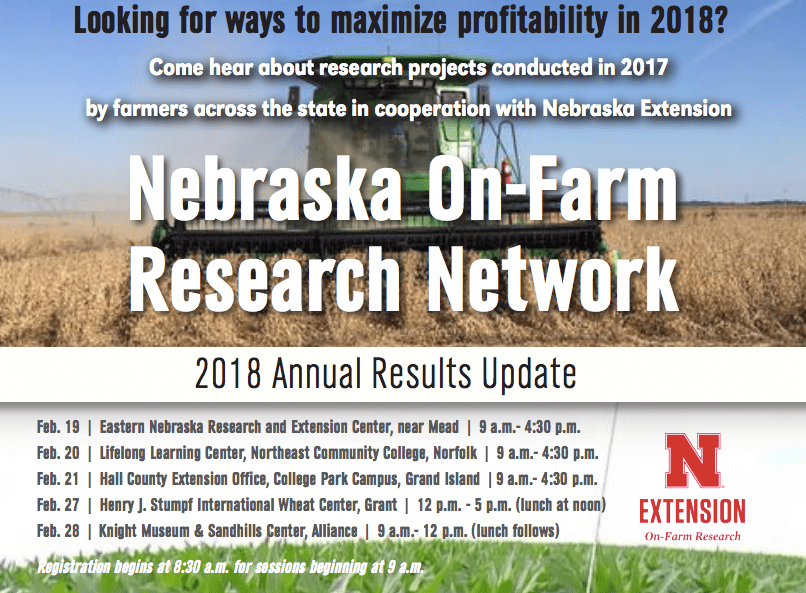
The Nebraska On-Farm Research Network is a statewide, on-farm research program that addresses critical farmer production, profitability and natural resources questions. Growers take an active role in the on-farm research project sponsored by Nebraska Extension in partnership with the Nebraska Corn Growers Association, the Nebraska Corn Board, the Nebraska Soybean Checkoff, and the Nebraska Dry Bean Commission.

These February programs will provide an opportunity to hear growers who conducted on-farm research share their results from the 2017 growing season. Field length replicated treatment comparisons were completed in growers’ fields, using their equipment.

Research projects to be discussed will include:  cover crops, variable rate seeding, planting populations, multi-hybrid planting, starter fertilizer, fungicide applications, alternate crop rotations, multi-hybrid planting uses, seed treatments, and sidedress nitrogen management technologies including drone and sensor based management, variable-rate nitrogen management.  Certified Crop Advisor Credits are applied for and pending upon approval.

Program Dates and Locations in Eastern Nebraska:

  • Feb. 19 — near Mead, Eastern Nebraska Research and Extension Center, 9 a.m. – 4:30 p.m.
  • Feb. 20 — Norfolk, Lifelong Learning Center, Northeast Community College, 9 a.m. – 4:30 p.m.
  • Feb. 21 — Grand Island, Hall County Extension Office, College Park Campus, 9 a.m. – 4:30 p.m.

These programs are free and include lunch, but preregistration is requested for meal planning purposes.  To preregister call (402) 624-8030. Registration check-in begins 30 minutes before the program start time at each site. To learn more about the Nebraska On-Farm Research Network and how to participate, visit http://cropwatch.unl.edu/farmresearch.

Source: UNL CropWatch

Crops, Irrigation, Livestock, Programming

Crop Insurance, Farm Bill and More

Crop Insurance.png

Today’s farmers and ranchers not only have to be efficient with production practices, but also need to be well-informed with risk management and economics of their business. With that in mind, the Farmers and Ranchers College is offering the program, “Crop Insurance, Farm Bill Policy Update and More” at the Fillmore County Fairgrounds in Geneva, NE on February 23rd. This workshop will start at 10:00 a.m. with registration at 9:45 and will wrap up at 3:00 p.m. Due to the generous contributions of many businesses and organizations, the program is free; registration is preferred for an accurate meal county by February 16th. Call the Fillmore County Extension office at (402)759-3712 or email Brandy at brandy.vandewalle@unl.edu to register.

Speakers for the program will be Steve Johnson who has served as the Farm & Ag Business Management Specialist in Central Iowa for Iowa State University Extension and Outreach since 1999.  He specializes in topics related to government farm programs, crop insurance, crop marketing, grain contracts, farmland leasing and other crop risk management strategies. Annually Steve conducts more than 100 meetings, workshops, seminars and conferences across the Corn Belt with over 10,000 in attendance. Steve uses web sites such as ISU Ag Decision Maker and Polk County Extension Farm Management along with various print and electronic media. He will highlight 2017 crop supply/demand & cash price outlook, discuss 2018 crop cost estimates, planted acreage & weather outlook, highlight seasonal trends for new crop futures, learn to use a variety of marketing strategies & tools and develop & implement new crop marketing plans.

Brad Lubben, a Nebraska Extension Policy Specialist with Nebraska Extension since 2005, also teaches agricultural economics courses on campus and is the Director for the North Central Extension Risk Management Education Center. His integrated research, extension and teaching interests include agricultural policy, trade policy, food policy, conservation and environmental policy and public policy.  A native Nebraskan, Lubben is dedicated to the producers and students he serves. Brad’s presentation will focus on how the current ARC and PLC program has provided substantial but declining support for Nebraska producers. He will discuss the new farm bill due to be written in 2018, but will need to reconcile several issues and budget challenges to get done on time, whether a new farm bill is completed or current legislation is extended, producers can expect a new ARC vs. PLC decision in 2019 under very different market conditions and finally how producers will also need to follow a number of other policy issues under debate in DC and beyond.

Austin Duerfeldt specializes in farm accounting, financial analysis, and taxation.  As the Southeast Regional Ag Economist, he provides educational training on grain marketing, cash rent, land valuation, financial analysis, taxes, and negotiations. He will talk about the 2017 Tax Cuts and Jobs Act (Farm Edition) in regards to S199A, depreciation, COOPs and other important factors that impact farmers and ranchers.

Ryne Norton, Fillmore County Farm Service Agency director will provide local FSA updates and Brandy VanDeWalle, Nebraska Extension Educator will talk about farm financial success and ways to cope during difficult times in addition to sharing resources for handling stress in challenging times.


Crops, Irrigation, Programming

Crop Production Clinics

The 2018 Clinics and Conference are an excellent opportunity for crop producers and agribusiness professionals can improve their profitability and sustainability. The clinics will be offered at four locations across Nebraska this January and the conference will be held over two days in Kearney.soybeans.jpg

They will feature presentations from Extension specialists and educators on soil fertility; soil, water, and irrigation management; crop production; ag business management and policy; pesticide safety; and disease, insect, and weed resistance management. The conference will also feature presentations from regional experts like Kevin Bradley from University of Missouri.

Program topics are tailored to meet the needs of cropping systems in different parts of the Nebraska, and vary by location.

The clinics and conference will be the primary venue for commercial and non-commercial pesticide applicators to renew their licenses in the categories of Ag Plant, Regulatory, and Demonstration/Research. Private pesticide operators can also be recertified.corn japanese beetles.jpg

Dicamba applicator training will be available at the Crop Production Clinics and Nebraska Crop Management Conference by attending the Pest Management (pesticide license re-certification) sessions in the afternoon and completing the sign-in at registration

Registration is available online at http://go.unl.edu/CPC-NCMC Cost for the program is $80 for online registration and $95 for on-site registration. The fee includes noon meal and refreshments, a 2018 Guide for Weed Management in Nebraska, and the 2018 Proceedings. The clinics start at 8:45 a.m.

Dates and locations for the 2018 Crop Production Clinics are:

January 10, Gering Civic Center, Gering
January 11, Sandhills Convention Center, North Platte
January 15 & 16 , Lifelong Learning Center, Norfolk
January 18, Embassy Suites, Lincoln
2018 Nebraska Crop Management Conference Dates:

January 24-25, Younes Conference Center, Kearney

For more information, contact a local UNL Extension office or call 402-472-5411 or 402-472-5636.

Crops, Irrigation, Programming

CropWatch: Your Place for Reliable Crops Information

nature-field-sun-agriculture.jpg

CropWatch is written by Nebraska Extension specialists and educators from across Nebraska to provide timely, research-based information to help you make your farm decisions. During pesticide education sessions and other programs, I remind producers about the vast amount of resources available. We continue to reach more people each year, but we still have many producers that are not checking it on a regular basis.  I hope you’ll all make it a goal or resolution to do so in 2018!  Just a sample of some CropWatch information I included in this week’s column.

Nebraska Crop Budgetsmoney bag
The Nebraska Crop Budgets have been updated for 2018 costs and conditions, and include five new budgets relative to corn-soybean rotations. In total, there are 78 crop production budgets for 15 crops, as well as information on crop budgeting procedures, machinery operation and ownership costs, material and service prices, and a crop budget production cost summary. The 2018 crop budgets are available at cropwatch.unl.edu/budgets.

NE Extension Successful Farmer Series
The Nebraska Extension Successful Farmer Series returns January 5 with the first of six workshops to be held at the Lancaster Extension Educator Center in Lincoln.

These Friday morning workshops, held from 9 to 11:30 a.m., are organized by topic so individuals can zero in on the topic most pertinent to their needs, he said.

The cost is $5 for each session or $15 to attend all six. Handouts and materials will be provided at each workshop and CCA credits will be available. For more information, see the program brochure. To preregister, call 402-441-7180. Refreshments will be provided.

Visit lancaster.unl.edu for the link to program live-streaming.

Dates & Topics
January 5: Weather and Crops with Justin McMechan, extension cropping systems specialist; Tyler Williams, extension educator; Al Dutcher, associate state climatologist; and Brian Barjenbruch of the National Weather Service
January 12: Soil Fertility with Aaron Nygren, extension educator, and Rick Koelsch, extension livestock environmental engineer
January 19: Farm Economics with Al Vyhnalek, extension educator, and Brad Lubben, extension ag policy specialist
January 26: Corn with Bijesh Marajhan, Extension soil and nutrient management specialist; Tamra Jackson-Ziems, extension plant pathologist; and Tom Hoegemeyer, corn breeder and former professor of practice in the Department of Agronomy and Horticulture
February 2: Wheat and Equpment with Paul Jasa, extension engineer; Nathan Mueller, extension educator, and Stephen Baenziger, wheat breeder and researcher in the Department of Agronomy and Horticulture
February 9: Soybeans with Stevan Knezevic, extension weeds specialist; Loren Giesler, extension plant pathologist; and a representative of the Nebraska Department of Agriculture.

Private Pesticide Applicator Trainings
Private pesticide applicators holding licenses that expire in 2018, as well as anyone seeking first-time private applicator certification, can contact the Extension office for information on pesticide safety education training sessions. About 200 statewide sessions will be held January-April. Letters to producers with a listing of the trainings should be in your mailbox soon if you need to recertify, but you can check the pested.unl.edu website for a complete listing.

Crops, Irrigation, Programming

On-Farm Research

Nebraska Extension has a long history in on-farm research. In 1989, twenty Saunders County producers came together through Nebraska Extension to form the Nebraska Soybean and Feed Grains Profitability Project. This group began doing randomized, replicated research to answer questions that impacted the profitability of their farming operation. Due to the original group’s success, the idea spread to surrounding counties and in 1998 the Quad Counties research group was formed in Clay, Fillmore, Hamilton, and York Counties in south central Nebraska. Extension Educators and Specialists worked with 20 farmers to produce reliable, unbiased research. The Nebraska On-Farm Research Network builds upon the success of these two organizations, expanding on-farm research to a state-wide effort in 2012.SoybeanPopCount.JPG

On-Farm Research Brainstorming/Discussion Session:  You hear and read about various production practices and products that work for other farmers.  You may have questions regarding a specific practice or product working on your farm.  On-farm research is a way to answer this for yourself!  In the past, our area on-farm research cooperators met before the growing season to brainstorm ideas and discuss potential research topics together.  We are resurrecting this brainstorming/discussion session with it to be held on Monday, November 27th from 1:00-4:00 p.m. at the Fairgrounds (4-H Building) in Aurora.  We encourage farmers who have conducted on-farm research in the past or are considering/interested in on-farm research in the future to attend.  If you’re interested in attending, please RSVP to Steve Melvin at steve.melvin@unl.edu or Jenny Rees at jrees2@unl.edu.

Crops, Irrigation, Livestock

Husker Harvest Days

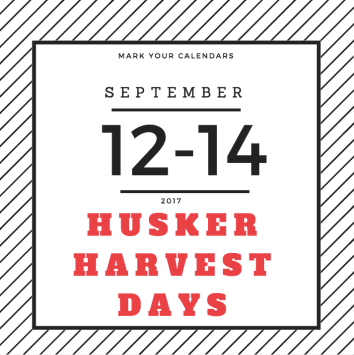
Don’t forget to visit the University of Nebraska-Lincoln’s IANR building at Husker Harvest Days! “Small Changes, Big Payback: Strengthening Nebraska’s Agricultural Economy” is the theme for the Institute of Agriculture and Natural Resources exhibits at the farm show Sept. 12-14 near Grand Island.HDD17

Exhibits inside IANR’s Husker Red building will provide information on:

  • Strategies for managing family budgets during challenging economic times;
  • The relationship between cost, nutritional value and impact of various feed sources for cow/calf operations;
  • Understanding the county-by-county differences in the risk factors that affect crop insurance rates and how they impact profitability and management decisions;
  • How farmers can better utilize the Farm Bill safety net;
  • Benchmarking the costs of pumping irrigation water to better control input costs and make decisions related to pump efficiency and energy usage;
  • Crop production strategies that can have a positive impact on cost per acre and profit margin;
  • Using crop budgets to analyze the operating costs for a farm to become a low-cost producer;
  • The university’s annual survey of agricultural land value and rental rates in Nebraska.
Crops, Irrigation

NE Ag Water Management Network

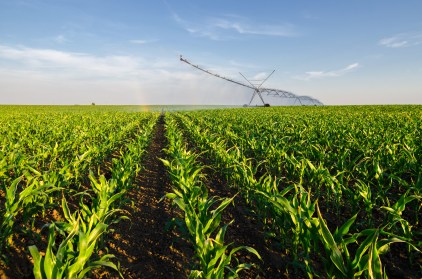
Agricultural irrigation system watering corn field in summer

If you have irrigated ground and are looking for ways to save money, reduce nutrient loss and use less water, consider joining the Nebraska Agricultural Water Management Network, or NAWMN.  Evaluation results have shown a one to two-inch savings of irrigation since it’s inception. The Network has been having significant impacts on both water and energy conservation due to farmers adopting information and implementing technologies in their irrigation management. The cost of applying an additional 2 inches of water is going to vary depending on your depth to water, system pressure, and equipment costs, but could easily run from $10 to $30 per acre.

irrigatepump

To determine the actual cost, I recommend using the IrrigateCost app, developed by Nebraska Extension. The app, which is available for both Apple and Android products, allows users to input their specific information such as acres irrigated, pumping lift, system PSI, pump and pivot life, and inches applied as well as related costs such as for the well and engine, labor, energy, district fees, and taxes. The app then calculates total irrigation, total ownership, and total operating costs. It also breaks down costs by irrigation well, pump, gear head, pump base, diesel engine and tank and system and calculates per acre annual cost and per acre-inch annual cost.

A couple of the tools the NAWMN uses are ETgages® or Atmometers which mimic crop evapotranspiration or ET and Watermark soil matrix sensors which measure soil matric potential or the energy required to remove water from the soil. These two tools have really worked well and have made irrigation management much easier than those gut feelings.  The more information you have the better decisions you can make!

If you are in the NAWMN, and have not already installed your equipment, be sure to remember to start the soaking/drying cycle on your Watermark sensors to be sure they work! It’s also important to replace the #54 alfalfa canvas covers and wafers on a regular basis at the start of each season. For more information, go to: http://water.unl.edu/web/cropswater/nawmdn.

Once you have your ETgage out, I hope you will post your weekly readings to the Nebraska Ag Water Management Network (NAWMN) website. As a reminder, once you are on the main screen, you can login to your site by entering your site name and password and clicking on “Login.” Once you have logged in, you will be taken to your weekly data from past weeks, including last year. To enter your weekly data, click on the “Add new ETgage reading” link which will take you to the data entry page where you can enter your growth stage, rainfall, and ETgage change.

If you’ve forgotten your site name or password, please contact Aaron Nygren at anygren2@unl.edu or 402-352-3821.

Source: UNL CropWatchwebsite

Crops, Irrigation, Livestock, Uncategorized

Census of Agriculture

According to a news release from the National Agricultural Statistics Service (NASS), America’s farmers and ranchers will soon have the opportunity to strongly represent agriculture in their communities and industry by taking part in the 2017 Census of Agriculture. Conducted every five years by the U.S. Department of Agriculture’s (USDA) National Agricultural Statistics Service (NASS), the census, to be mailed at the end of this year, is a complete count of all U.S. farms, ranches, and those who operate them.

pexels-photo
Photo Credit: pexels.com

The Census of Agriculture is the only source of uniform, comprehensive, and impartial agriculture data for every county in the United States, according to the NASS administrator Huber Hamer.  The Census of Agriculture highlights land use and ownership, operator characteristics, production practices, income and expenditures, and other topics. The 2012 Census of Agriculture revealed that over three million farmers operated more than two million farms, spanning over 914 million acres. This was a four percent decrease in the number of U.S. farms from the previous census in 2007. However, agriculture sales, income, and expenses increased between 2007 and 2012. This telling information and thousands of other agriculture statistics are a direct result of responses to the Census of Agriculture.

Producers who are new to farming or did not receive a Census of Agriculture in 2012 still have time to sign up to receive the 2017 Census of Agriculture report form by visiting http://www.agcensus.usda.gov and clicking on the ‘Make Sure You Are Counted’ button through June. NASS defines a farm as any place from which $1,000 or more of agricultural products were produced and sold, or normally would have been sold, during the census year (2017).

For more information about the 2017 Census of Agriculture and to see how census data are used, visit www.agcensus.usda.gov or call (800) 727-9540.

Crops, Horticulture, Irrigation, Livestock, Uncategorized, Youth

Celebrate Agriculture!

The Agriculture Council of America (ACA) hosts National Agriculture Day on March 21, 2017. This marks the 44th anniversary of National Ag Day, which is celebrated in classrooms and communities across the country. The theme for National Ag Day 2017 is “Agriculture: Food For Life.” The purpose of National Agriculture Day is to tell the true story of American agriculture and remind citizens that agriculture is a part of all of us. A number of producers, agricultural associations,Ag Day2017 corporations, students and government organizations involved in agriculture are expected to participate.
National Ag Day is organized by the Agriculture Council of America. ACA is a nonprofit organization composed of leaders in the agricultural, food and fiber community, dedicating its efforts to increasing the public’s awareness of agriculture’s role in modern society. The National Ag Day program encourages every American to:

  • Understand how food and fiber products are produced.
  • Appreciate the role agriculture plays in providing safe, abundant and affordable products.
  • Value the essential role of agriculture in maintaining a strong economy.
  • Acknowledge and consider career opportunities in the agriculture, food and fiber industry.NewAgDay_Original.jpg

Since National Ag Day is one day out of the year, it is important for us to note that we everyday we should promote agriculture and share our story. Did you know how amazing Nebraska agriculture is?  The Nebraska Department of Agriculture publishes some statistics that are interesting to read! For example, nationally, Nebraska ranks first in popcorn production, Great northern bean production and commercial red
meat production. Nebraska ranks second on pinto bean production, number of head of bison and proso millet production. We rank third for corn grain production and corn exports and fourth in cash receipts for all farm commodities. Nebraska ranks fifth soybean and grain sorghum production.

Cash receipts from farm marketings contributed over $23 billion to Nebraska’s economy in 2015 and 6.1 percent of the U.S. total. Every dollar in agricultural exports generates $1.22 in economic activities such as transportation, financing, warehousing and production. Nebraska’s $6.4 billion in agricultural exports in 2015 translate into $7.8 billion in additional economic activity.

One in four jobs in Nebraska is related to agriculture, thus the importance agriculture has on our economy. In Extension, we have several great programs that not only teach youth the importance of agriculture, but also strive to make youth aware of the numerous career opportunities in agriculture. As technology continues to advance, types of careers in agriculture will also continue to expand.

In conclusion, while March 21st is one day devoted to celebrating agriculture, we should celebrate agriculture everyday. If you ate, thank a farmer or rancher who produced your food. From the food we eat to the clothes we wear, tires on our cars, toothpaste, crayons, windshield wiper fluid, etc., we need to thank our American farmers and ranchers for providing us with products that are affordable and good for the environment. Thank you farmers and ranchers!

Crops, Irrigation, Programming, Uncategorized

Precision Ag Data Management Workshop

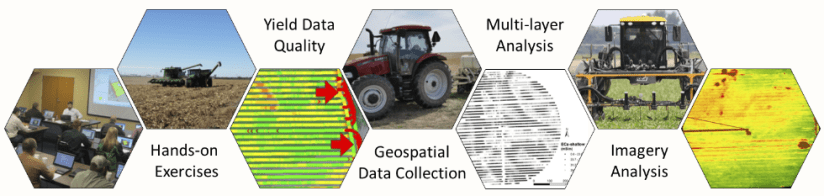
precison-agProduction agriculture continues to evolve into a data-intensive system as producers and other agricultural professionals look for ways to gather more actionable information from their data. Topics for the 2017 Nebraska Extension Precision Ag Data Management Workshops were developed to provide hands-on data analysis instruction on how to apply variable rate technologies for improving crop production efficiency and on-farm economics. Sessions will teach attendees options for creating management zones within fields as well as how to create variable rate application maps (for planting) and evaluate planting studies using GPS-enabled yield monitor data. In addition, exercises will provide information related to creating profitability maps using different data layers collected during the growing season.

Four two-day workshops will be held in Lincoln, York, Norfolk, and North Platte during January and February. Interested individuals can register for one or both days.

Program Sites
Lincoln — Jan. 10-11
York — Jan. 12-13
North Platte — Jan. 26-27
Norfolk — Feb. 7-8

For more information, please visit the 2017 Nebraska Extension Precision Ag Data Management Workshop registration website at http://agronomy.unl.edu/precisionag

Please contact Joe Luck (402-472-1488 or jluck2@unl.edu) if you have questions related to the workshops.