Crops, Irrigation, Programming, Uncategorized

Successful Farmer Series

Now that the growing season is coming to an end, there are many opportunities in the upcoming months to enhance your knowledge and garner new ideas to take back to your operation. Nebraska Extension provides numerous workshops, conferences and trainings all across the state to help you increase your profitability and environmental stewardship.successfulfarmer

One opportunity available to southeast Nebraska is the Successful Farmer Series. It is unlike many other Extension educational events and that it encompasses a host of agricultural topics in six individual events. Each event covers a different topic and you can choose which topics/events you wish to attend. Each topic will feature two to three speakers from the University of Nebraska-Lincoln. We will also invite other experts surrounding the topic to be in attendance and address more specific questions or interact with attendees during the breaks.

This is the second year of the Successful Farmer Series and the reviews from year one were quite positive. Nearly 90% of the attendees said they are very likely to attend the series in 2016-2017, so spots may fill up fast.

Workshops are every other Friday this winter (except December 30th) from 9:00 am until 11:30 am at the Lancaster Extension Education Center in Lincoln. CEUs are available and Refreshments will be provided.

Here are the dates and topics for this year’s Successful Farmer Series:

  • December 16th – Cover Crops & Wheat
  • January 6th – Ag Management Technology
  • January 20th – Farm Financial Management
  • February 3rd – Soil & Climate Tools
  • February 17th – Soybeans
  • March 3rd – Corn

The cost to attend is $5 for individual workshops or you can sign up for the entire series and pick which events to attend for $15. Pre-registration at least two days in advance is appreciated by contacting Karen Wedding at 402-441-7180 or online. Pay at the door, check or cash.

 (Source: Tyler Williams, Extension Educator in Lancaster County)

Crops, Irrigation

NE Ag Water Management Network

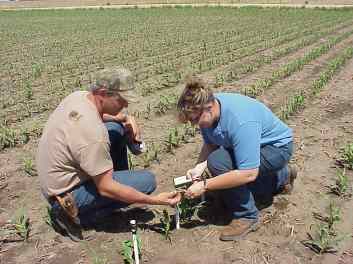
Planting has been well underway and hopefully we will receive timely rainfall this growing season with little need to irrigate. If you have irrigated ground and are looking for ways to save money, reduce nutrient loss and use less water, consider joining the Nebraska Agricultural Water Management Network, or NAWMN. I’ve been in Extension for nearly eleven years and a program I’ve been involved with that has been a very rewarding program and made a positive impact for many is the Nebraska Agricultural Water Watermark SensorsManagement Network, or NAWMN. Evaluation results have shown a one to two inch savings of irrigation since it’s inception. In 2005, only a few producers in the Upper Big Blue NRD, (shortly followed by the Little Blue NRD) were participating, but as of last fall, this program has reached 1,393 in 18 NRDs and 73 of 93 counties. The Network has been having significant impacts on both water and energy conservation due to farmers adopting information and implementing technologies in their irrigation management.

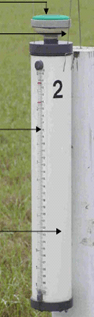
A couple of the tools we use are ETgages® or Atmometers which mimic crop evapotranspiration or ET and Watermark soil matrix sensors which measure soil matric potential or the energy required to remove water from the soil. These two tools have really worked well and have made irrigation management much easier than those gut feelings. The more information you have the better decisions you can make!  ETgage

If you would like to participate in this dynamic program, let me know and I’d be happy to help and get you started! If you are in the NAWMN, consider installing your ETgage soon and once done with planting, start the soaking/drying cycle on your Watermark sensors to be sure they work! It’s also important to replace the #54 alfalfa canvas covers and wafers on a regular basis at the start of each season. For more information, go to Nebraska Extension’s Water Website. 

Crops, Horticulture, Irrigation, Livestock, Programming, Uncategorized, Youth

What is Extension?

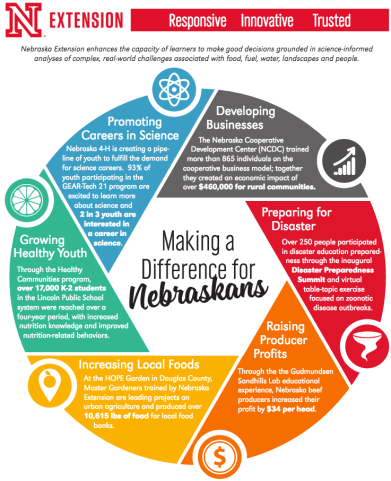
Often times when I tell people I work at the “Extension Office” they have no idea what it is we do. It is so hard to describe without giving a plethora of information. One of our signature programs people often most often associate with is the 4-H program. While this is a large and very successful component of Extension, it is only one of many programs.ExtensionDifferencepic

Everyday, whether you know it or not, you have most likely been indirectly impacted by Extension programming. Extension essentially takes science and research-based information from the University Of Nebraska – Lincoln and delivers it into the hands of the public. We make UNL easily accessible to the public. For example, we provide services and resources to the agricultural community, but also sectors as diverse as nutrition, health care and technology. From border to border, Nebraska Extension is making an incredible impact on the success of our state – its youth, its families, its farms & ranches, its communities, its economy.

For example, as a result of our Learning Child Extension staff, approximately 24,000 children in Nebraska benefit from early childhood professionals and parents who have the essential skills and knowledge to support the healthy growth and development in the children in their care. Take the crops area: last year, Extension presented workshops in 94 locations to over 4,000 participants from 93 Nebraska counties, 9 U.S. states and 4 foreign countries. Our community vitality programming has engaged over 10,000 Nebraskans in Broadband planning and engaged over 2,500 people through the Entrepreneurial Community Activation Process which resulted in community-wide visions, a new economic development corporation being started, community web portal and a young professional network.

Nebraska Extension continues to evolve and is one of the leading Extension programs in the world. In doing so, Extension Educators are more focused in their area of expertise and able to provide clients with robust information. For example, Extension staff covers a specific region to ensure clients are being served well. Each county has access to a professional in the areas of:

  • Community environment (horticulture)
  • Food, Nutrition & Health
  • Crops & Water
  • The Learning Child
  • Community Vitality
  • Beef & Livestock Systems
  • 4-H Youth Development

This has been a very brief overview of Extension and next week we’ll discuss how this impacts our multi-disciplinary programming and Fillmore County.

Irrigation, Programming, Uncategorized

Nebraska Ag Water Management Network Conference

Updates on irrigation engineering tools and research on new irrigation technologies, variable rate irrigation and fertigation fundamentals and cover crops will be the focus of the Nebraska Ag Water Management Network Conference that will be held on Thursday, March 10th. It will be a

MVC-003L
Those who participate in the program receive assistance installing equipment and education on how to read the equipment.

t the Holthus Convention Center, located at 3130 Holen Avenue in York. The conference will run from 9:30 a.m. to 3:20 p.m., with registration beginning at 9:15 a.m.

Producers, crop consultants, NRD, DNR, NRCS, irrigation districts and other professionals are invited to attend. Participants are encouraged to share their experiences that have helped make the Nebraska Ag Water Management Network (NAWMN) successful and any ideas they have for growing the network.

Topics that will be covered include:

  • Update on status of the NAWMN
  • Water-related smart phone apps
  • Z-Mag Ag Water Management Guide
  • Automated Water Use Database Project
  • Cover Crop Research
  • NRD Update
  • Update from the Upper Big Blue NRD CropTip
  • Underground Wireless Sensor Update
  • Soil Moisture Sensor Research Update
  • Variable Rate Irrigation Science and Engineering and Variable Rate Fertigation Research

A total of 4 continuing education units have been applied for in Soil/Water Management.

The NAWMN goal is to transfer high quality research information to producers to use water and energy resources more efficiently for crop production and to enhance crop water productivity. Started in 2005 with 15 collaborators, NAWMN has now grown to nearly 1400 collaborators who implement cutting-edge water management technologies/practices taught in the Network. Many of them regularly contribute water use database to a central NAWMN website. In turn, this information is used by growers across the state to fine-tune their irrigation management and application timing to current plant water needs. The fundamental objective of the NAWMN has been to integrate science, research and education/outreach principles to provide citizens best information available to help them to make better informed decisions in their irrigation management practices, which contributes to the Land-Grant Mission of UNL. The practices/procedures taught in the NAWMN have been based on the scientific and research-based information led by UNL-IANR professor Dr. Suat Irmak.

There is no cost to attend. Lunch will be provided but we ask participants to RSVP for planning purposes by March 7th to Jenny Rees at the Clay County Office Extension Office at 402-762-3644 or jenny.rees@unl.edu.


Irrigation

Scheduling the Last Irrigation

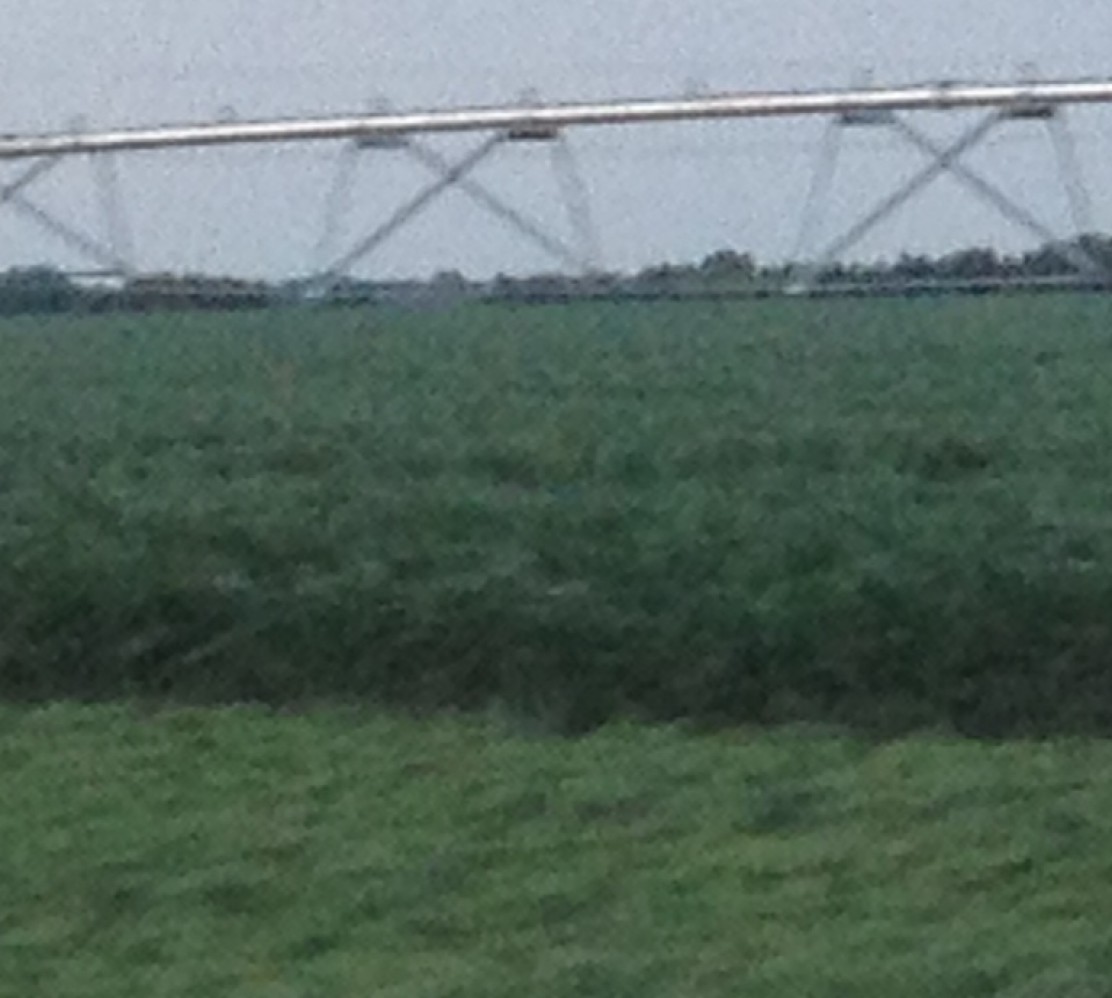
For some corn and soybeans in our area it will soon be time to start thinking of the last irrigation. Producers with watermark sensors should be checking them to see how many inches they have to carry plants through to physiological maturity. Corn that hasn’t approached full dent and soybeans in the R5 stage has a coefficient of 1.1. To estimate crop water use we multiply 0.8 times 1.1 for a total crop ET of 0.88 inches a week or about 0.13 inches a day.cropped-cornpivotblogpic1.jpg

As the crop begins to reach maturity, the crop water use slows. For example, corn at ¼ milk line requires 3.75 inches until maturity, while corn at ½ milk line only needs 2.25 inches. Soybeans at R5 (beginning seed enlargement) need 6.5 inches while soybeans at R6 (end of seed enlargement) need 3.5 inches.

Generally speaking, a silt loam soil can hold 2.2 inches per foot or 8.8 inches in the top 4 feet. The target is to have 60% available soil moisture depleted at the end of the season. My colleague from York, Gary Zoubek provided a good example, which relates to most soils in the area. His example uses a silt loam soil. If we draw down the available soil water to 60%, we would have 0.88 inch of water per foot of soil or 3.5 inches remaining in the top four feet of soil. Even though you have 3.5 inches remaining, if you draw the soil water past 60%, it can affect yields; therefore, our target is to have 60% depleted at the end of the season. This will leave room to capture 5.28 inches of water during the off-season from rain or snowfall.

For more information on the last irrigation, Predicting the Last Irrigation of the Season is available online or by stopping in the office.

Crops, Irrigation

NE Ag Water Management Network

Planting has been well underway and hopefully we will receive some timely rainfall with little need to irrigate. If you have irrigated ground and are looking for ways to save money, reduce nutrient loss and use less water, consider joining the Nebraska Agricultural Water Management Network, or NAWMN. I’ve been in Extension for nearly ten years and a program I’ve been involved with that has been a very rewarding program and made a positive impact for many is the Nebraska Agricultural Water Management Network, or NAWMN. Evaluation results have shown a one to two inch savings of irrigation since it’s inception. In 2005, only a few producers in the Upper Big Blue NRD, (shortly followed by the Little Blue NRD) were participating, but as of last fall, this program has reached 1,229 in 18 NRDs and 73 of 93 counties. The Network has been having significant impacts on both water and energy conservation due to farmers adopting information and implementing technologies in their irrigation management.

Those wishing to participate in the program receive assistance installing equipment and education on how to read the equipment.

A couple of the tools we use are ETgages® or Atmometers which mimic crop evapotranspiration or ET and Watermark soil matrix sensors which measure soil matric potential or the energy required to remove water from the soil. These two tools have really worked well and have made irrigation management much easier than those gut feelings. The more information you have the better decisions you can make!

If you would like to participate in this dynamic program, let me know and I’d be happy to help and get you started! If you are in the NAWMN, consider installing your ETgage soon and once done with planting, start the soaking/drying cycle on your Watermark sensors to be sure they work! It’s also important to replace the #54 alfalfa canvas covers and wafers on a regular basis at the start of each season. For more information, go to: http://water.unl.edu/web/cropswater/nawmdn.

Irrigation

Irrigation Apps Available

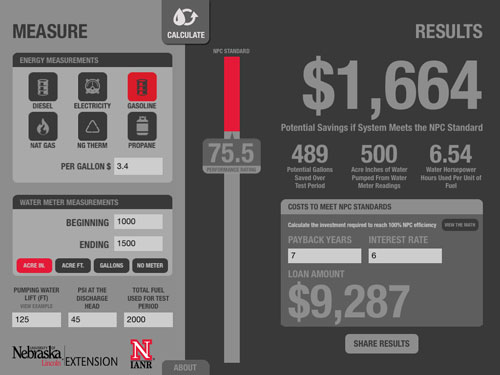
As I write this, we’ve been blessed with some rainfall and hopefully the need to irrigate will be minimal later this growing season. If you irrigate, UNL Extension just release two new appirrigatepumps to help you manage your irrigation. The first is an app to help measure irrigation pumping plant efficiency. This app uses existing records to help determine when pumping plants should be tested by a professional. It can help you identify irrigation pumping plants that are underperforming and need to be adjusted, repaired, or replaced with a better design. This app allows the user to enter six numbers related to pumping lift, pressure at the discharge, acre-inches of water pumped, fuel price, and total fuel used; it then calculates a pumping plant performance rating. It also provides an estimated cost to bring the pumping plant up to standard and the number of years necessary to pay back the investment at various interest rates.
Survey results in the past have shown many pumping plants used 30-50% more energy than expected by the Nebraska Pumping Plant Performance Criteria. Surveys of relatively new pumping plants indicate they’re operating at 82%-92% of the NPC. Results are anonymous but can be captured and emailed to yourself.

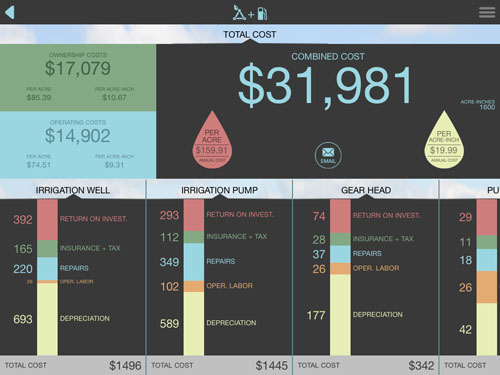
The second app comes from a decision-making spreadsheet that I’ve used with producers every year. Every year I receive questions related to the costs involved with irrigating a neighbors’ field or how to figure the irrigation operating costs versus ownership costs. Now, this can be easily done in the palm of your hands using a smartphone or iPad. Tom Dorn, former extension educator created this tool which calculates ownership and operating costs for your irrigation system. IrrigateCost models center pivot and gated pipe irrigation systems and the most commonly used energy sources. The user inputs information such as acres irrigated, pumping lift, system PSI, pump and pivot life, and inches applied as well as related costs such as for the well and engine, labor, energy, district fees, and taxes. The app then calculates total irrigation cost as well as total ownership and total operating costs.  It also breaks down costs by irrigation well, pump, gear head, pump base, diesel engine and tank and system and calculates per acre annual cost and per acre-inch annual cost. Results for different energy sources are displayed on separate tabs, allowing you to make side-by-side comparisons between energy options.irrigatecost
The calculator is also helpful when computing a fair crop-share rental agreement. Parties often will list all the contributions required for crop production in a table (land, irrigation system, machinery, labor, crop inputs, etc.). By using two columns (one for the landowner and one for the tenant) costs can be determined for each on the inputs. The columns are totaled and a percentage is determined for the landowners and tenants contributions. The “fair” rental arrangement would be to divide the crop on the same percentage as the contributions that each party has made.

The costs of owning and operating the irrigation system are some of the most difficult to identify when analyzing irrigated crop share arrangements. Much of the total cost of irrigation results from ownership costs and a large percentage of ownership costs are not annual out-of-pocket costs but rather hidden costs, such as return on capital investment, depreciation, taxes, and insurance. This app calculates ownership costs for each irrigation system component such as the well, pump, gear head, power unit and the irrigation distribution system.

Additional uses include:

  • Knowing what to charge for watering a portion of a neighbor’s field. This app can help you determine the ownership costs the neighbor should pay in addition to the operating costs for each acre-inch of water pumped.
  • Estimating costs to pump an acre-inch of water to help you determine how many additional bushels of a crop are needed by applying one more inch of water at the end of the irrigation season.

Both apps are available at the Apple Store and Google App Store for Android for $1.99/app.

Source: UNL Extension’s CropWatch
Irrigation

Irrigation Reminders

Hopefully producers won’t have to irrigate too much this year, but I’d like you to consider joining a program that can not only improve your irrigation efficiency, but reduce nutrient loss and save you money!  I’ve been in Extension for nearly nine years and a program I’ve been involved with that has been a very rewarding program and made a positive impact for many is the Nebraska Agricultural Water Management Network, or NAWMN.

Those wishing to participate in the program receive assistance installing equipment and education on how to read the equipment.

A couple of the tools we use are ETgages® or Atmometers which mimic crop evapotranspiration or ET and Watermark soil matrix sensors which measure soil matric potential or the energy required to remove water from the soil. These two tools have really worked well and have made irrigation management much easier than those gut feelings.  The more information you have the better decisions you can make!

If you would like to participate in this dynamic program, let me know and I’d be happy to help and get you started! If you are in the NAWMN, install your ETgage soon and start the soaking/drying cycle on your Watermark sensors to be sure they work! As crops have emerged or about to emerge, its important to install your Watermark Sensors soon.

It’s also important to replace the #54 alfalfa canvas covers and wafers on a regular basis at the start of each season. For more information, go to the NAWMN website.   

Irrigation

Irrigation Management Cost Share

ETgageNow is the time to begin planning and thinking about the upcoming irrigation season.  If you’ve been using the ETgages and Watermark Sensors, now is the time to check your inventory to see if you need to replace the ETgage canvas cover, bird spikes etc.  Do you need to replace some of the sensors that were damaged or are not working properly? If you have not been using this equipment, I’d suggest to give it a try,  I’d be happy to assist you installing/using the equipment.  This is a short ink to the Upper Big Blue NRD 2014 Cost share form.  If you are in the Little Blue NRD, check out their website. I hope you’ll consider ordering some of the equipment for you this season. Don’t hesitate to visit with me or the NRD if you have any questions about these tools.

Irrigation, Programming

Agricultural Water Update

Greetings Readers!  It has been a while since I’ve posted, as I was on maternity leave but am back and will continue to post my weekly updates.

The last Farmers & Ranchers College program for the 2013-14 programming year is quickly approaching!  March

Those wishing to participate in the program receive assistance installing equipment and education on how to read the equipment.
Those wishing to participate in the Nebraska Ag Water Management Network receive assistance installing equipment and education on how to read the equipment.

20th at the Fillmore County Fairgrounds will be the setting for the Irrigation Management and Policy program featuring Dr. Suat Irmak who is internationally known for his work with agricultural water management. Suat started the Nebraska Agricultural Water Management Network, which many producers in the area participate. From his research, UNL Extension has been able to implement irrigation efficiency practices for producers. Using the watermark sensors and ETgage, producers are able to save money and water by reducing water on their crops while still achieving excellent yields. On March 20th Suat will provide updates on new research he’s conducted and answer other questions on the future of irrigation technologies.

Gary Zoubek, UNL Extension Educator in York County will also be available to provide updates on the Nebraska Agricultural Water Management Network and technologies he has tried with producers as well. David Aiken will provide updates on water policy across the state and issues producers need to be concerned for the future.

Representatives from the Upper Big Blue and Little Blue Natural Resource Districts will provide an update on irrigation regulations and other policies. Ryne Norton from Farm Service Agency will provide a brief update as well.

This program is free due to the generous contributions from Farmers & Ranchers College sponsors. The Farmers & Ranchers College was formed in January 2000 with the purpose of providing high quality, dynamic, up to date educational workshops for area agricultural producers in south central Nebraska through a collaborative effort between business, industry and higher education leaders. The Farmers and Ranchers College Committee consists of Fred Bruning of Bruning, Bryan Dohrman of Grafton, Sarah Miller of Carleton, Ryne Norton of York, Jim Donovan of Geneva, Gordy Nuss of Sutton, Bryce Kassik of Geneva, Jennifer Engle of Fairmont and Brandy VanDeWalle of Ohiowa.

Registration starts at 9:45 a.m. and the program will run from 10:00 a.m. to 3:00 p.m. Some irrigation booth vendors will also be available to browse and look at their products. Please call the office ASAP to register at 402-759-3712.