Crops, Livestock, Youth

Celebrate Agriculture

IMG_1370
My daughters, McKenzie and Meredith love caring for their calves, helping in the garden and learning about agriculture.

Growing up on a small farm in Saline County, I appreciate the work of our farmers and ranchers. My dad still farms and my girls enjoy visiting the farm and I hope I can instill the same hard-working values and beliefs my parents instilled in my sister and I. This is part of the reason, my husband and I have starting raising a few chickens and have bucket calves for the girls to care for. With my husband as the Fillmore Central ag education instructor and myself as an extension educator for UNL, we hope to be teaching future generations the vast opportunities available in the agricultural industry. This week marks the time to celebrate agriculture so I have included some of the Agriculture Council of America’s press release in my column this week as well as some of Extension’s work in agriculture literacy.

2017AgDay 625x90The Agriculture Council of America (ACA) will host National Agriculture Day on March 20, 2018. This will mark the 45th anniversary of National Ag Day which is celebrated in classrooms and communities across the country. The theme for National Ag Day 2018 is “Agriculture: Food For Life.”

On March 20, 2018, ACA will host major events in the nation’s capital including an event at the National Press Club as well as a Taste of Agriculture Celebration. Additionally, the ACA will bring approximately 100 college students to Washington to deliver the message of Ag Day. These events honor National Agriculture Day and mark a nationwide effort to tell the true story of American agriculture and remind citizens that agriculture is a part of all of us. A number of producers, agricultural associations, corporations, students and government organizations involved in agriculture are expected to participate.

National Ag Day is organized by the Agriculture Council of America. ACA is a nonprofit organization composed of leaders in the agricultural, food and fiber community, dedicating its efforts to increasing the public’s awareness of agriculture’s role in modern society. The National Ag Day program encourages every American to:

  • Understand how food and fiber products are produced.
  • Appreciate the role agriculture plays in providing safe, abundant and affordable products.
  • Value the essential role of agriculture in maintaining a strong economy.
  • Acknowledge and consider career opportunities in the agriculture, food and fiber industry.

You might be glad to know that Nebraska Extension has a team of extension staff working on programming to educate consumers and youth about agriculture and tell the story of the American farmer and rancher. This is being done through agricultural literacy-focused festivals and programs, development of beef-booster curriculum, quality assurance programs and many others. In fact, over 26,000 youth learned about agriculture through ag literacy programs in 2017 alone and 216,000 individuals accessed web materials to teach/learn about food labeling, when food is still acceptable to eat and how to reduce food waste. Over 3,600 Nebraska youth were certified in Livestock Quality Assurance to implement good production practices ensuring animal care and well-being.

Check out the impact this group had in 2017 related to agriculture literacy. 

Crops, Livestock, Programming

Farm and Ranch Succession Workshop

Persons of all ages are invited to attend a “Farm and Ranch Estate Planning Workshop” hosted by UNL Extension.  This workshop will be held on Friday, March 23, 2018, 9:30 AM – 2:30 PM at Nebraska Extension in Saline County, 306 West 3rd Street, Wilber, NE.

Cost to attend is $20.00 per farm operation and $10.00 for each additional family member.  Please preregister by Tuesday, March 20, 2018 by calling Nebraska Extension in Saline County, phone (402) 821-2151, to ensure that there are enough handouts, food and other materials.  The registration fee will include your meal, handouts, and presentations.pexels-photo-315653.jpeg

One presentation will focus on the decisions and situations which should be addressed when thinking about how your farm or ranch estate will be passed.  Topics will include: the need for planning, proper family communications, who makes the decisions, concept of fair versus equal, preparing to meet with an attorney, and much more.  The presentation is designed to give some basic information to those that haven’t yet started to think about their succession or transition plan for their assets.

In addition, an agriculture attorney will be making his presentation to give agricultural families the basics of what they need to start planning their wills, trusts, and other end of life documents that need to be in order.  The objective is to start the process of having the farm succession or transition planned.

Allan Vyhnalek, UNL Extension Educator for Farm Succession, will present.  He was just assigned to the Ag Economics Department recently to work on farm and ranch succession and transition.  Joe Hawbaker, Omaha based attorney, will make the legal presentation.  He has worked with farmers for over 30 years and will cover the legal aspects of end of life decision making. Hawbaker will cover estate planning basics, including incapacity planning, then succession tools and how to use a decision tree.

Participants at previous events always report that they wished they would have started sooner, when asked about the value of attending the presentation.  The consequences of not having an appropriate plan in place can jeopardize the financial stability and the future of the family.  More importantly, we need to have our wishes known to others so the legacy of the farms and ranches can be passed to the individuals or entities intended.

For more information or assistance, please contact Randy Pryor, UNL Extension Educator, phone (402) 821-2151.

Crops, Livestock, Programming

Public Forums Address 2018 Farm Bill

Producers, landowners and other agricultural policy stakeholders seeking information on the 2018 farm bill are encouraged to register for a series of five forums scheduled at locations across Kansas and Nebraska. Experts from K-State Research and Extension and Nebraska Extension will discuss farm bill issues and policy options, and gather input to share with policymakers to help inform the continuing developmentmoney bag

A new federal farm bill is due this year and is under development in Congress. With action completed on a federal budget including some agricultural programs, the farm bill process could pick up quickly with proposals and legislation fully debated in the coming weeks.The meetings will provide an overview of the current debate and current economic conditions in agriculture which help frame the discussion and will look at crop and dairy commodity programs, conservation programs, and nutrition programs and other policy issues, as well as proposed crop insurance changes.

Leading the discussion will be Mykel Taylor and Art Barnaby from Kansas State University and Brad Lubben from the University of Nebraska-Lincoln. Taylor is a farm management specialist with expertise in producer decision-making, including in-depth analysis of the 2014 farm program enrollment decision. Her analysis of past decisions and outlook will provide perspective on the commodity programs, the potential changes and the decisions ahead in 2019. Barnaby is a national expert in crop insurance with keen insight on the features and performance of crop insurance. His work will explore the proposed changes and the potential ramifications to the program and to producer crop insurance and risk management decisions. Lubben is a noted expert in agricultural policy with insight on both the farm bill issues and the process. He will help frame the debate and the expectations for new programs and policies to provide perspective on the broader budget and policy challenges facing members of Congress in writing the new farm bill.

Each meeting will run from 9:00 a.m. to 2:30 p.m. Registration will begin at 8:30 a.m. with refreshments and lunch served. The closest meetings to our area include:

-MANHATTAN, KS.: March 1, Pottorf Hall – CiCo Park, Manhattan, KS     Host: Rich Llewelyn, rvl@ksu.edu or 785.532.1504

-MEAD, NEB.: March 5, ENREC near Mead, Eastern Nebraska Research and Extension Center, Ithaca, NE    Host: Keith Glewen, kglewen1@unl.edu or 402-624-8030

-HASTINGS, NEB.: March 7, Adams County Fairgrounds, Hastings, NE     Host: Ron Seymour, rseymour1@unl.edu or 402-461-7209

The registration fee is $20 if pre-registered five days before the date of each meeting, and will increase to $30 after the deadline or at the door. The fee covers the meal, refreshments and meeting materials. To register, visit http://www.agmanager.info/events/2018-farm-bill-meetings and clicking on the meeting you wish to attend. Further information is available on http://farmbill.unl.edu or by contacting the meeting host at each location.

Crops, Irrigation, Livestock, Programming

Crop Insurance, Farm Bill and More

Crop Insurance.png

Today’s farmers and ranchers not only have to be efficient with production practices, but also need to be well-informed with risk management and economics of their business. With that in mind, the Farmers and Ranchers College is offering the program, “Crop Insurance, Farm Bill Policy Update and More” at the Fillmore County Fairgrounds in Geneva, NE on February 23rd. This workshop will start at 10:00 a.m. with registration at 9:45 and will wrap up at 3:00 p.m. Due to the generous contributions of many businesses and organizations, the program is free; registration is preferred for an accurate meal county by February 16th. Call the Fillmore County Extension office at (402)759-3712 or email Brandy at brandy.vandewalle@unl.edu to register.

Speakers for the program will be Steve Johnson who has served as the Farm & Ag Business Management Specialist in Central Iowa for Iowa State University Extension and Outreach since 1999.  He specializes in topics related to government farm programs, crop insurance, crop marketing, grain contracts, farmland leasing and other crop risk management strategies. Annually Steve conducts more than 100 meetings, workshops, seminars and conferences across the Corn Belt with over 10,000 in attendance. Steve uses web sites such as ISU Ag Decision Maker and Polk County Extension Farm Management along with various print and electronic media. He will highlight 2017 crop supply/demand & cash price outlook, discuss 2018 crop cost estimates, planted acreage & weather outlook, highlight seasonal trends for new crop futures, learn to use a variety of marketing strategies & tools and develop & implement new crop marketing plans.

Brad Lubben, a Nebraska Extension Policy Specialist with Nebraska Extension since 2005, also teaches agricultural economics courses on campus and is the Director for the North Central Extension Risk Management Education Center. His integrated research, extension and teaching interests include agricultural policy, trade policy, food policy, conservation and environmental policy and public policy.  A native Nebraskan, Lubben is dedicated to the producers and students he serves. Brad’s presentation will focus on how the current ARC and PLC program has provided substantial but declining support for Nebraska producers. He will discuss the new farm bill due to be written in 2018, but will need to reconcile several issues and budget challenges to get done on time, whether a new farm bill is completed or current legislation is extended, producers can expect a new ARC vs. PLC decision in 2019 under very different market conditions and finally how producers will also need to follow a number of other policy issues under debate in DC and beyond.

Austin Duerfeldt specializes in farm accounting, financial analysis, and taxation.  As the Southeast Regional Ag Economist, he provides educational training on grain marketing, cash rent, land valuation, financial analysis, taxes, and negotiations. He will talk about the 2017 Tax Cuts and Jobs Act (Farm Edition) in regards to S199A, depreciation, COOPs and other important factors that impact farmers and ranchers.

Ryne Norton, Fillmore County Farm Service Agency director will provide local FSA updates and Brandy VanDeWalle, Nebraska Extension Educator will talk about farm financial success and ways to cope during difficult times in addition to sharing resources for handling stress in challenging times.


Livestock, Programming

Farmers and Ranchers Cow/Calf College

calf.jpg

The annual Farmers and Ranchers Cow/Calf College “Partners in Progress – Beef Seminar” will be held at the U.S. Meat Animal Research Center and Great Plains Veterinary Education Center near Clay Center on January 30, 2018 with registration, coffee and donuts starting at 9:00 a.m. The program will run from 9:30 a.m. until 3:30 p.m. This program is sponsored by Nebraska Extension’s Farmers and Ranchers College and will feature several outstanding speakers discussing issues and management strategies that can affect the profitability of all beef producers. There is no cost for the event and the public is invited. It does include a noon meal, which means that early registration is necessary to reserve materials and a meal.

The “Cow/Calf College” will begin at 10:00 a.m. with a welcome by Dr. Gary Bennett of USMARC and Dr. Dale Grotelueschen, Director of the Great Plains Veterinary Education Center. Brett Crosby with Custom Ag Solutions will kick off the event with “Ways to Optimize Cattle Marketing”.

photo 3

Mary Drewnoski, Nebraska Extension Specialist will present on “One Size Does Not Fit All: Grazing residue with various classes of cattle.” She will talk about some of the issues many producers had this year with so much corn in the stalks and strategies for effectively grazing residue.

Lunch is provided and will be handled with a rotation system during two noon sessions featuring split sessions on: “Livestock Disaster Assistance Programs” from Fillmore County FSA Director, Ryne Norton.

The afternoon session will start with Rob Eirich, Nebraska Extension Educator with the “Beef Quality Assurance Audit”. It is important to know how beef producers have done in regards to quality assurance and results were just released in the summer of 2017.

Dr. Kip Lukasiewicz, Sandhills Cattle Consultants Inc., will lead you through “Implementing BQA and Animal Husbandry”.  A popular presenter, Dr. Kip is sure to entertain you while being right on target to address some of critical quality assurance issues that face beef producers. For our beef producers Dr. Kip will also inform participants on effective animal husbandry and stockmanship techniques.

All presenters will then pull everything together, give their final thoughts and considerations and provide a coffee-shop style panel discussion during which cattlemen can ask questions and get answers on questions that came to them during the day’s sessions. A chance for door prizes will be awarded to those that stay for the entire event.

Please pre-register by January 23rd, to the Nebraska Extension Office in Fillmore County or call (402) 759-3712 to insure a seat and lunch. Walk-ins are accepted, but may not get a lunch. You may also complete your registration online on fillmore.unl.edu or go.unl.edu/t38n.  Remember, your contact information is required to be on the U.S. MARC property, so pre-registration is helpful and will save you time at the door!

Crops, Livestock, Programming

Reflections from Dr. Kohl

Those of us in agriculture are no stranger to risks involved with agriculture that are taken every day, whether it is financial, production, legal, price/market or human resource risks.  While we can’t control everything, there are measures that can be taken to protect one’s operation and reduce risk. Each year the Farmers & Ranchers College hosts Dr. David Kohl, Professor Emeritus from Virginia Tech who does an excellent job describing global risks which affect us locally and how those risks will affect the agricultural industry.

IMG_0872
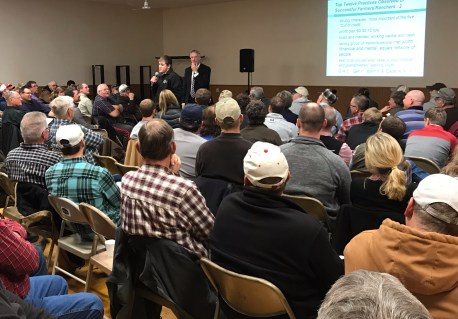
Approximately 120 people gathered for the first Farmers & Ranchers College program for the 2017-2018 programming year.

Several points I’d like to share in this week’s column are what Dr. Kohl coins as the top 40% of proactive producers or “greenliners” and the bottom 30% of producers or “redliners” and his top twelve practices observed of successful farmers and ranchers.

Characteristics of the top producers include being proactive by challenging themselves to improve their operation in three areas. These producers also have a sound financial system which includes accrual adjustments, knowing their cost of production for each enterprise or even better, each field.  Sound financial systems also look at trend analysis and ensure the records are in a safe and secure place (backed up, protected from cyber-attacks and in a fireproof safe). Proactive producers also have lower rental and fertilizer costs, have a third-person audit their practices and practice modest living. Understanding that a family might have to make sacrifices and pass on that new boat or trip can cut costs drastically, as they rose during the “good times”.

Now let’s take a look at the bottom 30% of producers. These producers typically overpay on marginal resources such as land. They lack financial or marketing skills. Kohl pointed out that something as simple as making one’s own spreadsheets or utilizing a solid record-keeping system is crucial to monitoring one’s cost of production and recommends quarterly meetings with your lender.  “Redliners” often do not make necessary improvements in their operation to keep with the times such as replacing worn out equipment. In fact, when operations are transitioned to the next generation, if everything is rusted and wore out, that next generation’s chance of “making it” are significantly reduced. These producers need to manage taxes, not minimize taxes. These producers often have a high cost of living and lack the ‘HUT’ principle which is to Hear what others tell you, Understand what they are saying and Take Action.

IMG_0875
College students who attended the program were tasked with asking someone for agricultural advice and Dr. Kohl had them report back to the group what they discovered.

Dr. Kohl also shared when he teaches producers strategies for success, he spends a large amount of time teaching about goal setting. Half the problem with businesses is that they don’t have WRITTEN goals. These should include business, family, personal, one and five-year goals. Balance in life is essential in every career, including farming and ranching. Making time for your spouse and other family members will prevent problems down the road. In addition to goals, he teaches producers to have a projected cash flow, break evens calculated, consider different “what-if” scenarios, updated balance sheets by Groundhog’s Day, develop a personal living budget and monitor your business with a lender or advisory team on a quarterly basis.

Dr. Kohl also provided the ten commandments of character. Character is often overlooked, but crucial to one’s integrity and success. His ten commandments of character included:

  1. Follow thru on commitments (educational program and financial statement requests).
  2. Use borrowed funds as agreed upon.
  3. Be accurate with financial statements such as balance sheets, income statement, etc.
  4. Have a willingness to sacrifice lifestyle pursuits and balance with business growth.
  5. Practice good communication of goals and in times when there are issues and challenges.
  6. There should be minimal surprise business purchases.
  7. Be willing to work with an advisory team, including a third party.
  8. Consider constructive coaching.
  9. Properly use profits, cash flows and windfalls.
  10. Utilize a network of people, peers and pursuits.

In summary, those who are unable to embrace change should open their minds and consider making changes. Kohl encouraged the college students in attendance to do an internship or take a job away from home to learn from others and bring fresh, new ideas back to the operation. He applauded those producers in attendance, as they are willing to learn and improve their business. When you graduate from high school or college, you are not done with learning and if you think you are, you will likely be left behind. This is where I’m proud to be a part of Nebraska Extension as we offer educational programs that provide research-based knowledge and our Nebraska On-Farm Research Network is a great avenue to test new practices, ideas or products.

Crops, Livestock, Programming

Ag Liens, Loans and Leases Workshop

One of the most common agricultural related questions our office receives is on cropland leases. If you have any questions similar to this, you are welcome to attend a free workshop on Ag Liens, Loans, and Leases.   The workshop will be held in Davenport, (December 13, 2017) at the Community Center. A lunch will be provided.  The workshop runs from 10:00 am to 2:30 pm.  There is no charge for the workshop.  To register (and for questions) call the Rural Response Hotline at 1-800-464-0258. For an accurate meal count please RSVP by Dec. 8th.

What the workshop is about?money bag.jpg

  • Liens – Nebraska’s statutory agricultural liens, from the producer’s perspective:  What are they?  How do they work? These are liens that give creditors rights in certain property, such as crops, feed and livestock, to secure payment of obligations for goods or services, such as seed, fertilizer, ag chemicals, petroleum products, veterinary assistance, cattle care, harvest work and machine repair.  The discussion will focus on identifying the liens and understanding how they work from the producer’s perspective.
  • Loans– The presentation will provide producers with an inside look at “What your lender is looking for.” The impact of Collateral, Cash Flow, Credit Score, Character and Trends on loan applications.  A brief overview of Balance Sheets, Trend Sheets and Ratio Analysis will also be included.
  • Leases– The importance of lease communications between the landlord and tenant and useful lease provisions will be discussed, along with highlights of current lease rates and trends in Nebraska.

This workshop is being presented by:

  • Joe Hawbaker, Agricultural Law attorney, with Hawbaker Law Office, Omaha
  • Dave Goeller, Agricultural Finance and Transition Specialist
  • Alan Vyhnalek, UNL Ag Economics, Extension Educator for Farm/Ranch Succession

This workshop is made possible by the North Central Risk Management Education, Nebraska Network for Beginning Farmers & Ranchers, the Farm and Ranch Project of Legal Aid of Nebraska, National Institute of Food and Agriculture, Nebraska Department of Agriculture’s Next Gen, Nebraska Farmers Union Foundation, Nebraska Extension- Thayer Co.

Meal sponsors include Cornerstone Bank- Davenport & Bruning State Bank.

Crops, Livestock, Programming

Farmers & Ranchers College

frcollege-logo-front-panel

The Farmers & Ranchers College was formed in January 2000 with the purpose of providing high quality, dynamic, up to date educational workshops for area agricultural producers in south central Nebraska through a collaborative effort between business, industry and higher education leaders. Furthermore, the Farmers & Ranchers College will provide the tools necessary so that agricultural producers will be able to respond positively to these changes using a profitable decision making process.

The Farmers and Ranchers College is a unique opportunity to educate agricultural producers in south central Nebraska. Approximately four hundred producers participated in the 2016-17 Farmers & Ranchers College programs. Producers attending these workshops managed over 170,500 acres. Participants surveyed indicated an average of $18.00/acre of knowledge gained from participating for a potential impact of $3 million.

IMG_7242.jpgThe sixteenth annual Partners in Progress- Beef Seminar featured a variety of industry, University and agricultural organization presenters. Participants managed over 8,500 head of cattle and indicated that on average the information presented will increase their profitability $17.50/head with a total potential impact of nearly $150,000.

Contributions and support of area businesses allow participants to attend at no cost, however for programs that have meals, it is requested that people RSVP at least a week in advance for an accurate meal count by calling Fillmore County Extension at (402) 759-3712.

The Farmers and Ranchers College Committee consists of Fred Bruning of Bruning, Bryan Dohrman of Grafton, Sarah Miller of Carleton, Jennifer Engle of Fairmont, Ryne Norton of York, Jim Donovan of Geneva, Bryce Kassik of Geneva, Eric Kamler of Geneva, and Brandy VanDeWalle of Ohiowa.

2017-18 Program Schedule:

December 7, 2017 – “Positioning for Success in the Economic Reset”” w/ Dr. David Kohl, Professor Emeritus, Dept. of AAEC, VA TECH at the Opera House in Bruning, NE from 1-4:00 pm

January 30, 2017** – “Partners In Progress Beef Seminar” Cow/Calf College at U.S. MARC near Clay Center, NE from 10-3:30 a.m., Registration at 9:30

February 23, 2017** – “Crop Insurance, Farm Bill Policy Update & More!” with Steve Johnson from Iowa State Extension and Brad Lubben, Nebraska Extension at  the Fillmore Co. Fairgrounds- Geneva, NE from 10- 3:00 p.m.,Registration at 9:30 a.m.

 ** Programs are free; however registration is appreciated for a meal count. Please call the Fillmore Co. Extension Office at (402) 759-3712 one-week prior to the program to reserve your spot.

Livestock, Programming

Cow-calf Management with Limited Pasture

Grazing Cover Crop Field Day.jpgIn a joint effort, Kansas and Nebraska Extension are hosting a 3-meeting series to address some possible options to help maintain cattle inventory with limited perennial pastures. Topics at these meeting will include confined cow feeding and management, usage of corn residue, cover crops and annual forages systems. All of the programs will start at 6:30 p.m. and the ones for us will be held on December 12, 2017 at the Helvering Center in Marysville, KS. Please RSVP to Anastasia Johnson at anastasia@ksu.edu or 785-562-3531. The second meeting will be held December 13, 2017 at the Blue Hill Community Center  in Blue Hill, NE. To attend, please RSVP to Brad Schick, brad.schick@unl.edu or 402-746-3417.

Dinner will be provided and there is no cost to attend; however please RSVP to the respective contacts by December 8, 2017 for an accurate meal count. Speakers for the event include extension specialists from Kansas State University and University of Nebraska.

Dr. Mary Drewnoski is a Beef Specialist with UNL based in Lincoln. She will be speaking about “Thinking outside the box: economical forage options”. Drewnoski is part of an interdisciplinary team evaluating Economical Systems for Integrated Crop and Livestock Production in Nebraska.

Dr. Jaymelynn Farney, Beef Systems Specialist with Kansas State University, will discuss “The dos and don’ts of cover crop (annual forages) grazing – from a livestock perspective”. Farney is housed in the Southeast Research and Extension Center in Parsons, KS where she spends her time working on research and outreach for practical cattle management.

“Confinement cow feeding – the science and the art” is the title of Dr. Karla Jenkins talk. Jenkins is a cow/calf specialist for UNL housed at the Panhandle Research and Extension Center in Scottsbluff, NE. Her research program includes finding more efficient and economical ways to produce beef cattle while sustaining the range resource.

Crops, Livestock, Programming, Youth

Food Label “Quiz”

With the holiday season upon us, many consumers will be preparing food for family and friends. When you go to the grocery store and select food, how well do you really know your food labels?  A survey of over 1,200 Nebraskans was conducted on how people think and feel about their food. Food labels were identified as the major information source by almost 64% of respondents. This work was done as a part of our Consumer Confidence team which works to find ways to inform people about food production. Are you an able food label reader? Do you know the answers to these questions? (Answers at the end of this article.)

Photo Credit: FDA
  1. A label box of cereal starts like this: “Ingredients: Whole wheat, brown sugar, molasses….”
    Which of these ingredients is present in the largest amount by weight in this food? a. Whole wheat      b. Brown sugar    c. Molasses     d. They are present in equal amounts
  2. Two chicken broths are labeled the following: Label 1: Real herbs, real flavor, sodium free chicken bouillon and Label 2: All natural, 100% chicken bouillon
    Which label does NOT have an approved “definition?” 
    a.  Label A     b. Label B
  3. A label says, “best if used by Dec., 27, 2019. Is a “Best If Used By” date a “safety” date?
    a. Yes     b. No
  4. Which of the following foods is “hormone free”?
    a. Meat     b.  Bread      c. Peas      d. None of them are “hormone free”
  5. Which animal is raised with “added” hormones?
    pig and chicken
    Photo Credit: Microsoft Powerpoint icons

    a. Pigs      b. Chicken      c. Both of them      d. Neither of them

  6. If “bananas-A” are labeled “GMO-Free” and “bananas-B” have no GMO labeling, which is a TRUE statement?
    a. Bananas-B are a GMO food      b. Neither of them are GMO foods       c. It’s impossible to tell if bananas-B are a GMO food

CHECK YOUR ANSWERS:

  1. a. Whole wheat. Ingredients are listed by their common or usual name in descending order by weight. For example: If “whole wheat” is listed first, that ingredient is found in the largest amount by weight in the product. The ingredient listed last contributes the least amount by weight.
  2. b. Label B. Currently, the U.S. Food and Drug Administration has not developed a definition for use of the term “natural.”
  3. a. No. A “Best If Used By” date describes product quality, where the product may not taste or perform as expected but is safe to use or consume.
  4. d. None of them are “hormone free.” Anything that is or has been alive contains hormones, including plants. There is no such thing as “hormone free” meat or animal product.
  5. d. Neither of them. Added hormones aren’t allowed by the U.S. Department of Agriculture in pork and poultry. A claim of “no hormones added” on pork or poultry must be followed by the statement, “Federal regulations prohibit the use of hormones.”  Be aware, the claim of “no hormones added” may be in much larger letters than the statement saying the use of hormones is prohibited.
  6. b. Neither of them are GMO foods. In today’s market place, you may find foods promoted as “GMO free” or “contains no GMOs.” Before you pay extra for this food, be aware it may not be made with any ingredients that contain GMOs in the first place. In other words, the same type of food without that label may also be free of GMO ingredients.

Neither banana is a GMO food and never has been! GMO foods currently available in the United States are: Corn (field and sweet), Soybeans, Cotton, Canola, Alfalfa, Sugar beets, Papaya (Hawaiian), Squash

NOTE: Not all versions of all these foods are genetically engineered. Artic apples will be available in some areas by 2017. Before being placed on the market, genetically modified foods must be approved by the U.S. Food and Drug Administration, the U.S. Department of Agriculture and the Environmental Protection Agency.

For more information or to view a self-paced slideshow on labeling, go to UNL’s food webpage.