Crops, Livestock, Programming, Uncategorized

Tips & Tricks for the Ag Women

The last Farmers and Ranchers College program of the season is a special program for the ladies in agriculture and will be February 27, 2017 at Lazy Horse Vineyard near Ohiowa, NE with registration at 5:45 and program starting at 6:00 p.m. Why a program for “just women”?

According to a 2016 Cornhusker Economics article:
“The involvement of women in agriculture nationwide and in Nebraska has increased in recent years. According to the 2012 Ag Census, there are approximately 47,000 operators in Nebraska– 20,000 are women who partner with their spouses or other business partners. In addition, 4,091 women are the primary operators of their agricultural operation. Many women comment that business and estate planning is an issue that is the most difficult to tackle with their partners and family members, but is the most important.” womenagprogram

Also according to the 2012 Ag Census, approximately 1 million women in the United States are involved in agriculture and women principal operators of U.S. farms account for around $13 billion in annual agricultural product sales.

According to the International Food Policy Research Institute (IFPRI), when women have more decision-making power in agriculture, there are positive effects on child health, nutrition and agricultural productivity. IFPRI’s research also found that women’s “innovative group-based approaches can help women’s capacity for risk management by safeguarding their control over critical assets.”

While there are hurdles women have overcome in agriculture, one way for women to face the stress and pressure of stigma is through peer social networking. For example, last year I conducted Annie’s Project, which is a 6-week program in which women learn risk management principles with their female peers. This program is successful largely due to the fact women are able to comfortably learn from each other.

Whether women (participants) want a chance to socialize with peers about agriculture or take some time to reflect on the important role they have in the ag industry, this final Farmers & Ranchers College program will feature Debbie Lyons-Blythe who is a mom, wife and rancher from Kansas. As a blogger since 2009, Debbie provides tips and trick for the ag woman in answering questions from people who don’t live in rural areas. Her blog can be found at kidscowsandgrass.com. Registration for this free program is appreciated by February 20th for meal planning purposes.

The Farmers and Ranchers College Committee consists of Fred Bruning of Bruning, Bryan Dohrman of Grafton, Sarah Miller of Carleton, Jennifer Engle of Fairmont, Ryne Norton of York, Jim Donovan of Geneva, Bryce Kassik of Geneva, Eric Kamler of Geneva, and Brandy VanDeWalle of Ohiowa.

Hope to see the women of ag at the Tips and Tricks for the Women in Ag on February 27th! To register, call the office at (402) 759-3712 or online.

Crops, Livestock, Programming, Uncategorized

Managing for Difficult Times

According to the Nebraska Department of Agriculture, one in four jobs is related to agriculture in Nebraska. This signifies the importance of agriculture to Nebraska’s overall economy. Current market conditions are a challenge for many agricultural producers. In response to the economic downturn, Nebraska Extension has developed an initiative focused on strengthening Nebraska’s agricultural economy.strong-neb-ag-twitter

A new series of educational materials is featured on the Nebraska Extension CropWatch and Beef websites. Nebraska Extension specialists and educators from across multiple disciplines share research-based information to help producers reduce input costs, increase efficiencies, and improve profitability of farm and livestock operations. In planning for the coming season, consider how you can incorporate the strategies that best match your cropping systems, livestock operations, and management styles into your operation.

These educational materials will be available on CropWatch.unl.edu and on Beef.unl.edu. Find related information on Twitter at #StrongNebAg.

As this initiative is being developed, Fillmore County will be hosting a program, building off these same materials, titled Managing for Difficult Times on February 22nd starting at 9:30 a.m. at the Fillmore County Fairgrounds in Geneva, NE. During this program, Nebraska Extension faculty will present topics to help improve profitability such as cutting out production practices that are not economically feasible. Land leasing updates and strategies will be presented in addition to a review of basic financial recordkeeping. This program will equip farmers with strategies for reducing stress and keeping our families healthy during difficult times. Finally, tips on preparing for farm loan renewal time will be given.

A local update on the progress of the Fortigen fertilizer plant will be given. Nebraska AgrAbility resources will be shared as well. As always, all programs are free due to the generous support of Farmers and Ranchers College Sponsors. Registration is due February 16th for a meal count and can be done online through fillmore.unl.edu or by calling the office at (402) 759-3712.

The Farmers and Ranchers College Committee consists of Fred Bruning of Bruning, Bryan Dohrman of Grafton, Sarah Miller of Carleton, Jennifer Engle of Fairmont, Ryne Norton of York, Jim Donovan of Geneva, Bryce Kassik of Geneva, Eric Kamler of Geneva, and Brandy VanDeWalle of Ohiowa.

Next week’s post will provide details about the last Farmers and Ranchers College program of the season which is a special program for the ladies in agriculture and will be February 27, 2017 at Lazy Horse Vineyard near Ohiowa, NE with registration at 5:45 and program starting at 6:00 p.m.

Livestock, Programming, Uncategorized

Cow/Calf College on January 31

The annual Farmers and Ranchers Cow/Calf College “Partners in Progress – Beef Seminar” will be held at the U.S. Meat Animal Research Center and Great Plains Veterinary Education Center near Clay Center on January 31, 2017 with registration, coffee and donuts starting at 9:00 a.m. The program will run from 9:30 a.m. until 4:00 p.m. This program is sponsored by Nebraska Extension’s Farmers and Ranchers College and will feature several outstanding speakers discussing issues and management strategies that can affect the profitability of all beef producers. There is no cost for the event and the public is invited. It does include a noon meal, which means that early registration is necessary to reserve materials and a meal.frcollege-logo-front-panel

The “Cow/Calf College” will begin at 9:35 a.m. with a welcome by Dr. John Pollak, Director of USMARC and Dr. Dale Grotelueschen, Director of the Great Plains Veterinary Education Center. Mary Drewnoski, Nebraska Extension Specialist and Chad Engle, USMARC Livestock Operations Manager, will kick off the seminar with “Annual Forage Systems – A Pasture Alternative.” They will offer strategies for utilizing cover crops and other forages. Kate Brooks with UNL’s Department of Agricultural Economics will present an update on the “Cattle Market”. Kate will share latest trends with beef marketing to make a profit.

Lunch is provided and will be handled with a rotation system during two noon sessions featuring split sessions on: “Management Tips and Strategies” from a local producer and the 2015 Leopold Conservation Winner, Brian Shaw.

The afternoon session will start with Aaron Berger, Nebraska Extension Educator on “Strategic Ranch Management during an Economic Downturn”. With lower prices, it is imperative for producers to have a plan in place and follow through with it in order to remain viable in today’s rapidly changing global markets.

Dr. Kip Lukasiewicz, Sandhills Cattle Consultants Inc., will lead you through “The Veterinary Feed Directive Update”. Back from last year, Dr. Kip is sure to entertain you while being right on target to address some of critical health issues that face beef producers. For our beef producers Dr. Kip will also inform participants how to comply with the Veterinary Feed Directive (VFD) as well as other feed and vaccine protocols.

All presenters will then join pull everything together, give their final thoughts and considerations and provide a coffee-shop style panel discussion during which cattlemen can ask questions and get answers on questions that came to them during the day’s sessions. A chance for door prizes will be awarded to those that stay for the entire event.

Please pre-register by January 24th, to the Nebraska Extension Office in Fillmore County or call (402) 759-3712 to insure a seat and lunch. Walk-ins are accepted, but may not get a lunch. You may also complete your registration online on fillmore.unl.edu by going to the agricultural page and clicking on the “registration link”. Remember, your contact information is required, so pre-registration is helpful!

Crops, Livestock, Uncategorized

Financial Literacy Workshops

Financial Literacy Class for Farmers and Ranchers

Are you ready to renew your farm or ranch operating note? Learn about preparing the information your lenders need and how to develop a solid financial record keeping system at a Financial Health Check workshop. The workshop will be held January 19th, 9:00 a.m. to 12:30 p.m. at the Clay County Fairgrounds in Clay Center, NE. RSVP to Clay Co. Extension at (402) 762-3644 by Jan. 13th. The cost to attend this workshop is $20 per person. The ideal class size for the financial heath check class is 10-12 participants; classes will be limited to 15. FinHealthImage.png

This workshop is designed to help farmers and ranchers develop a financial plan for their operation during this period of low income. Upon completion of this program, participants will have a better understanding of how financial records can be used to make management decisions and confidently discuss their financial position with their family, business partners, and lenders.

Topics covered include:

  • Basics of balance sheet construction and analysis
  • Cash flow and keeping farm/ranch financial records
  • Income statements for measuring profitability

Quicken Workshop for Farms & Ranches

Keep books for more than just your taxes!  In this 2.5-hour class, you will learn to use Quicken (a minimum cost bookkeeping software) to keep farm/ranch financial records, as well as your household expenses.  This “hands-on” training will help you understand how to set up categories & classes (for taxes & management), use the budget & loan features, and separate enterprise expenses.  You will also learn where to find online Quicken help resources directly related to farm records.

This workshop will be held January 19th, 2:00 p.m. to 4:30 p.m. at the Clay County Fairgrounds in Clay Center, NE. RSVP to Clay Co. Extension at (402) 762-3644 by Jan. 13th. The cost to attend this workshop is $20 per person. The ideal class size for the Quicken workshop is 10-12 participants; classes will be limited to 15.

Crops, Livestock, Programming, Uncategorized

Agriculture at the Crossroads

The agricultural economic reset is in the mid inning, analogous to a baseball game. What forces will change the current economics? How will interest rate and land value changes influence profitability and your balance sheet? Dr. David Kohl, Professor Emeritus with the Dept. of AAEC, VA TECH will present his challenges & opportunities tool kit to give you some tools to help your business position for success so be sure to attend this information packed, high energy session, sponsored by the Farmers & Ranchers College.kohl-program

This year’s program will focus on how to be a better borrower in these economic times. Dr. Kohl will discuss burn rates on working capital and burn rate on collateral. A special segment will examine what adjustments producers are making to navigate the economic white waters and position the business to evaluate opportunities.

This educational program will be held December 14, 2016 starting at 1:00 p.m. at the Bruning Opera House with registration starting at 12:30 p.m. Due to the generous support of area businesses and organizations, this program is free, but arrive early to save yourself a seat!

To speed up the registration process, online registration is available at fillmore.unl.edu; this will enable you to put your initials by your name, rather than filling in your full name and contact information.  

Livestock, Uncategorized, Youth

Being Thankful

Thankful can be defined as feeling gratitude or being glad about something. It is easy to overlook the many things we have to be thankful. For example, when having a somewhat unexpected and unpleasant event occur or being on the receiving end of a disgruntled person, I often have to remind myself of the many things I have to be thankful – a loving family, many friends, house, great career and so many other things. You may have heard the phrase, “one bad apple spoils the bunch.” We have to remind ourselves when in difficult situations or times to be thankful for the many great things in our lives. This column is intended to reflect on the many things we have to be thankful for living in the United States.thanksgiving1

Often times we forget how fortunate we are to have things such freedom. We can pursue the dreams we want, marry who we want, eat what we want and so much more. Give thanks to those who have served our country or are currently serving in the military. We are offered numerous educational experiences as well. Knowledge is power. We are able to attend any school we desire and can continue our education for the rest of our lives. I am blessed to have the opportunity to learn about the amazing work done by my University Of Nebraska colleagues and share that with clientele in the area.

Giving to those in need is another way we can practice gratitude. According to the USDA’s Economic Research Report, “an estimated 12.7 percent of American households were food insecure at least some time during the year in 2015, meaning they lacked access to enough food for an active, healthy life for all household members. That is down from 14.0 percent in 2014. The prevalence of very low food security declined to 5.0 percent from 5.6 percent in 2014. Both declines are statistically significant.”

Let’s talk about the Thanksgiving meal, include some facts about Thanksgiving and examine reasons to be thankful. First of all, according to the USDA, about $670 million is the monetary value of turkeys consumed for Thanksgiving every year which is based on an estimated 46 million turkeys and 92 cent-per-pound. On average, it costs about $50 for a 10-person Thanksgiving meal. Included in the $50 meal is the turkey, bread stuffing, sweet potatoes, rolls with butter, peas, cranberries, a relish tray of carrots and celery, pumpkin pie with whipped cream and beverages of coffee and milk (Source: American Farm Bureau). You can thank our American farmers and ranchers who are able to provide us the bounty of safe and affordable food we are able to consume.

Now let’s talk trivia:


turkey
Image source: allfreeclipart.com

Q: Why are turkeys raised?
A: Because of their excellent quality of meat and eggs


Q: What is a male turkey called?
A: Tom

Q: What is a female turkey called?
A: A Hen

Q: What sound do turkeys make?
A: Only tom turkeys gobble; the female makes a clucking sound.

Q: How many feathers does a turkey have at maturity?
A: 3,500 feathers

Q: How long does it take a turkey to reach market size?
A: Hens usually grow for 16 weeks and is 8-16 lbs. when processed while tom usually takes 19 weeks to reach market weight and weighs 24 lbs. Large toms (24-40 lbs. are a few weeks older.

Regardless of what you do this Thanksgiving, remember to be thankful for what really matters.

Crops, Livestock, Programming, Uncategorized

Farmers & Ranchers College

frcollege-logo-front-panelThe Farmers & Ranchers College was formed in January 2000 with the purpose of providing high quality, dynamic, up to date educational workshops for area agricultural producers in south central Nebraska through a collaborative effort between business, industry and higher education leaders. Furthermore, the Farmers & Ranchers College will provide the tools necessary so that agricultural producers will be able to respond positively to these changes using a profitable decision making process.

The Farmers and Ranchers College is a unique opportunity to educate agricultural producers in south central Nebraska. Approximately four hundred producers participated in the 2015-16 Farmers & Ranchers College programs. Producers attending these workshops managed over 215,000 acres. Participants surveyed indicated an average of $15.00/acre of knowledge gained from participating for a potential impact of $3 million.frcollege15-16impactinfographic

The fifteenth annual Partners in Progress- Beef Seminar featured a variety of industry, University and agricultural organization presenters. Participants managed over 10,000 head of cattle and indicated that on average the information presented will increase their profitability $17.80/head with a total potential impact of over $180,000.

Contributions and support of area businesses allow participants to attend at no cost, however for programs that have meals, it is requested that people RSVP at least a week in advance for an accurate meal count by calling Fillmore County Extension at (402) 759-3712.

The Farmers and Ranchers College Committee consists of Fred Bruning of Bruning, Bryan Dohrman of Grafton, Sarah Miller of Carleton, Jennifer Engle of Fairmont, Ryne Norton of York, Jim Donovan of Geneva, Bryce Kassik of Geneva, Eric Kamler of Geneva, and Brandy VanDeWalle of Ohiowa.

frcollegeregqrcode
Save time at the registration table. Register online!

2016-17 Program Schedule:

December 14, 2016 – “Agriculture at the Crossroads” w/ Dr. David Kohl, Professor Emeritus, Dept. of AAEC, VA TECH at the Opera House in Bruning, NE from 1-4:00 pm

January 31, 2017** – “Partners In Progress Beef Seminar” Cow/Calf College at U.S. MARC near Clay Center, NE from 10-3:30 a.m., Registration at 9:30

February 22, 2017** – Managing for Difficult Times (Cutting costs without cutting yields) at Fillmore Co. Fairgrounds- Geneva, NE from 9:30 – 3:00 p.m.,Registration at 9 a.m.

February 27, 2017** – Tips & Tricks for the Women of Agriculture at Lazy Horse Winery near Ohiowa, NE with registration at 5:45 and program starting at 6:00 p.m.

** Programs are free; however registration is appreciated for a meal count. Please call the Fillmore Co. Extension Office at (402) 759-3712 one-week prior to the program to reserve your spot.

Livestock, Uncategorized, Youth

Animal Enthusiasts Take Note

This past week, South Central Cattlewomen and Nebraska Extension coordinated the 19th Annual “AgVenture” Day for 169 area fourth grade youth. In short, youth learned how important agriculture is and how everyone is impacted daily by agriculture. At this program, livestock are present which is always a highlight for some youth. For some youth, this is their first close encounter with a beef animal, lamb, goat or horse. For some youth, their passion for livestock and all animals runs deep and as a farm kid, I remember wanting to be a veterinarian or work in the animal science field as lots of livestock kids do at one point. Youth without livestock might have a passion for companion animals such as dogs or cats and also consider a career working with animals.

For those youth or parents/grandparents who have a child with a passion for animals, read on!

open-house-flyer-10

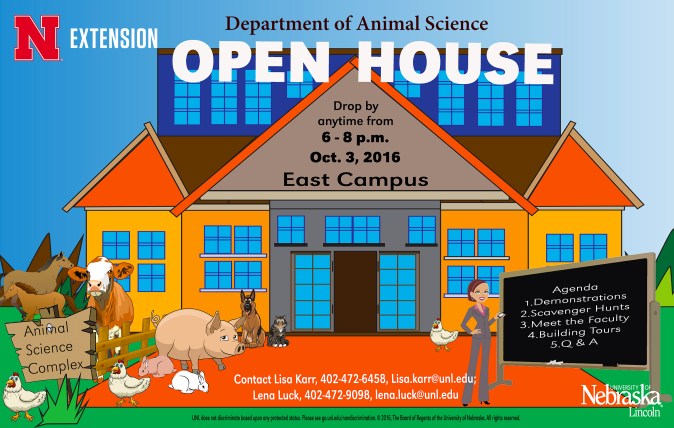
Did you know you could attend the University of Nebraska and get a degree focused on companion animals, horses or livestock? Or maybe you just want to take a few classes to learn more about these? You need to come to the University of Nebraska Animal Science Open House on October 3, 2016 from 6 – 8 p.m. to learn more. You can get questions answered and find out more about the vast opportunities, classes that are offered, careers and much more. During this Open House you will get some hands-on experiences, view demonstrations and meet with faculty and students involved in UNL’s equine, companion animal and livestock programs. Also you will get to find out more about the various animal-related organizations such as Equestrian team, Livestock and Horse Judging teams, SEECA (Students for the Education of Exotic and Companion Animals), Pre-Vet club, and Block and Bridle.  During the open house, you will get to travel through the Animal Science building on a bit of a “scavenger hunt” to seek out facts related to our classes and majors. Be sure to mark your calendars to not miss this night at the UNL Animal Science Complex, UNL East Campus!

A flyer, map and more details can be obtained at our Extension Office or by contacting Dr. Lisa Karr (lisa.karr@unl.edu) or Dr. Lena Luck (lena.luck@unl.edu).

Crops, Horticulture, Irrigation, Livestock, Programming, Uncategorized, Youth

What is Extension?

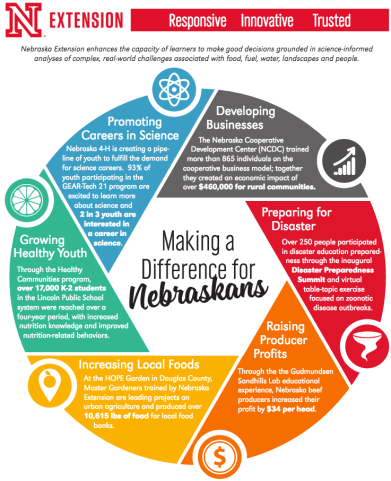
Often times when I tell people I work at the “Extension Office” they have no idea what it is we do. It is so hard to describe without giving a plethora of information. One of our signature programs people often most often associate with is the 4-H program. While this is a large and very successful component of Extension, it is only one of many programs.ExtensionDifferencepic

Everyday, whether you know it or not, you have most likely been indirectly impacted by Extension programming. Extension essentially takes science and research-based information from the University Of Nebraska – Lincoln and delivers it into the hands of the public. We make UNL easily accessible to the public. For example, we provide services and resources to the agricultural community, but also sectors as diverse as nutrition, health care and technology. From border to border, Nebraska Extension is making an incredible impact on the success of our state – its youth, its families, its farms & ranches, its communities, its economy.

For example, as a result of our Learning Child Extension staff, approximately 24,000 children in Nebraska benefit from early childhood professionals and parents who have the essential skills and knowledge to support the healthy growth and development in the children in their care. Take the crops area: last year, Extension presented workshops in 94 locations to over 4,000 participants from 93 Nebraska counties, 9 U.S. states and 4 foreign countries. Our community vitality programming has engaged over 10,000 Nebraskans in Broadband planning and engaged over 2,500 people through the Entrepreneurial Community Activation Process which resulted in community-wide visions, a new economic development corporation being started, community web portal and a young professional network.

Nebraska Extension continues to evolve and is one of the leading Extension programs in the world. In doing so, Extension Educators are more focused in their area of expertise and able to provide clients with robust information. For example, Extension staff covers a specific region to ensure clients are being served well. Each county has access to a professional in the areas of:

  • Community environment (horticulture)
  • Food, Nutrition & Health
  • Crops & Water
  • The Learning Child
  • Community Vitality
  • Beef & Livestock Systems
  • 4-H Youth Development

This has been a very brief overview of Extension and next week we’ll discuss how this impacts our multi-disciplinary programming and Fillmore County.

Crops, Livestock, Programming, Uncategorized

Passing the Farm to the Next Generation

At our final Farmers & Ranchers College program for the programming year, Dr. Ron Hanson from the University Of Nebraska – Lincoln Ag Economics Department spoke on the Importance of Family Farm Succession. This is never an easy task, yet essential for the farm to be passed on and able to financially operate. Most importantly, it is important to maintain relationships with family members and honor the wishes of the parents who intended for assets to be transferred a certain way.IMG_4969

Hanson had eleven challenges families face in order to being this process.

  1. First consider “Who is family” and is entitled to owning the farm. Are in-laws considered family? Usually excluding in-laws will backfire and cause hard feelings.
  2. It is difficult for parents to not play favorites with their adult kids. Parents should be fair and equitable, which is different than equal. Unfortunately, there are adult kids who are greedy and plan to retire on their parents’ assets, which is not an acceptable retirement plan. Parents should consider who has always taken care of them and which kids will care for them in end of life situations.
  3. Controlling parents need to give control of the farm/ranch to the adult kid who is farming. Serve as mentors and hand over responsibility to the future owner.
  4. Consider when farm ownership will happen. How will those changes occur?
  5. Think about if it is possible to keep the farm in the family. Are there kids who actually want to farm?
  6. Too often families don’t talk about the “what-ifs”. If a parent or adult kid were to tragically die tomorrow, are you prepared for that?
  7. If parents don’t agree on how to transfer assets, more than likely nothing will get done.
  8. Some children feel they are entitled. Children should RESPECT their parents and agree to their parents’ decision. Your parents don’t owe you anything.
  9. Greed has become a curse of family wealth and assets. Wealth can destroy family relationships and end a family legacy. No farm is worth losing family relationships!
  10. Families that don’t communicate openly about the parents plans are more likely to be unsuccessful with a succession plan. Parents must talk openly and honestly to all children – preferably at the same time. Parents should ask their children:
    1. Have we as parents done anything to make you not get along as a family when we are no longer here? If so, please tell me. Then apologize.
    2. Is there any reason you kids can’t get along as a family?
  11. Each family farm/ranch should have a vision. Family members should share this vision.

Family farm succession is time consuming, complicated and emotionally draining, but essential! After all, consider all of the hard work you have done to keep it going through rough economic times; why wouldn’t you put a plan together to protect it?