Uncategorized

Helping Others

One of the things I love about rural communities is the amount of help and support given when people go through difficult times. I can attest to that, on several occasions. For example, when my mom had her stroke in 2011, neighbors, coworkers and friends stepped up to provide support, send cards and helped when I was needing to make trips to visit her. Also in 2011, 2012 and 2014, I was laid up with ankle surgery and very blessed that many people in the community helped watch my girls, made meals for our family, and showed many other acts of kindness.  A quote by Ralph Waldo Emerson is one of my favorites, “The purpose of life is not to be happy. It is to be useful, to be honorable, to be compassionate, to have it make some difference that you have lived and lived well.”

Last year, I was so humbled that we were able to find creative solutions for our youth to still have a county fair and showcase their projects. The 4-H Councils, 4-H superintendents, FFA advisors and county fair board/ag societies all pitched in to help Nebraska Extension staff navigate through unprecedented times. One of the biggest things learned in 2020 is that we can change and find creative solutions to circumstances beyond our control. In 2021, county fairs will be able to be celebrated by more and continue as a key social event in the county, but one thing that won’t change is that our youth will be able to compete and continue learning life skills.

A part of the 4-H pledge is to “pledge one’s hands to larger service” and “heart to greater loyalty”. These are the values we try to instill in our 4-H youth. It is great to see youth helping each other during 4-H workshops and programs and friendships being made. There is research that shows how helping others has benefits for themselves. A professor, Thomas G. Plante from Santa Clara University, and adjunct clinical professor of psychiatry at Stanford University has found that his students who attend a spring break trip working with people in poor and marginalized areas managed stress better than those who did not attend trips. He believes the research finding is due to a matter of perspective. Additionally, when helping others, you generally experience more empathy, compassion, and solidarity with others as well.

As we approach county fair season, it is important to remind adults, as well as youth of 4-H’s core values of helping others with our hands. It might improve their stress management abilities and make for a smoother fair for all involved. Rather than seeking out problems, remember the 4-H pledge and help others. You’ll likely be happier and create a better experience for everyone around you. So, instead of only worrying about your exhibits or animals or trying to get others in trouble, consider helping a fellow exhibitor and fill one’s bucket with water or call that person and tell them their animal is running low on water. If an exhibitor is struggling to know where to check-in their static exhibit, offer to help them.

By practicing these small acts of kindness, you might be surprised how much less stressed you and those around you will be. I am certainly appreciative of 4-H parents who are able to help out my daughters when I am busy with my job. “I pledge my head to clearer thinking, my heart to greater loyalty, my hands to larger service and my health to better living, for my club, my community, my country and my world.”  If we practice these principles, we can make a positive difference in the lives of others.

County Fair Schedules

You can find the events for the Clay and Fillmore County Fairs on each extension website or social media. Locally, go to fillmore.unl.edu or clay.unl.edu.     
Uncategorized

Mosquitoes

Mosquitoes are a huge irritation in the summer months. Mosquitoes are a type of insect that is in the same order as flies, which means they are closely related to flies and gnats, which all tend to bother us. Mosquitoes are also vectors of many different diseases. Because of these factors, we need to do what we can to eliminate the problem and reduce mosquito populations.

The best way to avoid any pathogens transmitted by mosquitoes is to prevent being bitten. Like any pest management program, IPM is the strategy that works best to prevent mosquito bites at home in the yard. Sanitation is a must to eliminate breeding sites and harborage locations of mosquitoes. Female mosquitoes lay eggs on the surface of standing water and the larvae (“wigglers”) require water to survive before pupation. Removal of stagnant water in a variety of containers such as flowerpots, buckets, gutters, pool covers, used tires, and dog bowls will break the mosquito life cycle. A general rule is to dump any water that has been standing for more than five days.

Culex mosquitoes are active biters in the evening, so it is important to wear long sleeves and pants or permethrin-treated clothing when outdoors between dusk and dawn. The effective insect repellents applied to skin include those with the active ingredients: DEET, picaridin, or the oil of lemon eucalyptus.

As far as chemical control, Mosquito Dunks contain the active ingredient bacterium, Bacillus thurengiensis israelensis (Bti), which is toxic to mosquito larvae when consumed, but non-toxic to humans, pets, pollinators, fish, and other wildlife. They are sold in hardware stores and will dissolve in standing water such as water troughs, fishponds, rain barrels, and birdbaths. They are effective immediately and can last for a month. (We have mosquito dunks in our Extension office free from Public Health Solutions.)

It is not recommended to use foggers or adulticide treatments by homeowners. These treatments are not effective for more than a couple of days and should only be used a few days ahead of a large outdoor get-together if necessary.

It is best to utilize IPM to reduce your exposure to mosquitoes because they spread many diseases including West Nile Virus and the Zika virus. Most people who get West Nile Virus have no symptoms or have flu-like symptoms. However, from 2001 to 2009 1,100 deaths in the U.S. were attributed to West Nile Virus. Most of the deaths occurred in people ages 65 and older.

Information for this article came from Nicole Stoner, Drs. Jody Green and Jonathan Larson, Nebraska Extension Educators.

Uncategorized

Weed Management Field Day

Growers, crop consultants and educators are encouraged to attend Nebraska Extension’s Weed Management Field Day from 9 a.m. to 1 p.m. June 23, 2021, at the South-Central Agricultural Laboratory near Clay Center.

The field day will include on-site demonstrations of new technology and new herbicides for corn, soybean, sorghum, and sweet corn. An early morning tour will focus on weed management in soybean and sorghum followed by a tour of weed management in field corn and sweet corn. Field experiments will provide information for weed control options with various herbicide programs.

“Several new herbicides and technologies are coming to the market, including Enlist Corn and Soybean, XtendFlex Soybean, iGrowth and INZEN sorghum” said Extension Weed Management Specialist Amit Jhala. 

Three Certified Crop Advisor (CCA) Continuing Education Units are available in the integrated pest management category.

There is no cost to attend the field day, but participants are asked to preregister at http://agronomy.unl.edu/fieldday.

The South-Central Agricultural Laboratory is five miles west of the intersection of Highways 14 and 6, or 13 miles east of Hastings on Highway 6. GPS coordinates for the field day site are 40.57539, -98.13776.

Source: Amit Jhala, Extension Weed Management Specialist

Uncategorized

Youth Crop Scouting Competition – Connecting Youth with Crops

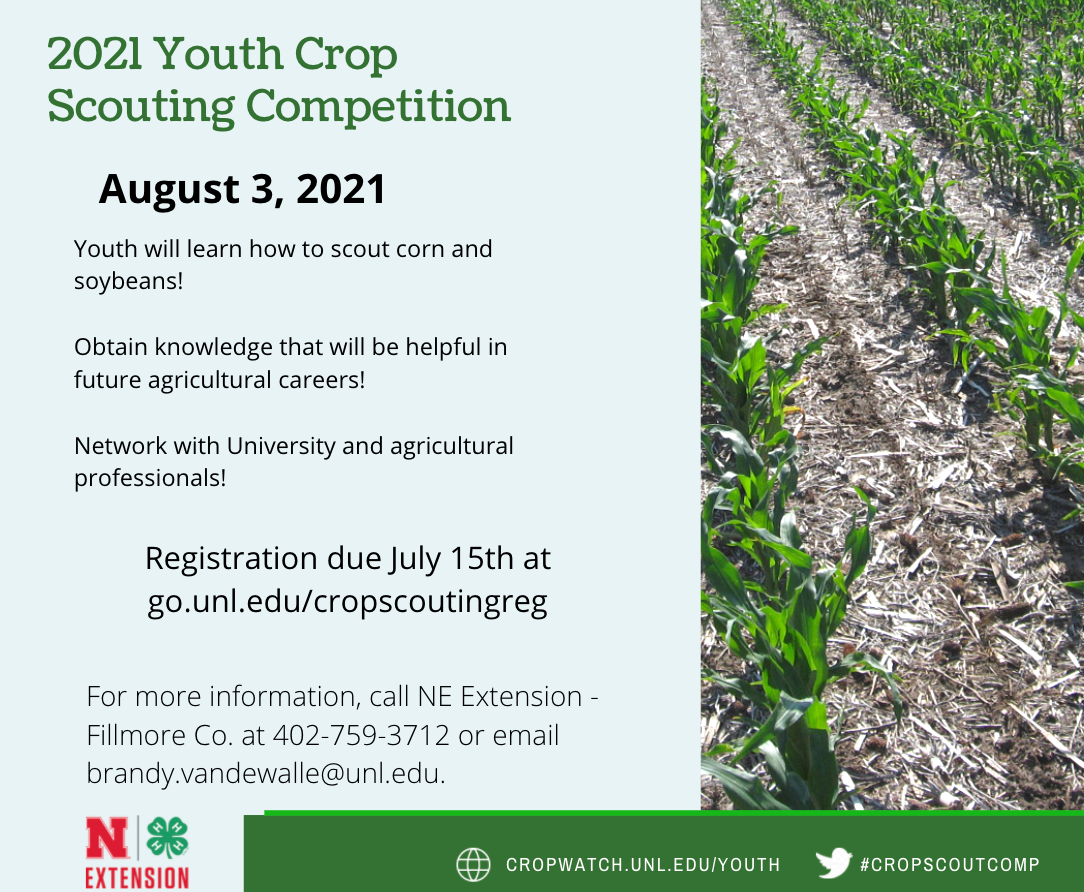
Looking for a fun club project? Want to unite your club members? Running out of ideas for club meetings?  If you answered, “yes” to any of these questions, help is on the way!  Nebraska Extension is pleased to present the 8th annual Crop Scouting Competition for Nebraska youth. Youth interested in crops can learn about crop growth & development and basic crop scouting principles. 

Don’t know a lot about crops?  Ask a local agronomist to assist by providing a short lesson on crop production. You can have the agronomist meet with youth a little during each meeting or outside of the meeting. This is one way to engage those youth interested in crops. 

This contest will be held at the Eastern Nebraska Research & Extension Center near Mead, Nebraska on August 3, 2021. The event will include both indoor and outdoor events. Teams of junior high and high school students (those completing 5-12th grades) from across Nebraska are invited to participate. This event is limited to the first ten teams who sign-up! 

Clubs or other organizations may enter a team composed of three to five participants. An adult team leader must accompany each team of students. Team leaders could be FFA advisors, crop consultants, extension staff, coop employees, etc. 

Top-scoring teams win prizes: $500 for first, $250 for second, $100 for third place. Top two teams will be eligible for regional competition held virtually this year.

Teams will be expected to know the basics of scouting corn and soybean fields. This includes crop staging; looking for patterns of crop injury; disease, insect and weed seedling identification; etc. Other topics many include but are not limited to, pesticide safety, nutrient disorders, and herbicide injury. 

More information about the crop scouting competition and instructions on how to register a team are available online at cropwatch.unl.edu/youth. Register at: https://go.unl.edu/cropscoutingreg

Teams must be registered by July 15. This program is sponsored by Nebraska Independent Crop Consultant Association, Ward Laboratories and Nebraska Extension.

Uncategorized

Inspiring Rich Conversations Through Questions

With the school year complete, hopefully an opportunity to spend more time with your child exists. Reconnect and reflect on the school year and plan for the summer. Recently I read an article written by two of my colleagues, Sarah Roberts and Jackie Steffen, Learning Child Extension Educators that I thought provided great tips on how to inspire conversations with your child by asking powerful questions which I’ve included in this week’s column.  

School is out! Engage in rich conservations with your children this summer.

Questions are powerful tools, and they encourage children to think at a higher level. The types of questions you ask young children can affect the quality of your conversation with them. Some questions only elicit rote answers and, therefore, will not spark a meaningful conversation or connection. Others encourage thought-provoking conversations and ideas. Having intentional and meaningful conversations with young children is critical to providing an atmosphere of emotional security. Engaging with and listening to children help them to feel valued and respected. They learn to feel safe talking with you and sharing thoughts and feelings that may be otherwise difficult to discuss.

Here Are Some Ways to Inspire Rich Conversations:

  • Try to ask more open-ended questions. Open-ended questions are questions that cannot be answered with one word. Instead of asking, “How was your day?” consider rephrasing and saying, “Tell me about the favorite parts of your day.”
  • Distractions are all around us. Take time to fully engage with young children and practice active listening in a one-on-one environment. That means removing electronics and getting down on their level. Giving children your full attention demonstrates that you respect them and what they have to say.
  • Make conversations a habit. The time of day that works best is different for everyone. Some might be able to connect deeply on the “to and from” activity/school commutes, others at bedtime or maybe around the table. Take notice of when your child feels the most comfortable opening up to you.
  • Do your homework. If your child is in school and you have access to daily announcements, lesson plans or newsletters, use that information to help spark conversations. Children can fail to mention exciting events unintentionally. They may be surprised with some pieces of information that you know about their day.
  • Finally, remember that conversations are a two-way street. If you ask too many questions, children can feel like they are being drilled. Do not just ask questions; open up and talk about YOUR day. Being authentic and modeling good communication with other adults in their school or home will encourage children to join in on conversations. Asking higher-level questions takes practice and time. Think about what information you want to share with your child and what you would like to know from them. Be genuine. If it is tough to talk to them, don’t worry. It is important to start practicing conversation skills, especially when children are young. Have fun and keep a sense of humor and wonder. Children will follow your lead. Here are a Few Open-Ended Questions to Get You Started
  • If you were the family chef, what would you make today for breakfast (lunch, dinner)? Why?
  • If you could do anything today, what would it be?
  • What was your favorite part about the holidays this year?
  • This year has been hard for lots of people. Is there anything positive you experienced? What things do you wish you could change?
  • If you could ask me anything (teachers or parents), what would it be?

References: “Big Questions for Young Minds: Extending Children’s Thinking by Janis Strasser and Lisa Mufson Bresson

Uncategorized

Celebrate Beef Month

As we enter the spring and summer months, nothing smells better than a delicious, juicy hamburger or steak on the grill and being able to barbecue outside with friends and family. It’s no surprise then that May is National Beef Month!  The beef industry is especially important to Nebraska’s economy. In fact, according to the USDA National Ag Statistics Service, Nebraska is the #1 commercial red meat production state in the United States (February 2021). So, why is Nebraska, the beef state?  It has a unique mix of natural resources and according to the Nebraska Beef Council, cattle turn grass from 24 million acres of rangeland and pasture, more than one half of Nebraska’s land mass, into protein and many other products for humans. Land that is grazed allows more people to be fed than otherwise possible and more than one billion bushels of corn are produced in Nebraska, of which 40% is fed to livestock in the state.

Nebraska’s farms and ranches utilize 45.2 million acres of the state’s total land area – that is 91% of the land! There are nearly 23 million acres of rangeland and pastureland in Nebraska – half of which are in the Sandhills. Here is another fun fact – January 2012 data shows that cattle outnumber Nebraskans nearly 4 to 1.

Photo by Gonzalo Guzman on Pexels.com

Now that I have explained how and why the beef industry is important to Nebraska, let’s explore the health benefits of beef. Beef is a good source of zinc, iron and protein and there are 29 cuts of beef that meet the government labeling guidelines for being lean. In fact, a 3-ounce cooked serving of lean beef (which is about the size of a deck of cards) provides 10 essential nutrients and about half of the daily value of protein in about 170 calories. According to recent research from Purdue University, the cuts of beef considered lean can be included as a part of a heart-healthy diet to support cardiovascular health and has consistently demonstrated that the nutrients in beef promote health through life.

If you would like more information on beef production, you can view our Nebraska Extension website beef.unl.edu. Our Extension experts have a variety of articles from beef nutrition to reproduction to lease information. If you would like recipes or tips for preparing beef, you can also check out Nebraska Extension’s food.unl.edu website. There are some great tips on saving money when purchasing beef and links to the Nebraska Beef Council website which has great recipes as well.

Enjoy some beef today! 

Uncategorized

Communicating with Farmers Under Stress

Farmers and ranchers have many stressors in their lives. Weather challenges and disasters like many Nebraskans have recently experienced have led to uncertainty in their crop and livestock operations. Machinery breakdowns, debt loads, volatile markets, sleep deprivation, changing regulations, and the stress of holding onto a multi-generational farm/ranch all play a part of the stress and mental health of a farmer or rancher. Farmers and ranchers know the importance of planning and talking about their financial health to bankers, financial planners, spouses, etc. but might not realize how important it is to spend time on their mental health. 

Photo by Liza Summer on Pexels.com

Nebraska Extension, in partnership with Michigan State University Extension, offers a free online webinar, “Communicating with Farmers Under Stress.”. This workshop is beneficial for individuals who work with farmers and ranchers on a regular basis, such as bank lenders, ag suppliers, educators and consultants, healthcare professionals, and anyone involved with the lives of farmers and ranchers. In addition to being helpful for working with farmers and ranchers, the workshop educates participants about managing stress in their own lives and teaches how stressors can affect physical health and relationships with family or coworkers.

This webinar will be Wednesday, May 5th from 10-11:30 a.m., CDT. Registration and more resources can be found on Nebraska Extension’s Rural Wellness website at https://ruralwellness.unl.edu/. For more information, contact Nebraska Extension Educators myself, Brandy VanDeWalle, brandy.vandewalle@unl.edu or Susan Harris, susan.harris@unl.edu.

Uncategorized

Practicing Gratitude

One of my goals for 2021 was to be better about practicing gratitude. I have heard from colleagues they keep a gratitude journal to help them reminder all they have to be thankful for. I am happy to say that I purchased one and am mostly diligent about writing in it, but still have room to improve. When difficult things happen that we can’t explain, it can be hard to cope. I searched for ways gratitude can help us in tough times and found a lot of research and science behind how practicing gratitude can help. A team of 15 researchers and mental health practitioners runs a website, positivepsychology.com which I’ve decided to share some tips on handing difficult situations.

Photo by Gabby K on Pexels.com

As I write this, the Nebraska Extension community is grieving the loss of a respected member of our team, Leanne Manning. Leanne was an extension educator at the Saline County office since 1988. She not only taught me about 4-H as I grew up and help me excel in many areas but was a mentor for me in my professional career as a Nebraska Extension educator. While many of across the system have been struggling with her passing, I felt inclined to dedicate this article to her and share ways to cope with grief by practicing gratitude.  

Psychologists have defined gratitude as a positive emotional response that we perceive on giving or receiving a benefit from someone (Emmons & McCullough, 2004). You might have heard the expression that “it is better to give than to receive’. This reminds me of gratitude. Gratitude can actually enlighten the mind and make us feel happier. Research documents physical, social and psychological benefits from expressing gratitude on a regular basis. Gratitude improves interpersonal relationships at home and work (Gordon, 2012). The connection between gratitude and happiness is multi-dimensional. Expressing gratitude not only to others but also to ourselves, induces positive emotions, primarily happiness. 

A study by Moll, Zahn, et al. 2007 showed that the effect of practicing gratitude on the brain is long lasting. For example, it releases toxic emotions, reduces pain, improves sleep quality, aids in stress regulation and reduces anxiety and depression. Positivepsychology.com has tips on “Gratitude and Grief”. First, the article says to cry your heart out; crying doesn’t make us weak. This helps us vent to the pain we are experiencing. Secondly, collect the broken pieces. In other words, grieving with gratitude allows us to appreciate what we still have (job, family, etc.). Also, ask for help; it is ok to seek professional help when all other of your coping mechanisms fail. Finally, keep a gratitude jar. This can be a glass jar or clean box with paper beside it. Place one sheet of paper in the container every day to express what you are grateful for that day. As the container is fuller, you will feel more gifted and hopeful.

This is not to say that grief is easy to handle, rather providing strategies to gain and strength to look beyond it.  I am truly blessed and honored to have known Leanne Manning as “my” extension educator growing up and also as a mentor and colleague in my current professional role.

Uncategorized

Ag Safety Day

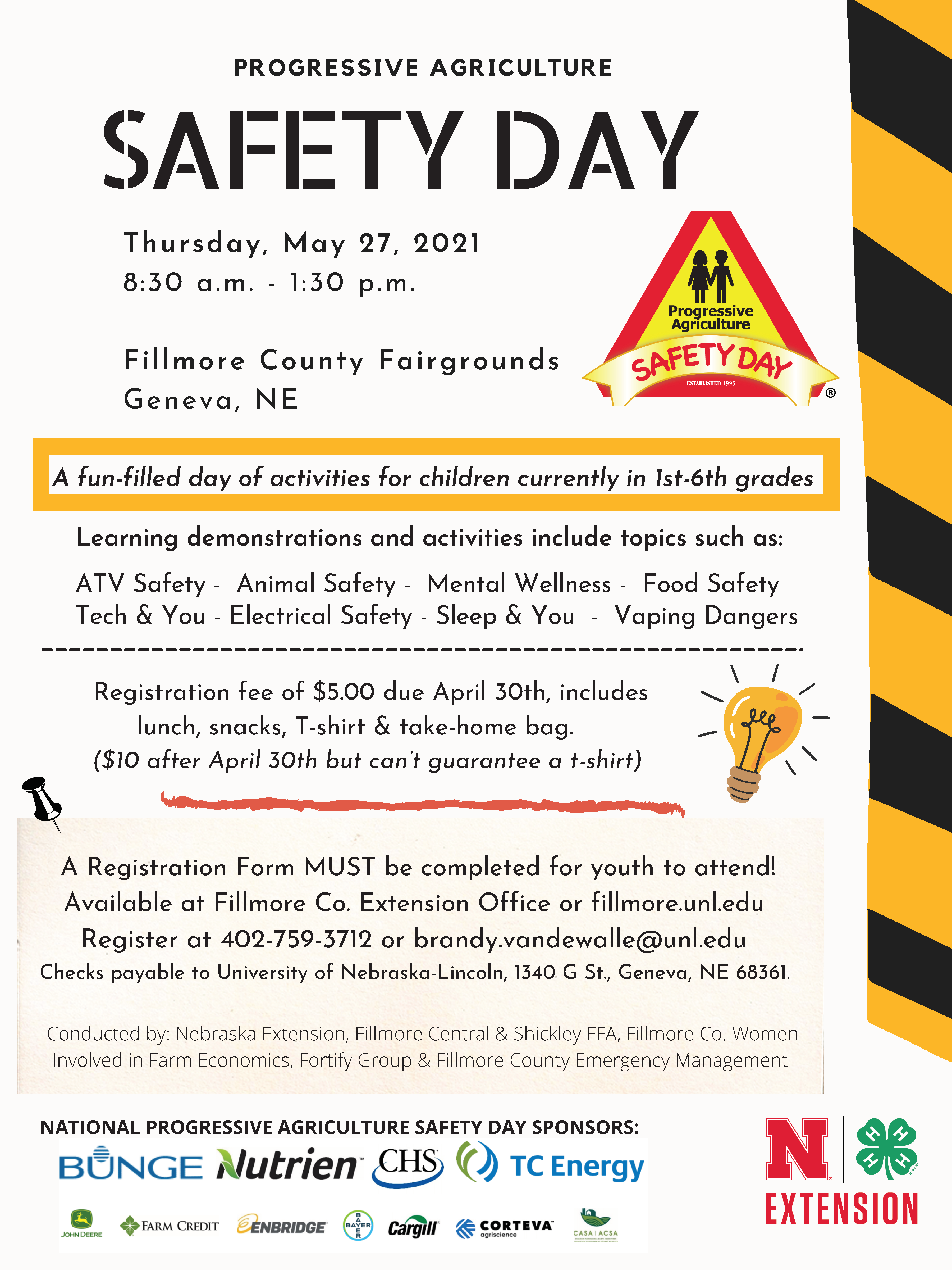
Progressive Agriculture Safety Day

Statistics from those impacted by a farm-related injury or death are sobering. Many know someone who was impacted by a farm accident that in many cases could have been prevented. This is why I feel so passionately about conducting the Annual Progressive Safety Day each year. The Progressive Agriculture Foundation provides safety and health information to rural communities that need it, which is why I’ve teamed up with them. The mission of Progressive Agriculture Days is simple – to provide education, training, and resources to make farm and ranch life safer and healthier for children and their communities. The vision is that “no child become ill, injured or die from farm, ranch and rural activities.”

During the program’s first year, a total of 2,800 participants and volunteers were reached throughout the South and Midwest and now the program impacts close to 110,000 annually. To date, the program has impacted more than 1.6 million children and adults. The Progressive Agriculture Foundation is in its 27th year of programming in the United States and 20th year in Canada.

Locally, since I have been involved with a Progressive Agriculture Safety Day in Geneva, we have grown from approximately 60 participants to 140 youth from surrounding counties. This half-day event involves many volunteers and local sponsors to make the program what it is today. Every year, business staff or volunteers help teach the hands-on activities. In addition area FFA chapters assist in delivery of sessions and guiding youth participants to each session.

Current 1st through 6th graders are invited to attend Progressive Agriculture Safety Day on Thursday, May 27, 2021 at the Fillmore County Fairgrounds in Geneva, NE.  Youth will participate in a variety of events designed to help them be aware of safety in potentially hazardous situations in and around rural and agricultural settings, including electricity, mental wellness, ATV safety, animal safety, food safety, etc.  NE Extension hosts this event in Fillmore County, along with Shickley, Fillmore Central, Exeter-Milligan-Friend FFA chapters, 4-H, W.I.F.E. and Fillmore County Emergency Management. Early registration forms and $5 are due April 30th; forms can be downloaded at fillmore.unl.edu. After April 30th, registration is $10/youth. For more info or to register, call 402-759-3712 or email brandy.vandewalle@unl.edu.

Uncategorized

Nebraska LEAD Program Update

Many of you know I am a LEAD alum which provided so many excellent leadership opportunities, networking and confidence building which have helped me with my career. Recently the LEAD program came out with the following news release announcement which I’ve decided to share this week

After a year hiatus, due to the pandemic, the Nebraska LEAD Program will resume seminars in September 2021. “We are anxiously anticipating the resumption of LEAD programming this coming fall. We have spent our pause year reassessing the entire program,” said Ed Woeppel, Chairman of the Nebraska Agricultural Leadership Council, which sponsors the program. “We are confident that the Nebraska LEAD Program is positioned to continue to be a leader in agricultural leadership development. We look forward to continuing the experiences for LEAD 39 after a one-year pause as well as to welcome in a new group in LEAD 40.”

“Up to 30 motivated men and women with demonstrated leadership potential will be selected from five geographic districts across our state,” said Terry Hejny, Nebraska LEAD Program director. Fellowship applications for Nebraska LEAD (Leadership Education/Action Development) Group 40 are now available for men and women involved in production agriculture or agribusiness.

Applications are available via e-mail from the Nebraska LEAD Program office: leadprogram@unl.edu, by writing to Nebraska LEAD Program, PO Box 830940, Lincoln, NE 68583-0940, or by calling (402) 472-6810.

 For information about the selection process please click on the above application to program tab on the website which is lead.unl.edu. Applications are due no later than June 15, 2021.

The Nebraska LEAD Program began 40 years ago to develop agricultural leaders from Nebraska’s future generations. The constant changes that occur in agricultural policy, marketing, economics and technology point to the need for strong leaders to advocate for the heart of Nebraska’s economy–agriculture. Now in our third decade of forming pioneering agricultural leaders, we have evolved into one of the nation’s premier agricultural leadership development programs.

The program is recognized both statewide and nationally as an innovative organization that has improved Nebraska in many ways. For example, many members of commodity boards, extension boards, local school boards, or local church councils, count themselves among our 1000+ alumni. After you look through our website, search out and speak to our alumni. Encourage them to describe their LEAD experiences. Take time to learn what they have accomplished since graduating to serve their local community, our state or our nation. We believe you will be impressed. If you cannot locate a past participant or have other questions, contact Shana at sgerdes2@unl.edu or 402-472-6810.

If you have any questions, would be glad to share my experiences with you and can be reached at brandy.vandewalle@unl.edu or by phone at (402) 759-3712.