Uncategorized

Reflection

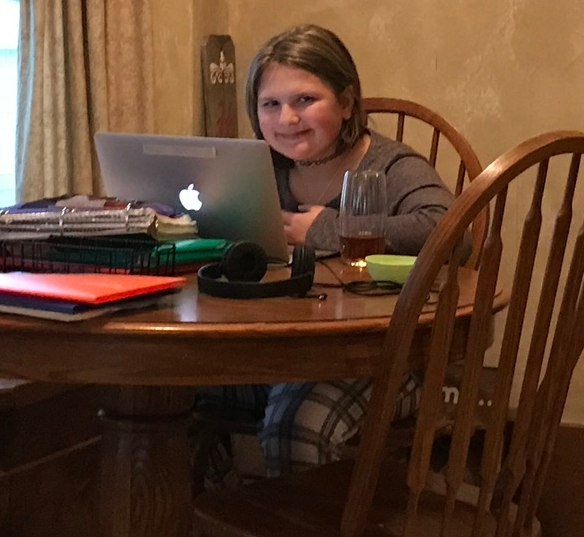
COVID-19 has changed the way our world is run. For me, I’m working at home while facilitating distance education school for my two girls. It can be challenging and test my patience, but I’m also viewing it as an opportunity. For example, I haven’t had night meetings away from them, we’ve had supper at the table every night, I’m more involved in their education by helping answer questions they have with their school work AND they are even helping me with some work projects as I figure out how to transition face-to-face programs to an online offering. You might be seeing them star in some videos! IMG_8152

Try and use this uncertain time to reconnect with people via phone or internet and find gratitude in what you have and take care of each other! 130D3026-5C16-4BBF-9AD9-1EA31DF8D78A_1_105_c

Recently a video talked about dealing with the stress during a pandemic…https://mediasite.video.ufl.edu/Mediasite/Play/bf0a42f96e874778bf47a8517125f1591d

Uncategorized

EXTENSION PROGRAM ANNOUNCEMENT

n_4h-ext-3c

blank book business clean
Photo by PhotoMIX Ltd. on Pexels.com

Nebraska Extension is fully committed to the health and well-being of Nebraskans. In a disease situation like COVID-19, the principle of social distancing is one of the main methods that can be used to help reduce the spread of the disease.

Chancellor Ronnie Green has issued guidance that all UNL classes will move to ‘remote’ modes. To be consistent with that guidance, Nebraska Extension will, whenever possible, provide Extension programs remotely (video or teleconferencing) but will not provide in-person Extension programs, at least until May 9. We recognize that this practice may create some level of disruption relative to the important information we provide to Nebraskans. In addition to our ‘remote’ course offerings, we encourage Nebraskans to visit extension.unl.edu to access a wide array of online information.

Crops, Uncategorized, Youth

Innovative Youth Corn Challenge

Science, technology, engineering, and math (STEM) careers are in high demand and will continue to be in future years. To engage youth in crop science based education, the Innovative Youth Corn Challenge (IYCC) was created as a partnership between the Nebraska Corn Board and Nebraska Extension.  Since the Innovative Youth Corn Challenge program’s inception in 2012, 53 teams have participated in the program with 32 teams successfully harvesting and analyzing their plot data. A total of 148 youth have participated. This contest, open to 4-H or FFA members, guided participants through all aspects of corn production, as well as agricultural careers related to corn production.IYCC brand.png
The winning team from the 2019 growing season was the Kornhusker Kids 4-H Club which included Kaleb and Landon Hasenkamp,  Matthew and James Rolf, Levi Schiller, Ian and Payton Schiller. They worked with the UNL Project SENSE on an in-season nitrogen management program comparing using in-canopy sensors, a drone MZR treatment, or their standard grower treatment. Their results showed that the grower strips had the highest yield of 256.6 bu/acre but cost the most.  The MZR treatment yielded 238.67 bu/acre. The Project SENSE treatment yielded 245.5 bu/acre and had the best return on investment. Also, it is important to note is that this team randomized their treatments and had 3 replications of the plots which is important in figuring out the statistical significance. Their project sponsor was Chris Schiller.

Receiving second place was the Allen-Wakefield FFA Chapter which consisted of Katie Bathke and Ashley Kraemer with Jeff Geiger as their sponsor and Josh Batenhorst as their advisor. They wanted to test a polymicrobial solution for bulk fertilizers called Nachurs Rhyzo-Link LF. The hypothesized that the treated plants would yield better due to the five Bacillus strains creating a better environment for the roots. They found that the Rhyzo-Link plot had a yield of 243 bu/acre compared to 240 bu/acre for the control, with five replications.
C1AD11B5-CA53-4FA1-B59E-8D2F39FF43A8_1_105_c.jpeg

Third place went to the Rising Stars 4-H Club from Platte County which consisted of Kade and Isaac Stromberg with Brad Stephens as their sponsor. They tested seeding a blend of two hybrids compared to each planted separately. They had two replications and found that the blend of Pioneer 1197AM with Dekalb DKC60-88RIB yielded 245.48 bushels/acre, while the 1197 by itself yielded 243.99 and the 60-88 yielded 240.29 by itself. This team also took advantage of an offer from Crop Metrics to have a free soil water sensor placed in their field to monitor irrigation scheduling.

Other teams who completed their plots were the Oakland-Craig FFA team of Joe Monson, Aiden Jorgensen, Ryan Smith, Cole Buress, Hannah Mosemen with Kylie Penke as their sponsor. They tested Envite seed treatment, which is supposed to help non-legume plants fix nitrogen to see if there would be an increased yield when the nitrogen rate on the entire plot was reduced by 40%. They found that the Envite plot had a yield of 232 bu/acre compared to 229 bu/acre for the control.

Also finishing their project was Shelton FFA with Jacob Synder and Andrew Rayburn and Hannah Horak as their advisor. The main topic of their research was a starter fertilizer with a microbial catalyst called Nachur’s Rhyzo-Link 9-15-3. They had 2 reps and found that the Nachur’s Rhyzo-Link yielded 230.25 bu/acre at a cost of $9.95 per acre and no treatment yielded 224.4 bu/acre.
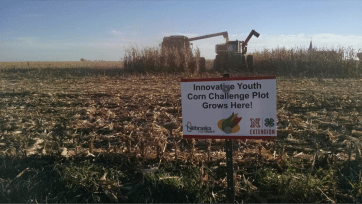
CornPlotPic16.png

Other teams that participated but due to various circumstances were unable to finish their project included Adams Central FFA Chapter, Ord FFA Chapter and the Golden Gate Clever Clovers 4-H Club of Washington County.

As a team, youth worked with an adult mentor throughout the process. Mentors can be extension faculty, ag teachers, or other qualified agronomy professionals.

Other awards handed out during the banquet held on UNL’s East Campus included:

  • The Extra Mile Award went to the Rising Stars 4-H Club.
  • The Innovation Award was presented to the Kornhusker Kids 4-H Club.
  • The Sustainability Award went to the Rising Stars 4-H Club. They utilized the Field to Market tool which is a leading multi-stakeholder initiative that is working to unite the agricultural supply chain in defining, measuring and advancing the sustainability of food, fiber and fuel production in the United States.

To participate in 2020, youth must complete and return an entry form by March 15th to the Fillmore County Extension Office in Geneva, NE. Forms can be downloaded at https://cropwatch.unl.edu/youth/cornchallenge. For more information, contact Brandy VanDeWalle at brandy.vandewalle@unl.edu.

Programming

Strategies For Family Farming Success In The Shark Tank

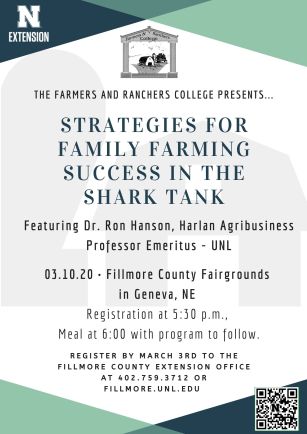
Developing and implementing a business management contingency plan to overcome unexpected changes to the organizational structure and/or management leadership to a family farm is crucial for the continued success of a farming operation.  This is an important step in preventing potential misunderstandings between farm family members as well as helping to avoid possible family disputes.  Can a farm business survive a potential shark attack (unexpected change) and still prosper?  An effective management strategy is to put yourself in the ‘shark tank’ and begin addressing the difficult questions and situations that might arise from these uncertainties in farming.Hanson20flyer.jpg

To aid farmers and ranchers with a business management plan, the Farmers & Ranchers College will be offering the final program of the 2019-2020 programming year on March 10th. This program will take place at the Fillmore County Fairgrounds in Geneva, NE featuring Dr. Ron Hanson, UNL Harlan Agribusiness Professor Emeritus. Registration starts at 5:30 p.m. with a meal to start at 6:00 p.m., followed by the program, Strategies For Family Farming Success In The Shark Tank.

Hanson points out that few farming operations ever survive an unexpected change to the organizational management structure of their farming business, let alone a crisis situation within the family.  Most farm families realize the importance of implementing a contingency business plan for if and when something ever happens, but few families ever accomplish this management goal. No one wants to be in the shark tank and be faced with a stressful situation.  These issues (unexpected death, sudden illness, family dispute, loss of a key employee) are often never discussed and usually avoided. But what if it does happen?  What might actually happen next?  What impacts could result to the farm?  To family members?

This presentation will identify the importance of implementing a business contingency planning process so that a farming operation continues when and if the unexpected actually happens. Striving to find answers as well as solutions is an effective strategy for a success when initiating a business contingency plan in case an unexpected change happens to the farm or family or even both at once.

Please pre-register by March 2nd, to the Nebraska Extension Office in Fillmore County or call (402) 759-3712 to assure a seat and meal. Walk-ins are accepted, but may not get a meal. You may also complete your registration online on fillmore.unl.edu or http://go.unl.edu/farmersrancherscollegePre-registration will also save you time at the door!


Crops, Programming

Risk and Reward Workshops 

An upcoming Nebraska Extension workshop will help farmers develop marketing plans for 2020. “Risk and Reward: Using Crop Insurance and Marketing to Manage Farm Survival” will be presented in Clay Center on February 5th. Extension economists will discuss the role of farm location and yield/price relations in making informed grain marketing and crop insurance decisions.

green field during sunset
Photo by VisionPic .net on Pexels.com

“This is a unique opportunity to think about grain marketing differently,” said Jessica Groskopf, a regional economist with Nebraska Extension.  “Often, we think of marketing and crop insurance as two separate decisions. This workshop will show the importance of how these tools work together to help farms survive.”

“Understanding production risk becomes especially important as farm locations move farther from the center of the corn belt,” said Cory Walters, associate professor in the Department of Agricultural Economics. “These workshops are designed to assist Nebraska farmers improve their decision-making and understand the role of production risk considerations in their marketing plans.”

Participants will learn how to use crop insurance and pre-harvest marketing together. The workshops will encourage producers to focus on specific risks to evaluate the balance between these two tools, which will vary from operation to operation.

“The role of crop insurance and marketing is not the same for everyone,” said Walters. “Farm location matters.”

Attendees should leave the workshops with a strategic plan of farm survival, focused on the role and use of crop insurance and pre-harvest marketing specific to their location and crop.

Schedule for “Risk and Reward: Using Crop Insurance and Marketing to Manage Farm Survival

Clay Center, Feb. 5, 9 a.m.-2 p.m., at the Clay County Fairgrounds, 701 N Martin Ave. To register, call 402-762-3644.

Livestock, Programming

Cow/Calf College – January 28

Farmers and Ranchers Cow/Calf College – January 28

The annual Farmers and Ranchers Cow/Calf College “Partners in Progress – Beef Seminar” will be held at the U.S. Meat Animal Research Center and Great Plains Veterinary Educational Center near Clay Center on January 28, 2020 with registration, coffee and donuts starting at 9:30 a.m. The program will run from 9:55 a.m. until 3:30 p.m. This program is sponsored by Nebraska Extension’s Farmers and Ranchers College and will feature several outstanding speakers discussing issues and management strategies that can affect the profitability of all beef producers. There is no cost for the event and the public is invited. It does include a noon meal, which means that early registration is necessary to reserve materials and a meal. 1-15 F&R College.jpg

The “Cow/Calf College” will begin at 10:00 a.m. with a welcome by Dr. Mark Boggess of USMARC. Dr. Mary Drewnoski will kick off the program with “Do Your Herd & Your Bank Account a Favor – Test Your Hay”.  She will discuss the benefits and proper techniques for testing your hay and the advantages that can serve in your operation. Mary is part of an interdisciplinary team evaluating economic systems for integrated crop and livestock production in Nebraska.

Glennis McClure, Nebraska Extension Agricultural Economist will present on annual cow costs and provide updates on basic beef economics. Her responsibilities include publishing livestock and crop enterprise budgets, surveying and publishing the Farm Custom Rates Guide, and assisting with special economic analyses in the department.

Lunch is provided and will be handled with a rotation system featuring a session on: “Questions to Ask Your Vet Before Calving Season Begins” with Dr. Halden Clark, veterinarian with the Great Plains Veterinary Educational Center (GPVEC).  Dr. Clark’s duties at GPVEC include teaching veterinary students, engaging in research projects at GPVEC and providing extension service to beef producers and veterinarians.

The afternoon session will start with “Blockchains: Connecting Consumers with their Food” by a representative from IMI Global. IMI Global specializes in verification and certification program for the livestock industry to enable producers, feeders, growers, packers and processors to meet the ever changing needs of both domestic and international consumers.  Wrapping up the program will be a presentation by Dr. Alison L. Van Eenennaam on “Alternative Meats and Alternative Statistics: What do the data say”.  We’ve heard a lot in the news about alternative meats, how they are produced and how the nutrition compares to real meat, but what does the research really show?  Dr. Van Eenennaam from the Dept. of Animal Science at the University of California, Davis will join us via the web to provide insight on her work in this arena. Alison is an animal geneticist who discovered it is possible to splice the “hornless” gene from Aberdeen Angus cattle into the widespread black-and-white Holstein dairy cows so they are born without protrusions.

All presenters will then pull everything together, give their final thoughts and considerations and provide a coffee-shop style panel discussion during which participants can ask questions and get answers on questions that came to them during the day’s sessions. A chance for door prizes will be awarded to those that stay for the entire event.

Please pre-register by January 21st, to the Nebraska Extension Office in Fillmore County or call (402) 759-3712 to assure a seat and lunch. Walk-ins are accepted, but may not get a lunch. You may also complete your registration online on fillmore.unl.edu or http://go.unl.edu/farmersrancherscollege.  Remember, your contact information is required to be on the U.S. MARC property, so pre-registration is helpful and will save you time at the door!

Uncategorized

New Year’s Resolutions

If you are like many nearly half of the American population, you probably have a New Year’s Resolution set for 2020, while 38% of Americans absolutely never make New Year’s Resolution according to research by University of Scranton, 2016. A majority of those resolutions are self-improvement or education related resolutions (47%), weight related (38%), money related (34%) or relationship related (31%).  University of Southern California’s John Monterosso who is an expert on psychology and neuroscience of self-control offers insight on how to achieve setting those resolutions.

Monterosso suggests thinking of a resolution as a special kind of plan and visualizing your future-self. If you have already made that resolution or still working to tweak it, he suggested keeping the following in mind:

Photo by Oleg Zaicev on Pexels.com
  • Failed resolutions are not harmless. Most people don’t like to fail; in fact, it hurts our confidence and can actually lead to worse behavior. Keeping this in mind and accepting the fact that one might not have accomplished all that was planned is important. If you get off track, you can always start again and don’t have to wait until a new year.
  • Resolutions work by linking single decisions to a bigger picture. For example, if you have a goal of quitting smoking or eating unhealthy foods and let a craving lead to poor decisions, you might think, “it’s just one cigarette or just one meal of fried foods” which may or may not lead to the continuation of a bad habit. If one takes a resolution seriously, think about the health consequences and the potential “relapse” that could occur.
  • Consider being less ambitious in your resolutions. We tend to be overly confident when making a resolution and think we can change our behavior overnight. While it is good to be confident with your goals, be careful not to make overly ambitious goals. For example, if you plan to work out one hour/day every day of the week and have an already packed life with a career, community obligations and a family, consider starting at 20 minutes/day and work up to more minutes if time allows. Setting a good resolution requires being realistic.
  • Resolutions should not be vague. If you set a resolution of “eating healthier.”  What does that mean?  Does it mean drinking 64 oz. of water/day?  Does it mean to include a fruit or vegetable at every meal?  Write down a SMART goal that is Specific, Measurable, Achievable, Realistic, and Time-based.
  • The New Year is a fresh start.Setting resolutions/goals at the first of the year helps us “clean the slate” and put past failures away. It gives us a sense of confidence and optimism. Capitalize on that.
  • Even successful resolutions can be mistakes. If youset restrict your diet to the point of starvation or over-exercise to the point of hurting yourself, you must be able to adapt, know yourself and use common sense and wisdom to correct the resolution.

In summary, Monterosso suggests that done correctly, “resolutions play a role in great human achievements.”

Extension’s Help with Resolutions

As stated above, almost half of resolutions made include education or self-improvement. If you need any educational resources or materials on nearly any subject, Extension has resources. Whether it is information on a website, talking with an extension professional, utilizing an app from your smart phone, attending a face-to-face program, participation in a webinar or many other avenues, Extension works to solve complex problems for clients. If you haven’t been to Extension’s website recently, I encourage you to go to extension.unl.edu. There you will find an abundance of resources on topics such as food, nutrition and health, cropping & water systems, community vitality, community environment, learning child, beef systems and 4-H youth development. Consider attending a program or utilizing a resource to help you achieve a resolution or goal you may have.

For a list of extension programs in the area, visit our website at fillmore.unl.edu or call our office at (402) 759-3712.

Crops, Irrigation, Livestock, Programming

Managing Stress During the Holidays

I love the holiday season! It is a great time for getting together with friends and family and a time to reflect on the year. Holiday baking, looking at Christmas lights, and showing appreciation to those in your life by giving gifts are just a few of the many things I enjoy.  While I enjoy many things and truly do love the holiday season, it can also be a stressful time. Situations may be challenging, especially if there are increased financial stressors.

selective focus photography of ceramic mug near candy cane
Photo by fotografierende on Pexels.com

For farm and ranch families, the stress is also very real – someone still has to break the ice and feed the livestock, manage financial recordkeeping, tax preparation, evaluate crop yields, and plan for the next growing season; there is lots to do. The downturn in the agricultural economy and weather-related disasters have only compounded the stress many agriculturalists have had to endure. This can make one’s situation seem hopeless. My colleague, Holly Hatton-Bowers shared an article that pointed out the American Psychological Association found that in the US people tend to feel more stressed around the holidays.

Before you become dragged down by negative feelings and stress, try to sprinkle your winter holiday with these seven tips compiled by my colleague, Dr. Holly Hatton Bowers. Doing these practices may help you manage your stress and even find some moments of joy during the holidays.

  1. Challenge Your Thinking – Often when we are faced with challenges, failures or even criticism, we begin to tell ourselves stories that lead to more stress. It can be helpful to ask yourself, “Is this True?” “Am I being Kind to Myself?” “What can I learn from this experience?” It can also be helpful to remember that feelings come and go. Acknowledge your feelings and also take note that they are not here to stay.
  2. Set Your Intentions to Eat for Gains, Sleep, and Move – During the Winter Holidays, many of us take joy in eating sweet, sugary and fatty foods. Sometimes our family and friends bake our favorite pies and cookies. Enjoy these foods in small amounts and also be intentional in eating foods that give you energy or a “net gain” for your wellbeing. Before drinking that next sugar filled coffee or soda, choose water. Choose a side of vegetables instead of French fries. It’s is also important to not skip meals which can lead to headaches, draining your energy and lead to you feeling more down. Set your intentions to get sleep. Turn-off technology an hour before bedtime and wake up at the same time each morning. Finally, set your intention to move your body. It is recommended to move your body every 20 minutes for at least two minutes.
  3. Reach Out and Connect with Your Support System– If you are feeling lonely, sad, or overwhelmed, you are not alone. Sometimes we need a friend or family member to listen or offer us support and help. Expressing your thoughts and feelings with those you trust may be helpful and deepen your relationships. Plan for difficult days by having an activity planned or by checking in with a relative or close friend. If you are having a lot of difficulty, reach out to a mental health expert. If you are feeling very isolated and having serious thoughts of self-harm or suicide call the National Suicide Prevention Lifeline at 1-800-273-8255.
  4. Plan and Budget Expenses – It may feel daunting to stick to a reasonable budget during the holidays. In the moment you may think, I can just charge this and pay it later. Often these impulsive buys can lead to more stress later. Miriam Caldwell in her “Get Tips on Making and Sticking to a Holiday Budget” suggests listing out your holiday expenses, stick to a spending limit, and making a shopping list so that you are less likely to overspend.
  5. Embrace the Messy – At time we may have expectations for how events and activities will go. We plan celebrations and expect them to be filled with complete joy and fun. Often these expectations may not go as planned. Let go and be ok when this happens. Stop and breathe. It can be helpful to breathe in for a count of 5 and breathe out for a count of 7. Practice this breathing a few times and then tell yourself to embrace the mess.
  6. Create a To-Do or a Done List – Write down four things you can accomplish and do it! If a to-do list sounds stressful, then try a DONE list. Write down the things that you have accomplished today.
  7. Cultivate Gratitude – Practicing gratitude can help you de-stress by focusing on what you have, and what you value. Make a list of 5 things/people/experiences you are grateful for.

What will you do to combat your stress during the Winter Holidays? Take time to be present and find ways to intentionally create holiday experiences that are less stressful and a little more pleasant and meaningful.

Programming

Keeping Stress Levels in Check

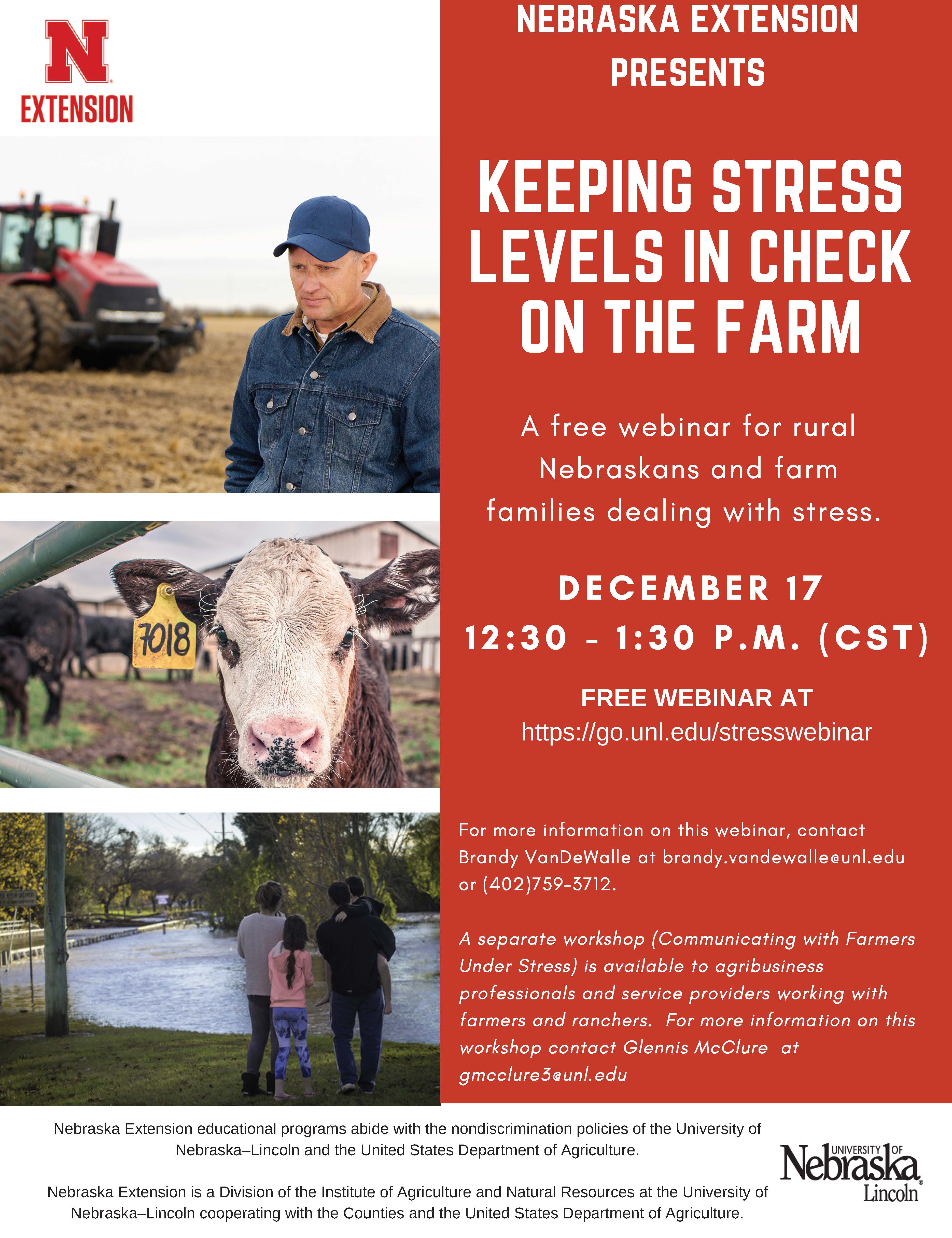
The holidays are a wonderful time of year. It’s a time of year to reflect on the many blessings in our life and reconnect with family members. It can also be a time of year to trigger many stressors and create anxiety for those dealing with added stress. For that reason, my colleague, Glennis and I have decided to provide a webinar for anyone in agriculture dealing with some extra stress this holiday season.nebraska extension12.17.19web

Farmers and ranchers have many stressors in their lives. Weather challenges and disasters like many Nebraskans have recently experienced have led to uncertainty in their crop and livestock operations. Machinery breakdowns, debt loads, volatile markets, sleep deprivation, changing regulations, and the stress of holding onto a multi-generational farm/ranch all play a part of the stress and mental health of a farmer or rancher. Farmers and ranchers know the importance of planning and talking about their financial health to bankers, financial planners, spouses, etc. but might not realize how important it is to spend time on their mental health.

A free webinar will be offered December 17 via the web for farm and ranch families.  The webinar will take place over the noon hour (12:30 p.m. CST) and can be accessed at go.unl.edu/stresswebinar.  “Keeping stress levels in check” will be presented by Nebraska Extension Educators Glennis McClure and Brandy VanDeWalle starting at 12:30 p.m. (CST). This free webinar is available for farm and ranch families to participate and will provide strategies for dealing with the stress of farming or ranching in today’s difficult economic environment.

Participants will learn: How to recognize the signs and symptoms of stress; understand the role stress plays in our lives; and strategies and resources to manage stress.

For more information, contact Brandy VanDeWalle at brandy.vandewalle@unl.edu or (402)759-3712.

A separate workshop available to agribusiness professionals and service providers working with farmers and ranchers titled, Communicating with Farmers Under Stress can also be taught face-to-face. For more information on this workshop contact Glennis McClure at gmcclure3@unl.edu or (402) 472-0661.

Uncategorized, Youth

Happy Thanksgiving!

Let’s talk about the Thanksgiving meal, include some facts about Thanksgiving and examine reasons to be thankful. First of all, according to the USDA, about $670 million is the monetary value of turkeys consumed for Thanksgiving every year which is based on an estimated 46 million turkeys and 92 cent-per-pound. On average, it costs about $50 for a 10-person Thanksgiving meal. Included in the $50 meal is the turkey, bread stuffing, sweet potatoes, rolls with butter, peas, cranberries, a relish tray of carrots and celery, pumpkin pie with whipped cream and beverages of coffee and milk (Source: American Farm Bureau).  You can thank our American farmers and ranchers who are able to provide us the bounty of safe and affordable food we are able to consume.

2_thanksgiving_digital.jpgNow let’s talk trivia:

Q: Why are turkeys raised?   A: Because of their excellent quality of meat and eggs

Q: What is a male turkey called?  A:  Tom

Q: What is a female turkey called?  A:  A Hen

Q: What sound do turkeys make?  A: Only tom turkeys gobble; the female makes a clucking sound.

Q: How many feathers does a turkey have at maturity?  A:  3,500 feathers

Q: How long does it take a turkey to reach market size?   A: Hens usually grow for 16 weeks and is 8-16 lbs. when processed while tom usually takes 19 weeks to reach market weight and weighs 24 lbs. Large toms (24-40 lbs. are a few weeks older.

Regardless of what you do this Thanksgiving, remember to be thankful for what really matters

2_thanksgiving_digital.jpg