Uncategorized

Youth Crop Scouting Competition – Connecting Youth with Crops

Looking for a fun club project? Want to unite your club members? Running out of ideas for club meetings?  If you answered, “yes” to any of these questions, help is on the way!  Nebraska Extension is pleased to present the 12th annual Crop Scouting Competition for Nebraska youth. Youth interested in crops can learn about crop growth & development and basic crop scouting principles. 

Don’t know a lot about crops?  Ask a local agronomist to assist by providing a short lesson on crop production. You can have the agronomist meet with youth a little during each meeting or outside of the meeting. This is one way to engage those youth interested in crops. 

This contest will be held at the Eastern Nebraska Research & Extension Center near Mead, Nebraska on August 5, 2025. The event will include both indoor and outdoor events. Teams of junior high and high school students (those completing 5-12th grades) from across Nebraska are invited to participate. This event is limited to the first ten teams who sign-up! 

Clubs or other organizations may enter a team composed of three to five participants. An adult team leader must accompany each team of students. Team leaders could be FFA advisors, crop consultants, extension staff, coop employees, etc. 

Top-scoring teams win prizes: $500 for first, $250 for second, $100 for third place. Top two teams will be eligible for regional competition held in Iowa this year.

Teams will be expected to know the basics of scouting corn and soybean fields. This includes crop staging; looking for patterns of crop injury; disease, insect and weed seedling identification; etc. Other topics many include but are not limited to, pesticide safety, nutrient disorders, and herbicide injury. 

More information about the crop scouting competition and instructions on how to register a team are available online at cropwatch.unl.edu/youth. Register at: https://go.unl.edu/cropscoutingreg

Teams must be registered by July 15. This program is sponsored by Nebraska Independent Crop Consultant Association, Ward Laboratories, the Nebraska Soybean Board and Nebraska Extension.

Uncategorized

Nebraska LEAD Program

It is hard to believe it has been 17 years since I participated in the Nebraska LEAD program! Through this program, I met twenty-nine talented individuals with a passion of agriculture through the Nebraska LEAD program. To date, I remain friends with many of them and the networking opportunities have been tremendous. The in-state seminars challenged me to think outside of the box and remain an advocate for agriculture. I could go on and on about the excellent opportunities the LEAD program has provided, but I challenge you to experience it yourself!

Individuals passionate about agriculture, leadership and making a difference across Nebraska are encouraged to apply for the Nebraska LEAD (Leadership Education/Action Development) Program’s 44th cohort. Applications for this premier agricultural leadership development program are now being accepted through June 15, 2025.

For more than four decades, the Nebraska LEAD Program has identified and cultivated leaders for Nebraska’s agricultural industry and rural communities. Over the course of two years, Nebraska LEAD Fellows participate in a series of dynamic seminars, in-state and national study travel, and a life-changing international study experience — all designed to build critical leadership skills, broaden perspectives and strengthen participants’ ability to shape the future of agriculture and their communities.

“Nebraska agriculture needs visionary leaders who can not only navigate change but drive it — leaders who advocate fiercely for our industry and unite people toward a common purpose,” said Kurtis Harms, Nebraska LEAD Program Director. “The Nebraska LEAD Program offers an unparalleled opportunity for both personal growth and professional impact. Whether you farm, ranch, work in agribusiness or champion rural communities, if you’re passionate about leadership and ready to make a difference, Nebraska LEAD is your next step.”

Individuals involved in production agriculture, agribusiness or professions closely tied to the agricultural industry are encouraged to apply. Ideal candidates are emerging leaders who have demonstrated a commitment to leadership and service.

Application packets can be requested online at lead.unl.edu. Those interested can also nominate individuals who exhibit high leadership potential to receive application information.

The deadline to submit applications for Nebraska LEAD Group 44 is June 15, 2025.

For more information about the Nebraska LEAD Program, including eligibility requirements and program details, visit lead.unl.edu.

Uncategorized

Celebrate Beef Month

As we enter the spring and summer months, nothing smells better than a delicious, juicy hamburger or steak on the grill, and being able to barbecue outside with friends and family. It’s no surprise, then, that May is National Beef Month!  The beef industry is especially important to Nebraska’s economy. According to the Nebraska Department of Agriculture, Nebraska is first in commercial cattle slaughter, second in beef and veal exports, and second in commercial red meat production. According to the Nebraska Beef Council website, Nebraska has the top three beef cow counties in the U.S., including the nation’s No. 1 cow county – Cherry County, with nearly 166,000 cows. Custer County is No. 2 (100,000,) and Holt County is No. 3 (99,000). Also among the top counties in the nation is Lincoln County at No. 12 (69,000).

The Nebraska Beef Council also reports that nearly 5 million head are finished and marketed in Nebraska, a state with a population of 1.9 million residents. January 2023 figures illustrate that Nebraska continues to have far more cattle than people. With over 6 million cattle in the state, cattle outnumber people by more than 3 to 1! The 1.8 million cows combined with the nearly 5 million head that are annually fed in Nebraska total nearly 6.8 million cattle. That’s over 3.5 times more cattle than people in Nebraska!

So, why is Nebraska the beef state?  It has a unique mix of natural resources and according to the Nebraska Beef Council, cattle turn grass from 24 million acres of rangeland and pasture, more than half of Nebraska’s land mass, into protein and many other products for humans. Land that is grazed allows more people to be fed than otherwise possible, and more than one billion bushels of corn are produced in Nebraska, of which 40% is fed to livestock in the state.

Now that I have explained how and why the beef industry is important to Nebraska, let’s explore the health benefits of beef. Beef is a good source of zinc, iron, and protein and there are 29 cuts of beef that meet the government labeling guidelines for being lean. In fact, a 3-ounce cooked serving of lean beef (which is about the size of a deck of cards) provides 10 essential nutrients and about half of the daily value of protein in about 170 calories. According to recent research from Purdue University, the cuts of beef considered lean can be included as a part of a heart-healthy diet to support cardiovascular health, and has consistently demonstrated that the nutrients in beef promote health throughout life.

With May being beef month, I want to remind you that the 2025 Nebraska Beef Passport launches May 1 in locations across the state that are known for offering outstanding beef. This year’s participants include 30 restaurants and 28 meat processors or meat shops. This is the 5th year of the program which encourages people to visit the featured locations and earn points towards prizes offered by the Nebraska Beef Council.  Check out nebeef.org.

If you would like more information on beef production, you can view our Nebraska Extension website beef.unl.edu. Our Extension experts have a variety of articles on everything from beef nutrition to reproduction to lease information. If you would like recipes or tips for preparing beef, you can also check out Nebraska Extension’s food.unl.edu website. There are some great tips on saving money when purchasing beef and links to the Nebraska Beef Council’s website, which has great recipes as well.

Enjoy some beef today! 

Uncategorized

Youth Tractor Safety Course

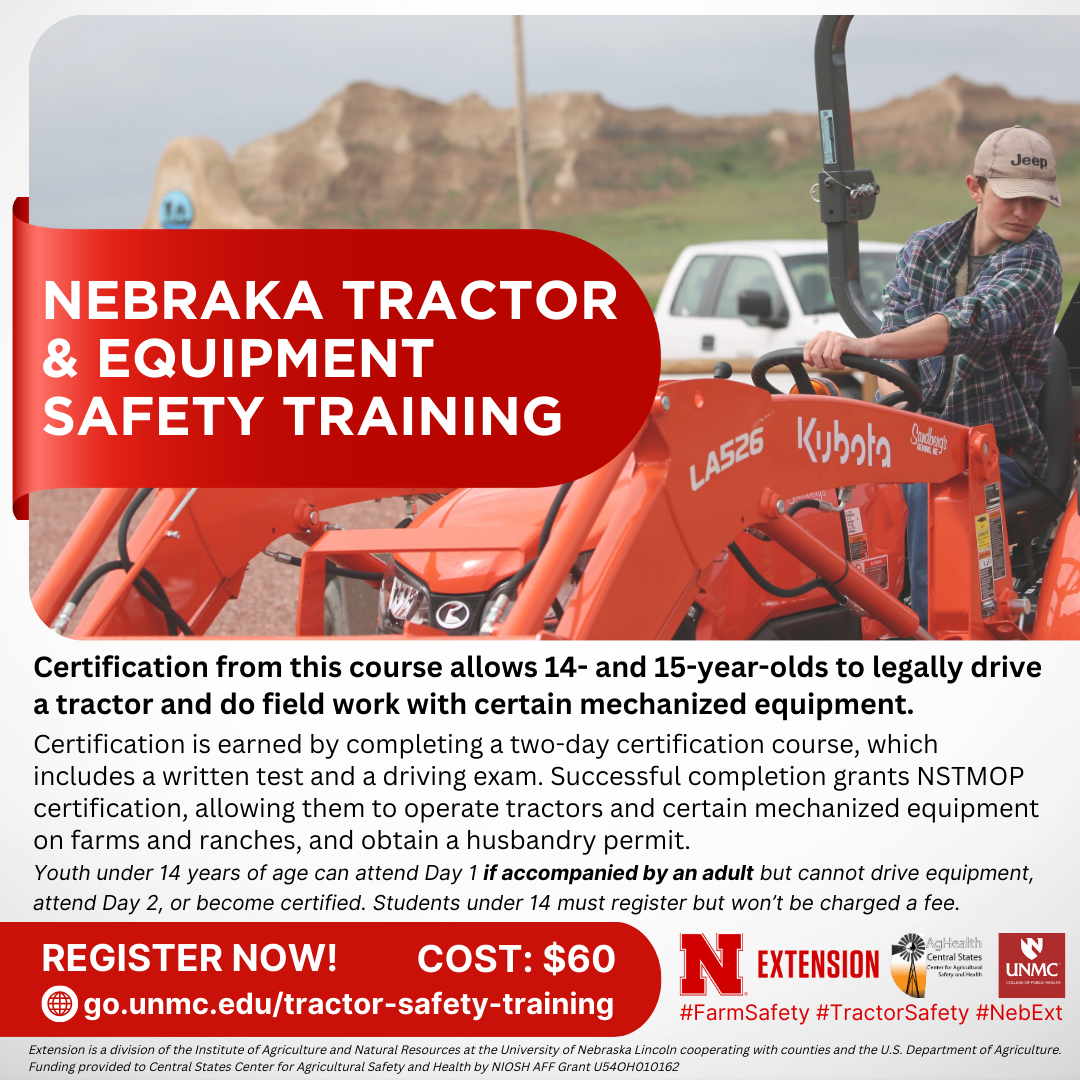
Federal law prohibits youth under 16 years of age from using certain equipment on a farm unless their parents or legal guardians own the farm. However, certification received through the National Safe Tractor and Machinery Operation Program (NSTMOP) grants an exemption to the law, allowing 14- and 15-year-olds to drive a tractor and to do field work with certain mechanized equipment. In Nebraska, Nebraska Extension and CS-CASH collaborate to offer NSTMOP certification.

Certification is earned by completing a two-day certification course, which includes a written test and a driving exam. Successful completion grants NSTMOP certification, allowing youth to operate tractors and certain mechanized equipment on farms and ranches, and obtain a husbandry permit.

Day 1 covers the required elements of NSTMOP, including quizzes which students must pass to attend the driving portion of training. Once a student is registered, they will be sent instructions, materials, course paperwork, and a link to the online course if they will not be attending in-person.

Day 2 includes a driving test and equipment operation and ATV safety lessons. Students must demonstrate competence in hitching and unhitching equipment and driving a tractor and trailer through a standardized course. Instructors will also offer education about safe behaviors and laws for ATVs, utility-task vehicles (UTVs), and other off-road vehicles (ORVs).

The cost of the course is $60 and includes educational materials, the online learning link (if applicable), supplies, and lunch and snacks at in-person trainings. Payment will be made via credit card if registering online or via check if registering by mail. Youth under 14 years of age can attend Day 1 if accompanied by an adult but cannot drive equipment, attend Day 2, or become certified. Students under 14 must register but won’t be charged a fee.

Day 1:

  • June 9 – Raising Nebraska, 501 East Fonner Park Road, Suite 100, Grand Island, NE
  • June 17 – Upper Big Blue NRD, 319 East 25th Street, York, NE Virtual Module – For those attending a location that only offers Day 1 or are attending a location that offers both days but live 50 miles or more from the location.

Day 2:

  • June 10 – Raising Nebraska, 501 East Fonner Park Road, Suite 100, Grand Island, NE
  • June 18 – Upper Big Blue NRD, 319 East 25th Street, York, NE

Those attending a location that only offers Day 2 must complete Day 1 at another location OR complete the virtual module. Those attending a location that offers both days, but live 50 miles or more from the location, may complete the online module for Day 1. Day 1 (or online module) MUST be completed, with written exam, before attending Day 2. To register, visit: go.unmc.edu/tractor-safety-training. Contact Kelsey Irvine at kepalm@unmc.edu or 402-321-4236 with questions.

Uncategorized

Progressive Agriculture Safety Day

Recognized as the largest rural safety and health education program for children in North America, Progressive Agriculture Safety Day® (PAF Safety Day) provides age-appropriate, hands-on educational lessons primarily designed for children ages 4 to 13 years old. Since the program’s start in 1995, more than 1.9 million individuals have been reached in 45 states, two U.S. territories, and nine Canadian provinces.  Trained PAF Safety Day Coordinators partner within their community, using one of the three delivery modes, to customize their PAF Safety Day selecting from more than 30 safety and health topics with hundreds of activities and demonstrations to meet the needs of the youth in their area.

Statistics from those impacted by a farm-related injury or death are sobering. Many know someone who was impacted by a farm accident that in many cases could have been prevented. Therefore, I feel so passionately about conducting the Annual Progressive Safety Day each year. The Progressive Agriculture Foundation provides safety and health information to rural communities that need it, which is why I’ve teamed up with them. The mission of Progressive Agriculture Days is simple – to provide education, training, and resources to make farm and ranch life safer and healthier for children and their communities. The vision is that “no child become ill, injured or die from farm, ranch and rural activities.”

Locally, since I have been involved with a Progressive Agriculture Safety Day in Geneva for nearly 20 years. We have grown from approximately 60 participants to nearly 100 youth from surrounding counties. This half-day event involves many volunteers and local sponsors to make the program what it is today. Every year, business staff or volunteers help teach the hands-on activities. In addition, area FFA chapters assist in delivery of sessions and guiding youth participants to each session.

Current 1st through 6th graders are invited to attend Progressive Agriculture Safety Day on Thursday, May 29, 2025 at the Fillmore County Fairgrounds in Geneva, NE.  Youth will participate in a variety of events designed to help them be aware of safety in potentially hazardous situations in and around rural and agricultural settings, including electricity, online safety, severe weather safety, lawn mower safety, sun safety, chemical look-alikes, impacts on mental health and a drug dog demonstration.  NE Extension hosts this event in Fillmore County, along with Shickley, Fillmore Central, Exeter-Milligan-Friend FFA chapters, 4-H, W.I.F.E. and Fillmore County Emergency Management. Early registration forms and $5 are due April 25th; forms can be downloaded at fillmore.unl.edu. After April 25th, registration is $10/youth. For more info or to register, call 402-759-3712 or email brandy.vandewalle@unl.edu.

Uncategorized

Resiliency: What is It?

Resiliency: what is it and why is it important?  In short, resiliency is the “ability to bounce back from challenges or hardships”. According to the Center on the Developing Child from Harvard University, “Reducing the effects of significant adversity on children’s healthy development is essential to the progress and prosperity of any society. Science tells us that some children develop resilience, or the ability to overcome serious hardship, while others do not. Understanding why some children do well despite adverse early experiences is crucial because it can inform more effective policies and programs that help more children reach their full potential.”

According to the Connect with Kids network, adapted from “Project Resilience”, there are

seven attributes that describe ways you can show resiliency when facing challenges. Keep in mind that you – like most people – may show some, but not all, of these attributes/strengths when faced with difficult situations.

  • INSIGHT—Having insight means asking questions of yourself, even when the questions are difficult. If you answer honestly, you can learn and move forward. Having insight helps you understand the problem and how to best solve it. Insight helps you analyze the situation from as many perspectives as you can.
  • INDEPENDENCE—Showing independence means keeping a healthy distance between yourself and other people so you can think things through and do what is best for you. It also means knowing how to step away from people who seem to cause trouble or make things worse by their words or actions.
  • RELATIONSHIPS—Building relationships means finding connections with people that are healthy for both of you and keeping those relationships growing.
  • INITIATIVE—Taking the initiative means taking control of the problem and working to solve it. It means asking questions of yourself and answering them as honestly as you can, so you can move past a sticky situation. Sometimes people who take initiative become the leaders in activities and teamwork.
  • CREATIVITY—Using creativity requires that you use your imagination or resourcefulness to express your feelings, thoughts, and plans in some unique way. Remember that when you make something happen, it shows resiliency of spirit and a positive attitude.
  • HUMOR—Humor is the ability to find something funny (especially yourself!) in a situation, even when things seem bad. Humor often gives you the perspective needed to relieve tension and make a situation better.
  • MORALITY— Being a person of morality means knowing the difference between right and wrong and being willing to choose and stand up for what is right.

In conclusion, it is important for both youth and parents to communicate ways how they can adapt to change, stress or problems and are able to take things in stride. The result of this bouncing back is a feeling of success and confidence.

Uncategorized

Hopeful Purpose

There are many distractions that adults and youth alike face in today’s ever-changing world. Finding something that provides oneself with a sense of purpose and hope can help one stay grounded. Today’s 4-H professionals continue to work in the positive youth development area by helping youth find their spark, which motivates youth to accomplish something and find a purpose in their lives.  

National 4-H used a model, called the 4-H Thriving Model, which has several social, emotional, and cognitive learning pieces that intentionally aim to help youth succeed or thrive. One of the indicators of a successful youth program is providing youth with a sense of “hopeful purpose”.  When youth have a hopeful purpose, they see themselves as being on the way to a happy and successful future.  

Research shows that youth with a sense of purpose are more goal-directed and have increased life satisfaction, better emotional well-being, and great positive affect. To help youth achieve a sense of hopeful purpose, program staff and volunteers should aim first at helping youth identify what interests a youth or “makes them tick”. This is known as a spark. Some youth may know what their spark is right away, while others may need to explore several areas to find their spark. An adult should work to actively facilitate the development of a young person’s spark. This could be done by inviting that youth to a series of workshops, connecting that youth to a mentor, or if appropriate, involving that youth in co-teaching a program.  Adults should encourage, and assist, youth in developing meaningful SMART goals. Following this, a caring adult should coach youth to achieve them. Which, in turn, shows youth a pathway to the future. 

Today’s youth have so much to offer, such as skills, ideas, and resources, which aid in developing future leaders. Some ways you can help facilitate a hopeful purpose in youth include creating youth development programs that empower youth voices and show how they can make a difference; helping youth work on a service project they are passionate about and help them succeed; helping youth identify their unique gifts and talents and courage them to understand how those strengths can be used to make the world a better place.   

In summary, thriving youth have a sense of hope and purpose, and see themselves on the way to a happy and successful future. 
4-H Thrive Model
Uncategorized

Returning to the Farm Program

Recently, I facilitated the “Leaving a Lasting Legacy” program conducted by the Women in Ag program. This four-part series was an eye-opening experience. Kicking off the program were two women in agriculture who both suffered the painful losses of a spouse, leaving them both young widows. This left them both as single parents to raise their children solo and the difficulty navigating all the difficult decisions involved in an agricultural operation. Working through the legality issues of property ownership, having access to accounts and so much more behind more of a burden than most can imagine. The program continued with strategies for creating a succession and transition plan, which are different. Working through family communication and relationship dynamics, decision-making, and understanding steps to take before the loss of a family member occurs were all key factors of the program.      

An intense program designed for families to attend together will be coming to Hastings soon which will dig even deeper into the above-mentioned topics. The Center for Agricultural Profitability at the University of Nebraska-Lincoln will present Returning to the Farm 2025, a workshop series for families who are in the transition process of bringing members back to the farm or ranch. It will begin with a two-day workshop for multi-generational families on March 7 and 8, at Central Community College in Hastings. The series also includes two follow-up workshops, to be held virtually after the in-person meetings. 

The series assists families and agricultural operations with developing financial plans and successful working arrangements to meet their unique needs. It will guide families in developing estate and transition plans, setting personal and professional goals, and improving the communication process between family members.

Presenters will include extension experts as well as agribusiness and legal professionals. During the program, participants will:

  • Learn communication strategies
  • Set both personal and professional goals
  • Develop a farm or ranch transition plan
  • Identify estate planning issues and develop effective strategies for planning
  • Review financial feasibility and financial tools

The workshop fee is $75 per person on or before Feb. 28. March 1, the fee increases to $85 per person. Registration includes dinner on March 7 and lunch on March 8. It also includes two follow-up workshops, to be held virtually March 18 & April 8, from 6:30 – 8:30 p.m. Central Time. Hotel accommodations are not included.

Crops, Programming

Crop Insurance, FarmBill & Weather!

The Farmers & Ranchers College continues to offer high-quality programming to area producers and agribusiness professionals for the 2024-25 season. The college started with its traditional program featuring Dr. David Kohl, which drew nearly 140 attendees! The Cow/Calf College also provided an in-depth, hands-on program with strong learner engagement. The final program of the season is coming up soon.

On February 21, 2025, the Farmers & Ranchers College will conclude with a comprehensive session covering crop revenue management and a 2025 weather outlook. Two nationally recognized experts will lead this program, which will be held at the Fillmore County Fairgrounds in Geneva, NE. Registration begins at 8:30 a.m., with the program starting promptly at 8:45 a.m. with Steve Johnson.

Steve Johnson served as the Farm Management Specialist in Central Iowa for Iowa State University Extension and Outreach for 21 years, retiring in early 2021. He now consults with private industry, farm organizations, commodity groups, ag media, and other agriculture-related clients, focusing on crop marketing, government farm programs, crop insurance, and crop risk management strategies. Steve has presented at winter meetings, workshops, seminars, webinars, and conferences across the Corn Belt, delivering his “Managing Crop Revenue & Market Price Risk” program. His session will address both 2024 and 2025 crop supply/demand, crop price outlooks, and strategies to manage crop insurance decisions and create a written marketing plan to capture higher futures prices.

Steve’s topics will include:

  • Latest USDA reports, highlighting 2024 & 2025 crop supply/demand and cash price projections
  • Pre-harvest marketing strategies and seasonal futures price trends
  • Projections for 2024 net farm income, plus crop costs and returns for 2024 & 2025
  • Five strategies for managing tight margins
  • How to develop crop marketing plans with price and time targets for 2024 & 2025 crops
  • Crop risk management resources and websites

Dr. Eric Snodgrass will also provide a weather update and how it relates to your operation. Weather risk is an inherent challenge in agriculture, and successful crop planning relies on accurate forecasting and analysis. We often base our operations on weather averages and recent experiences, but each year brings new challenges. In his session, Eric will discuss how to use the wealth of available weather data to stay ahead of disruptive weather events. He will cover the limits of predictability, resources for monitoring long-range forecasts, lessons learned from the previous growing season, and the risk of severe storms, particularly high winds, hail, and tornadoes. He’ll also discuss the impact of major seasonal drivers like El Niño and La Niña, as well as the outlook for the next growing season in South America, which directly competes with our crops.

Eric Snodgrass is a Principal Atmospheric Scientist for Conduit, where he develops predictive and analytical software solutions to manage weather risk in global agriculture. He provides frequent weather updates on how high-impact weather events affect global agricultural productivity. His research, which uses machine learning to assess field-level weather impacts on yields, helps improve long-range weather predictions. Eric is a sought-after speaker, presenting at over 100 conferences annually to farmers, commodity traders, and other stakeholders.

Pre-registration is not required, but it is appreciated. To register, please call the Fillmore County Extension Office at 402-759-3712 or go online at: go.unl.edu/frcollege.

Programming

Nebraska Extension: Part Two

Last week I shared about Nebraska Extension and some of my yearly impacts from 2024 and this week, I’ll share a few more. I am blessed to work with other talented Extension colleagues who create positive change every day. Some Extension impacts can be found online at https://extension.unl.edu/impact-nebraska/.

In 2024, I conducted the Nebraska Youth Crop Scouting Competition with 31 youth on 7 teams competing from 5 counties at ENREEC by Mead. Seven stations ranged from precision ag scouting to diseases, insects weed identification, etc. with judges from the Cropping Systems programming area. The Nebraska Soybean Board, Independent Crop Consultant Association, and UNL’s Doctor of Plant Health program sponsored this in-depth learning experience. 2024 survey results show that:

  • 80% of youth learned about a new career option
  • 93% of youth are more aware of degree opportunities at UNL & improved knowledge of accurately identifying pests as well as learning effective non-chemical control practices.
  • 97% of youth have an improved knowledge of crop scouting procedures.
  • I learned how to use aerial imagery to better diagnose a field.” – Participant

As state co-superintendent of 4-H Agronomy, I led the Special Agronomy Project (SAP) which delivered nearly 700 seed packets to NE youth. Eleven sugar beet projects were exhibited at the state fair.

  • 38% of participants who completed the evaluation said it was the first time they took an agronomy project to fair & 81% learned a skill that can be used in the future; 92% will enroll in the SAP next year.
  • This is a neat program, and I’d love for our whole club to do this next year.” – 4-H mom
  • This project made headlines on IANR news and was featured in a statewide booth by Western Sugar.

STEM Education – The Department of Defense projects that 80% of jobs will require STEM skills in the next decade, underscoring the need to engage students and educators in impactful STEM experiences. In 2024, I taught 1,619 STEM lessons to youth across 11 counties and 42 adults from the U.S. and a U.S. territory, covering topics from electricity and robotics to soil science and pollinator education.

I forged a new partnership with Nebraska EPSCoR through my ROOTED in Ag project. This led to an opportunity to organize a session at the National EPSCoR Conference. Alongside project members from Alaska and Hawaii, we delivered a cutting-edge workshop showcasing our agricultural science virtual reality field trips—demonstrating the power of technology in education. I developed a VR Robotic Dairy field trip and captured 360-degree images of cropping systems throughout the year, as well as drone footage and still images, all of which will be integrated into our group’s website and project. These immersive, high-tech field trips are slated for full implementation in 2025, promising to create lasting impacts on STEM education. Impacts from 18 direct teaching hours, representing a total of 64,110 direct learner hours taught in STEM-based.

Leadership Education– Investing in youth leadership development is a vital skill that contributes to both the personal success of young people and the overall well-being of our society. I taught both the Leadership Summit and Purple Ribbon Kid programs to 105 youth from 9 classrooms in 3 counties.

  • 100% of teachers who participated in the Purple Ribbon Kid program agreed/strongly agreed they have already witnessed positive behavior change in their students because of the lessons.
  • Because of the program, one youth said, “I will be more open to other people and their perspectives.” The teacher reported that the class “looks forward to using this knowledge as they continue throughout their lives” and 100% of youth now feel they can create positive change in their community.