Programming

Gate to Plate Reflection

Recently at our Farmers & Ranchers College program we had Michele Payn speak on the importance of advocating for agriculture. While it is frustrating that we need to advocate for just doing our jobs, it seems necessary to educate others about the agriculture industry. If it wasn’t for our farmers and ranchers, we would have a hungry world. Michele founded Cause Matters Corp. in 2001, which is a company designed to build connections around the food plate. Cause Matters Corp. focuses on addressing food myths, developing science communication, and connecting farm to food.
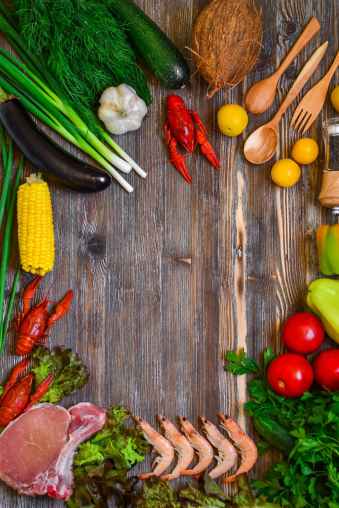
vegetables and tomatoes on cutting board
Photo by Pixabay on Pexels.com

At the recent program she delivered in Fillmore County, she explained to participants the importance of connecting with consumers on a personal level rather than just spewing facts and statistics at people. When we are able to connect with others on a personal level, it allows us to share our stories with them and understand where they are coming from with their potential concerns. She has also extensively researched social media trends and encouraged participants to share their messages on social media, especially Instagram which is extremely popular with the younger generation. Engaging in dialogue is important to spread the message of agriculture.

Michele’s book, Food Truths: From Farm to Table highlights 25 food truths to shop and eat without guilt. Some of them I’ve decided to highlight include:

  • Hormones are in everything.
  • Antibiotics have benefits.
  • Animal welfare is an hourly concern on farms and ranches.
  • Housing is used to protect animals – and your food – from nature.
  • Organic farming is about production methods, not nutritional value.
  • Food costs are a shared concern.
  • Local is not always better for the environment.
  • Chemicals are naturally in food and needed to protect it.
  • Soil is a farm’s greatest asset.
  • The media isn’t the best source of information about food.
  • Food is an amazing science from farm to table.

I decided to share the food truths above due to the recent disasters we have in Nebraska. Those unfamiliar with the agriculture industry may not know that our farmers and ranchers care greatly for their animals and the loss of animals due to the floods and blizzards is sickening to them. Some gave up many evenings to help bring baby calves into the world only to see them taken away by powerful surges of water. Farmers and ranchers were already struggling with the low commodity prices and this will cause an additional burden making it difficult for some to survive. That being said, if you are in the agricultural industry or know about agriculture, share with others how hard our farmers and ranchers work and the good they do in feeding our hungry and growing population.


Crops, Irrigation, Livestock, Programming, Youth

Celebrate Agriculture

UNADJUSTEDNONRAW_thumb_7b68.jpg
 It is a highlight for my girls to ride in the combine at harvest time; my girls have the opportunity to experience harvest with my Dad. 

Growing up on a small farm in Saline County, I appreciate the work of our farmers and ranchers. My dad still farms and my girls enjoy visiting the farm and I hope I can instill the same hard-working values and beliefs my parents instilled in my sister and I. This is part of the reason, my husband and I have starting raising a few chickens and have bucket calves for the girls to care for. With my husband as the Fillmore Central ag education instructor and myself as an extension educator for UNL, we hope to be teaching future generations the vast opportunities available in the agricultural industry. This week marks the time to celebrate agriculture so I have included some of the Agriculture Council of America’s press release in my column this week as well as some of Extension’s work in ag literacy2019AgDay 235x250.jpg

The Agriculture Council of America (ACA) will host National Agriculture Day on March 14, 2019. National Ag Day is celebrated in classrooms and communities across the country. The theme for National Ag Day 2019 is “Agriculture: Food For Life.”

On March 14, 2019, ACA will host major events in the nation’s capital including an event at the National Press Club as well as a Taste of Agriculture Celebration. Additionally, the ACA will bring approximately 100 college students to Washington to deliver the message of Ag Day. These events honor National Agriculture Day and mark a nationwide effort to tell the true story of American agriculture and remind citizens that agriculture is a part of all of us. A number of producers, agricultural associations, corporations, students and government organizations involved in agriculture are expected to participate

National Ag Day is organized by the Agriculture Council of America. ACA is a nonprofit organization composed of leaders in the agricultural, food and fiber community, dedicating its efforts to increasing the public’s awareness of agriculture’s role in modern society. The National Ag Day program encourages every American to:

  • Understand how food and fiber products are produced.
  • Appreciate the role agriculture plays in providing safe, abundant and affordable products.
  • Value the essential role of agriculture in maintaining a strong economy.
  • Acknowledge and consider career opportunities in the agriculture, food and fiber industry.

You might be glad to know that Nebraska Extension has a team of extension staff working on programming to educate consumers and youth about agriculture and tell the story of the American farmer and rancher. This is being done through agricultural literacy-focused festivals and programs, development of beef-booster curriculum, quality assurance programs and many others. Through 2018, over 51,000 Nebraska youth and adults statewide made changes and/or reinforced knowledge of food safety practices from when food is produced until food reaches consumers’ plates. Their actions will influence both the safety of food consumed by them and others.

Nebraska Extension’s team finalized and utilized five questions to evaluate youth programming focused on Consumer Confidence topics. Compiled results from youth who participated in three state-wide programs (Animals Inside & Out, AgCiting Science & Ag Festivals, which Fillmore & Clay County youth participated) for over 5400 elementary youth in 2018 showed: 97% of youth stated yes “I learned something new” as a result of the program, 97% of youth stated yes “I know farmers make good choices to keep our food safe”, 95% of youth stated yes “I can make healthy decisions about my food”, 95% of youth stated yes “I better understand where my food comes from” & 86% of youth stated yes “I will share with others about agriculture”. Forty-five certifications were provided in 2018 with 2,879 Beef Cattle Producers completed Beef Quality Assurance Certification which is valid for 3 years. In 2018, 9,189 Nebraska Youth participated in the Youth for Quality Care of Animals. This program trains youth of the Quality Assurance practices for all food animal species.

To see more of the impact Nebraska Extension’s programs had in 2018, go to https://extension.unl.edu/impact/.

Programming

AgrAbility Conference

Since my time in Extension, I have been fortunate to become aware of an excellent program for agricultural workers with disabilities or chronic illness. This program is known as AgrAbility and my colleague Susan Harris-Broomfield recently wrote an article about an upcoming conference hosted by Nebraska AgrAbility. The workshop, hosted by Nebraska AgrAbility, is the foremost educational event in the nation addressing disabilities in agriculture. Potential clients and their families, AgrAbility staff members and stakeholders — including U.S. Department of Agriculture and rehabilitation professionals, other nonprofit members, and suppliers of products beneficial to AgrAbility customers — are invited. The AgrAbility National Training Workshop will occur from March 25-28 at the Embassy Suites in downtown Lincoln.

barn on field against sky
Photo by Pixabay on Pexels.com

The program will offer information on leveraging resources and direct service to clients; networking opportunities with other clients, service providers and agency representatives; and training. Registration is required at http://www.agrability.org/agrability-national-training-workshop. Registration closes March 21.

AgrAbility aims to enhance the quality of life for farmers, ranchers and other agricultural workers with disabilities so that they, their families and communities can continue to succeed.

Nebraska AgrAbility’s team includes Nebraska Extension educators Nancy Frecks and Susan Harris-Broomfield, University of Nebraska faculty member Aaron Yoder and Nebraska Easterseals staff members Angie Howell, Rod Peterson, Emily Freudenburg and John Davis.

Success can have multiple meanings, whether it is getting back to one’s own business, gaining employment in agricultural production or gaining the assistive technology needed to complete everyday tasks. Nebraska AgrAbility’s priorities are to develop educational programs that increase individual knowledge, advance capabilities through new technologies, encourage peer networking and provide direct services to agricultural workers in need. Nebraska AgrAbility has worked with 567 clients since 1995, serving clients in 92 of the state’s 93 counties.

For more information on Nebraska AgrAbility, visit https://agrability.unl.edu.

Source: Article written at IANR news from Susan Harris-Broomfield, Nebraska Extension Educator

Crops, Programming

Gate to Plate- Women’s Farmers & Ranchers College Program

In 2014, I had the opportunity to present at the AgChat Foundation Conference held in Austin, Texas. Along with 3 other colleagues, we shared with the other 140 people in attendance on how Nebraska Extension is able to reach a large audience through collaboration and reaching beyond our own areas of expertise and programming. At that time, through the use of Facebook, Twitter, LinkedIn, Pinterest, YouTube, blogs and websites, we reached nearly 3 million people!farmers and ranchers college presents

At that conference, I had the pleasure of meeting Michele Payn, international winning author and food translator. Michele founded #AgChat and #FoodChat on Twitter, in April 2009. Tens of thousands of people from more than 20 countries participated in this highly visible conversation around food and farm issues.  This community nominated Michele as one of Mashable’s Top Three Twitter Users of the Year in 2009, putting agriculture alongside celebrities. Michele was a founding AgChat Foundation’s board member to grow the story of farmers, ranchers and agvocates in social media.

Utilizing her diverse professional experience in the agricultural, sales and not-for-profit sectors, Michele founded Cause Matters Corp., a company designed to build connections around the food plate, in 2001. Cause Matters Corp. focuses on addressing food myths, developing science communication, and connecting farm to food. In each of these core areas, Michele helps organizations clearly identify issues, understand their audience and grow solutions. Michele’s goal is to help you communicate “why your cause matters” – whether you’re a scientist, dietitian or in agribusiness.

Michele has earned the Certified Speaking Professional designation, awarded to less than 10% of professional speakers globally. She resides with her daughter on a small farm in central Indiana, where they enjoy Registered Holsteins, MSU Spartans and cooking. Michele’s resources and website can be found at http://causematters.com.

I’m excited to announce that we will be having Michele Payn in Fillmore County at the next Farmers & Ranchers College program on March 14th with a program for women, titled, “Gate to Plate”. This informative and light-hearted program will start with registration at 6:00 p.m., a light meal and program to follow. The venue will be Lazy Horse Vineyard & Brewery near Ohiowa, NE or at 211 Road 20, Ohiowa, NE. This program is for women involved in agriculture to learn strategies for sharing their story of agriculture to today’s consumers. This program is free, however space is limited so a registration will secure your spot and help our meal count. To register, call the Fillmore County Extension Office by March 7th at 402-759-3712 or register online at go.unl.edu/farmersrancherscollege.

The Farmers and Ranchers College Committee consists of Fred Bruning of Bruning, Bryan Dohrman of Grafton, Sarah Miller of Carleton, Jennifer Engle of Fairmont, Ryne Norton of York, Jim Donovan of Geneva, Bryce Kassik of Geneva, Eric Kamler of Geneva, and Brandy VanDeWalle of Ohiowa.

Programming, Uncategorized

N-150 Celebration

N150_16x9_Importance.jpgThe University of Nebraska was chartered on February 15, 1869 and charged with its land-grant mission of public education and service to Nebraska. In 2019, we mark a 150-year legacy of improving the quality of life for Nebraska and beyond. Last week, you may have noticed a lot of social media posts with the hashtag #GlowBigRed. This was a fun day where everyone was encouraged to wear red, raise their Husker flags and show their Nebraska pride. If you missed it, there will be more opportunities to participate in celebrating 150 years of the University of Nebraska!

I decided to include excerpts of an article written by Meg Lauerman, Andy Schadwinkel, Ron Hull. You may recall the Morill Act of 1862 was the start of the creation of the land-grant colleges in each state, primarily teaching agriculture, engineering and military tactics. The prologue includes the following:

Nebraska Legislator Augustus Harvey wrote the Charter of the University of Nebraska in 1869, spelling out six original colleges, a model farm, and a clear objective of affording inhabitants of the state the means of acquiring a thorough knowledge of the various branches of literature, science and the arts. The charter further specified that no person should be deprived of the privileges of the university because of age, sex, color or nationality. Inclusivity has remained a hallmark of our strength to this day.

Believe it or not, the bill containing this charter was passed by both houses of the state legislature (before it was a one-house unicameral legislature) and signed into law by Nebraska’s first governor, David Butler, in one day—on Feb. 15, 1869. Lightning fast, we had a charter.

Since 1869, our university has opened a few million doors, inspiring both inventions and inventiveness. A few million ideas have sparked between like and unlike minds of folks who may not have otherwise ever come together in one place. The likes of Warren Buffett, Johnny Carson, Ruth Leverton, Aaron Douglas, Harold Edgerton and Loren Eiseley. Nobel laureates George W. Beadle, Alan Heeger and Donald Cram. Pulitzer Prize winners including Willa Cather, Ted Kooser and Marjie Lundstrom. Heisman trophy winners Johnny Rodgers, Mike Rozier and Eric Crouch. Perhaps you, and of course, the 26,000+ students, plus dedicated faculty and staff on campus right now, are all part of our past, present and future.N150_square_blk_2.jpg

Our University of Nebraska is an audacious 1869 experiment that has turned into a $2 billion annual economic boost for the state. And so much more is yet to come.

The next chapters in the story of our Big Red university will certainly unfold with the shaping of millions more lives and the creation of thousands of jobs, many in yet-to-be-conceived fields of interest and entrepreneurship. Guided by the ‘north star’ of our mission, we continue the story of empowerment and inspiration through research, teaching and outreach long into the future.

Please join us in celebrating the historic past of your University and helping us chart a bold new future. Check out our FaceBook pages at “Fillmore County Extension” or “Fillmore County 4-H” or website at fillmore.unl.edu for the latest information.

Source: University of Nebraska’s 150-year history points to the future by Meg Lauerman, Andy Schadwinkel, Ron Hull, 2019.

Crops, Irrigation, Programming

2019 Wilber Crop Clinic

There are many timely topics planned for Southeast Nebraska agricultural producers and agri-professionals at the 2019 Wilber Crop Clinic.  Host Extension Educator Randy Pryor said a wide range of presentation topics and commercial displays will be featured at this year’s event scheduled for Friday, February 8, 2019 at Sokol Hall in Wilber.

macro photo of green plant
Photo by rawpixel.com on Pexels.com

Pryor said we strive to bring cutting edge, research-based information to attendees and with over 20 commercial sponsors we are able to offer this program free to clientele. The clinic will begin with registration, viewing of sponsor displays, coffee, kolace, and rolls at 8:00 a.m.  The educational program starts at 9:00 a.m. to 2:30 p.m.

Speakers and topics include:

  • Al Dutcher, Associate State Climatologist, on how El-Nino impacts will likely dominate the first half of 2019.
  • Jeff Peterson, Grain Marketing Analyst, Heartland Farm Partners, will discuss his corn and soybean marketing outlook and opportunities for 2019.
  • Tim Creger, Program Manager for the Department of Agriculture Pesticide Division, will discuss key dicamba label changes for 2019 and program update.
  • Brad Lubben, UNL Agricultural Economics Professor, will inform attendees key provisions in the 2018 Farm Bill and what to expect.
  • The most interesting title of the program is “Don’t Get Caught with Your Plants Down!” by Tamra Jackson-Ziems, UNL Plant Pathology.
  • Ray Ward, Ward Laboratories, will discuss how soil health improves fertilizer efficiency and profitability.
  • Randy Pryor will discuss on-farm research being done in the area and assist with the door prizes at the end of the program.

For more information or for commercial booth space, contact Lou Hajek at the Nebraska Extension Office in Saline County at 402-821-2151.  For program sponsors and more details, see the program flyer at Saline.unl.edu or CropWatch.unl.edu. CCA credits will be available.

Crops, Irrigation, Livestock, Programming

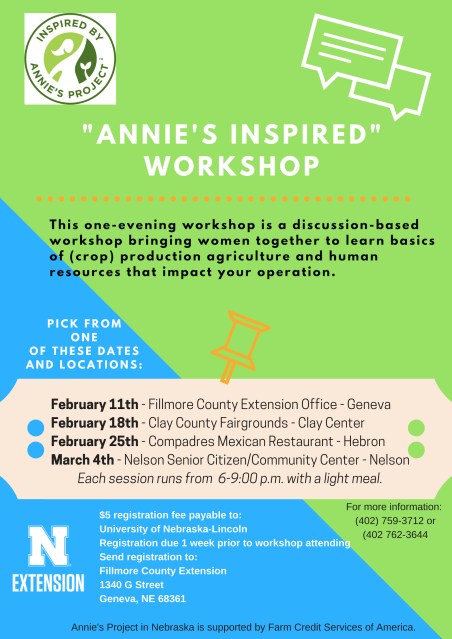
Annie’s Inspired – A Three Hour Session for Farm Women Involved in Agriculture 

Annies Inspired 2019.jpg

Farm and ranch women are generating a cultural tide in American agriculture that is moving management, assets and opportunities to a new wave of farmers across the country. At Annie’s Project workshops, farm women become empowered to be better business partners or sole operators through networks and by managing and organizing critical information. Whether you are a woman working full-time in the operation or have off-farm employment, Annie’s Project is for you.

A new “short-course”, titled Annie’s Inspired will be held in four different locations in South Central Nebraska. This one-evening workshop is being repeated in Fillmore, Clay, Nuckolls and Thayer Counties, all running from 6-9:00 p.m. with a light meal included. Registration is $5 per participant and due one week prior to the respective program date. Program dates and locations include:

  • February 11th – Fillmore County Extension Office – Geneva
  • February 18th – Clay County Fairgrounds – Clay Center
  • February 25th – Compadres Mexican Restaurant – Hebron
  • March 4th – Nelson Senior Citizen/Community Center – Nelson

The workshop is designed to be discussion-based, bringing women together to learn from experts in human resources, basic crop production issues, and other topics of interest to the group. There will be plenty of time for questions, sharing, reacting and connecting with presenters and fellow participants. The learning environment will be relaxed and fun, providing a dynamic way to learn, grow and meet other farm and ranch women.

To register, the $5 fee is payable to University of Nebraska-Lincoln due 1 week prior to the workshops attending and can be sent to: Fillmore County Extension, 1340 G Street, Geneva, NE 68361. Statewide program sponsor includes Farm Credit Services of America.  Annie’s Project courses have successfully reached more than 9,000 farm and ranch women in 33 states. Linda, an Annie’s Project alumna says, “I took the class to gain a better understanding about agribusiness and how financial decisions impact our farm operation. I have a better understanding of balance sheets and the futures market…this class has improved communication with my spouse on concerns he works with on a daily basis.”

Course size is limited, so please register by calling the Fillmore or Clay County Extension office at 402.759.3712 or 402.762.3644 or for more information, go to: https://wia.unl.edu/anniesproject.  For more information contact Brandy VanDeWalle at 402.759.3712 or brandy.vandewalle@unl.edu.

Crops, Irrigation, Livestock, Programming

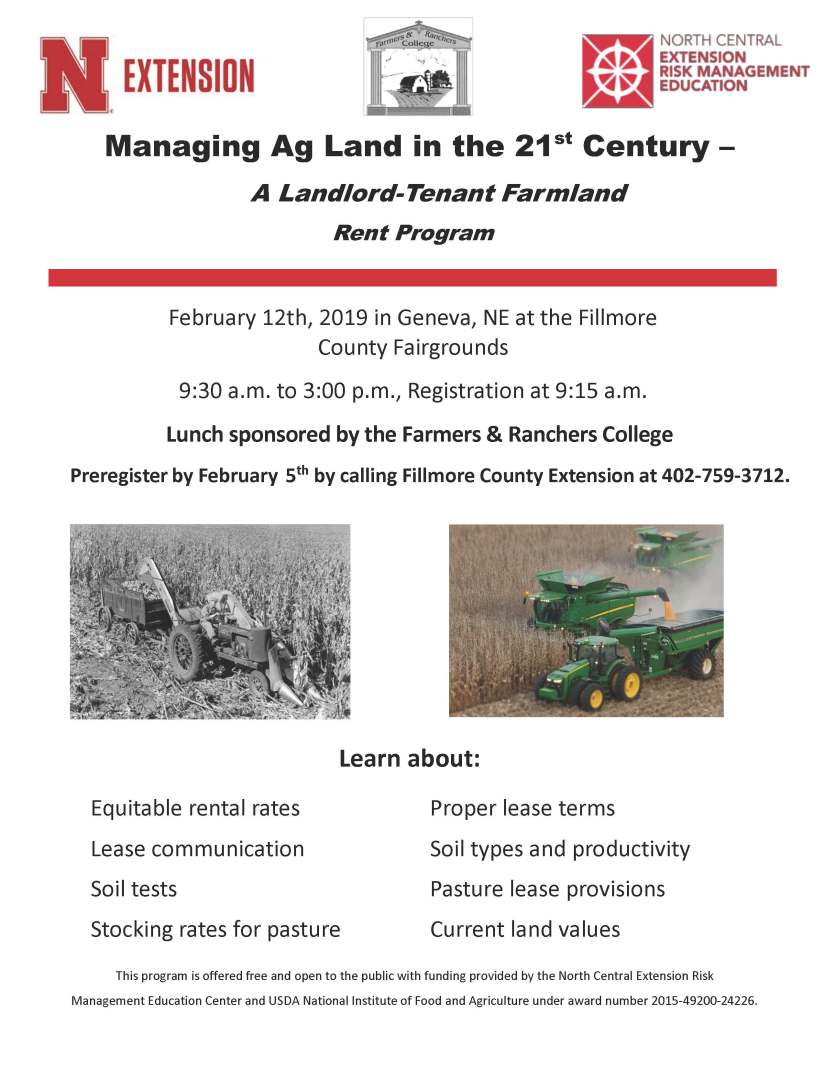
Managing Agricultural Land for the 21st Century

Current and future landowners and tenants should make plans to attend a free land management workshop sponsored by the University of Nebraska-Lincoln Extension. “Managing Agricultural Land for the 21st Century” will cover current trends in cash rental rates, lease provisions, and crop and grazing land considerations.

sky clouds cloudy earth
Photo by Pixabay on Pexels.com

This meeting is being held in Geneva at the Fillmore County Fairgrounds on February 12, 2019.  Registration is at 9:15 a.m., program starting at 9:30 a.m., and ending by 3:00 p.m.  The meeting is free due to the generous contributions of the Farmers & Ranchers College donors. For an accurate meal count, please,  please register by calling (402) 759-3712 by February 5th.

Nebraska Extension Educators Allan Vyhnalek, Aaron Nygren, and Jim Jansen conduct research and outreach in land management, agronomy and beef production. They will address common agricultural landlord and tenant questions. What does an equitable rental rate look like for my land? How do I manage a farmland lease? What should I expect for communications between the landlord and tenant? What does a soil test tell me? I hear about organic or natural production; how does that vary from what my farmer is currently doing? If corn or soybeans are not making money, should something else be raised on my land? What are key pasture leasing considerations including stocking rates? Who is responsible for cedar tree removal from grazing land?

“Landlords and tenants often struggle with land management questions.” said Allan Vyhnalek, Extension Educator and workshop presenter. “Both are concerned with fair treatment but it can be difficult to keep up with the current trends. Our workshop will provide participants with up-to-date information so they can be confident about their lease arrangements.”

This program is free and open to the public with funding provided by the North Central Extension Risk Management Education Center and USDA National Institute of Food and Agriculture under award number 2015-49200-24226.

For more information or assistance, please contact me at 402-759-3712 at Fillmore County Extension, Allan Vyhnalek, Extension Educator, Farm Succession, at 402-472-1771 or e-mail avyhnalek2@unl.edu, or contact Jim Jansen, Extension Economist for eastern Nebraska at 402-261-7572 or e-mail jjansen4@unl.edu.

Programming, Youth

This is 4-H

My colleague, Megan Burda in York County did a great job describing 4-H in one of her recent columns so I decided to share facts about 4-H in case you are unfamiliar or haven’t experience 4-H in many years, as it has changed and evolved with the times.4h_mark1

The 4-H Pledge – I pledge my head to clearer thinking, my heart to greater loyalty, my hands to larger service, and my health to better living, for my club, my community, my country, and my world.

Head, Heart, Hands, and Health are the four H’s that describe how youth are engaged in the 4-H program.  Using their heads they learn to manage many different things in their 4-H projects and life. Through their heart, they learn to relate to others and be caring to those around them and their projects.  With their hands, 4-Hers are able to work on various projects. By living healthy they are practicing being capable of caring for self and others.

How can being involved in 4-H foster youth’s success?  In 2002 the 4-H Study of Positive Youth Development longitudinal study began and was then repeated annually for eight years.  There were more than 7,000 adolescents from across 42 states in the United States that participated in the study. The Tufts research team examined how structured-out-of-school time learning, leadership experiences, and adult mentoring that young people receive through 4-H plays a role in helping them achieve success.

4-Hers practice responsibility by being involved in a variety of different projects offered through the program.  The project areas are Animal Science, Communication and Expressive Arts, Entrepreneurship, Environmental Education and Earth Sciences, Family and Consumer Sciences, Healthy Lifestyle Education, Leadership and Citizenship, Plant Science, and Plant Science and Technology.  If a youth chooses to participate in a Healthy Lifestyle Education project, they may learn the skill of meal planning for themselves and their family.  This skill could lead to them actually planning out healthy meals for themselves and their family members and may even include keeping a food budget for their family.

4-Hers practice responsibility by caring for animals daily in various animal science projects. 4-Hers make sure their animals have a safe place to be, have appropriate food and water, and that their animals are cared for and can be handled.  This takes much time and dedication by the 4-Her and their family and does not just happen one week out of the year at the county fair.  4-Hers in livestock projects take 4-H Livestock Quality Assurance to help prepare them for daily care and management.  They also work closely with their family members and veterinarian and participate in animal science contests throughout the year.

The Tufts research longitudinal study showed that compared to their peers, youth involved in 4-H programs excelled in several areas.

4-Hers are:

  • Nearly 4x more likely to make contribution to their communities.
  • About 2x more likely to be civically active.
  • Nearly 2x more likely to participate in science programs during out-of-school time, 2x more likely (Grade 10) and nearly 3x more likely (Grade 12) to take part in science program compared to girls in other out-of-school time activities.
  • Nearly 2x more likely to make healthier choices.

For information on how you can be involved in 4-H in Fillmore County, go to fillmore.unl.edu or for Clay County 4-H information, go to clay.unl.edu.

 Source: The Positive Development of Youth; Comprehensive Findings from the 4-H Study of Positive Youth Development, Institute for Applied Research in Youth Development, Tufts University.