Programming, Youth

Keeping Youth Safe

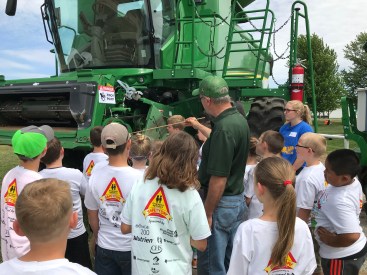
That, “no child would become ill, injured or die from farm, ranch and rural activities.” That is the vision for the Progressive Agriculture Foundation. The Progressive Agriculture Foundation governs and secures funding solely to educate youth and families on ways to make farm, ranch and rural life safer for children and their families. The Progressive Agriculture Foundation is the largest rural safety and health education program for children in North America, which Fillmore County is proud to provide one of those programs. In fact, over 400 safety days are planned across the United States & Canada reaching over 104,000 participants in 2018 alone. Since 1995, the Progressive Ag Safety Foundation and its sponsors has provided resources for over 6,972 safety days have occurred reaching nearly 1.3 million participants and over 347,000 volunteers.IMG_2378.jpg
IMG_2433.jpg

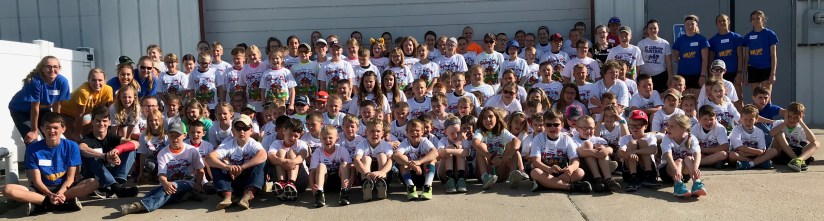
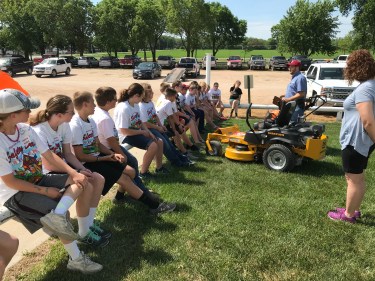
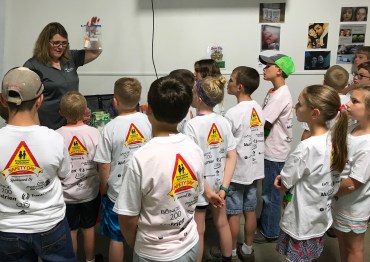
On May 24, 2018 Nebraska Extension in Fillmore & Clay Counties coordinated Progressive Agriculture Safety Day for 128 area youth in collaboration with the local WIFE (Women Involved in Farm Economics), Emergency Management and Fillmore Central and Shickley FFA Chapters. The event for youth who just completed 1st to 6th grades provided hands-on activities for youth on a variety of topics from knife safety to healthy lifestyles to lawnmower safety.
IMG_2406.jpg

This program is possible through the assistance of numerous volunteers from varying agencies or businesses including Plains Power, Nick’s Farm Store, Perennial Public Power, Fortify Group, Nebraska Extension, Shickley and Fillmore Central FFA Chapters. Sponsorship from W.I.F.E. (Women Involved in Farm Economics), Fortify, Fillmore County Emergency Management, Fortigen, Sutton Vision Center and Harre Seed. Lunch was served and provided by the Fillmore Central FFA Booster Club.
IMG_2418.jpg

New this year, youth learned about the severity of the opioid epidemic and were given information on its devastating effects on people. Goody bags with lots of resources and other activities were sent home with the record-breaking number of participants. Each family received a weather radio this year as well. Local coordinator, Brandy VanDeWalle attends the annual Progressive Agriculture Safety Day training and works to coordinate this collaborative event. For information on how to be involved locally in the future, contact Brandy at the Fillmore County Extension Office at 402-759-3712.

Crops, Programming, Youth

Connecting Youth with Crops

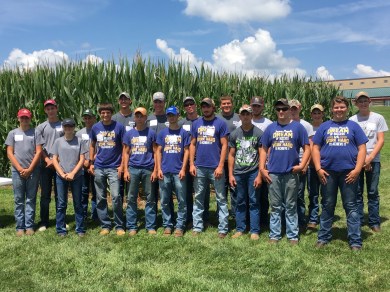
Looking for a fun project for 4-H or FFA youth? Want to unite your club members? Running out of ideas for youth projects?  If you answered, “yes” to any of these questions, help is on the way!  Nebraska Extension is pleased to present the 5th annual Crop Scouting Competition for Nebraska youth. Youth interested in crops have the opportunity to learn about crop growth & development and basic crop scouting principles.IMG_9071.jpg

Don’t know a lot about crops?  Ask a local agronomist to assist by providing a short lesson on crop production. You can have the agronomist meet with youth a little during each meeting or outside of the meeting. This is one way to engage those youth interested in crops.

This contest will be held at the ARDC near Mead, Nebraska on July 26, 2018. The event will include both indoor and outdoor events. Teams of junior high and high school students (those completing 5-12th grades) from across Nebraska are invited to participate. This event is limited to the first ten teams who sign-up!

Clubs or other organizations may enter a team composed of three to five participants. An adult team leader must accompany each team of students. Team leaders could be FFA advisors, crop consultants, extension staff, coop employees, etc.IMG_9110.jpg

Top-scoring teams win prizes: $500 for first, $250 for second, $100 for third place. Top two teams will be eligible for regional competition in August at Nebraska.

Teams will be expected to know the basics of scouting corn and soybean fields. This includes crop staging; looking for patterns of crop injury; disease, insect and weed seedling identification; etc. Other topics many include but are not limited to, pesticide safety, nutrient disorders, and herbicide injury.

More information about the crop scouting competition and instructions on how to register a team are available online at cropwatch.unl.edu/youth. Register at: go.unl.edu/cropscoutingregistration. For more questions, contact me at brandy.vandewalle@unl.edu or (402) 759-3712.

Teams must be registered by July 18. This program is sponsored by Nebraska Independent Crop Consultant Association, DuPont Pioneer, Farm Credit Services of America and Nebraska Extension.

Programming, Youth

Raise Your Hand for 4-H

cropped-n_4h-ext-3c.pngNebraska 4-H currently reaches one in three youth through 4-H programming. Considering the amazing benefits youth experience through participation in 4-H programming, Nebraska 4-H anticipates reaching one in two youth by the year 2020. In order to achieve this goal, leadership of Nebraska 4-H asked counties to establish growth goals for their local 4-H programs beginning in 2014. These growth goals were meant to encourage and challenge 4-H programs to think of creative and innovative ways to engage more youth in 4-H programming. While reaching one in two youth may initially seem overly ambitious, fifty four counties currently reach one in two youth through their 4-H programs. This is due, in large part, to the great work of our 4-H alumni and volunteers. Fortunately, Fillmore and Clay Counties have already achieved this goal and are working to expand even more through diverse audiences.
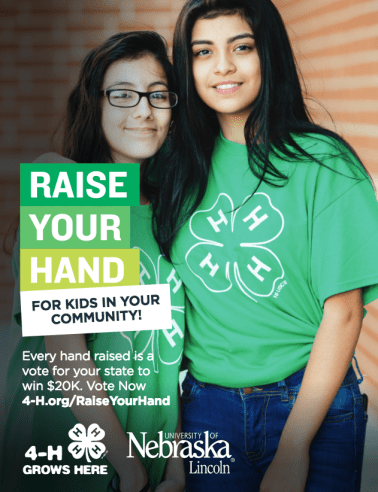
Recently, the National 4-H Council announced their own growth goal of reaching ten million youth through 4-H programming by 2025. They asked all states to begin setting growth goals to help them achieve this. It is great to see Nebraska 4-H setting the standard for growth and leading the way as we work to give as many youth as possible the opportunity to make their best, better.

pexels-photo-669011.jpeg

How can you be a part of Nebraska 4-H reaching one in two youth by 2020? Invite new members to join 4-H clubs, perform community outreach projects in the county, or invite your child’s teacher to utilize school enrichment programs in their classroom. Are you on social media? As you share great accomplishments with 4-H members and use the hashtag #4Hgrowshere and #NE4H. Even if you are not directly involved in 4-H programming, share great 4-H memories or experiences that helped you make the best better. Growing the reach of Nebraska 4-H begins with volunteers and alumni sharing their stories and shining the spotlight on the life changing moments experienced in 4-H. Help Nebraska 4-H continue to lead the way to reaching one in two youth in counties of our great state and ten million youth nationally.2018-04-13_1457.png

If you are a 4-H alum, don’t forget to Raise Your Hand! Together we can help 4-H provide the hands-on learning that empowers kids across America with the skills to handle what life throws at them.

It’s easy:

  1. Raise Your Hand: Go to www.4-H.org/RaiseYourHand to show your pride as a 4-H alumni.
  2. Compete for Your State: Raising your hand is a vote towards a $20,000, $10,000 or $5,000 award for the states with the most alumni hands raised. In Nebraska, this award will be used to reach more youth through Science, Technology, Engineering, and Math (STEM) programs.
  3. Pay it Forward: Tweet, post and share your #4HGrown and #NE4H experience or support and tag fellow alumni asking them to raise their hands for their state at www.4-H.org/RaiseYourHand 

In addition, share the campaign by:

  • Adding the Nebraska 4-H Frame to Facebook Profile Picture – Log into Facebook. Click this link to change your profile picture. Search for “Nebraska 4-H” and click “Use as Profile Picture.”
  • Asking Four Friends to Raise Their Hand by Voting for Nebraska – Send an email, social media message, or text to four friends asking them to Raise Your Hand for Kids in Nebraska! Include the link to https://4-h.org/raise-your-hand.

Help kids learn responsibility, compassion, respect and the value of hard work by supporting 4-H. Together we can grow the next generation of true leaders.

Programming, Youth

Progressive Ag Safety Day

agsafety.png

Statistics from those impacted by a farm-related injury or death are sobering. Many know someone who was impacted by a farm accident that in many cases could have been prevented. This is why I feel so passionately about conducting the Annual Progressive Safety Day each year. The Progressive Agriculture Foundation provides safety and health information to rural communities that need it, which is why I’ve teamed up with them. The mission of Progressive Agriculture Days is simple – to provide education, training, and resources to make farm and ranch life safer and healthier for children and their communities.Safety_Day

During the program’s first year, a total of 2,800 participants and volunteers were reached throughout the South and Midwest and now the program impacts close to 110,000 annually. To date, the program has impacted more than 1.6 million children and adults.

Current 1st through 6th graders are invited to attend Progressive Agriculture Safety Day on Thursday, May 24, 2018 at the Fillmore County Fairgrounds.  Youth will participate in a variety of events designed to help them be aware of safety in potentially hazardous situations such as electricity, emergencies, lawn mowers, tractors and pinchpoints, agricultural settings, and others.  Youth will also learn about protecting their eyes and the opioid epidemic and how this impacts families. This year, families will walk away with a weather radio to use in the case of storms. Registration and consent form is REQUIRED by all youth who participate. This can be found at fillmore.unl.edu or by stopping by the Extension Office in Geneva or Clay Center.

April 20th is early bird registration at only $5 per child that includes a t-shirt, lunch, snack and goodie bag. After April 20th,  registration increases to $10 per youth in order to participate.

This event is conducted by Nebraska Extension in Fillmore/Clay Counties, Shickley and Fillmore Central FFA chapters, 4-H and W.I.F.E. For more info or to register, call 402-759-3712 or email brandy.vandewalle@unl.edu.

Programming, Youth

Tractor Safety Training for Teen Farm/Ranch Workers

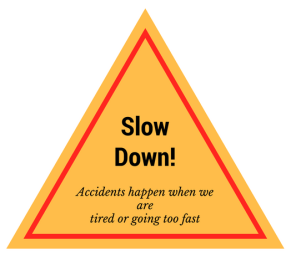
Federal law prohibits youth under 16 years of age from using specific equipment on a farm unless parents or legal guardians own the farm.  Certification received through a course provided by Nebraska Extension grants an exemption to the law, allowing 14- and 15-year-olds to drive a tractor and work with certain mechanized equipment. slow-down

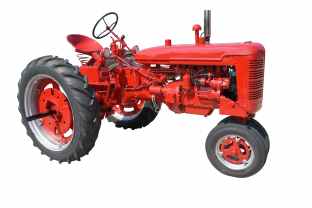
The most common cause of agricultural-related death in Nebraska is overturned tractors and all-terrain vehicles (ATVs).  Employing anyone uncertified under age 16 is a liability risk for farmers if those children operate such equipment.

Nebraska Extension’s Tractor Safety & Hazardous Occupations Courses take place at 12 Nebraska locations this year for teens 14 or 15 years of age who will work on a farm.  Anyone older than 15 is also welcome to attend, but those under age 14 are not eligible to take the class.  Extensive training on tractor and ATV safety occurs during in-class lessons with hands-on activities.  Instilling an attitude of safety and a respect for agricultural equipment are primary goals of the course.

The first day of classroom instruction includes hands-on demonstrations, concluding with a written test.  Classroom instruction will cover the required elements of the National Safe Tractor and Machinery Operation Program.  Students are required to pass the test before taking the driving test on day two.  The second day will include a physical driving test with equipment operation and ATV safety lessons.  To receive certification, students must demonstrate competence in hitching and unhitching equipment and driving a tractor and trailer through a standardized course.  Instructors will offer an ATV simulator experience to learn about safe behaviors and laws for ATVs and UTVs.  Students will also complete homework assignments for the second day.pexels-photo-327378.jpeg

Two locations, Gordon and McCook, will offer online course instruction to replace the first day of the two-day course.  Students complete this at their convenience before attending the driving component of the course on-site.  All on-site classes begin at 8:00 A.M. and end times will vary, depending on the number of participants.  Training site locations, Site Coordinator contact numbers, and dates of training are as follows:

Training Site Location                Site Coordinator            Dates of Training

  • Fairgrounds, Geneva                  (402) 759-3712            May 22 & 23
  • Fairgrounds, Hastings                (402) 461-7209            May 24 & 25
  • Fairgrounds, Kearney                 (308) 236-1235            May 29 & 30
  • Fairgrounds, Auburn                  (402) 274-4755            May 31 & June 1
  • Evangelical Free, Ainsworth        (402) 387-2213            June 5 & 6
  • Plains Equipment, O’Neill           (402) 336-2760            June 7 & 8
  • WCREC, North Platte                 (308) 532-2683            June 12 & 13
  • Fairgrounds, Wayne                 (402) 375-3310            June 19 & 20
  • Fairgrounds, Gordon                 (308) 327-2312            June 21 (Day 1 online)
  • Fairgrounds, McCook                (308) 345-3390            June 22 (Day 1 online)
  • Fairgrounds, Weeping Water     (402) 267-2205            June 29 & 30

old-red-tractor-nostalgia-158689.jpeg

Cost of the course is $60, which includes educational materials, instruction, supplies, and lunches.  Print and complete a registration and submit with payment to the appropriate Extension office location at least one week before the course (call the specific location number listed above for mailing address and instructions).

Crops, Livestock, Youth

Celebrate Agriculture

IMG_1370
My daughters, McKenzie and Meredith love caring for their calves, helping in the garden and learning about agriculture.

Growing up on a small farm in Saline County, I appreciate the work of our farmers and ranchers. My dad still farms and my girls enjoy visiting the farm and I hope I can instill the same hard-working values and beliefs my parents instilled in my sister and I. This is part of the reason, my husband and I have starting raising a few chickens and have bucket calves for the girls to care for. With my husband as the Fillmore Central ag education instructor and myself as an extension educator for UNL, we hope to be teaching future generations the vast opportunities available in the agricultural industry. This week marks the time to celebrate agriculture so I have included some of the Agriculture Council of America’s press release in my column this week as well as some of Extension’s work in agriculture literacy.

2017AgDay 625x90The Agriculture Council of America (ACA) will host National Agriculture Day on March 20, 2018. This will mark the 45th anniversary of National Ag Day which is celebrated in classrooms and communities across the country. The theme for National Ag Day 2018 is “Agriculture: Food For Life.”

On March 20, 2018, ACA will host major events in the nation’s capital including an event at the National Press Club as well as a Taste of Agriculture Celebration. Additionally, the ACA will bring approximately 100 college students to Washington to deliver the message of Ag Day. These events honor National Agriculture Day and mark a nationwide effort to tell the true story of American agriculture and remind citizens that agriculture is a part of all of us. A number of producers, agricultural associations, corporations, students and government organizations involved in agriculture are expected to participate.

National Ag Day is organized by the Agriculture Council of America. ACA is a nonprofit organization composed of leaders in the agricultural, food and fiber community, dedicating its efforts to increasing the public’s awareness of agriculture’s role in modern society. The National Ag Day program encourages every American to:

  • Understand how food and fiber products are produced.
  • Appreciate the role agriculture plays in providing safe, abundant and affordable products.
  • Value the essential role of agriculture in maintaining a strong economy.
  • Acknowledge and consider career opportunities in the agriculture, food and fiber industry.

You might be glad to know that Nebraska Extension has a team of extension staff working on programming to educate consumers and youth about agriculture and tell the story of the American farmer and rancher. This is being done through agricultural literacy-focused festivals and programs, development of beef-booster curriculum, quality assurance programs and many others. In fact, over 26,000 youth learned about agriculture through ag literacy programs in 2017 alone and 216,000 individuals accessed web materials to teach/learn about food labeling, when food is still acceptable to eat and how to reduce food waste. Over 3,600 Nebraska youth were certified in Livestock Quality Assurance to implement good production practices ensuring animal care and well-being.

Check out the impact this group had in 2017 related to agriculture literacy. 

Crops, Programming, Youth

4-H offers numerous opportunities

Any youth ages 5-18 (as of January 1st) is eligible to participate in the 4-H youth development program. Youth in Clay and Fillmore Counties  need to enroll by April 1st to take advantage of this excellent opportunity. This year, all youth will register online at ne.4honline.com.  We also need caring adults to help volunteer with the program and volunteers also need to enroll online. If you have any further questions, please contact Holly at the Fillmore County Extension office at 402-759-3712 or Deanna in Clay County at 402-762-3644.cropped-n_4h-ext-3c.png

All across Nebraska 4-H youth are beginning to select their 4-H projects for 2018! Let the Nebraska 4-H Pick Your Project help connect you with projects that fit your interests and skill levels!

The interactive, web-based Nebraska 4-H Pick Your Project is found online at http://4hcurriculum.unl.edu. Use this as a guide when completing your enrollment form. Check out the curriculum and spark an interest in a new project for this year!

Locally, some programs coming up include Youth Animal Science Day and the kick-off of a Plant Science Investigation series which I’ll describe.

bull-calf-heifer-ko-162240.jpeg

4-H Animal Science Day

Coming to Geneva on Sunday, March 18th is a short animal science program (FREE) which will offer a livestock judging contest, a face to face Youth for the Quality Care of Animals (YQCA) program, tips for your livestock projects and other fun hands-on animal science activities. This requires a lot of planning and assistance so if you are interested in participating, sign up by March 14th.  There must be a minimum of 25 youth in order for this program to occur; invite your friends from neighboring counties too! RSVP to the Fillmore County Extension office at 402-759-3712 or by email Rachel at rachel.adam@unl.edu.

PSI - Fillmore (3)
For more info, go to Fillmore County 4-H Facebook page.

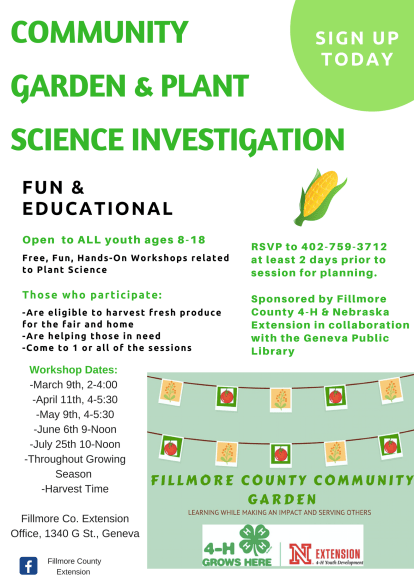
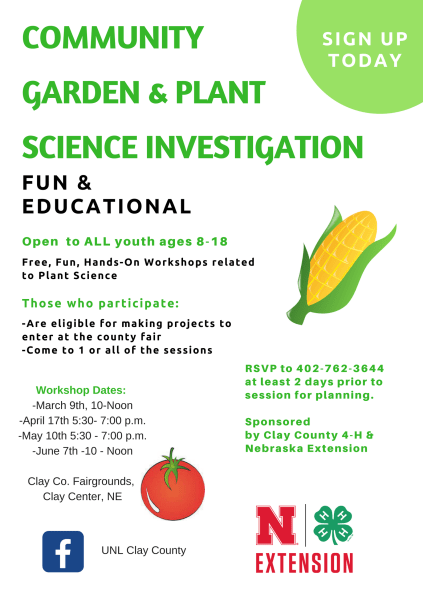
Plant Science Investigation (PSI) & Community Garden

Have a green thumb?  Interested in gardening?  If you answered yes to any of those questions, join the PSI and/or Community Garden teams this year. Here’s what you can learn about in PSI:

  • Learn about the importance of agriculture and how crops are used.
  • Conduct cool, hands-on science experiments.
  • Listen to speakers and learn about careers.
  • Help conduct field plot research.
  • Become a PSI investigator and detect plant problems.

The program will kick-off in Fillmore County at the Extension office on March 9th from 2pm – 4pm. Youth in Clay County can attend the program at the Clay County Fairgrounds on March 9th from 10-Noon.  We will learn about plant propagation methods and more!

PSI Clay

If you are unable to participate in this program, there will be more opportunities through the growing season.  For youth in Fillmore County, we will continue the Community Garden  and be partnering with the Geneva Library as well. If you are interested, please let the Extension office know by April 1st.

Crops, Programming, Youth

7th Annual Innovative Youth Corn Challenge

iycc-coverAttention 4-H and FFA Youth! Do you enjoy being outside? Learning new things about crops? Considering a career involving crops, insects, diseases, soils, water or more? Do you want to help figure out how to feed our world’s growing population in a sustainable way?


Science, technology, engineering, and math (STEM) careers are in high demand and will continue to be in future years. To engage youth in crop science based education, the Innovative Youth Corn Challenge (IYCC) was created as a partnership between the Nebraska Corn Board and Nebraska Extension.  Since the Innovative Youth Corn Challenge program’s inception in 2012, 35 teams have participated in the program with 20 teams successfully harvesting and analyzing their plot data. A total of 105 youth have participated. This contest, open to 4-H members or FFA members, guides participants through all aspects of corn production, as well as agricultural careers related to corn production.

IMG_1313.jpg
2017 participants attended the banquet in January to receive recognition for their hard work. 

Nebraska Extension and the Nebraska Corn Board are offering the seventh Innovative Youth Corn Challenge contest. This contest, open to 4-H members (age 10 & older as of Jan. 1st) or FFA members (in-school members), guides participants through all aspects of corn production, as well as agricultural careers related to corn production.

As a team (2 or more participants), youth will be challenged to implement a production practice different than normal to determine if they increased their yield. Economics and sustainability of the practice will also be considered. Yields, cropping history, and production information will be collected in the Corn Yield Challenge management summary.

Cash prizes and plaques are given. First place receives $1,000, second place receives $500, and third place receives $250.  Sustainability, crop scouting and “extra mile” awards are also given as cash awards.

To participate in 2018, youth must complete and return an entry form by March 15th to the Fillmore County Extension Office in Geneva, NE. Forms can be downloaded after January 1st at cropwatch.unl.edu/youth/activities. For more information, contact Brandy VanDeWalle at brandy.vandewalle@unl.edu.

Crops, Livestock, Programming, Youth

Food Label “Quiz”

With the holiday season upon us, many consumers will be preparing food for family and friends. When you go to the grocery store and select food, how well do you really know your food labels?  A survey of over 1,200 Nebraskans was conducted on how people think and feel about their food. Food labels were identified as the major information source by almost 64% of respondents. This work was done as a part of our Consumer Confidence team which works to find ways to inform people about food production. Are you an able food label reader? Do you know the answers to these questions? (Answers at the end of this article.)

Photo Credit: FDA
  1. A label box of cereal starts like this: “Ingredients: Whole wheat, brown sugar, molasses….”
    Which of these ingredients is present in the largest amount by weight in this food? a. Whole wheat      b. Brown sugar    c. Molasses     d. They are present in equal amounts
  2. Two chicken broths are labeled the following: Label 1: Real herbs, real flavor, sodium free chicken bouillon and Label 2: All natural, 100% chicken bouillon
    Which label does NOT have an approved “definition?” 
    a.  Label A     b. Label B
  3. A label says, “best if used by Dec., 27, 2019. Is a “Best If Used By” date a “safety” date?
    a. Yes     b. No
  4. Which of the following foods is “hormone free”?
    a. Meat     b.  Bread      c. Peas      d. None of them are “hormone free”
  5. Which animal is raised with “added” hormones?
    pig and chicken
    Photo Credit: Microsoft Powerpoint icons

    a. Pigs      b. Chicken      c. Both of them      d. Neither of them

  6. If “bananas-A” are labeled “GMO-Free” and “bananas-B” have no GMO labeling, which is a TRUE statement?
    a. Bananas-B are a GMO food      b. Neither of them are GMO foods       c. It’s impossible to tell if bananas-B are a GMO food

CHECK YOUR ANSWERS:

  1. a. Whole wheat. Ingredients are listed by their common or usual name in descending order by weight. For example: If “whole wheat” is listed first, that ingredient is found in the largest amount by weight in the product. The ingredient listed last contributes the least amount by weight.
  2. b. Label B. Currently, the U.S. Food and Drug Administration has not developed a definition for use of the term “natural.”
  3. a. No. A “Best If Used By” date describes product quality, where the product may not taste or perform as expected but is safe to use or consume.
  4. d. None of them are “hormone free.” Anything that is or has been alive contains hormones, including plants. There is no such thing as “hormone free” meat or animal product.
  5. d. Neither of them. Added hormones aren’t allowed by the U.S. Department of Agriculture in pork and poultry. A claim of “no hormones added” on pork or poultry must be followed by the statement, “Federal regulations prohibit the use of hormones.”  Be aware, the claim of “no hormones added” may be in much larger letters than the statement saying the use of hormones is prohibited.
  6. b. Neither of them are GMO foods. In today’s market place, you may find foods promoted as “GMO free” or “contains no GMOs.” Before you pay extra for this food, be aware it may not be made with any ingredients that contain GMOs in the first place. In other words, the same type of food without that label may also be free of GMO ingredients.

Neither banana is a GMO food and never has been! GMO foods currently available in the United States are: Corn (field and sweet), Soybeans, Cotton, Canola, Alfalfa, Sugar beets, Papaya (Hawaiian), Squash

NOTE: Not all versions of all these foods are genetically engineered. Artic apples will be available in some areas by 2017. Before being placed on the market, genetically modified foods must be approved by the U.S. Food and Drug Administration, the U.S. Department of Agriculture and the Environmental Protection Agency.

For more information or to view a self-paced slideshow on labeling, go to UNL’s food webpage.  

Youth

Celebrate National 4-H Week

For the 75th consecutive year, millions of youth, parents, volunteers and alumni across the country will be celebrating National 4-H Week during the first full week of October.

4-H alumni around the country are always the first to acknowledge the significant positive impact 4-H had on them as young people; the opportunities and experiences that 4-H4hweek_2017_logo.jpg provides youth empowers them to become true leaders. In fact, research has shown that young people in 4-H are almost four times as likely to contribute to their communities, and are twice as likely to engage in Science, Technology, Engineering andMath (STEM) programs in their free time.

In Nebraska, more than 25,000 youth are enrolled in 4-H and 12,000 volunteers are involved in 4-H. In addition, approximately 56,000 youth participate in Nebraska 4-H school enrichment experiences. One of the most anticipated events of National 4-H Week every year is 4-H National Youth Science Day, which sees hundreds of thousands of youth across the nation taking part in the world’s largest youth-led science challenge. The exciting theme for this year’s challenge is Incredible Wearables.2017-09-29_1343

On Wednesday, Oct. 4, youth will use the engineering design process to build a prototype wearable technology that will gather data to help solve a real-world problem. Wearable technologies are now used in industries around the globe, from education and sport, to health, fashion, entertainment, transportation and communication. To learn more about National Youth Science Day, please visit http://www.4-h.org/nysd/.

About 4-H: 4-H, the nation’s largest youth development and empowerment organization, cultivates confident kids who tackle the issues that matter most in their communities right now. In the United States, 4-H programs empower six million young people through the 110 land-grant universities and Cooperative Extension in more than 3,000 local offices serving every county and parish in the country. Outside the United States, independent, country-led 4-H organizations empower one million young people in more than 50 countries. National 4-H Council is the private sector, non-profit partner of the Cooperative Extension System and 4-H National Headquarters located at the National Institute of Food and Agriculture (NIFA) within the United States Department of Agriculture (USDA).

Learn more about 4-H at www.4-H.org, find us on Facebook at www.facebook.com/4-H and on Twitter at https://twitter.com/4H. For Nebraska 4-H, go to 4h.unl.edu.