

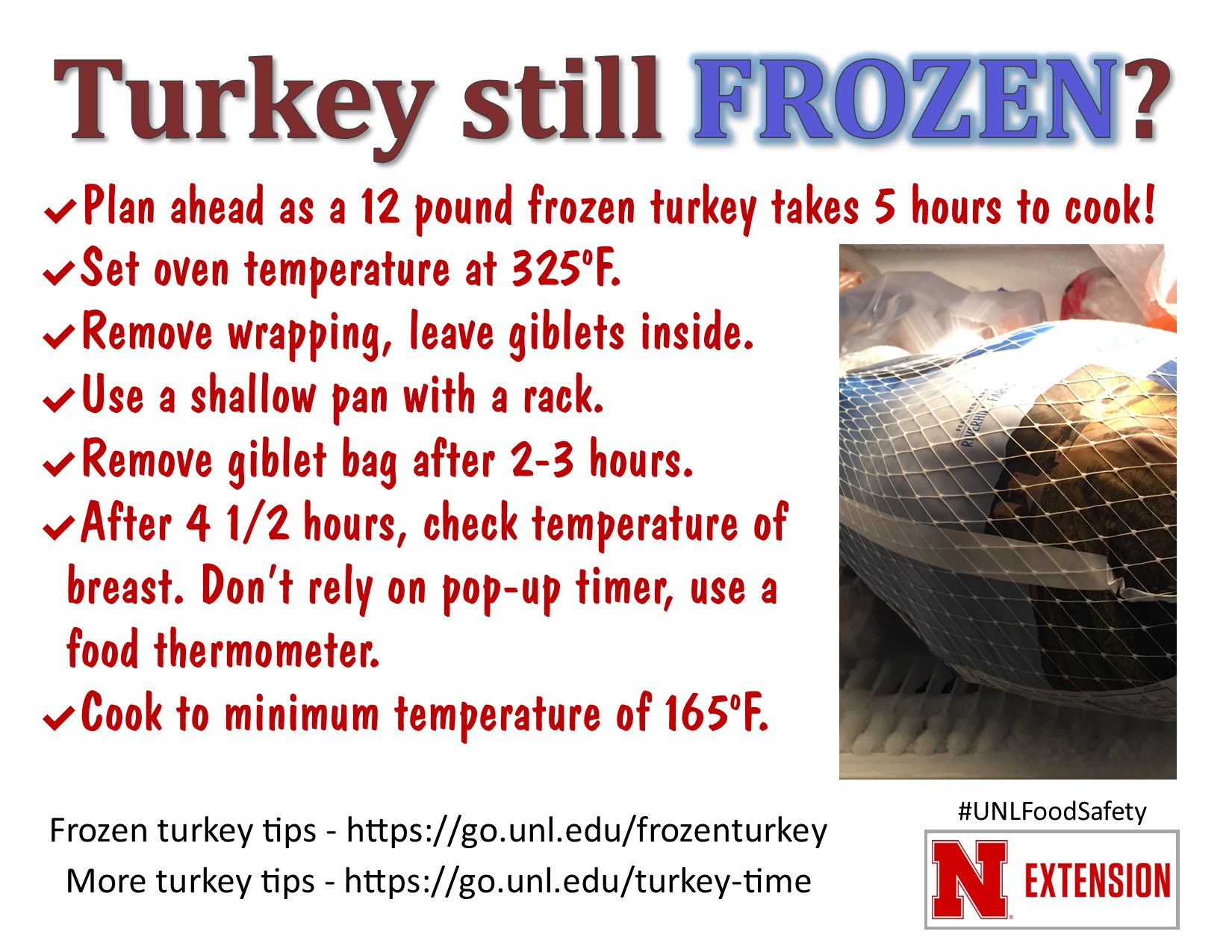
Is your turkey done?
Last week I provided tips for holiday gatherings during the COVID-19 era and ways to stay engaged even if in a virtual setting. One thing that doesn’t have to look different is some of the traditional holiday foods. Trade recipes with family members so you can learn to make that special dish that someone normally brings. If the dish is too large, only make half of the recipe. Worried that a turkey will be too big for your family? Consider making a large one and freezing it so you have meals ready to go for other meals.

The American Farm Bureau Federation annually calculates the cost of a Thanksgiving meal to serve 10 people with plenty for leftovers. This year, with a traditional Thanksgiving meal, Farm Bureau estimated a meal total of $46.90 which is less that $2.00 from last year. This is largely due to retail turkey prices being the lowest since 2010. Included in the meal is a 16-lb. turkey, bread stuffing, sweet potatoes, rolls with butter, peas, cranberries, a relish tray of carrots and celery, pumpkin pie with whipped cream and beverages of coffee and milk. You can thank our American farmers and ranchers who are able to provide us the bounty of safe and affordable food we are able to consume even through a pandemic. Another interesting fact about Thanksgiving include that 88% of Americans are expected to be feasting on turkey for Thanksgiving this year (National Turkey Federation).
Now let’s talk trivia:
Q: Why are turkeys raised? A: Because of their excellent quality of meat and eggs
Q: What is a male turkey called? A: Tom
Q: What is a female turkey called? A: A Hen
Q: What sound do turkeys make? A: Only tom turkeys gobble; the female makes a clucking sound.
Q: How many feathers does a turkey have at maturity? A: 3,500 feathers
Q: How big was the heaviest turkey ever raised? A: 86 pounds, about the size of a large dog
Q: Which gender of turkeys are usually consumed whole? A: Hens (females) are usually sold as whole birds. Toms (males) are processed into turkey sausage, turkey franks, tenderloins, cutlets and deli meats.
Q: How long does it take a turkey to reach market size? A: Hens usually grow for 16 weeks and is 8-16 lbs. when processed while tom usually takes 19 weeks to reach market weight and weighs 24 lbs. Large toms (24-40 lbs. are a few weeks older.
Regardless of what you do this Thanksgiving, remember to be thankful for what really matters and stay safe this year.
The holidays are usually a time filled with joy as many reunite with family members not seen as often. You might share special family recipes, play games, watch movies and just “catch up”. COVID-19 has certainly made this very difficult for face-to-face interaction but that doesn’t mean you can’t find other ways to connect. We have to be more creative and purposeful in how to interact.

According to an article published earlier this year by UNL faculty and published on Nebraska Extension’s ruralwellness.unl.edu website, “Research consistently tells us that taking care of others and maintaining meaningful relationships across generations are important for resilience and wellbeing.” (Bulling et al. 2020) Meaningful relationships contribute to a sense of belonging and help us feel connected. Sharing family stories and traditions among multiple generations is also a very special bond.
With the current pandemic, maintaining distance from our loved ones is difficult. We have missed birthdays, special events and probably other annual events or outings. The holiday season often triggers stress and sometimes even depression. Think about all of the demands we add to our plates – shopping, baking, cooking meals, cleaning and hosting events, just to name a few. This year, however, you are probably feeling a different type of stress – lack of normalcy, anxiety and disconnect. While COVID-19 has added new challenges, it has sparked creativity for some people. Like many of you, I’ve been trying to find new ways to stay emotionally connected to loved ones, so I searched and brainstormed some options.

This might be a year to reflect on the things that really matter to you and find ways to allocate more time towards those activities. If you have kids, let them brainstorm for alternative plans and start new traditions. Help children cope with the holiday blues and validate their feelings of disappointment and sadness to their disrupted holiday traditions. Remember that helping children overcome disappointment helps them build resiliency. Teach fun relaxation strategies such as meditation or even trying out a new candle scent or lotion.
Regardless how you celebrate your holiday season, remember that you are not alone. We are all navigating through these uncertain times together and it’s okay to ask for help if things get too overwhelming.
Reaching Out is Nebraska Strong
Reaching out to others and asking for help may look a bit different now but staying emotionally and socially connected is important to our health and wellbeing at all times. Learning to recognize your stressors and how to manage stress can help you personally and those around you. If you recognize someone in distress, use a caring approach in listening to them, and then connect them to resources.
Keep these Hotlines in your phone contacts:
Resources:

November is National Entrepreneurship Month! Did you know youth entrepreneurship is a program priority for Nebraska 4-H? Through various programs, Nebraska 4-H connects youth to important careers and strengthens their entrepreneurship skills. Entrepreneurship programs aim to increase the number of youths returning to rural communities in business and professions and to increase the number of youths who are entrepreneurs.
Nebraska Extension has created several programs to introduce youth to entrepreneurship and the mind set behind being an entrepreneur. Curriculum reach youth between grades 3-8. The curriculum, “T.E.C Box and “INVENTURE Day” have allowed youth to use their creativity through hands-on learning to explore the basics of Entrepreneurship while connecting them to their local communities.
Tinker. Explore. Create. (TEC) Box is an experiential learning and maker movement activity that actively engages learners by encouraging them to think for themselves, work hard and learn with hands-on, minds-on methods. Through this program, youth will engage with entrepreneurship, empathy and utilize their innovative spark. Two hundred sixty-five youth participated in TEC Box curriculum activities.
During INVENTURE Day, students familiarize themselves with local businesses and business owners to identify potential entrepreneurial careers. Using innovation and creation, youth work in teams to develop a unique business around a product that solves a problem in the community.
In celebration of National Entrepreneurship Month, teachers and educators are invited to utilize a toolkit of free resources, including:
A sample Spark to Start activities book is also being sent to all 4th-grade teachers in Nebraska. To access the free resources, simply complete a form at go.unl.edu/e-shipmonth.
Participants in Nebraska extension entrepreneurship and innovation programs have been shown to embrace an entrepreneurial mindset and gain skills to create new businesses, which ultimately contributes to the economic vitality of Nebraska communities and beyond.
Stress seems to be prevalent in the agriculture sector, with even more concerns arising due to the COVID-19 pandemic. Many farmers and ranchers are facing financial problems and market uncertainties, along with challenges such as production risks, farm transfer issues, and more. When temporary stress turns into chronic stress, it can impact physical health and mental wellness.

Nebraska Extension, in partnership with Michigan State University Extension, presents a free online webinar, “Communicating with Farmers Under Stress”, Tuesday, November 10, 2020 from 10:30 a.m. to noon, CST. This workshop is beneficial for individuals who work with farmers and ranchers on a regular basis, such as bank lenders, ag suppliers, healthcare professionals, and anyone involved with the lives of farmers and ranchers.
Workshop Objectives include:
* Build awareness around potentially stressful conditions affecting some farmers and ranchers.
* Learn stress triggers, identify signs of stress, and review helpful techniques for responding.
* Learn techniques for identifying, approaching, and working with farmers who may not cope with stress effectively.
* Learn where to find additional help.
In addition to being helpful for working with farmers and ranchers, the workshop educates participants about managing stress in their own lives and teaches how stressors can affect physical health and relationships with family or coworkers. Register for the free online workshop at: go.unl.edu/stress2020 . For more information, contact Nebraska Extension Educators Glennis McClure, gmcclure3@unl.edu or Susan Harris, susan.harris@unl.edu.
If you or your employees would like this program taught locally, feel free to contact me at brandy.vandewalle@unl.edu as I am also a certified trainer for the program.
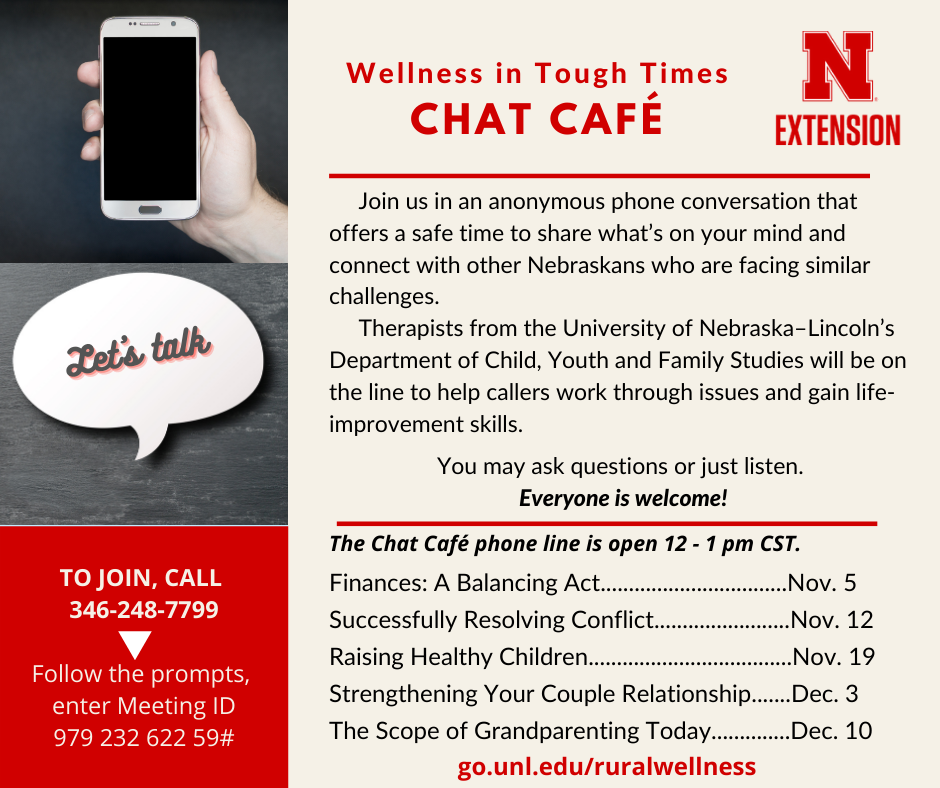
The Wellness in Tough Times Chat Café features an anonymous group of phone conversations that offer a safe time to share what’s on your mind and connect with other Nebraskans who are facing similar challenges. Therapists from the University of Nebraska–Lincoln’s Department of Child, Youth and Family Studies will be on the line to help callers work through issues connected to natural disaster recovery and gain skills to improve lives. You may ask questions or just listen. Everyone is welcome!
Mark your calendars to join our Wellness in Tough Times Chat Café for the following discussion topics: Follow the prompts and enter Meeting ID 979 232 622 59#.
For more information on the Wellness in Tough Times Team and resources similar to these programs, go to Nebraska Extension’s, ruralwellness.unl.edu.
For many, autumn events like Halloween are a time to wear costumes, go trick-or-treating, go to parties with friends, and eat sweet treats. Celebrations such as Halloween are a chance to not only have fun, but also provide healthy snack options and be physically active with friends and family. Make your Halloween season healthier this year by getting plenty of physical activity to balance food intake and help children choose wisely and eat their treats in moderation. Below are tips to make your Halloween healthier for trick-or-treaters and guests.

Hand out healthier treats.
Try out non-food treats.
Promote physical activity.
Moderation is key.
Survive sweet treats at work.
Find recipes and learn more at https://food.unl.edu.
This past week, I listened to a webinar hosted by Bryan LGH which featured Collin Kartchner who is an advocate for teen mental health. Specifically, fighting social media’s influence on teen mental health and emphasizing that their voice matters. There has been a lot of research which supports this, and results are shocking. This is one of the reasons, I as a parent was hesitant on allowing my 7th grader access to a smartphone. After Collin’s presentation and reading through literature, as a parent and educator there will be some changes made in our house and I hope you’ll read along to see key research points.

On his presentation sponsored by BLGH, Kartchner pointed out that parents need to be role models for their kids when it comes to phones and devices. This can be very hard to do in such an instantaneous society. Social media has made us share more than we have ever shared before. Think about it, how many posts do you see every day? It is easier to connect with others and keep them updated on events which is handy, and it is also easy to push your political, social or other differing views which can create tension. How many of us carry cameras with us to kids’ events or other celebrations? When is the last time you’ve actually printed off pictures to physically display? I know I have caught myself being too involved with watching my kids through my phone rather than firsthand with my eyes.
When you pick up kids from school, do they see you on your device? When you are at home on the couch debriefing everyone’s day, are you on your device? Have you checked your screen time lately? How many hours are you working or socially engaged on your phone? Is it fair to blame our kids for wanting to be on their phones? They have been conditioned that phones are a lifeline and connection.
Jean Twenge, a Professor of Psychology at San Diego State University authored a study that found teenagers are increasingly depressed, feel hopeless and are more likely to consider suicide. Her and colleagues found a sudden increase in teens’ symptoms of depression, suicide risk factors and suicide rates in 2012 — around the time when smartphones became popular. An excerpt from an article on NPR, found that, “Twenge’s research found that teens who spend five or more hours per day on their devices are 71 percent more likely to have one risk factor for suicide. And that’s regardless of the content consumed. Whether teens are watching cat videos or looking at something more serious, the amount of screen time — not the specific content — goes hand in hand with the higher instances of depression.” She found that half an hour or one hour seemed to be the time youth could handle electronic devices in terms of mental health. Twenge said that at 3 hours and more, there is a more pronounced increase in youth who had at least one risk for suicide.
Melanie Hempe, RN and founder of Families Managing Media summed up why social media is not for teens. 1) Social media was not designed for them. Biologically, their underdeveloped frontal cortex can’t manage all the temptations and information on social media. 2) Social media is an entertainment (and marketing) technology. It will not make them more prepared for real life of a job. 3) A tween’s “more is better” mentality is a dangerous match for social media. Do they really have as many “friends” as social media portrays? 4) Social media is an addictive form of screen entertainment. 5) Social media replaces learning the hard “work” of dealing face-to-face with peers. 6) Social media can cause teens to lose connection with family and instead view “friends” as their foundation. 7) Social media use represents lost potential for teams. It’s too easy for teens to waste their brain on a digital world, as it’s hard to balance everything.
So, what can we do? Twenge suggests both teens and adults limit time on social media and phones to no more than two hours. She encourages people to spend time resting, seeing friends face-to-face (of course in COVID-19 times, FaceTime or other electronic devices might have to be adapted), going outside, exercising, engaging in a non-electronic hobby, etc. If you use your phone to facilitate those things, that’s an acceptable route to take.
Collin Kartchner also provided ideas for families. First of all, one day each week, have a designated time for NO phones. He recommended the time of 5-9 p.m. because kids need time to talk to their parents and parents need to listen. Kids need family dinner with no phones or distractions. He said to talk like it’s 1994. He also recommends making sure your children get 8 hugs every day for 8 seconds minimum. That might seem like a lot, but kids need physical touch and connection with their parent/guardian. He recommended that parents, guardians and even grandparents also evaluate their own digital behaviors and make necessary changes. Create a Family Tech Contract that is voiced by all family members, signed and posted on the fridge or visible spot.
Extension Resources
For resources on mental health, check out Nebraska Extension’s webpage at https://ruralwellness.unl.edu/.

