Crops, Livestock, Programming

Reflections from Dr. Kohl

Those of us in agriculture are no stranger to risks involved with agriculture that are taken every day, whether it is financial, production, legal, price/market or human resource risks.  While we can’t control everything, there are measures that can be taken to protect one’s operation and reduce risk. Each year the Farmers & Ranchers College hosts Dr. David Kohl, Professor Emeritus from Virginia Tech who does an excellent job describing global risks which affect us locally and how those risks will affect the agricultural industry.

IMG_0872
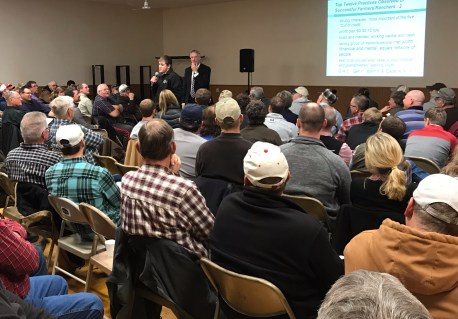
Approximately 120 people gathered for the first Farmers & Ranchers College program for the 2017-2018 programming year.

Several points I’d like to share in this week’s column are what Dr. Kohl coins as the top 40% of proactive producers or “greenliners” and the bottom 30% of producers or “redliners” and his top twelve practices observed of successful farmers and ranchers.

Characteristics of the top producers include being proactive by challenging themselves to improve their operation in three areas. These producers also have a sound financial system which includes accrual adjustments, knowing their cost of production for each enterprise or even better, each field.  Sound financial systems also look at trend analysis and ensure the records are in a safe and secure place (backed up, protected from cyber-attacks and in a fireproof safe). Proactive producers also have lower rental and fertilizer costs, have a third-person audit their practices and practice modest living. Understanding that a family might have to make sacrifices and pass on that new boat or trip can cut costs drastically, as they rose during the “good times”.

Now let’s take a look at the bottom 30% of producers. These producers typically overpay on marginal resources such as land. They lack financial or marketing skills. Kohl pointed out that something as simple as making one’s own spreadsheets or utilizing a solid record-keeping system is crucial to monitoring one’s cost of production and recommends quarterly meetings with your lender.  “Redliners” often do not make necessary improvements in their operation to keep with the times such as replacing worn out equipment. In fact, when operations are transitioned to the next generation, if everything is rusted and wore out, that next generation’s chance of “making it” are significantly reduced. These producers need to manage taxes, not minimize taxes. These producers often have a high cost of living and lack the ‘HUT’ principle which is to Hear what others tell you, Understand what they are saying and Take Action.
IMG_0875
College students who attended the program were tasked with asking someone for agricultural advice and Dr. Kohl had them report back to the group what they discovered.

Dr. Kohl also shared when he teaches producers strategies for success, he spends a large amount of time teaching about goal setting. Half the problem with businesses is that they don’t have WRITTEN goals. These should include business, family, personal, one and five-year goals. Balance in life is essential in every career, including farming and ranching. Making time for your spouse and other family members will prevent problems down the road. In addition to goals, he teaches producers to have a projected cash flow, break evens calculated, consider different “what-if” scenarios, updated balance sheets by Groundhog’s Day, develop a personal living budget and monitor your business with a lender or advisory team on a quarterly basis.

Dr. Kohl also provided the ten commandments of character. Character is often overlooked, but crucial to one’s integrity and success. His ten commandments of character included:

  1. Follow thru on commitments (educational program and financial statement requests).
  2. Use borrowed funds as agreed upon.
  3. Be accurate with financial statements such as balance sheets, income statement, etc.
  4. Have a willingness to sacrifice lifestyle pursuits and balance with business growth.
  5. Practice good communication of goals and in times when there are issues and challenges.
  6. There should be minimal surprise business purchases.
  7. Be willing to work with an advisory team, including a third party.
  8. Consider constructive coaching.
  9. Properly use profits, cash flows and windfalls.
  10. Utilize a network of people, peers and pursuits.

In summary, those who are unable to embrace change should open their minds and consider making changes. Kohl encouraged the college students in attendance to do an internship or take a job away from home to learn from others and bring fresh, new ideas back to the operation. He applauded those producers in attendance, as they are willing to learn and improve their business. When you graduate from high school or college, you are not done with learning and if you think you are, you will likely be left behind. This is where I’m proud to be a part of Nebraska Extension as we offer educational programs that provide research-based knowledge and our Nebraska On-Farm Research Network is a great avenue to test new practices, ideas or products.

Crops, Livestock, Programming

Ag Liens, Loans and Leases Workshop

One of the most common agricultural related questions our office receives is on cropland leases. If you have any questions similar to this, you are welcome to attend a free workshop on Ag Liens, Loans, and Leases.   The workshop will be held in Davenport, (December 13, 2017) at the Community Center. A lunch will be provided.  The workshop runs from 10:00 am to 2:30 pm.  There is no charge for the workshop.  To register (and for questions) call the Rural Response Hotline at 1-800-464-0258. For an accurate meal count please RSVP by Dec. 8th.

What the workshop is about?money bag.jpg

  • Liens – Nebraska’s statutory agricultural liens, from the producer’s perspective:  What are they?  How do they work? These are liens that give creditors rights in certain property, such as crops, feed and livestock, to secure payment of obligations for goods or services, such as seed, fertilizer, ag chemicals, petroleum products, veterinary assistance, cattle care, harvest work and machine repair.  The discussion will focus on identifying the liens and understanding how they work from the producer’s perspective.
  • Loans– The presentation will provide producers with an inside look at “What your lender is looking for.” The impact of Collateral, Cash Flow, Credit Score, Character and Trends on loan applications.  A brief overview of Balance Sheets, Trend Sheets and Ratio Analysis will also be included.
  • Leases– The importance of lease communications between the landlord and tenant and useful lease provisions will be discussed, along with highlights of current lease rates and trends in Nebraska.

This workshop is being presented by:

  • Joe Hawbaker, Agricultural Law attorney, with Hawbaker Law Office, Omaha
  • Dave Goeller, Agricultural Finance and Transition Specialist
  • Alan Vyhnalek, UNL Ag Economics, Extension Educator for Farm/Ranch Succession

This workshop is made possible by the North Central Risk Management Education, Nebraska Network for Beginning Farmers & Ranchers, the Farm and Ranch Project of Legal Aid of Nebraska, National Institute of Food and Agriculture, Nebraska Department of Agriculture’s Next Gen, Nebraska Farmers Union Foundation, Nebraska Extension- Thayer Co.

Meal sponsors include Cornerstone Bank- Davenport & Bruning State Bank.

Crops, Livestock, Programming

Farmers & Ranchers College

frcollege-logo-front-panel

The Farmers & Ranchers College was formed in January 2000 with the purpose of providing high quality, dynamic, up to date educational workshops for area agricultural producers in south central Nebraska through a collaborative effort between business, industry and higher education leaders. Furthermore, the Farmers & Ranchers College will provide the tools necessary so that agricultural producers will be able to respond positively to these changes using a profitable decision making process.

The Farmers and Ranchers College is a unique opportunity to educate agricultural producers in south central Nebraska. Approximately four hundred producers participated in the 2016-17 Farmers & Ranchers College programs. Producers attending these workshops managed over 170,500 acres. Participants surveyed indicated an average of $18.00/acre of knowledge gained from participating for a potential impact of $3 million.

IMG_7242.jpgThe sixteenth annual Partners in Progress- Beef Seminar featured a variety of industry, University and agricultural organization presenters. Participants managed over 8,500 head of cattle and indicated that on average the information presented will increase their profitability $17.50/head with a total potential impact of nearly $150,000.
Contributions and support of area businesses allow participants to attend at no cost, however for programs that have meals, it is requested that people RSVP at least a week in advance for an accurate meal count by calling Fillmore County Extension at (402) 759-3712.

The Farmers and Ranchers College Committee consists of Fred Bruning of Bruning, Bryan Dohrman of Grafton, Sarah Miller of Carleton, Jennifer Engle of Fairmont, Ryne Norton of York, Jim Donovan of Geneva, Bryce Kassik of Geneva, Eric Kamler of Geneva, and Brandy VanDeWalle of Ohiowa.

2017-18 Program Schedule:

December 7, 2017 – “Positioning for Success in the Economic Reset”” w/ Dr. David Kohl, Professor Emeritus, Dept. of AAEC, VA TECH at the Opera House in Bruning, NE from 1-4:00 pm

January 30, 2017** – “Partners In Progress Beef Seminar” Cow/Calf College at U.S. MARC near Clay Center, NE from 10-3:30 a.m., Registration at 9:30

February 23, 2017** – “Crop Insurance, Farm Bill Policy Update & More!” with Steve Johnson from Iowa State Extension and Brad Lubben, Nebraska Extension at  the Fillmore Co. Fairgrounds- Geneva, NE from 10- 3:00 p.m.,Registration at 9:30 a.m.

 ** Programs are free; however registration is appreciated for a meal count. Please call the Fillmore Co. Extension Office at (402) 759-3712 one-week prior to the program to reserve your spot.

Livestock, Programming

Cow-calf Management with Limited Pasture

Grazing Cover Crop Field Day.jpgIn a joint effort, Kansas and Nebraska Extension are hosting a 3-meeting series to address some possible options to help maintain cattle inventory with limited perennial pastures. Topics at these meeting will include confined cow feeding and management, usage of corn residue, cover crops and annual forages systems. All of the programs will start at 6:30 p.m. and the ones for us will be held on December 12, 2017 at the Helvering Center in Marysville, KS. Please RSVP to Anastasia Johnson at anastasia@ksu.edu or 785-562-3531. The second meeting will be held December 13, 2017 at the Blue Hill Community Center  in Blue Hill, NE. To attend, please RSVP to Brad Schick, brad.schick@unl.edu or 402-746-3417.

Dinner will be provided and there is no cost to attend; however please RSVP to the respective contacts by December 8, 2017 for an accurate meal count. Speakers for the event include extension specialists from Kansas State University and University of Nebraska.

Dr. Mary Drewnoski is a Beef Specialist with UNL based in Lincoln. She will be speaking about “Thinking outside the box: economical forage options”. Drewnoski is part of an interdisciplinary team evaluating Economical Systems for Integrated Crop and Livestock Production in Nebraska.

Dr. Jaymelynn Farney, Beef Systems Specialist with Kansas State University, will discuss “The dos and don’ts of cover crop (annual forages) grazing – from a livestock perspective”. Farney is housed in the Southeast Research and Extension Center in Parsons, KS where she spends her time working on research and outreach for practical cattle management.

“Confinement cow feeding – the science and the art” is the title of Dr. Karla Jenkins talk. Jenkins is a cow/calf specialist for UNL housed at the Panhandle Research and Extension Center in Scottsbluff, NE. Her research program includes finding more efficient and economical ways to produce beef cattle while sustaining the range resource.

Horticulture

Uninvited House Guests

You are sitting at home and all of a sudden a little gray rodent with relatively large ears and small black eyes scurries across the room!   It is about 1/2 ounce in weight and if an adult 5 1/2 to 7 1/2 inches long, including its 3 – 4 inch tail.  Of course, you must know by now that I am describing a house mouse.  The house mouse is considered one of the most troublesome and economically important rodents in the United States.  They can cause damage to property and transmit diseases such as salmonellosis and swine dysentery.  You will know you have mice if you see small droppings, fresh gnaw marks and mouse nests made from fine shredded paper or other fibrous material.  They are active mostly at night, but can occasionally be seen during daylight hours.  Mice are excellent climbers and can jump up 12 inches from the floor to a flat surface; they can squeeze through openings slightly larger than 1/4 inch in diameter.

mouse-2814846_1280.png
Photo Source: pixabay.com 

Sanitation, mouse-proof construction, and population reduction allow for effective control of mice.  Mice cannot survive in large numbers if they have few places to rest, hide, or build nests; however a few mice can survive with limited amounts of food and shelter. Proper sanitation is an important step to control mice.  Most buildings that handle food will have problems with mice not matter how clean they are, but the house should be mouse-proofed.   To mouse-proof a house, eliminate all openings larger than 1/4 inch.  Steel wool can be used as a temporary plug; cracks in building foundations and openings for water pipes, vents, etc. can be sealed with metal or concrete.  Doors and windows should fit tightly.  Cover doors and windows with metal to prevent gnawing.  Latex, plastic, rubber, and wood are unsuitable for plugging holes.

Once you find mice in your house, traps can be used to control the population.  The advantages of traps are 1) it does not rely on hazardous rodenticides, 2) it permits the user to view his/her success, and 3) it allows for disposal of trapped mice therefore eliminating dead mouse odors that may occur when poisoning is done.  Peanut butter works great to put on traps because it is easy to use and very attractive to mice.  Simple inexpensive wood-based snap traps are effective, as well as glue traps.  Glue traps must not be in extreme temperatures and can lose their effectiveness over time with dust collecting on them.  Whatever traps, you decide to use, be sure to set them behind objects, in dark corners, and in places where evidence of mouse activity is seen.

For more information on mouse control, refer to NebGuide, Controlling House Mice that can be accessed at http://extensionpubs.unl.edu or through your local extension office.

Crops, Livestock, Programming, Youth

Food Label “Quiz”

With the holiday season upon us, many consumers will be preparing food for family and friends. When you go to the grocery store and select food, how well do you really know your food labels?  A survey of over 1,200 Nebraskans was conducted on how people think and feel about their food. Food labels were identified as the major information source by almost 64% of respondents. This work was done as a part of our Consumer Confidence team which works to find ways to inform people about food production. Are you an able food label reader? Do you know the answers to these questions? (Answers at the end of this article.)

Photo Credit: FDA
  1. A label box of cereal starts like this: “Ingredients: Whole wheat, brown sugar, molasses….”
    Which of these ingredients is present in the largest amount by weight in this food? a. Whole wheat      b. Brown sugar    c. Molasses     d. They are present in equal amounts
  2. Two chicken broths are labeled the following: Label 1: Real herbs, real flavor, sodium free chicken bouillon and Label 2: All natural, 100% chicken bouillon
    Which label does NOT have an approved “definition?” 
    a.  Label A     b. Label B
  3. A label says, “best if used by Dec., 27, 2019. Is a “Best If Used By” date a “safety” date?
    a. Yes     b. No
  4. Which of the following foods is “hormone free”?
    a. Meat     b.  Bread      c. Peas      d. None of them are “hormone free”
  5. Which animal is raised with “added” hormones?
    pig and chicken
    Photo Credit: Microsoft Powerpoint icons

    a. Pigs      b. Chicken      c. Both of them      d. Neither of them

  6. If “bananas-A” are labeled “GMO-Free” and “bananas-B” have no GMO labeling, which is a TRUE statement?
    a. Bananas-B are a GMO food      b. Neither of them are GMO foods       c. It’s impossible to tell if bananas-B are a GMO food

CHECK YOUR ANSWERS:

  1. a. Whole wheat. Ingredients are listed by their common or usual name in descending order by weight. For example: If “whole wheat” is listed first, that ingredient is found in the largest amount by weight in the product. The ingredient listed last contributes the least amount by weight.
  2. b. Label B. Currently, the U.S. Food and Drug Administration has not developed a definition for use of the term “natural.”
  3. a. No. A “Best If Used By” date describes product quality, where the product may not taste or perform as expected but is safe to use or consume.
  4. d. None of them are “hormone free.” Anything that is or has been alive contains hormones, including plants. There is no such thing as “hormone free” meat or animal product.
  5. d. Neither of them. Added hormones aren’t allowed by the U.S. Department of Agriculture in pork and poultry. A claim of “no hormones added” on pork or poultry must be followed by the statement, “Federal regulations prohibit the use of hormones.”  Be aware, the claim of “no hormones added” may be in much larger letters than the statement saying the use of hormones is prohibited.
  6. b. Neither of them are GMO foods. In today’s market place, you may find foods promoted as “GMO free” or “contains no GMOs.” Before you pay extra for this food, be aware it may not be made with any ingredients that contain GMOs in the first place. In other words, the same type of food without that label may also be free of GMO ingredients.

Neither banana is a GMO food and never has been! GMO foods currently available in the United States are: Corn (field and sweet), Soybeans, Cotton, Canola, Alfalfa, Sugar beets, Papaya (Hawaiian), Squash

NOTE: Not all versions of all these foods are genetically engineered. Artic apples will be available in some areas by 2017. Before being placed on the market, genetically modified foods must be approved by the U.S. Food and Drug Administration, the U.S. Department of Agriculture and the Environmental Protection Agency.

For more information or to view a self-paced slideshow on labeling, go to UNL’s food webpage.  

Crops, Irrigation, Programming

On-Farm Research

Nebraska Extension has a long history in on-farm research. In 1989, twenty Saunders County producers came together through Nebraska Extension to form the Nebraska Soybean and Feed Grains Profitability Project. This group began doing randomized, replicated research to answer questions that impacted the profitability of their farming operation. Due to the original group’s success, the idea spread to surrounding counties and in 1998 the Quad Counties research group was formed in Clay, Fillmore, Hamilton, and York Counties in south central Nebraska. Extension Educators and Specialists worked with 20 farmers to produce reliable, unbiased research. The Nebraska On-Farm Research Network builds upon the success of these two organizations, expanding on-farm research to a state-wide effort in 2012.SoybeanPopCount.JPG

On-Farm Research Brainstorming/Discussion Session:  You hear and read about various production practices and products that work for other farmers.  You may have questions regarding a specific practice or product working on your farm.  On-farm research is a way to answer this for yourself!  In the past, our area on-farm research cooperators met before the growing season to brainstorm ideas and discuss potential research topics together.  We are resurrecting this brainstorming/discussion session with it to be held on Monday, November 27th from 1:00-4:00 p.m. at the Fairgrounds (4-H Building) in Aurora.  We encourage farmers who have conducted on-farm research in the past or are considering/interested in on-farm research in the future to attend.  If you’re interested in attending, please RSVP to Steve Melvin at steve.melvin@unl.edu or Jenny Rees at jrees2@unl.edu.

Horticulture

Proper Tree Planting

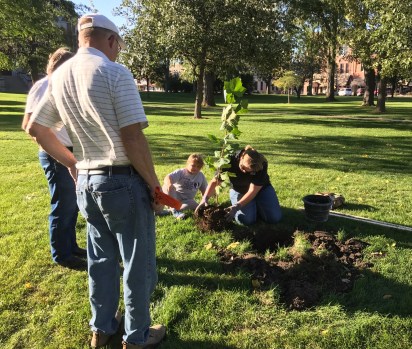
Some of the most common questions we receive in the office on an ongoing basis is related to trees. Whether trees appear to be dying, stressed or have a pest problem, sometimes there is nothing that can be done and in fact many times the issue is environmentally related or beyond treatment. That being said, if you do have to replace a tree or are looking to add a new tree to your landscape be sure to get your tree off to a great start by properly planting the tree. Recently Nicole Stoner, a horticulture educator presented a hands-on workshop teaching how to plant a tree. Many people think, dig a hole, put the tree in and that’s it. While that is essentially the case, the depth and techniques used will impact that tree’s life 5-10 years down the road. Many trees are planted incorrectly so let’s examine the proper techniques.

IMG_0201.jpg

First, select the best type of tree for your situation. Be well informed on the height and spread of the tree and look all around ensuring it won’t interfere with power-lines or crowd nearby plants. Check the adaptability for the tree; is it well-suited for your area? Is it susceptible to pests? One of the fun parts of selecting trees or plants of any kind is the color and shape of it, pick what you like and look for diversity from your own landscape and the landscapes of many of your neighbors.

Then, when preparing the site, be sure the soil is adequate for the plant. If you are planting in an area for the first time and unsure of your soil quality you can submit a sample to a lab for analysis of the pH and nutrient content. Next, is digging the hole. It is not recommended to add any soil amendments to the hole. Soil amendments can make it more difficult for the roots to move through the amended soils and into the natural soils of the area which can cause the roots to circle and eventually girdle and kill the tree. Dig the hole only as deep as the soil ball of the tree. If dug too deep, the roots will suffocate. The hole should be two to three times the diameter of the tree’s root ball. Also, do NOT dig it deeper than needed and backfill it with loose soil; most likely the tree will settle to the bottom over time and then be planted too deep. Instead, place the soil on undistributed soil.

Then, take the tree out of the container and break up the roots if they are started to circle the pot or are girdled. Then, fill the hole with soil, trying to break it up so the hole has relatively loose soil surrounding the side of the tree’s root ball. Gently pat the hole; do not pack or stomp the hole. Depending on the height of the tree, decide if it needs to be staked. If it is leaning over, it obviously will need support until the roots are able to anchor it. Be sure to use a softer material such as tree staking straps; you should never use a wire or something abrasive that could damage or cut into the bark. It is also important to remove the stakes within a year of planting the tree.

Mulch is very important for the tree as well. Be sure to put down an organic source of mulch such as woodchips. Mulch aides in weed control, conserving moisture and can also regulate the temperature of the soil. Mulch should be no deeper than 2 to 3 inches but should be as wide as acceptable to the tree owner. Then be sure to water the tree well at least once a week with a slow trickle for 20 minutes if no rain occurs, but don’t overwater. Consider using a 5-gallon bucket or tub with drilled holes near the bottom as a cost-effective drip irrigation method.

If you have any additional questions you can contact Nicole Stoner at Gage County Extension (402)223-1384 or by email at nstoner2@unl.edu

Horticulture, Programming

Tree Grant

img_0203.jpgNebraska Extension- Fillmore County received a grant for ten free trees through the ReTree Nebraska program. This grant was funded by Trees for Nebraska Towns and the Sustainable Schoolyard Partnership programs by the Nebraska Statewide Arboretum and the Nebraska Environmental Trust and the Nebraska Forest Service’s Community Marketing of Trees grant funded by the U.S. Forest Service. As part of the grant, educational outreach to increase public awareness of the benefits of trees and proper tree care was done with a workshop conducted by Nicole Stoner, horticulture extension educator in which I assisted. Seven trees were planted at the courthouse lawn and three trees were planted at the Extension Office and Fillmore County East Building.