
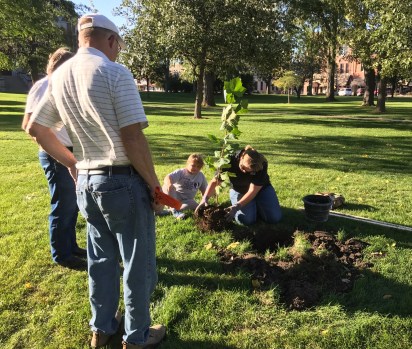
Some of the most common questions we receive in the office on an ongoing basis is related to trees. Whether trees appear to be dying, stressed or have a pest problem, sometimes there is nothing that can be done and in fact many times the issue is environmentally related or beyond treatment. That being said, if you do have to replace a tree or are looking to add a new tree to your landscape be sure to get your tree off to a great start by properly planting the tree. Recently Nicole Stoner, a horticulture educator presented a hands-on workshop teaching how to plant a tree. Many people think, dig a hole, put the tree in and that’s it. While that is essentially the case, the depth and techniques used will impact that tree’s life 5-10 years down the road. Many trees are planted incorrectly so let’s examine the proper techniques.

First, select the best type of tree for your situation. Be well informed on the height and spread of the tree and look all around ensuring it won’t interfere with power-lines or crowd nearby plants. Check the adaptability for the tree; is it well-suited for your area? Is it susceptible to pests? One of the fun parts of selecting trees or plants of any kind is the color and shape of it, pick what you like and look for diversity from your own landscape and the landscapes of many of your neighbors.
Then, when preparing the site, be sure the soil is adequate for the plant. If you are planting in an area for the first time and unsure of your soil quality you can submit a sample to a lab for analysis of the pH and nutrient content. Next, is digging the hole. It is not recommended to add any soil amendments to the hole. Soil amendments can make it more difficult for the roots to move through the amended soils and into the natural soils of the area which can cause the roots to circle and eventually girdle and kill the tree. Dig the hole only as deep as the soil ball of the tree. If dug too deep, the roots will suffocate. The hole should be two to three times the diameter of the tree’s root ball. Also, do NOT dig it deeper than needed and backfill it with loose soil; most likely the tree will settle to the bottom over time and then be planted too deep. Instead, place the soil on undistributed soil.
Then, take the tree out of the container and break up the roots if they are started to circle the pot or are girdled. Then, fill the hole with soil, trying to break it up so the hole has relatively loose soil surrounding the side of the tree’s root ball. Gently pat the hole; do not pack or stomp the hole. Depending on the height of the tree, decide if it needs to be staked. If it is leaning over, it obviously will need support until the roots are able to anchor it. Be sure to use a softer material such as tree staking straps; you should never use a wire or something abrasive that could damage or cut into the bark. It is also important to remove the stakes within a year of planting the tree.
Mulch is very important for the tree as well. Be sure to put down an organic source of mulch such as woodchips. Mulch aides in weed control, conserving moisture and can also regulate the temperature of the soil. Mulch should be no deeper than 2 to 3 inches but should be as wide as acceptable to the tree owner. Then be sure to water the tree well at least once a week with a slow trickle for 20 minutes if no rain occurs, but don’t overwater. Consider using a 5-gallon bucket or tub with drilled holes near the bottom as a cost-effective drip irrigation method.
If you have any additional questions you can contact Nicole Stoner at Gage County Extension (402)223-1384 or by email at nstoner2@unl.edu
 Nebraska Extension- Fillmore County received a grant for ten free trees through the
 provides youth empowers them to become true leaders. In fact, research has shown that young people in 4-H are almost four times as likely to contribute to their communities, and are twice as likely to engage in Science, Technology, Engineering andMath (STEM) programs in their free time.


 An Iowa State Extension publication,




 Extension Educator, Kelly Feehan
