Crops, Irrigation, Programming, Uncategorized

Successful Farmer Series

Now that the growing season is coming to an end, there are many opportunities in the upcoming months to enhance your knowledge and garner new ideas to take back to your operation. Nebraska Extension provides numerous workshops, conferences and trainings all across the state to help you increase your profitability and environmental stewardship.successfulfarmer

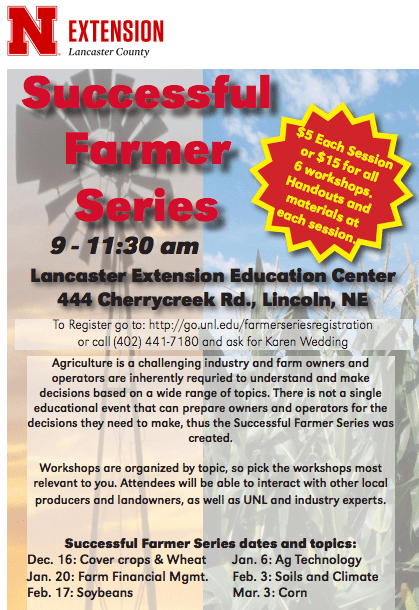
One opportunity available to southeast Nebraska is the Successful Farmer Series. It is unlike many other Extension educational events and that it encompasses a host of agricultural topics in six individual events. Each event covers a different topic and you can choose which topics/events you wish to attend. Each topic will feature two to three speakers from the University of Nebraska-Lincoln. We will also invite other experts surrounding the topic to be in attendance and address more specific questions or interact with attendees during the breaks.

This is the second year of the Successful Farmer Series and the reviews from year one were quite positive. Nearly 90% of the attendees said they are very likely to attend the series in 2016-2017, so spots may fill up fast.

Workshops are every other Friday this winter (except December 30th) from 9:00 am until 11:30 am at the Lancaster Extension Education Center in Lincoln. CEUs are available and Refreshments will be provided.

Here are the dates and topics for this year’s Successful Farmer Series:

  • December 16th – Cover Crops & Wheat
  • January 6th – Ag Management Technology
  • January 20th – Farm Financial Management
  • February 3rd – Soil & Climate Tools
  • February 17th – Soybeans
  • March 3rd – Corn

The cost to attend is $5 for individual workshops or you can sign up for the entire series and pick which events to attend for $15. Pre-registration at least two days in advance is appreciated by contacting Karen Wedding at 402-441-7180 or online. Pay at the door, check or cash.

 (Source: Tyler Williams, Extension Educator in Lancaster County)

Crops, Livestock, Programming, Uncategorized

Agriculture at the Crossroads

The agricultural economic reset is in the mid inning, analogous to a baseball game. What forces will change the current economics? How will interest rate and land value changes influence profitability and your balance sheet? Dr. David Kohl, Professor Emeritus with the Dept. of AAEC, VA TECH will present his challenges & opportunities tool kit to give you some tools to help your business position for success so be sure to attend this information packed, high energy session, sponsored by the Farmers & Ranchers College.kohl-program

This year’s program will focus on how to be a better borrower in these economic times. Dr. Kohl will discuss burn rates on working capital and burn rate on collateral. A special segment will examine what adjustments producers are making to navigate the economic white waters and position the business to evaluate opportunities.

This educational program will be held December 14, 2016 starting at 1:00 p.m. at the Bruning Opera House with registration starting at 12:30 p.m. Due to the generous support of area businesses and organizations, this program is free, but arrive early to save yourself a seat!

To speed up the registration process, online registration is available at fillmore.unl.edu; this will enable you to put your initials by your name, rather than filling in your full name and contact information.  

Horticulture, Uncategorized

Christmas Tree Farms

With the Holiday season approaching, I thought it was appropriate to include some pointers on selecting a real Christmas tree. If you plan to use a live cut tree, buy a fresh tree. The best way to ensure freshness is to buy from a local grower. To locate area Christmas trees growers, refer to the Nebraska Christmas Tree Growers Association at nebraskachristmastreegrowers.com. There are Christmas tree farms in 16 counties so it shouldn’t be difficult to find a tree farm.xmastree

When buying an already cut tree, check the tree closely for freshness. Do not buy a tree with brittle or shedding needles. Tap the base of the trunk on the ground and comb your fingers through branches to look for shedding needles. Bend a few needles in half to check for brittleness. After bringing the tree home, make a clean cut across the base of the trunk to better allow the tree to take up water. Keep the tree in a sturdy stand that holds at least one gallon of water. Check the stand daily as a fresh tree can take up one or more gallons of water each day. Selecting Nebraska grown trees and checking for freshness will help increase safety during the holidays.

Uncategorized, Youth

Leadership Skills Top Ten

Recently I had the opportunity to help recognize 4-H Club Leaders from both Fillmore and Clay counties. With so many organizations, school activities, careers and many other items on parents’ plates, I hope leaders know how much I appreciate their help and commitment to the 4-H program. Without leaders to guide 4-H’ers and lead the meetings, 4-H clubs would not be as successful as they are today.leadership

To describe what a leader is, I’ve made up my own top ten skills that make a good leader.

#10. Flexibility – the ability to go with the flow when needed”

#9. Negotiation – ability to compromise and come up with a “win/win” situation

#8. Creativity – develop solutions and look towards the future

#7. Determination – possess “grit” even when projects don’t go as planned

#6. Mentoring – teaching and helping others

#5. Listening – actively listen to what others might need

#4. Integrity – doing things for the right reason and not self-seeking

#3. Teamwork – ability to bring people together and accomplish a common goal

#2. Compassion – desire to make a positive difference in the lives of others

#1. Communication – articulate ideas clearly to others and in an appropriate manner, most often conflict occurs because others are unaware of a situation

Many of our club leaders possess these skills and I would like to thank them for their years of service. While there is no such think as a perfect leader, whether in a volunteer or career-related position, a leader is able to work as a team, admit when he/she is wrong and work towards the greater good and move an organization forward.

Livestock, Uncategorized, Youth

Being Thankful

Thankful can be defined as feeling gratitude or being glad about something. It is easy to overlook the many things we have to be thankful. For example, when having a somewhat unexpected and unpleasant event occur or being on the receiving end of a disgruntled person, I often have to remind myself of the many things I have to be thankful – a loving family, many friends, house, great career and so many other things. You may have heard the phrase, “one bad apple spoils the bunch.” We have to remind ourselves when in difficult situations or times to be thankful for the many great things in our lives. This column is intended to reflect on the many things we have to be thankful for living in the United States.thanksgiving1

Often times we forget how fortunate we are to have things such freedom. We can pursue the dreams we want, marry who we want, eat what we want and so much more. Give thanks to those who have served our country or are currently serving in the military. We are offered numerous educational experiences as well. Knowledge is power. We are able to attend any school we desire and can continue our education for the rest of our lives. I am blessed to have the opportunity to learn about the amazing work done by my University Of Nebraska colleagues and share that with clientele in the area.

Giving to those in need is another way we can practice gratitude. According to the USDA’s Economic Research Report, “an estimated 12.7 percent of American households were food insecure at least some time during the year in 2015, meaning they lacked access to enough food for an active, healthy life for all household members. That is down from 14.0 percent in 2014. The prevalence of very low food security declined to 5.0 percent from 5.6 percent in 2014. Both declines are statistically significant.”

Let’s talk about the Thanksgiving meal, include some facts about Thanksgiving and examine reasons to be thankful. First of all, according to the USDA, about $670 million is the monetary value of turkeys consumed for Thanksgiving every year which is based on an estimated 46 million turkeys and 92 cent-per-pound. On average, it costs about $50 for a 10-person Thanksgiving meal. Included in the $50 meal is the turkey, bread stuffing, sweet potatoes, rolls with butter, peas, cranberries, a relish tray of carrots and celery, pumpkin pie with whipped cream and beverages of coffee and milk (Source: American Farm Bureau). You can thank our American farmers and ranchers who are able to provide us the bounty of safe and affordable food we are able to consume.

Now let’s talk trivia:


turkey
Image source: allfreeclipart.com

Q: Why are turkeys raised?
A: Because of their excellent quality of meat and eggs


Q: What is a male turkey called?
A: Tom

Q: What is a female turkey called?
A: A Hen

Q: What sound do turkeys make?
A: Only tom turkeys gobble; the female makes a clucking sound.

Q: How many feathers does a turkey have at maturity?
A: 3,500 feathers

Q: How long does it take a turkey to reach market size?
A: Hens usually grow for 16 weeks and is 8-16 lbs. when processed while tom usually takes 19 weeks to reach market weight and weighs 24 lbs. Large toms (24-40 lbs. are a few weeks older.

Regardless of what you do this Thanksgiving, remember to be thankful for what really matters.

Programming, Uncategorized, Youth

Engaging with Consumers

Recently I participated in an Engage workshop taught by the Center for Food Integrity. The overall goal of the workshop is to help those involved in the food production system engage with others of differing opinions, specifically those issues which can be controversial or sensitive in nature. Consumers are asking more questions now than ever regarding their food, including how it is produced.

img_6564
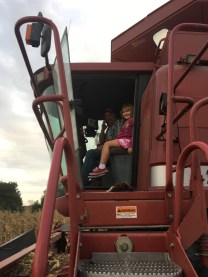
When farmers engage in conversations with consumers or better yet, invite them to their farm, respect for each other is possible.

In order to achieve this, we must first embrace consumers’ concerns and realize their concerns are real. Once we are able to recognize their concern, we should find what shared values we have. By finding a “common ground”, it is easier to establish a connection with that person and have a friendly conversation. Once you are able to see where that person is coming from and you share information about yourself, it is easier to start a conversation. It is important that you are committed to having a conversation and not just educate, defend or correct any misinformation that person might have. Keep your emotions in check; these conversations are important, but they may get uncomfortable.

The Center for Food Integrity provides three steps to have tough conversations. Following Stephen Covey’s, “Seek first to understand, then be understood” is important. The first step is to actively listen to the person, don’t interrupt or judge – rather try and understand where their concerns are coming from and what they value. Then ask questions to invite dialogue and clarify their perspective. In other words, acknowledge their concern; this shows you have heard them. Then ask questions that show you are trying to understand them better. The third step is to share your information. Focus on topics that you both agree on and then have a conversation guided by your values and sharing facts that guide your decisions. While you may both still disagree, recognize that is okay. It is important not to become defensive and admit when you don’t know an answer to their question. If we are to build trust among consumers, we must be transparent.

Other conversation from this workshop when discussing sensitive issues with consumers is to acknowledge that nothing is ever without fault. For example, while the pros might outweigh the cons of a particular food production system, recognize it is not perfect. The training provided an example how to start a conversation with a consumer concerned about animal care and modern farming. It might go like this:

img_5800
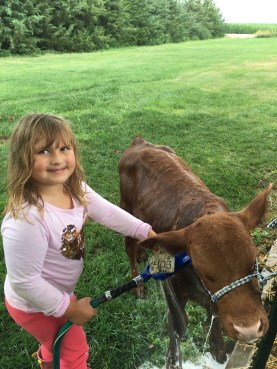
My daughter loved caring for her calf this summer. Her calf, “Cutie” is enjoying a bath on a warm summer day! Sharing pictures and personal stories with consumers helps share our message and the good work we do.

“It is very disturbing to see a video of animal abuse. Animal abuse of any kind is never acceptable and those responsible should be held accountable. I assure you that animal care is a top priority for me and all of the farmers I know. While today’s farms look different than those of the 1950’s, technology allows us to take better care of our animals now than ever before.” This is allowing you to share your values with the person by letting them know you care about animals and an overwhelming majority of farmers do too. You are relating to the individual on a personal basis. Then it is okay to provide information or facts, but follow the KISS principle (Keep It Simple Stupid). Sharing too much technical information may confuse the person even more. In our example you could say, “We house our animals in climate-controlled buildings where they’re protected from the elements and where we can closely monitor their feed, water and health.” If we use the word, “rations” they might not know what we are talking about. Everyone can relate to feed or food.

Other tips for having successful conversations:

  • Enter the conversation with an open mind.
  • Admit when you don’t know.
  • Be yourself and share your story.
  • Know when to disengage.
  • Foster a relationship or offer to connect with them beyond your initial conversation and offer them resources.

In conclusion, today it seems we have gone from a world of being able to compromise and accept differences in opinions to a culture of placing blame on others and seeking to “be right” and ostracize others when they don’t agree with us. That will only cause more divide among us. While it takes time and practice having these delicate conversations, the more we positively engage with consumers the better they will understand agriculture’s story. And to feed our rapidly growing population, it will take all types of production systems – conventional vs. organic farms and genetically modified crops vs. non-genetically modified crops.

Uncategorized, Youth

Rural Poll Finds Nebraskans Value Local Schools

At least three-quarters of rural Nebraskans rate a safe environment for students, high graduation rate, high-quality teachers, teaching problem solving or critical thinking skills to students and preparing students for college as high priorities for their local schools, according to the 2016 Nebraska Rural Poll.

In smaller communities, schools have been argued to provide other benefits to residents. However, providing an economic base and community social events were not highly prioritized by rural Nebraskans or residents of smaller communities.

“While we know that schools provide an important function in communities beyond the classroom, including economic and social activity, the survey results suggest that rural Nebraskans prioritize education first, with relatively low percentages also prioritizing economic and social effects of schools on communities,” said Brad Lubben, assistant professor of agricultural economics at the University of Nebraska¬-Lincoln.

Poll manager Rebecca Vogt said these questions were an effort to measure what rural Nebraskans expect from their local schools and if those expectations are being met.

Some of the highly prioritized items also have the highest satisfaction ratings. At least four in 10 rural Nebraskans surveyed are very satisfied with the safety of the environment for students, graduation rate, quality school buildings, and opportunities for physical activities and sports at their local school.

However, there are some large differences between the characteristics that people expected from their local school and how they describe it. For almost all of the characteristics listed, the proportions that feel each is a high priority are larger than the proportions very satisfied with each. For example, 76 percent of rural Nebraskans rate teaching problem solving or critical thinking skills to students as a high priority, but only 22 percent said they are very satisfied with that characteristic in their local school.

Many of those gaps are greater for residents of the largest cities because people living in or near smaller towns are more likely to express satisfaction with many of the characteristics at their local school. At least half of people living in or near communities with populations under 5,000 are very satisfied with the safe environment for students, compared to 34 percent of people living in or near cities with populations of 10,000 or more. Forty-three percent of people living in or near communities with populations under 1,000 are very satisfied with class sizes, compared to 20 percent of people living in or near cities with populations of 10,000 or more.

As community size increases, satisfaction levels increase when it comes to providing courses for college credit, advanced placement, foreign languages and English as a second language. “Rural Nebraskans value their local schools,” said Jeanne Surface, associate professor for educational leadership at the University of Nebraska at Omaha. “Unfortunately, the challenge of population decline continues to constitute a threat to our rural schools and communities and their ability to prepare students for future success.”

The 21st annual Rural Poll was sent to 6,115 households in 86 Nebraska counties in April. Results are based on 1,746 responses. It is the largest annual poll of rural Nebraskans’ perceptions on quality of life and policy issues. This year’s response rate was 29 percent. The margin of error is plus or minus 2 percent. Complete results are available at http://ruralpoll.unl.edu.

Although the Grand Island area (Hall, Hamilton, Howard and Merrick counties) was designated a metropolitan area by the U.S. Census Bureau in 2013, the Rural Poll continues to include those counties in its sample. Also, Dixon and Dakota counties were added to the poll in 2014.

The university’s Department of Agricultural Economics conducts the poll in cooperation with the Nebraska Rural Futures Institute with funding from Nebraska Extension and the Agricultural Research Division in the Institute of Agriculture and Natural Resources.

Source: Becky Vogt, Survey Research Manager, Department of Agricultural Economics
Contact her at 402-750-1727 or
rvogt2@unl.edu.
Crops, Livestock, Programming, Uncategorized

Farmers & Ranchers College

frcollege-logo-front-panelThe Farmers & Ranchers College was formed in January 2000 with the purpose of providing high quality, dynamic, up to date educational workshops for area agricultural producers in south central Nebraska through a collaborative effort between business, industry and higher education leaders. Furthermore, the Farmers & Ranchers College will provide the tools necessary so that agricultural producers will be able to respond positively to these changes using a profitable decision making process.

The Farmers and Ranchers College is a unique opportunity to educate agricultural producers in south central Nebraska. Approximately four hundred producers participated in the 2015-16 Farmers & Ranchers College programs. Producers attending these workshops managed over 215,000 acres. Participants surveyed indicated an average of $15.00/acre of knowledge gained from participating for a potential impact of $3 million.frcollege15-16impactinfographic

The fifteenth annual Partners in Progress- Beef Seminar featured a variety of industry, University and agricultural organization presenters. Participants managed over 10,000 head of cattle and indicated that on average the information presented will increase their profitability $17.80/head with a total potential impact of over $180,000.

Contributions and support of area businesses allow participants to attend at no cost, however for programs that have meals, it is requested that people RSVP at least a week in advance for an accurate meal count by calling Fillmore County Extension at (402) 759-3712.

The Farmers and Ranchers College Committee consists of Fred Bruning of Bruning, Bryan Dohrman of Grafton, Sarah Miller of Carleton, Jennifer Engle of Fairmont, Ryne Norton of York, Jim Donovan of Geneva, Bryce Kassik of Geneva, Eric Kamler of Geneva, and Brandy VanDeWalle of Ohiowa.

frcollegeregqrcode
Save time at the registration table. Register online!

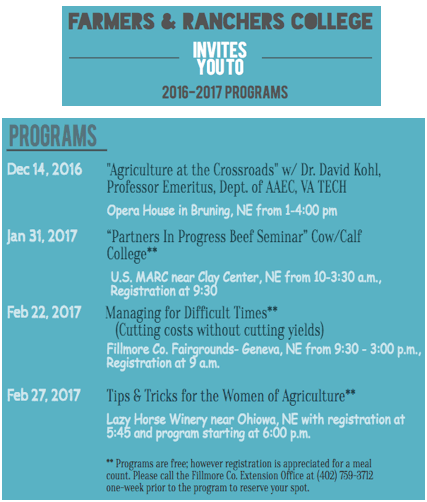
2016-17 Program Schedule:

December 14, 2016 – “Agriculture at the Crossroads” w/ Dr. David Kohl, Professor Emeritus, Dept. of AAEC, VA TECH at the Opera House in Bruning, NE from 1-4:00 pm

January 31, 2017** – “Partners In Progress Beef Seminar” Cow/Calf College at U.S. MARC near Clay Center, NE from 10-3:30 a.m., Registration at 9:30

February 22, 2017** – Managing for Difficult Times (Cutting costs without cutting yields) at Fillmore Co. Fairgrounds- Geneva, NE from 9:30 – 3:00 p.m.,Registration at 9 a.m.

February 27, 2017** – Tips & Tricks for the Women of Agriculture at Lazy Horse Winery near Ohiowa, NE with registration at 5:45 and program starting at 6:00 p.m.

** Programs are free; however registration is appreciated for a meal count. Please call the Fillmore Co. Extension Office at (402) 759-3712 one-week prior to the program to reserve your spot.