
Crops, Uncategorized

Early Season Crop Diseases

Photo courtesy of Aaron Nygren

Diseases in Wheat and Soybeans

            In early May, parts of the county were very dry; even pivots were running to get the crops out of the ground.  With a significant amount of rainfall within the last couple weeks, now brings concern for diseases.  Before treating for diseases though, it is important to scout your fields and confirm if and how much disease is present.

Scout for Soybean Seedling Diseases

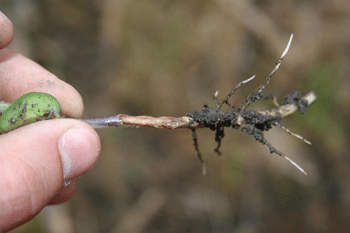
Wet spring conditions have led to the development of soybean seedling diseases in some Nebraska fields. Seedling damping off and seed rot caused by several fungi commonly occur in Nebraska. Early season damping off and root rots are often followed by premature death, which in many instances may be attributed to fungal infections earlier in the season. In some situations, large areas of a field or even entire fields need to be replanted due to early season fungal problems. This may especially be true in a year like this when cool, wet weather early in the growing season creates favorable conditions for infection by certain soil borne pathogens that attack developing soybean plants.Seedling diseases also are active whenever soils are saturated.

Several soybean disease pathogens may cause damping off or root rot seedling diseases. The most common in Nebraska are species of Phytophthora, Pythium, Rhizoctonia, and Fusarium. All four are capable of killing soybean seedlings or at least causing damage sufficient enough to affect the plant’s ability to achieve full yield potential.

These seedling diseases have similar symptoms, often making diagnosis difficult. Microscopic examination and other laboratory analyses of the diseased seedlings often are necessary to identify the cause and differentiate damage from disease, insect injury, herbicide damage, planting problems, or environmental stresses that have similar symptoms. If you think you have some, we can get those samples to our UNL Plant Pathology lab for proper diagnosis.                (Source, CropWatch, May 26, 2011 Issue)

Scab Risk Moderate in South Central Nebraska

The following information was provided by Stephen Wegulo, Extension Plant Pathologist. With wheat flowering occurring or approaching, the National Fusarium Head Blight Risk Assessment Tool has elevated the risk of scab from low to high in an area of southeast Nebraska and to moderate in areas of eastern, south central, southwest, and north central Nebraska. Scab appears in the field as prematurely whitened or bleached heads. Affected heads are partially or entirely bleached and often are seen suddenly scattered over small, large, or entire areas of the field. It is recommended that a fungicide be applied at early flowering to suppress scab in scab-prone areas (southeast, south central, and southwest Nebraska). The fungicides Prosaro and Caramba are good in suppressing scab and very good to excellent in controlling foliar diseases.

Timing of fungicide application for scab suppression is critical. Early flowering is the optimal time. Once bleached heads appear scattered in the field, it is too late to apply a fungicide for scab suppression. For fields where wheat is not flowering yet, if foliar disease pressure is low and the flag and flag -1 leaves are free of disease, delay a fungicide application until early flowering and then apply a fungicide that will both suppress scab and provide protection against foliar diseases.

If foliar disease pressure is high and the flag leaf is at risk of infection, consider applying a fungicide to protect the flag leaf and monitor the risk of scab as heading and flowering approach. In this case a second fungicide application to suppress scab may be warranted in high risk and high yield potential fields, such as irrigated fields, if the risk of scab rises prior to flowering. Refer to a fungicide table  for a list of fungicides and their efficacy against various diseases.
Crops, Uncategorized

Early Season Flooding

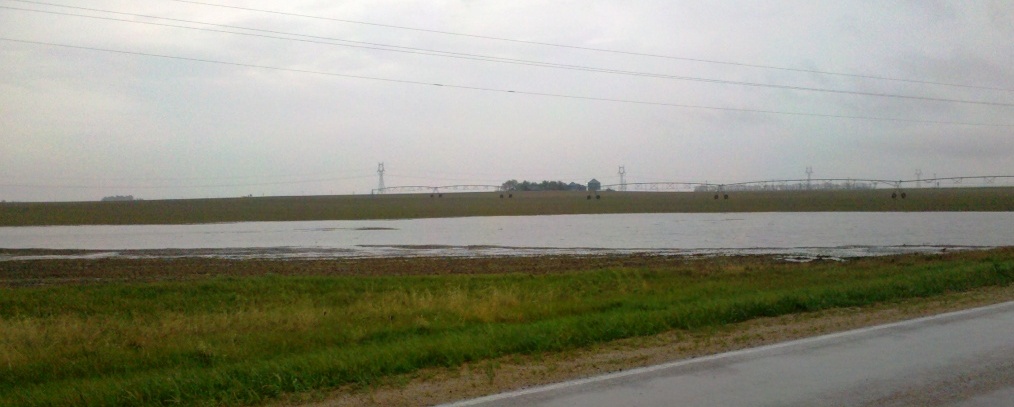
As I write this article, parts of Fillmore County received over 4 inches of rain in less than a 24-hour period, which has brought flooding in some fields. You might wonder how this affects the crop condition so I found an article from Purdue University written May, 2010 that describes what could happen. The longer an area remains ponded, the higher the risk of plant death. The article, Effects of Flooding or Ponding on Young Corn was written by R. L. (Bob) Nielson summarizes the following:

  • Corn that is completely submerged is at higher risk than corn that is partially submerged.
  • Plants that are only partially submerged may continue to photosynthesize, albeit at limited rates.
  • Most agronomists believe that young corn can survive up to about 4 days of outright ponding if temperatures are relatively cool (mid-60’s F or cooler); fewer days if temperatures are warm (mid-70’s F or warmer).
  • Soil oxygen is depleted within about 48 hours of soil saturation. Without oxygen, the plants cannot perform critical life sustaining functions; e.g. nutrient and water uptake is impaired and root growth is inhibited.
  • Even if surface water subsides quickly, the likelihood of dense surface crusts forming as the soil dries increases the risk of emergence failure for recently planted crops.
  • The greater the deposition of mud on plants as the water subsides, the greater the stress on the plants due to reduced photosynthesis.
    • Ironically, such situations would benefit from another rainfall event to wash the mud deposits from the leaves.
  • Corn younger than about V6 (six fully exposed leaf collars) is more susceptible to ponding damage than is corn older than V6.
    • This is partly because young plants are more easily submerged than older taller plants and partly because the corn plant’s growing point remains below ground until about V6. The health of the growing point can be assessed initially by splitting stalks and visually examining the lower portion of the stem (Nielsen, 2008). Within 3 to 5 days after water drains from the ponded area, look for the appearance of fresh leaves from the whorls of the plants.
  • Extended periods of saturated soils AFTER the surface water subsides will take their toll on the overall vigor of the crop.
  • Some root death will occur and new root growth will be stunted until the soil dries to acceptable moisture contents. As a result, plants may be subject to greater injury during a subsequently dry summer due to their restricted root systems.
  • Associated with the direct stress of saturated soils on a corn crop, flooding and ponding can cause significant losses of soil nitrogen due to denitrification and leaching of nitrate N.
  • Significant loss of soil N will cause nitrogen deficiencies and possible additional yield loss.
  • On the other hand, if the corn dies in the ponded areas it probably does not matter how much nitrogen you’ve lost.
  • Lengthy periods of wet soil conditions favor the development of seedling blight diseases, especially those caused by Pythium fungi (Sweets, 2008).
  • Poorly drained areas of fields are most at risk for the development of these diseases and so will also be risky for potential replant operations.
  • Certain diseases, such as common smut and crazy top, may also become greater risks due to flooding and cool temperatures (Malvick, 2002).
  • The fungus that causes crazy top depends on saturated soil conditions to infect corn seedlings.
  • The common smut fungal organism is ubiquitous in soils and can infect young corn plants through tissue damaged by floodwaters. There is limited hybrid resistance to either of these two diseases and predicting damage is difficult until later in the growing season.
Uncategorized

Agricultural Leadership – LEAD Program

As a LEAD 27 participant, our class traveled to China, South Korea & Hong Kong!

 LEAD Application Deadline is June 15

As the number of individuals involved in agriculture continues to decrease—and the challenges continue to increase—the need for highly trained, effective and articulate spokespersons and leaders in the agricultural industry becomes even more critical. If you would like to be a part of the leadership necessary to chart the course . . . now and in the future, and you are presently involved in production agriculture or agribusiness, there will never be a better time to make application to the Nebraska LEAD Program.

Fellowship applications for Nebraska LEAD (Leadership Education/Action Development) Group XXXI (31) are now available for men and women involved in production agriculture or agribusiness and are due on June 15. Up to 30 motivated men and women who are passionate about our industry will be selected from five geographic areas of the state.

In addition to monthly three-day seminars throughout Nebraska from mid-September through early April each year, Nebraska LEAD Fellows also participate in a 10-day National Study/Travel Seminar to Kansas City, Washington, D.C. and Chicago during the first year, and a two week International Study/Travel Seminar during the second year.

Seminar themes include leadership assessment and potential, natural resources and energy, agricultural policy, leadership through communication, our political process, global perspectives, nuclear energy, social issues, understanding and developing leadership skills, agribusiness and marketing, advances in health care, and the resources and people of Nebraska’s Panhandle.

The Nebraska LEAD Program is designed to prepare the spokespersons, problem-solvers and decision makers for Nebraska and its agricultural industry. In its 30th year, the program is operated by the Nebraska Agricultural Leadership Council, a nonprofit organization, in collaboration with the University of Nebraska-Lincoln’s Institute of Agriculture and Natural Resources and in cooperation with Nebraska colleges and universities, business and industry, and individuals throughout the state.

Applications are due no later than June 15 and are available via e-mail from the Nebraska LEAD Program. Application materials can be requested by contacting Shana at sgerdes2@unl.edu, by calling (402) 472-6810, or by writing Room 318 Biochemistry Hall, University of Nebraska-Lincoln, 68583-0763.

As a graduate of LEAD XXVII, I would highly recommend anyone even thinking about applying to visit with me and I’ll share more personal insights on this excellent program. I can attest to the high quality and how its helped improve my leadership skills and confidence and made me more aware of important issues and opportunities to continually improve myself and knowledge.

Irrigation

Prepare for Irrigation Season

As the 2011 growing season is underway, we hope that irrigation is a long ways away, but if you are a part of the Nebraska Agricultural Water Management Network (NAWMN), you will need to get those watermark sensors out and start soaking and drying them to determine if they are reading as they should be. Check that ET gage canvas cover and the ceramic plate to be sure it works. If you are not a part of this excellent program which saves not only water but money you might be wondering what these tools are and what the NAWMN program is all about. The network which started in 2005 with only a few producers has grown to over 500 producers across Nebraska and will gain even more this growing season.

The tools used and mentioned above are the ETgage® or Atmometer which mimics crop evapotranspiration or ET rates and the Watermark soil matrix sensors which measure soil matric potential. This information along with crop stage of growth can help determine when to irrigate. These two tools have worked well and have made irrigation management much easier than gut feelings. The more information you have the better decisions you can make! As soon as the crops grow it will be time to install Watermark sensors to monitor soil water status. It’s important to soak and dry them a couple of times before installing them each year. They should read 5 or less when completely wet.

For more information or installation tips, check out this web site. At this site you can check out the videos and publications. While at the site, also check out the on-line ETgage site. Participants the past few years have reported saving 2 inches of water/acre for both corn and soybeans with little or no effect on yields. Two inches represents a water savings of about 7 million gallons of water for a typical 130 acre center pivot. With today’s fuel prices these energy savings are significant! These tools are not costly and check with the NRDs if cost share funds are still available. I’d be happy to work with you this season and can be contacted at the office at 402-759-3712 or bvandewalle2@unl.edu.