
Livestock

Get The Most From Grazing Corn Stalks

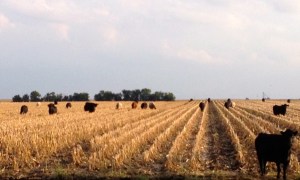
cropped-cropped-cornweb.jpgMy colleague and Extension Specialist, Bruce Anderson recently provided some tips for grazing corn stalks which I’ve decided to share in the first part of my column this week.

One of the most important decisions in all grazing situations is stocking rate, including corn stalks.  Fortunately, you can get a good estimate for corn stalks by dividing the corn grain yield by 3.5 to estimate grazing days per acre for a 1,200-pound cow.UNADJUSTEDNONRAW_thumb_85d1
So, for a field that yielded 210 bushels per acre, dividing 210 by 3.5 gives 60 grazing days per acre.  Thus, a 160-acre field could provide 9,600 cow grazing days.  That means you could graze 9,600 cows for one day or 1 cow for 9,600 days.  Not very practical, so some other combinations need to be explored.

One possibility is to graze 60 cows for 160 days.  Starting here at the end of October, that could take you all the way through March.  Sounds pretty good but how will this work nutritionally?  Cows will eat the best feed first, any downed grain and the husks.  After a couple months, all that will be left are stalks and leaves that have been walked over, rained or snowed upon.  Without a lot of supplements, these cows will be in very poor shape by the end of March.

Clearly, shorter grazing periods are needed.  Maybe, instead of 60 cows for 160 days you graze 160 cows for 60 days.  Better, but you still may need supplements near the end of the 60 days.  Better still would be to give those 160 cows just one week’s worth of the stalks to start, a little over 18 acres.  By day 6 and 7 those 160 cows will have cleaned up just about everything, but on day 8 you give them a fresh 18 acres, returning them to high quality feed without so much supplement.

Both stocking rate and changes in the quality of grazing with time need consideration as you plan and manage stalk grazing.  Do it right and corn stalks become a great winter feed resource.

Source: Bruce Anderson, Extension Professor- University of Nebraska-Lincoln

Livestock

Black Nightshade & Grazing

Recently I received a question from a producer wanting to graze cattle in stalks but was concerned because of black nightshade in the field. I sought advice from UNL Extension forage specialist, Bruce Anderson and recently he wrote the following article.

Black nightshade is common in corn and soybean fields this fall, especially those with hail damage.  It usually isn’t a problem, but if the population gets high it can poison livestock grazing many of the plants.  Almost all livestock, including cattle, sheep, swine, horses, and poultry are susceptible.  All plant parts contain some of the toxin and the concentration increases as plants mature, except in the berries.  Drying as hay or after a freeze will not reduce the toxicity.photo 3

It is very difficult to determine how much black nightshade is risky.  Guidelines say that a 1000-pound animal that eats one to three pounds per day of fresh black nightshade is at risk of being poisoned.  These guidelines, though, are considered conservative since there is little data on the actual toxicity of nightshade plants.  Also encouraging is that reports of nightshade poisoning have been very scarce in the past.

How will you know how much nightshade your animals will eat?  In a corn stalk or bean stubble field, cattle usually don’t appear to seek out nightshade plants to graze.  However, green plants of nightshade might become tempting to a grazing animal, especially if there is little grain, husks, or leaves to select.

So common sense and good observation must be your guide.  If you see animals selectively graze green plants in stalk or stubble fields, pull them out and wait for a hard freeze before trying again.  Check again every couple days since diet selection may change as more desired residue parts are removed. If still unsure, expose only a few animals at a time to risky feed.

Bruce reminds us, that, “Just remember, an ounce of prevention is worth a pound of cure.”

Crops, Livestock

Grazing Corn Stalks

As I drive to work every morning, I go past a field or two being grazed by cattle. Bruce Anderson, UNL Extension Forage Specialist recently wrote an article on grazing corn stalks, which I’ve included in this week’s column.  Grazing corn stalks during winter has many benefits.  It can save over a dollar a day per cow compared to feeding expensive hay.

photo 3

But, the way you manage grazing of stalks by your cattle can have a big effect on its success.  For instance, maybe you have a goal of feeding as little protein supplement as possible while winter grazing.  Then you must make sure you have enough acres of corn stalks so your cattle only need to select just the higher quality plant parts to eat.  And whenever the grain and husks are gone, move to a fresh field.  Or, maybe you use stalks just as a filler to keep cows from bellowing while you limit feed corn, distiller’s grains, or other more nutrient dense feeds.  Then high stocking levels and unrestricted access might be best.

Another strategy might be to stretch winter stalks as far as possible.  In that case, restricting animal access to small areas at a time by strip grazing until nearly all the grazable stalks are gone might be best.  Be careful, though, about forcing cows to eat the lower stalks.  They won’t get much protein or energy from lower stalks but the nitrate levels might be dangerously high.

Whatever your strategy, consider carefully what kind of nutrition animals are getting from the stalk pasture so you neither underfeed nor overfeed expensive supplements.

Also be sure to provide salt, calcium, phosphorus, and vitamin A free choice at all times.  And once all the grain is gone, cows need about half a pound per day of an all-natural protein to meet nutrient needs. Stalk season is here.  Make wise decisions to use them best.

Crops, Livestock

Grazing Corn Stalks in No-till Fields

The drought this year has left many cattle producers in a bind. Hay prices are high and pastures are burnt up which leaves corn stalks as an excellent grazing option. While many producers annually graze cornstalks, this year it will be of even more importance. Cattle are already in stalks and there are lots of corn fields being baled for forage.

A recent UNL CropWatch article by Charles Wortmann, Terry Klopfenstein, and Aaron Stalker showed that in a corn-soybean rotation study conducted from 1996 to 2011, the effects on yields of the following crop were determined for fall-winter grazing (November to February) and spring grazing (February to mid-April, the time of greatest concern of compaction by animal traffic on thawed and wet soil). The field was irrigated and had three treatments (fall/winter grazed, spring grazed, and ungrazed) which have been maintained in the same area since 1996. The stocking rate was with yearlings at 2.5 times the normal level since 2000. On average, yield of the following soybean crop was increased by about 2 bu/ac with fall-winter grazing, and 1.3 bu/ac with spring grazing, compared with no grazing of corn stalks. Yield of corn as the second crop after grazing was not significantly affected. There is ongoing research which will be reported in the 2013 Nebraska Beef Cattle Report which include a dryland trial.

The article concluded that grazing corn stalks is compatible with no-till management in eastern Nebraska and probably is for irrigated fields throughout the state with no loss in average grain yield expected. With wet soil conditions in the spring, consider removing cattle from the field or taking other steps management steps to minimize the effect of compaction.