Horticulture

Bagworms

One common horticultural pest our office receives questions on is bagworms. Bagworms feed on the foliage of a wide variety of trees and shrubs, but are of most concern for evergreens, especially junipers. Bagworms overwinter as eggs in their bags which are attached to tree branches. The eggs hatch in mid-May to early June. As bagworms grow, leaf fragments are added to bags which often grow to 2 inches in length by the end of the summer. The earliest signs of bagworm injury in evergreens are brown or stressed needles at the tips of branches. Heavy infestations  of older bagworms may completely defoliate a tree or shrub and if severe enough can kill the tree or shrub. Less severe injury will slow growth and stunt plants.

To control bagworms on small trees or small infestations, remove the bags by pulling them off the branches and immersing them in soapy water. If you place the bags next to the tree, the larvae might return to the host plants. If you have bagworms in a windbreak or large tree, insecticides are most effective when applied during early bagworm development. For early season damage, insecticides from mid to late June when bags are less than ½ inch in length are effective. By late August, chemical control is no longer effective as the bagworms have ceased feeding and are enclosed within their bags.

Reduced-risk insecticides to use contain Bacillus thuringiensis (Bt) and insecticidal soaps are quite effective on young bagworm larvae but may require repeated applications. Additional insecticide options for bagworms include: acephate, bifenthrin, carbaryl, cyfluthrin, malathion or others. As always, be sure to read and follow all label instructions and use all insecticides with caution to avoid exposure to humans, pets, wildlife and other non-target organisms.

For more information, check out Nebraska Extension’s NebGuide on bagworms which can be accessed online through extension.unl.edu website.

Crops, Programming, Youth

Tractor safety course for teens

The Central States Center for Agricultural Safety and Health at the University of Nebraska Medical Center, College of Public Health and Nebraska Extension have announced new plans for the tractor safety training course that was originally scheduled to be held at 12 sites across Nebraska this spring and summer. The new plans are designed to protect the health of the students and trainers during the COVID-19 pandemic.  Students will take the first day of the course online through the eXtension Foundation Campus website. After successfully completing the online course and testing, the required driving test will be offered at five locations across Nebraska July 27-31, 2020.

green and yellow tractor on dirt
Photo by John Lambeth on Pexels.com

Teens 14 or 15 years of age who work on farms, or others who are interested in learning about safe farming practices, are encouraged to register for the Course. Anyone under age 14 is not eligible to take the class.

Federal law prohibits children under 16 years of age from using certain equipment on a farm unless their parents or legal guardians own the farm. However, certification received through the course grants an exemption to the law allowing 14- and 15-year-olds to drive a tractor and to do field work with certain mechanized equipment.

Susan Harris, University of Nebraska Extension Educator, reports that a common cause of agricultural-related injuries and deaths in Nebraska is overturned tractors and ATVs. She emphasized that this course is designed to train students how to avoid these incidents as well as many other hazards on the farm and ranch.

The online course will cover the required elements of the National Safe Tractor and Machinery Operation Program, including quizzes which students must pass to attend the driving portion of training. Once a student is registered, they will be sent a training manual, course paperwork and a link to the online course.

The onsite driving training and exam will include a driving test and equipment operation and ATV safety lessons. Students must demonstrate competence in hitching and unhitching equipment and driving a tractor and trailer through a standardized course. Instructors will also offer education about safe behaviors and laws for ATVs, utility-task vehicles (UTVs), and other off-road vehicles (ORVs).

In order to protect students and trainers, the number of students on site will be limited to allow proper social distancing. All students and trainers will be required to wear a mask at all times during instruction and driving. Masks will be provided along with instructions for proper use. Equipment, steering wheels, control knobs, hitches, will be disinfected before and after each student completes their testing. Students who have had a fever or persistent cough within 14 days of testing will be required to reschedule their driving test. Additional driving tests may be added in August to accommodate students who are unable to attend the 5 scheduled trainings.

Instructors for the course are members of the Central States Center for Agricultural Safety and Health: Aaron Yoder, Ellen Duysen; UNMC graduate student Alyssa Damke; and Nebraska Extension educators Troy Ingram, Randy Saner, and John Thomas.

Cost of the modified course is $40 and includes educational materials, online learning link, and supplies. More information on the 2020 Tractor Safety Course can be found at kearney.unl.edu.

Driving dates, site locations, and site coordinator contact information is below:

  • July 27 – Akrs Equipment, 49110 US Hwy 20 in O’Neill, contact Debra Walnofer, 402.336.2760, dwalnofer2@unl.edu
  • July 28 – Legacy of the Plains Museum, 2930 Old Oregon Trail #8500 in Gering, contact Stacy Brown, 308.632.1480, sbrown7@unl.edu
  • July 29 – West Central Research & Extension Center, 402 West State Farm Rd., North Platte, contact
  • Randy Saner or Vicki Neidhardt 308.532.2683, saner@unl.edu
  • July 30 – Hall County Extension, 3180 W. Hwy 34, Grand Island, contact Nancy Usasz, 308.754.5422, usasz@unl.edu
  • July 31 – Cass County Fairgrounds, 8420 144th St, Weeping Water, contact Sandy Prall, 402.267.2205, sprall2@unl.edu

For more information or to register, contact the appropriate Extension staff member above.  Visit kearney.unl.edu for a registration form.

Horticulture, Programming

Online Gardening Program

There has been a huge interest in gardening during this time period. For some people, this might be their first time with a garden and for some, we’ve been gardening for years, but are always looking for tips to improve productivity. If you fit into one of those categories, join Nicole Stoner, Gage County Extension Educator, for an online seminar about managing your backyard garden on Tuesday, June 2, 2020, 6:30 PM – 7:30 PM.  To receive the Zoom login, contact Nicole by Friday, May 29, 2020 at nstoner2@unl.edu.

Gardening Online Program Flyer, 2020

Programming, Youth

Nebraska Extension Showcasing 4-H’ers at County Fairs

Nebraska Extension is working to make sure all 4-H’ers across the state have the opportunity to showcase their hard work come county fair time this summer. Since COVID-19 hit, rest assured Nebraska 4-H faculty and staff have been diligently working on numerous plans and options to celebrate our youth and showcase their hard work. Recently, our Dean and Director, Chuck Hibberd released an article which also describes our efforts.4h_mark1

County fair boards and agricultural societies in Nebraska’s 93 counties are determining what their county fairs will look like – or whether to have them at all — as the state responds to COVID-19. Nebraska Extension is working with these groups to design in-person or virtual 4-H experiences or a combination of both appropriate for each county.  Recommendations of both the governor’s office and Nebraska’s district health departments will determine what strategies will work best on a county-by-county basis.

“We are absolutely committed to making sure all youth who take part in 4-H across Nebraska have the opportunity to exhibit their hard work at a fair,” said Chuck Hibberd, dean and director of Nebraska Extension. “We are equally committed to protecting the health and safety of our youth, volunteers, judges and spectators.

Nebraska has one of the highest 4-H participation rates in the nation, with one in three – a total of over 140,000 — youth engaged in the program. Nebraska Extension began adapting 2020 4-H programming to virtual formats back in March, when social distancing and other directed health measures were first put in place. Locally, I’m proud to say that Clay and Fillmore Counties actually reach one in two – youth engaged in the program.

“Fairs may look different than they have in the past with social distancing, different arrangements for livestock shows, and the possible option for virtual shows; we also know that the fair experience is an important part of a 4-H’ers summer,” Hibberd said. “We are excited to be able to make that happen.”

Additional information for county fairs will be available as details are finalized.  Please be patient with our staff and council members as we work through options.

Crops, Horticulture, Irrigation, Livestock

Hail Know: Resources To Remember This Growing Season

Screen Shot 2020-05-22 at 2.14.03 PMWhen hail strikes and growers have questions, Nebraska Extension has new resources to answer them at Hail Know located online at cropwatch.unl.edu/hailknow. Videos, infographics, and articles by a team of Extension experts in climate science, agronomy, engineering, agricultural technology, economics, and disaster education have been developed to build upon and expand Extension’s hail-related programs. Hail Know focuses on six key topics: Hail formation and storms; damage assessment; crop insurance and risk management; replanting considerations; managing a recovering crop; and cover crops.

In the aftermath of a hailstorm visit Hail Know for the answers and certainty, you need to make sound, research-based decisions to manage your crop. Hail Know is also on social media. Follow @HailKnowUNL on Twitter at twitter.com/HailKnowUNL and like Hail Know on Facebook at facebook.com/HailKnowUNL for all the latest information and updates.

Hail Know is a section of CropWatch.unl.edu, Nebraska Extension’s crop production and crop pest management website. The development of Hail Know was funded by a USDA National Institute of Food and Agriculture (NIFA) Smith-Lever Special Needs Grant with matching funds from the University of Nebraska-Lincoln. The column was co-written with Ashley Mueller, Nebraska Extension Disaster Educator. While you cannot prevent hail, you can prepare for and respond quickly when dealing with hail damage to crops. Nebraska Extension is here to help you make informed, timely decisions. Know your crop, know your tech, know your bottom line.

Horticulture, Programming, Youth

Biggest Grower Youth Competition

Nebraska Extension and the Department of Agronomy and Horticulture have launched a new student gardening competition to take place this summer. The Biggest Grower competition offers Nebraska high school students the opportunity to learn how to start their own garden and small growing operation. Students will plant, grow, cultivate, harvest and distribute their own fresh specialty crops in a garden space or in containers. Participants will be placed in virtual teams with one team chosen as The Biggest Grower and each team member will be awarded a $50 Amazon gift card. Additionally, one high school junior or senior will be awarded a College of Agricultural Sciences and Natural Resources Department of Agronomy and Horticulture scholarship of $1,000.

The goal of this competition is to help increase awareness in growing food, improve personal wellness and community involvement, explore opportunities in entrepreneurship and expand the availability of specialty crops in fresh food drought areas.  Stacy Adams, an associate professor of practice in agronomy and horticulture and a Nebraska Extension specialist is in charge of the program.3EC4F63F-DE54-490B-92DE-378D19986434_1_105_c.jpeg

This project can expose Nebraska youth to the fundamentals of plant production and demonstrate career opportunities in agriculture. Funding is provided through the Nebraska Specialty Crop Block Grant Program as a means to enhance the competitiveness of non-commodity specialty crops, such as fruits, vegetables, flowers, nuts and ornamentals.

This competition is beneficial for both rural and urban students; growing specialty crops can expand income potential for farmers as well.

The Biggest Grower competition is free to Nebraska high school students entering the ninth through 12th grade this fall 2020. Nebraska Extension and a university horticulture student, who will be a personal garden mentor, will work with each student virtually on a weekly basis. Participants will be randomly placed into 10, statewide virtual teams of 10 gardeners. These teams will compete over the summer to find out which team is The Biggest Grower.

Students can register at https://agronomy.unl.edu/the-biggest-grower.

Each participant will use an existing garden space at their home or they can choose to grow in pots as a container gardener. Competition garden space as a backyard gardener is limited to 80 square feet, maximum. Participants will complete the activities assigned by the garden mentor and will be given a toolkit consisting of a hand spade, weeding tool, seeds and starter plants.

Participants will be asked to participate and complete the following:

  • 10 weekly activities.
  • develop and cultivate specialty crops in their backyard or container garden.
  • record productivity data in the growers’ leaderboard.
  • record the amount of harvest consumed.
  • record the amount distributed.
  • participate in virtual The Biggest Grower Day hosted by the Department of Agronomy and Horticulture on June 26 from the University of Nebraska–Lincoln East Campus.

High school junior and senior participants, who want to be eligible for the scholarship award, will be asked to write a 350 to 500-word essay on how The Biggest Grower competition affected them and their community, or the use of specialty crops in their future. Students must also enroll in one of four majors within the Department of Agronomy and Horticulture in CASNR at Nebraska.

The competition will begin May 25 and end Aug. 7. After all the data is entered and the essays are reviewed, The Biggest Grower team and the scholarship winner will be announced Sept. 4. Complete application guidelines and more information may be found online.

Source: IANR News & Stacy Adams, Associate Professor Nebraska Extension/ Department of Agronomy and Horticulture

3EC4F63F-DE54-490B-92DE-378D19986434_1_105_c.jpeg

Youth

Cultivate ACCESS Announces New Summer Program

Cultivate ACCESS is an agricultural mentoring program through the University of Nebraska-Lincoln. This program encourages students from rural towns to learn more about agricultural jobs in science, technology, engineering, and math (agSTEM). Participating high school students connect with college students and career professionals through online conversations about agSTEM careers. In this 10-week program students learn how to improve their communication, leadership, and teamwork skills.

Screen Shot 2020-05-08 at 4.29.24 PM.png

Cultivate ACCESS participants include students from all over Nebraska. One participant is a student from McCook, NE interested in working for her family’s business. Another participant lives on the other side of the state in Omaha and aspires to become a zookeeper. These students’ career choices are examples of different careers in agSTEM. One Cultivate ACCESS participant commented on her experiences in the program, “No matter what your background is you can do anything you set your mind to.” If you have an interest in gaining essential employability skills and exploring agSTEM careers this summer, we are currently accepting applications for the 2020 summer session of Cultivate ACCESS starting June 1st and running through August 7th.

Please see our website cultivate.unl.edu to learn more and apply.

Programming, Youth

May Youth Project Workshops

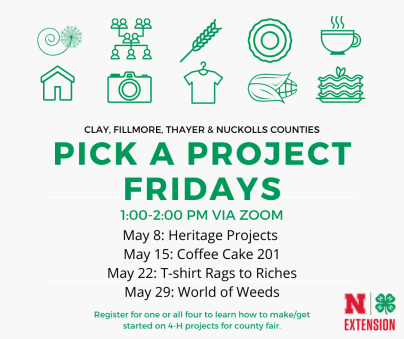
Pick a Project Fridays Square_EDIT.pngClay, Fillmore, Nuckolls, and Thayer counties are hosting a “Pick A Project” Zoom workshop series to encourage local youth to practice their fair project prowess and to learn how to make (or at least get started on) projects for County Fair 2020. We encourage youth ages 8-18 to register for one or all four of the workshops. Even though COVID-19 disruptions have limited in-person programming, we’re excited to inspire 4-H members to practice experiential learning and learn to do new projects.

Register by visiting https://go.unl.edu/4hpickaprojectfridays.

May 8 – Heritage

Join Nuckolls/Thayer 4-H Educator Kylie Kinley as she explores the Heritage project. We’ll peer into the past and brainstorm what historical stories or family heirlooms would make quality projects for fair. Supplies: Pencil and paper, potential heirlooms, family photos, list of family members for family tree drafting.

May 15 – “Coffeecake 201”

Join Clay County 4-H Associate Holli Alley from her kitchen as she bakes coffee cake for the Cooking 201 project. Youth will learn basic baking techniques to perfect yummy coffee cake for the county fair.

May 22 –  “T-shirt Rags to Riches”

Fillmore County 4-H Assistant Rachel Adams will show youth how to use old t-shirts that would normally be used as rags to make a one-of-a-kind rug. Don’t know how to sew? No problem! We’ll use a braiding technique to craft our rugs. This will not be a project we will get done in an hour, but you can work on it in your spare time. Supplies: Old T-shirts cut into 1 ½ inch strips. Around 10 XL shirts or the equivalent would be a good place to start. Avoid too many seams in your strips. You will also need scissors (fabric scissors would work best).

May 29 – World of Weedsplant-148601_1280.png

Join Fillmore County Extension Educator Brandy VanDeWalle & Todd Boller, county weed superintendent, as they explore common weeds and even start you on an exhibit for county fair. Create a Weed Display, which allows original and creative exhibits that contain educational information about weeds, such as interesting information about a weed species, the effects of weed control, herbicide-resistant weeds, what makes a weed, or uses for weeds. Supplies needed: 1-3 weeds to identify, sheet of paper and pencil to brainstorm a poster idea. (Optional: poster board & supplies to get started on a poster.)

Youth

Creating a Routine in Changing Times

By Guest Columnist: Dr. Jill Lingard, Nebraska 4-H Youth Development

With virtual-learning, social distancing, and a long list of cancelled beloved pastimes, life can feel pretty far from what we once knew.  Change is hard.  Yet, amidst a time of uncertainty and change we are searching to find a new normal.  A sense of stability, routine, and familiarity are important for youth.    Parents, care-providers, and youth development professionals can help youth plan their day to reestablish routine. Having a daily routine enables youth to have some control and choice in their life which is important for their well-being.

white blank notebook
Photo by Tirachard Kumtanom on Pexels.com

Consider the following as you develop daily or weekly plans:

  • Engage youth in planning a routine together. Adults and youth may have differing ideas about ways to spend time, start by having a conversation about what expectations you have.  In the beginning of your planning determine what activities that are non-negotiable. Be clear about the expectations that need to be met. If possible, offer some choice for when these “must happen” activities can occur.
  • Find a healthy balance between flexibility and consistency when establishing routine.  Creating plans that are too ambitious or rigid will be difficult for youth and for caring adults in their lives to monitor.
  • Maintain self-care routines. Regularity with hygiene practices, diet, sleep, and exercise will set adults and youth up for success.
  • Stay focused on what youth value. During times of change, it might be tempting for youth to abandon goals that were important to them.  Take this opportunity to talk about why persistence toward goals is important.
  • Create a balanced routine that includes time for unstructured activity and FUN! We all need a healthy amount of free-time, so don’t overschedule the day.  Be aware of the amount of screen time a plan includes.  For free time, consider non-screen activities like playing outside, reading a book for enjoyment, drawing, family game night, cooking, or other hands-on activities.
  • Focus on what youth can control. During periods of change there so many things that can’t be controlled.  Help youth focus on what they CAN do as opposed to what they can’t. This can be an opportunity for youth to explore an interest they haven’t had time for in the past and invest in learning something new.
  • Stay connected. Successful routines should include intentional ways to keep young people connected to the important people in their lives.  Staying connected to those we care about helps manage anxiety and challenges that times of change can create.
  • Practice gratitude. Change can present feelings of loss and it is important to acknowledge and address those feelings.  At the same time, change can be an opportunity to talk about gratitude.  Challenge youth to explore what they are thankful for and look for ways to express that gratitude.

Experiencing change and finding a new normal can be hard. While creating new plans won’t solve all of the challenges associated with change, planning can be a positive way to help young people respond to the uncertainty of the situation by establishing a flexible routine.

More information and resources about youth social-emotional development in difficult times can be found at https://disaster.unl.edu/families or by contacting your local county Nebraska Extension office.