At the end of the July I coordinated the fifth annual Crop Scouting Competition for Nebraska youth in which four teams from across Nebraska competed. It was held in at the Eastern Nebraska Research and Extension Center near Mead, Nebraska on July 26, 2018. Teams of students (those completing 5-12th grades) participated by completing a written knowledge test and seven crop scouting exercises in field plots.
The purpose of the competition was to provide students an opportunity to learn crop scouting and principles of integrated pest management (IPM) for corn and soybeans in Nebraska, to obtain knowledge and skills that will be helpful in future careers and to demonstrate newer crop scouting technologies.
Results from the 2018 competition were as follows:
First place- Colfax County 4-H (Logan Nelson, Brad Kratochvil, Austin Steffensmeier & Korbin Kudera)
Second place – Kornhusker Kids 4-H Club of Cuming County (Payton & Levi Schiller, Matthew & James Rolf and Kaleb Hasenkamp)
Third place – Humphrey FFA Team #2 (Mikayla Martensen, Bryce Classen Jacob Brandl and Wyatt Wegener)
Also participating was Fillmore Central FFA with Carson & Brock Tatro, KayLynn Sieber, Kaylea Geiser and Gunner Gewecke.
Top-scoring teams won prizes: $500 for first, $250 for second, $100 for third place. The top two teams will represent Nebraska at the regional competition held in Nebraska on August 27, 2018.
Teams were expected to know the basics of scouting corn and soybean fields. This included crop staging; looking for patterns of crop injury; disease, insect and weed seedling identification; etc.
More information about the crop scouting competition are available online at cropwatch.unl.edu/youth. Click on the link that says, “Crop Scouting Competition”.
This program was sponsored by DuPont Pioneer, the Nebraska Independent Crop Consultant Association and Farm Credit Services of America in collaboration with Nebraska Extension. If you know of a company or you would are interested in sponsoring the 2019 program, please contact me at brandy.vandewalle@unl.edu.
This week, I have a guest columnist who has been an integral part of the summer 4-H program for the past three years. Alexis Schmidt, has been working at the extension office as a summer aide/intern and been a huge asset to the 4-H county program so I decided to share some of her experiences before she goes to college. Alexis writes:
I have been a part of the Fillmore County 4-H program for 9 years now. As a 4-Her you don’t see what truly happens at the County Fair. I have had the great opportunity to experience both sides. For the last three summers I have worked as a summer aide. I started this job when I was heading into my junior year of high school. That previous February I had to undergo knee surgery. This surgery put my athletic career on hold. What does a high school athlete do when she can’t do what she’s known all of her life? I had many options such as sitting around and moping around about it. This is not the way that I live my life though.
Alexis teaching at Ag Safety Day
I decided that I was going to find a job. I remembered the Extension Office having a summer aide, and I enjoy helping younger kids develop 4-H projects. I decided that I would apply for the position. Now, as a sixteen year old I didn’t have much experience filling out a job application or even a job interview. So right off the bat this job has given me lessons for the future. A couple days later I received a phone call saying that I was hired for the job and that I would be serving as a summer aide/office manager. This office manager part of the position scared me quite a bit. I was a sixteen year old trying to take a key role at the Extension Office.
I finished school and a couple days later I started training for this position. Let me tell you there was a lot of information that was thrown at me, and I was very overwhelmed, but I made it though! I am sure there were mistakes that I made and didn’t hear about especially on the livestock and financial side of things. If you know me you know that my family doesn’t raise livestock. I knew there were shows at the County Fair, but didn’t really pay attention to them because I was a kid who exhibited static exhibits. This threw me for a loop because people were asking me livestock questions and I didn’t know the answers. We made it through the County Fair successfully though. This experience is not forgotten though. I experienced my first fair from the other side. The other side meaning setting up Ag Hall for fair, listening to concerns in the livestock barns, and continuously checking on the Food Stand to make sure things were run smoothly. I would have never thought about the amount of work put into such a week.
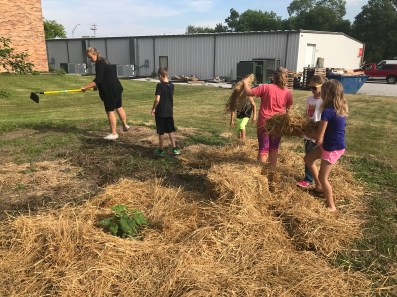
Alexis has been instrumental in maintaining our community garden.
I had the opportunity to come back for a second year. This year was much different as Holly, our office manager, was not on maternity leave. I spent most of the summer seeing the complete other side of the Extension office. For example, I went to my first Excellences in Ag Sciences Day, which is a day where teachers see curriculum that the University is developing. The topic was about horticulture and landscape. I would have never thought about what neat things teachers could incorporate into their lesson plans to help students understand what is going on in the horticulture industry. Then, I was fortunate enough to plan and execute my own workshop for 4-Hers. This experience was tied into my Supervised Agriculture Experience for FFA so I had to tie it into agriculture. How was I going to tie agriculture into a cupcake-decorating workshop? That’s a great question, but I ended up asking kids where the ingredients of cupcakes came from. You would be shocked at some of the responses I received. After the discussion, we spent time making a project that they could take to the fair. There’s that word again, fair! Fair was soon coming and many hours of prep and figuring out how to make it run as smoothly as possible both for static exhibits and livestock exhibits. I was able to experience what it was like to run the livestock shows. It was quite different for this “indoor kid.”
Finally came year three. This year I have had the great opportunity to be in a routine from last year as far as preparing for Excellences in Ag Sciences Day, Ag Safety Day, my own workshops, and fair. I was able to relax a little bit more and have some fun with the year. I have learned a lot about crops and agronomy this year. On a Monday I brought in one of my crops from our farm, and we dissected it to see the different parts of the plant. We were fortunate enough to see the tassel just forming! This experience as well as the many trips to fields for soil samples or the Friday morning ET gage check has helped me develop a great passion for agronomy and what is going on with our crops. Later in the summer, came fair. I can remember showing up to the horse show wondering what we were forgetting because everything was so well organized and run. I had that thought run through my mind many times throughout the week but I never heard anything too major. This year I spent even more time out in the livestock area and I was finally told that I couldn’t classify myself as an “indoor kid” anymore because of the knowledge that I knew about running the shows and the time that I spent out in the barns.
That leads me to where I am now. This job has provided me many great experiences and memories that I will cherish forever. I have met many people in Extension as well as many of the 4-H families that make Fillmore County’s 4-H program so strong. I have developed a great passion of helping 4-Hers and their families learn and grow in the agriculture industry. Working at the Extension Office has also helped me choose a major in Agriculture Education. I am thankful for the amazing staff I get to work with and that they didn’t shun me when I decided to not go to the University of Nebraska.
Alexis will be attending South Dakota State University and serve as a member of the track team throwing discus and shotput. I wish her well and know she will be successful in all of her endeavors!
As we wrap up county fair related work and head back into other extension programming, I always reflect on the county fair experience. This year’s fair went very well, mostly due to the amount of teamwork and collaboration observed. It was a challenge this year with the Fillmore and Clay County fairs falling right on top of each other, but due to the excellent amount of preparation and teamwork that occurred, fairs went very well. First of all, when it comes to putting together a fair, there are many small, behind the scenes tasks that occur. I’d like to give a lot of credit to the entire staff of Fillmore and Clay Counties. Weeks before the fair, data is entered into the computer system, stall assignments are created, awards ordered, reminders sent to exhibitors about completing quality assurance, registration deadlines, etc. All of this preparation allows for a much smoother fair during the actual week of fair.
A highlight of this year’s Fillmore County Fair was a visit from UNL’s Chancellor, Ronnie Green!
Without the collaboration of staff, fair would not occur. Also, there is a lot of time spent from volunteers such as Council members and superintendents. From helping with winter and spring weigh-ins to helping answer questions and attend meetings, volunteers are engaged year-round to make the program the best it can be.
An article adapted from Belgrad, W., Fisher, K., & Rayner, S. (1995) best summarizes that “collaboration and teamwork require a mix of interpersonal, problem-solving, and communication skills needed for a group to work together towards a common goal.” The best teams I have worked with put their own agenda aside and work towards the greater good for the team. This article also provides tips for how to develop a collaborative team environment. There are five themes that must be present.
The first is trust. Being honest with the team helps each other develop respect within a team. Give team members the benefit of the doubt and work to eliminate conflicts of interest. Secondly is to clarify roles. When teach team member knows their key roles, they are able to perform more effectively and can figure out ways to help each other. Next, it is important to communicate openly and effectively. Work to clear up misunderstandings quickly and accurately. Its best to over-communicate, rather than not communicate. Learn to be a good listener and recognize team member efforts. Fourth, is to appreciate diversity of ideas. Be open-minded and evaluate each new idea and remember that it is okay to disagree with one another, but learn how to reach consensus. Often times, much is learned from those who differ from you. Finally, balance the team’s focus. Regularly review and evaluate effectiveness of the team. Assign team members specific tasks to evaluate and provide praise to other team members for achieving results.
I would certainly like to take some time this week to thank the entire Clay and Fillmore county staff for the hours of time spent. Without the entire staff working together, fair would be miserable. Also, I’d like to thank the 4-H Council members who have so freely given of their time during the whole year with various tasks and take time away from their own family to help manage the food stand, help clerk auctions, etc. Of course, livestock superintendents put in a large amount of time during the fair during check-in, the show, round robin, auction, etc. Special thanks to the fair board for their support of the 4-H program and the countless hours they spend setting up for events, etc. Businesses and financial donors help provide youth with incentives for their projects. There are so many other individuals and businesses who are helpful and do things without any recognition and to all of you, thank you!
This was the first year, my oldest McKenzie showed a “big” calf, so it was great being able to watch her and be a “mom”.
This year, I’d also like to thank everyone for allowing me the chance to be a “mom” on beef show day and help McKenzie get her three calves ready. It was valuable time I was able to spend teaching her and being able to create memories. One of the best quotes someone once told me has stuck with me: “It’s better to be a part of the solution, rather than a part of the problem.” I saw a lot of sportsmanship being conducted in a positive manner this year which is refreshing at a time when so many people in our country, find things that are wrong and focus on those. Congratulations Clay and Fillmore County 4-H and FFA programs on a great week!
Source: Belgrad, W., Fisher, K., & Rayner, S. (1995). Tips for Teams: a Ready Reference for Solving Common Team Problems. McGraw-Hill: New York.
It is important for one to stand for what they believe in and takes an active role in one’s community. Effective leadership is crucial to any community or organization. An effective leader understands the issues at-hand, is knowledgeable in his/her area, knows the proper ways to motivate others, embraces change, can work in a variety of settings and with a variety of personalities, and involves the group or followers in important decision-making. That being said, remember that a leader is not only a political figure or someone that is well known, but a leader can be a farmer, local businessmen/women, or anyone in a community or organization. For those individuals desiring to take on leadership roles, consider serving on the FSA County Committee. Details for how to step into this role follow.
Fillmore County USDA Farm Service Agency (FSA) Executive Director Ryne Norton announced that the nomination period for local FSA county committees began on June 15, 2018. Nomination forms must be postmarked or received in the Fillmore County FSA Office by Aug. 1, 2018. Producers play a critical role in the day-to-day operations of FSA, making important decisions on programs dealing with disaster and conservation, emergencies, commodity loan price support, county office employment and other agricultural issues.
“County committees are unique to FSA and allow producers to have a voice on federal farm program implementation at the local level,” said CED Norton. “It is also important that committees are comprised of members who fairly represent the diverse demographics of production agriculture for their community. I encourage all producers, including women, minority and beginning farmers and ranchers, to participate in the nomination and election process.”
Producers can nominate themselves or others. Organizations, including those representing beginning, women and minority producers, may also nominate candidates to better serve their communities. To be eligible to serve on an FSA county committee, producers must participate or cooperate in an FSA program and reside in the area where the election is being held.
This year, nominations and elections for Fillmore County will be held in local administrative area 2, which includes Bennett, Geneva, Grafton, Momence and West Blue Townships. To be considered, a producer must sign an FSA-669A nomination form. The form and other information about FSA county committee elections are available at www.fsa.usda.gov/elections, or from the Fillmore County FSA office. Visit farmers.gov for more information.
Election ballots will be mailed to eligible voters beginning Nov. 5, 2018. Read more to learn about important election dates.
On behalf of the Clay County Extension staff, we’d like to welcome Michael Sindelar to the Extension Family as he is the new cropping and water systems educator based out of Clay Center in Clay County. Here is a little bit about Michael:
“I was born and raised in Lincoln, Nebraska. However, I was exposed to agriculture at a young age as my father would take me to the family farm located near Richland, Nebraska in Colfax county to “help” with the farm work. I joined the Navy in 2005 and served until 2010. I was a cryptologist collective (CTR) and worked in military intelligence. I was stationed out of Hawaii for my enlistment. I had the opportunity to see parts of the pacific and spent one year deployed in Afghanistan where I collected intelligence and conducted combat operations. After having fun for a couple of years I got my act together and earned a bachelor’s degree in Agronomy from the University of Nebraska. This spring I completed my master’s degree in Agronomy with a specialization in soil and water science from the University of Nebraska. I spent most of my master’s degree studying how changes in soil management affect soil water storage, recharge, and heat as storage and transfer through the soil. I look forward to starting my new position on Monday. I sign most of my emails using V/R which is a carryover from the military meaning very respectfully.”
Webster’s Third International Dictionary defines sportsmanship as “conduct becoming to an individual involving fair and honest competition, courteous relations and graceful acceptance of results”. Sportsmanship starts with parents teaching their youth how to accept a win or a loss, although in the 4-H youth development program, even if the youth receives a red ribbon, nothing is lost as long as some basic knowledge and skills were gained. Too often in our society we focus on the tangible results of a ribbon or trophy and don’t think about the process that youth went through to achieve the end results and what was learned from that process.
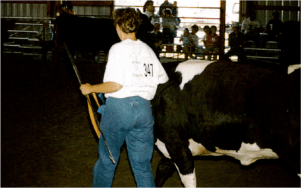
I often use the example that as a youth, I’ll never forget receiving a red ribbon for a market heifer; I was disappointed, but will never forget my dad asking me, what the judge said in the comments. After we talked it over, I realized his reasoning and was able to understand the type of animal I should select the following year. That was a lesson I’ll never forget. My parents instilled the value of hard work into my sister and I and any animal we showed we bought with our own money to build a small cow/calf herd or they came from our own herd. We rarely had the award-winning animal and were extremely excited to even receive a purple ribbon. The learning that occurred, memories and fun we had were just as valuable than if we would have received a trophy or plaque.
I enjoyed showing cattle and while purples were exciting to receive, the ribbon placing didn’t matter; it was the learning experience and fun had with friends!
For these reasons, it is really rewarding to work with youth who are happy with any ribbon placing- white, red, blue or purple. It really is just one person’s opinion on one particular day!
The 4-H Program focuses on providing positive youth development and developing young people as future leaders. A ribbon or plaque placing does not achieve this; rather it is the process, skills and effort that went into the project. It is also important to mention that the entire 4-H program extends beyond the county fair and is done through educational workshops, career portfolios, leadership experiences and much more and is a year-round program.
Three reasons adults and teen leaders should be concerned with developing sportsmanship are:
Youth programs are easier to conduct and are more positive experiences for everyone involved if good sportsmanship is demonstrated.
The development of sportsmanship is an important part of youth development. Youth and adults who develop and show good sportsmanship get along better, and are much more successful on a long-term basis in becoming self-directing, productive, contributing, competent, caring, capable adults, than are those whose behavior is un-sportsmanship-like.
Sportsmanship is one of the key elements of civilized society. Those who think of the “big picture” know the reasons for developing sportsmanship extend beyond an individual, a community, or a program. When societies allow sportsmanship to decline, their civilizations also decline.
As we get ready for another County Fair, let’s be reminded that the end result is not the ribbon placing, but the skills that each youth learned!
Source: Kathryn J. Cox, Ohio Extension 4-H Specialist, Youth Development, Developing Sportsmanship- A Resource For Preparing Youth And Their Families For Participation in Competitive Programs and Events, 2006
One of the things I love about rural communities is the amount of help and support given when people go through difficult times. I can attest to that, on two occasions. For example, when my mom had her stroke in 2011, neighbors, coworkers and friends stepped up to provide support, send cards and helped out when I was needing to make trips to visit her. Also in 2011, 2012 and 2014, I was laid up with ankle surgery and very blessed that many people in the community helped watch my girls, made meals for our family and showed many other acts of kindness. A quote by Ralph Waldo Emerson is one of my favorite, “The purpose of life is not to be happy. It is to be useful, to be honorable, to be compassionate, to have it make some difference that you have lived and lived well.”
You might be wondering why I am writing about this topic of helping others. A part of the 4-H pledge is to “pledge one’s hands to larger service” and “heart to greater loyalty”. These are the values we try to instill in our 4-H youth. It is great to see youth helping each other during 4-H workshops and programs and friendships being made. There is actually research that shows how helping others has benefits for themselves. A professor, Thomas G. Plante from Santa Clara University and adjunct clinical professor of psychiatry at Stanford University has found that his students who attend a spring break trip working with people in poor and marginalized areas managed stress better than those who did not attend trips. He believes the research finding is due to a matter of perspective. Additionally, when helping others, you generally experience more empathy, compassion and solidarity with others as well.
Youth helping each other at a 4-H workshop!
As we approach county fair season, it is important to remind adults, as well as youth of 4-H’s core values of helping others with our hands. It might improve their stress management abilities and make for a smoother fair for all involved. Rather than seeking out problems, remember the 4-H pledge and help others. You’ll likely be happier and create a better experience for everyone around you. So, instead of only worrying about your exhibits or animals or trying to get others in trouble, consider helping a fellow exhibitor and fill one’s bucket with water or calling that person and telling them their animal is running low on water. If an exhibitor is struggling to know where to check-in their static exhibit, offer to help them.
By practicing these small acts of kindness, you might be surprised how much less stressed you and those around you will be. I am certainly appreciative of a 4-H parent who helped my daughter last year by putting her calf in after it somehow got out of its pen. “I pledge my head to clearer thinking, my heart to greater loyalty, my hands to larger service and my health to better living, for my club, my community, my country and my world.” If we practice these principles, we can make a positive difference in the lives of others.
Mosquitoes are a huge irritation in the summer months. Mosquitoes are a type of insect that is in the same order as flies, which means they are closely related to flies and gnats, which all tend to bother us. Mosquitoes are also vectors of many different diseases. Because of these factors, we need to do what we can to eliminate the problem and reduce mosquito populations.
The best way to avoid any pathogens transmitted by mosquitoes is to prevent being bitten. Like any pest management program, IPM is the strategy that works best to prevent mosquito bites at home in the yard. Sanitation is a must to eliminate breeding sites and harborage locations of mosquitoes. Female mosquitoes lay eggs on the surface of standing water and the larvae (“wigglers”) require water to survive before pupation. Removal of stagnant water in a variety of containers such as flowerpots, buckets, gutters, pool covers, used tires, and dog bowls will break the mosquito life cycle. A general rule is to dump any water that has been standing for more than five days.
Culex mosquitoes are active biters in the evening, so it is important to wear long sleeves and pants or permethrin-treated clothing when outdoors between dusk and dawn. The effective insect repellents applied to skin include those with the active ingredients: DEET, picaridin, or the oil of lemon eucalyptus.
As far as chemical control, Mosquito Dunks contain the active ingredient bacterium, Bacillus thurengiensis israelensis (Bti), which is toxic to mosquito larvae when consumed, but non-toxic to humans, pets, pollinators, fish, and other wildlife. They are sold in hardware stores, and will dissolve in standing water such as water troughs, fishponds, rain barrels, and birdbaths. They are effective immediately and can last for a month. (We have mosquito dunks in our Extension office free from Public Health Solutions.)
It is not recommend to use foggers or adulticide treatments by homeowners. These treatments are not effective for more than a couple of days and should only be used a few days ahead of a large outdoor get-together if absolutely necessary.
It is best to utilize IPM to reduce your exposure to mosquitoes because they spread many diseases including West Nile Virus and the Zika virus. Most people who get West Nile Virus have no symptoms or have flu-like symptoms. However, from 2001 to 2009 1,100 deaths in the U.S. were attributed to West Nile Virus. Most of the deaths occurred in people ages 65 and older.
As for the Zika Virus, it has been known about since 1947, but has just recently hit the news as it spreads more. Zika does appear to have minimal impacts on adult humans, but if a pregnant woman becomes infected, her fetus may suffer from developmental abnormalities such as microcephaly. The good news is that the main mosquito that transmits Zika isn’t in Nebraska. The mosquito that most commonly transmits zika to humans is the yellow fever mosquito, Aedes aegypti. We are not on high alert for Zika in Nebraska, but it is still a good idea to protect yourself from mosquito bites to reduce the chance of West Nile and other mosquito vectored diseases.
Information for this article came from Nicole Stoner, Drs. Jody Green and Jonathan Larson, Nebraska Extension Educators.
This year has been difficult for our lawns. Since our cold April, our temperatures skyrocketed and we haven’t had many rain events throughout this spring and early summer. This has been causing our lawns to look a little ragged and brown.
Ascochyta
Many cool season lawns throughout Eastern Nebraska have begun to look brown due to Ascochyta leaf blight, a widespread disease found throughout the early part of summer this year. Mowing during the hot Memorial Day weekend seemed to have worsened the symptoms of this disease.
Symptoms
A close-up of the blades of turf infected by Ascochyta
Ascochyta is a diseased that is stress-induced and often shows up in the early summer when the weather shifts from cold and wet to hot and very dry. Ascochyta is a dieback from the tip of the leaf blades of cool season turf. Red-brown spots can also…

 Fillmore Central FFA with Carson & Brock Tatro, KayLynn Sieber, Kaylea Geiser and Gunner Gewecke.





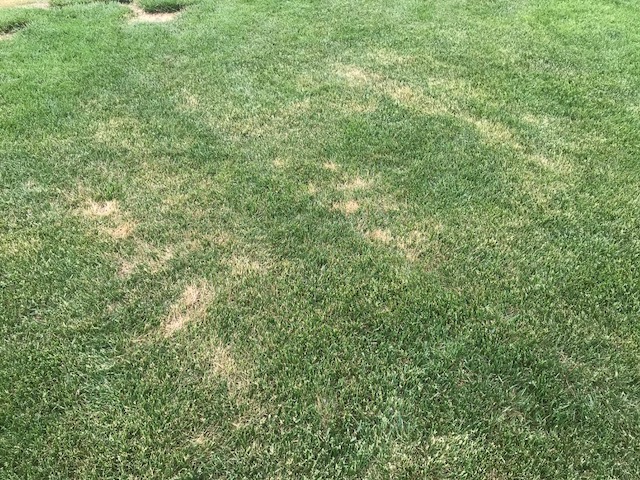 Symptoms from Ascochyta Leaf Blight
 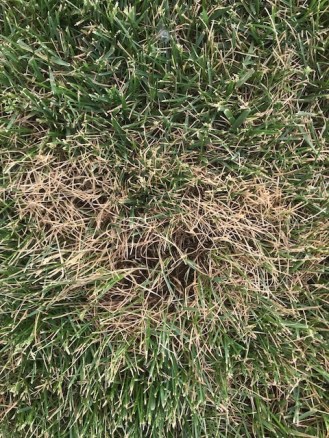 A close-up of the blades of turf infected by Ascochyta
  Views from VanDeWalle