A couple of years ago, I hosted Nicole Stoner, Extension Horticulturist for a program on Emerald Ash Borer and she reminded attendees that it’s not a matter of if it will happen, but when it happens. Guess what? The Nebraska Department of Agriculture announced recently that the emerald ash borer (EAB) has found in sout heast Omaha. This is the first confirmation of the insect in Nebraska. EAB has killed hundreds of millions of ash trees in 26 states. It is projected that Nebraska’s taxpayers and homeowners will spend over $961 million on ash tree removal, disposal and replacement. The following information was take from the Nebraska Forest Service’s press release.
Deputy State Forester John Erixson reminds people that now is a good time for residents in and around Omaha—and municipalities throughout the state—to take proactive steps to deal with EAB as once EAB is found in an area, most ash trees are killed within 10-15 years. Residents with ash trees in the Omaha area may want to begin treatments. “The best candidates for treatments are healthy, high-value trees that are in a good location,” said Mark Harrell, Forest Health Program Leader with the Nebraska Forest Service. “Trees in poor condition or located under wires or too close to sidewalks or buildings generally should be removed rather than treated.”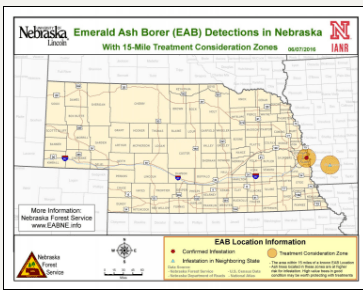
Professionally applied trunk injections are the most effective treatments, especially for large trees. Their main drawback is the damage they cause to the tree and therefore are best applied by certified arborists well-trained in the procedure. The most common products available to the homeowner are soil applications, but they are somewhat less effective than injections and have a greater chance of harming beneficial insects, such as bees.
“Treatments need to be applied every one to two years and must be done for the remaining life of the tree,” said Harrell. “For this reason, many trees will not be worth saving.” Owners of ash trees outside of the Omaha area may be anxious to begin treatments, but the recommendation is still to wait until EAB has been found within 15 miles of your trees. The chances that your tree will be the first one infested is very low, especially if it is being well cared for.
The current treatment consideration zone extends from Fort Calhoun to Plattsmouth and from Gretna to east of Council Bluffs. Municipalities and anyone else managing large numbers of ash trees even if they are outside of the Omaha area should take steps now to prepare for EAB. “Upwards of 80% of the ash trees will die within 8 years after EAB is found in a community if nothing is done to manage the pest,” said Eric Berg, Program Leader for Community Forestry and Sustainable Landscapes. “This can put a strain on city budgets and staff and create liability issues if dead trees are left standing. Nebraska municipalities need to be proactive in dealing with EAB.”
“Municipalities should gain an understanding of the number, locations, sizes and conditions of their ash trees and develop a management plan,” Berg added. “Removing poor quality trees in a community even before EAB is discovered will help spread removal costs over more years.” As trees are removed, they should be replaced with a diverse selection of trees, not just a few species. This will help avoid another significant loss of the urban tree canopy when the next serious pest arrives.
More information about the emerald ash borer, finding an arborist, and recommendations for municipalities can be found at www.eabne.info.
An educational program on Emerald Ash Borer program will be held June 30th at 5:30 p.m. free to the public. This will be held at the Fillmore County Extension Office in Geneva, Nebraska and taught by Extension Horticulturist, Nicole Stoner.



 Growers, crop consultants and educators are encouraged to attend Nebraska Extension’s Weed Management Field Day from 8 a.m. to 1 p.m. June 29 at the South Central Agricultural Laboratory near Clay Center. The field day will include on-site demonstrations of new technology and new herbicides for corn, soybean and sorghum. An early morning tour will focus on weed management in soybeans followed by a tour of weed management in corn and sorghum. Field experiments will provide information for weed control options using several herbicide programs.
 Growers, crop consultants and educators interested in management of herbicide-resistant Palmer amaranth are encouraged to attend Nebraska Extension’s Field Day, supported by the Nebraska Corn Board, from 8:30 a.m. to 1:30 p.m. July 12 near Shickley. Palmer amaranth is a member of the pigweed family and is one of the most troublesome weeds in seed cornfields because of its resistance to atrazine and HPPD inhibitors. Greenhouse dose-response studies have confirmed resistance when atrazine and HPPD inhibitors were applied post-emergence. Palmer amaranth is of particular concern in south-central Nebraska because of its proximity to intense seed corn production, which is heavily reliant on these herbicides for weed.


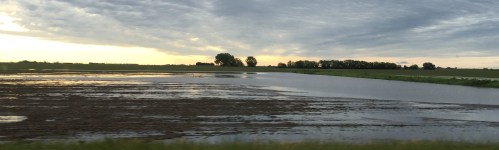 t ponding if temperatures are relatively cool (mid-60’s F or cooler); fewer days if temperatures are warm (mid-70’s F or warmer). Soil oxygen is depleted within about 48 hours of soil saturation. Without oxygen, the plants cannot perform critical life sustaining functions; e.g. nutrient and water uptake is impaired and root growth is inhibited. Even if surface water subsides quickly, the likelihood of dense surface crusts forming as the soil dries increases the risk of emergence failure for recently planted crops.
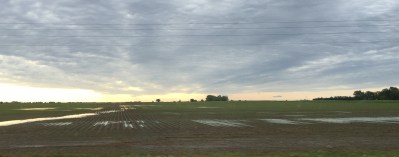 stunted roots and dying roots. As a result, plants may be subject to greater injury during a subsequently dry summer due to their restricted root systems.
 Special thanks to Barbur Floral for donating the vegetable plants and Roddy Salmon for tilling the garden and residents at Pioneer Manor for assisting as well! If you or your organization is interested in contributing or participating in the Fillmore County Community Garden this year, please contact the
