Crops

Cover Crops during Drought

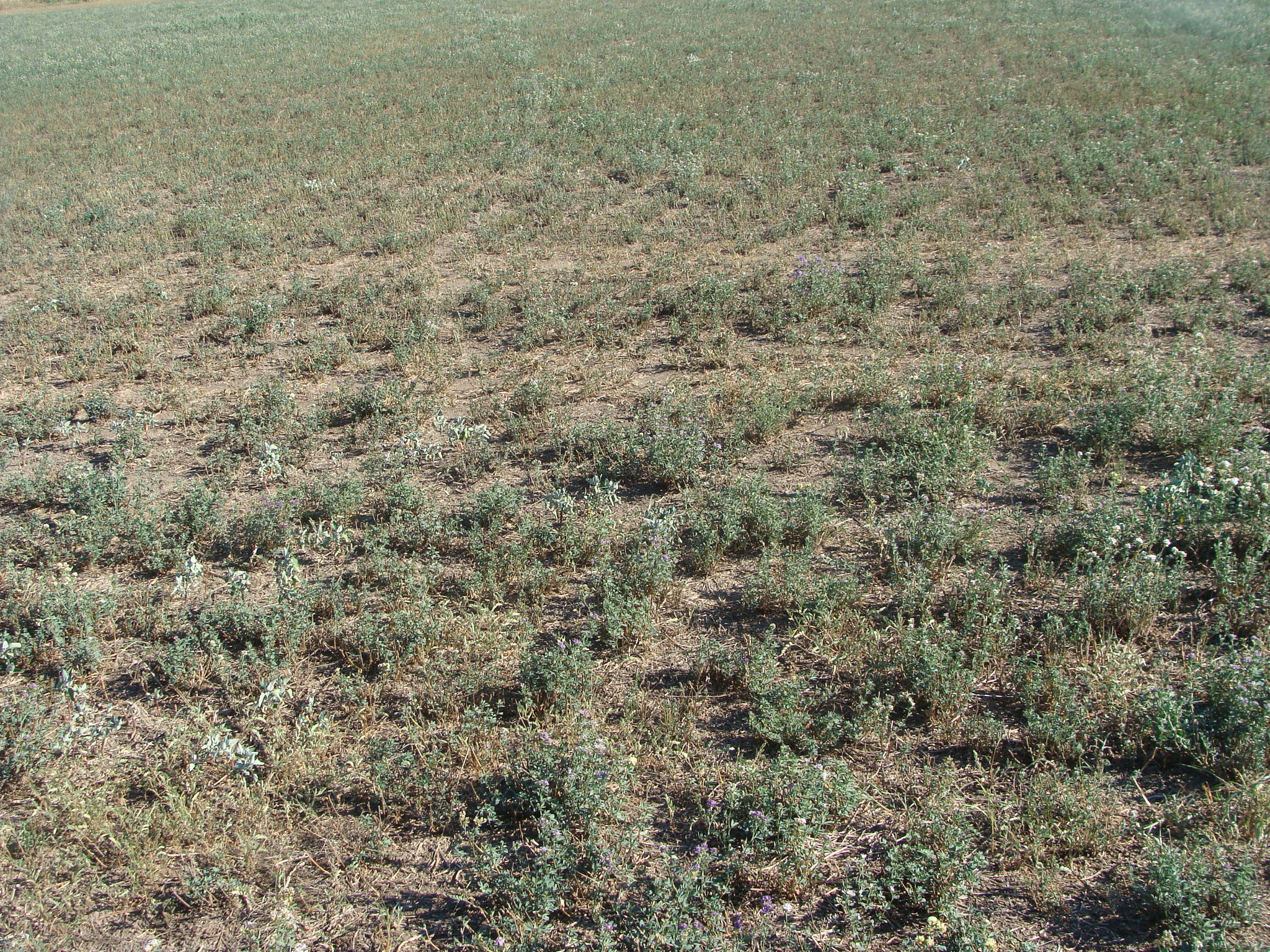
Recently I’ve been asked by several producers about the feasibility of planting cover crops during drought so I researched several different articles. Kris Nichols a soil microbiologist with USDA ARS in North Dakota says that when in a drought, farmers should consider planting a cover crop as they play a vital role in soil and plant health. Nichols said in a Farm Industry News article, “Many times during a drought, plants are not as much water stressed as they are nutrient stressed. The way plants get nutrients from the soil to their roots is through water. In times of drought, plants will sometimes give off their own water supply to create a water fill around the roots so nutrients can travel.”

Will there be enough moisture for the cover crops to germinate? According to Justin Fruechte, cover crop and forage specialist for Millborn Seeds in South Dakota, even in drought stricken areas, cover crops can still grow. Fruechte says that, “Most species have very fine seeds and require little moisture to germinate. When planting into dry soil, be sure to close the furrow tightly and that seed will wait for moisture.”

UNL Extension Educator, Paul Hay pointed out that for those needing grazing, turnips can be seeded in the later part of August until early September. Fall rains will dictate the amount of growth. For those with experience, there is lots of feed long after the tops are gone, as the cattle root out the tubers. Oats can also be a late fall opportunity for haying or grazing. Oats will do better in fall production. Wheat, rye or triticale would be better choices for spring pastures which could be grazed off before killing them and planting summer crops.

Crops

Grazing Alfalfa

A question brought up regards grazing alfalfa fields that are too short to cut. Bruce Anderson, UNL Forage Specialist wrote the following article earlier this year which is another resource for livestock producers. One thing that can’t be emphasized enough is the need to have cows full when turning out and to turn them out early in the afternoon rather than morning as there is less chance of dew and the alfalfa tends to contain more carbohydrates and less bloat-increasing proteins at that time of day.

Anderson went on to say that both drought-stunted alfalfa and well-growing alfalfa might fill the role of a temporary pasture.  To get started, he recommends dividing fields so animals graze no longer than 5 days at a time on any one area.  One rule of thumb is that one ton of standing alfalfa hay will provide about 45 cow days of grazing.  If you estimate your alfalfa would yield one ton of hay if you cut it right now, then one acre should feed 45 cows for one day.  Also if possible, limit the size of paddocks to 10 acres or less to get more uniform grazing.  After grazing a paddock, plan grazing and haying so at least 35 days of regrowth will occur before harvesting the same area again.

To reduce bloat, begin grazing alfalfa after it begins to bloom.  Short, drought-stunted, yet blooming alfalfa should be pretty safe.  Also, be sure animals are full before first turning onto alfalfa and never let animals get hungry.  In addition, begin grazing mid-afternoon and do not turn them onto fresh alfalfa that is moist with dew, rain, or irrigation.  Yearlings tend to bloat less than cows, but feeding supplements like poloxalene, rumensin, and oxytetracycline can help reduce bloat for all classes of cattle.

These precautions and management practices can help you use alfalfa for pasture and overcome the late summer pasture slump.

Crops

Corn Stalk Nitrate Risk

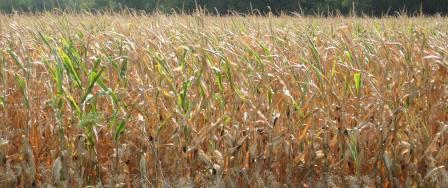
It is crazy to see harvest underway and corn fields being picked in areas already! With the lack of forage for livestock and some dry land crops burnt, I’ve been receiving several questions about nitrates in corn stalks for grazing. Bruce Anderson, UNL Forage Specialist recently wrote an article on the nitrate risk when grazing corn stalks which I’ve inserted below.

Anderson poses the following questions: Will drought-stressed corn stalks have high nitrates?  Probably.  Are they dangerous to graze?  Maybe.  Should you use them?  Don’t know because nitrates are unpredictable.  There are however certain characteristics about nitrates in corn stalks and grazing animals that can be used to develop better answers to these important questions. For starters, testing for nitrates is absolutely essential for making wise decisions and you need to sample the right plant material for testing to get useful information.

What is the right material?  Begin by looking for the most dangerous situations such as patches of dryland corn less than three feet tall which cows will seek out and graze right to the ground.  Sample the whole plant.  If nitrates are dangerously high, consider fencing it out.  For taller, heavier plants where cows are unlikely to eat the bottom stalk unless forced, test the whole plant except for that part of the stalk the cows won’t eat.  Maybe sample plants in areas that received both manure and nitrogen fertilizer.  Bruce also reminds producers to not forget about the weeds. Pigweed, lambsquarter, kochia, nightshade, and other weeds can be toxic.

Finally, Anderson reminds us that nitrates in drinking water can make the situation worse so check your those levels and be extra cautious using protein supplements based on non-protein nitrogen sources like urea. Be extra careful grazing corn stalks this year to keep your animals safe.

Soybean Pest Updates

Several years ago I was called to a Thayer county field where I found soybean stem borer present. Then I sampled several fields in Fillmore County and found them as well. Now is the time to be cognizant of this if you notice dead leaves and lodging. There are no control measures at this time, but monitoring your fields and being aware of fields with large populations will help minimize losses due to lodging by harvesting those fields first.

Two of my colleagues, Loren Giesler and John Wilson have recently pointed out that “this year’s drought conditions may hold one benefit for soybean producers: a better opportunity than most years to scout for the elusive soybean cyst nematode (SCN).” They go on to say that damage due to soybean cyst nematode typically does not show any above ground symptoms, especially with normal conditions for soybean production. In years with stressful conditions, especially drought stress, symptoms will be more evident.

Patches of stunted, yellow, and/or wilted soybeans could indicate the presence of SCN. The nematode population will vary across the field and will be found in dense pockets. You may see patches of soybeans that are more affected with gradients of damage extending out from a center area which corresponds to these pockets of higher soybean cyst nematode. This will look much like a low spot in the field that has a root rot problem.

If you see these symptoms and have not tested for SCN in your fields, consider collecting soil from these sites. The Nebraska Soybean Board funds a free sample program
. Send in your soil sample to receive have it tested and determine the egg density in your field. Sample bags are available at the extension office or by calling (402) 472-2559.

Crops, Irrigation

Crop ET/Final Irrigation Weekly Report

The ETgage reading south of Geneva dropped 1.1 inches for the week of Aug. 3 – 10th. Corn and soybeans in our area is ready to start thinking of the last irrigation. Those producers with watermark sensors should be checking them to see how many inches they have to carry plants through to physiological maturity.  Corn that hasn’t approached full dent and soybeans in the R5 stage has a coefficient of 1.1. To estimate crop water use we multiply 1.1 times 1.1 for a total crop ET of 1.2 inches a week or about 0.17 inches a day.

As the crop begins to reach maturity, the crop water use slows. For example, corn at ¼ milk line requires 3.75 inches until maturity, while corn at ½ milk line only needs 2.25 inches. Soybeans at R5 (beginning seed enlargement) need 6.5 inches while soybeans at R6 (end of seed enlargement) need 3.5 inches.

Generally speaking, a silt loam soil can hold 2.2 inches per foot or 8.8 inches in the top 4 feet. The target is to have 60% available soil moisture depleted at the end of the season.  My colleague from York, Gary Zoubek provided a good example in a recent CropWatch article which relates to most soils in the area. His example uses a silt loam soil. If we draw down the available soil water to 60%, we would have 0.88 inch of water per foot of soil or 3.5 inches remaining in the top four feet of soil. Even though you have 3.5 inches remaining, if you draw the soil water past 60%, it can affect yields; therefore, our target is to have 60% depleted at the end of the season. This will leave room to capture 5.28 inches of water during the off season from rain or snowfall.

For more information on the last irrigation, read Predicting the Last Irrigation of the Season.

Expected Yields

With the drought conditions, I’ve been getting questions on thoughts about yields. Fortunately, several of my colleagues have recently written a great article on UNL CropWatch which uses UNL’s Hybrid-Maize, a model to simulate expected yields based on historical data, etc. Here are the highlights from their article:

  • Projected 2012 end-of-season corn yields are, on average, 30% (dryland) and 8% (irrigated) below the long-term averages.
  • There is very high probability (near 100%) of below-average dryland yields and also a high probability (3 out of 4) of below-average irrigated yields at all locations except dryland corn at Brookings, S.D. and irrigated corn at O’Neill.
  • If dry hot conditions persist for the coming weeks, we expect that projected yields would drop further under both dryland and irrigated condition
Crops

Crop ET Weekly Report

The ETgage reading south of Geneva dropped 2.4 inches for the week of July 15 – July 27th. Corn and soybeans in our area has a coefficient of 1.1 inches so it used 2.64 inches or .38 inches per day!  We received almost .20 inches of rain and unfortunately as I write this, there is no decent chance of precipitation in sight. One interesting fact I came across from The New York Times showed that more than half of the country was under moderate to extreme drought in June, the largest area of the contiguous United States affected by such dryness in nearly 60 years. Nearly 1,300 counties across 29 states have been declared federal disaster areas.

Drought Resources
With drought conditions extending through most of Nebraska, UNL Extension has created a new website with resources for agricultural producers, homeowners and all seeking information for coping with this emerging issue. To access these materials, go to UNL Extension’s Drought Site.

North Central Nebraska Fires

Along with drought comes concern for fires, as witness by the Fairfield Creek Fire in the Niobrara river valley in north central Nebraska. Once of my Extension colleagues, Dennis Bauer shared the following article which depicts some of the many challenges ahead for producers in that area.

North Central Nebraska livestock producers have been hit with a one -two punch, drought and now fire.  The extremely dry conditions, coupled with the fire which has burned tens of thousands of acres of pasture land, and that continues to burn, has turned this into a disaster of major proportions.

The fire has consumed hundreds of miles of permanent fence, along with what little summer grass was left for several thousand cows and calves to feed on.  The fences that have been destroyed will have to be rebuilt before grazing can resume next year, if weather conditions permit a good growing season.

The North Central Development Center in Ainsworth has set up a fund to take monetary donations to help with the cost of the fire.  Donations may be made on line through PayPal.

Donations of wire and post may be delivered to the Farmers and Ranchers Coop in Ainsworth Ne., 224 South Main St.  Contact is Rocky Sheehan, Plant Manager, phone – 402-387-2810.

Individuals who wish to specify their donations to help with fencing materials and hay may send checks to the University of Nebraska Extension office in Ainsworth. The mailing address is BKR Extension office, 148 West 4th Street, Ainsworth, NE. 69210.  Donations will be deposited into the NCDC Fire Relief Fund.

100% of the funds collected will go to help those who have been affected by the fire.  All needs will be taken from the fund, whether it is fencing, hay, feed for animals, personal needs of those impacted by the fire and help for other fire departments that have responded to our distress.

For more information please contact the UNL extension office in Ainsworth 1-800-634-8951 or e-mail dbauer1@unl.edu.  The NCDC can also be contacted at 402-387-2740 for more information.

Youth

County Fair Reflection

As I reflect from last week’s county fair I was reminded about the great volunteers we have that make the 4-H youth development program a success! There are many details and behind the scene tasks that must be completed to make a fair run smoothly and it is incredible how effective teamwork accomplishes them. It takes many people to make a fair work, before the fair and the “clean-up” details after the fair, including members of the Ag Society (Fair Board), 4-H Council, Extension staff, superintendents and other volunteers.  It is always great to see people with diverse backgrounds and talents come together to make the each event a success!  Whenever a task needed to be done or I needed some help, volunteers stepped up to the plate and assisted.

A team or group of people that is able to communicate effectively as a team can achieve better results than individuals working alone. The amount of teamwork witnessed last week proved that “two heads are better than one”!  When all of the 4-H leaders, members, parents, etc. come together and build a sense of commitment, trust and support for one another, it allows them to develop and accomplish the desired results – a fun and educational experience for all involved.  As I stated in my weekly column after my first Fillmore County fair in 2006, “It doesn’t matter what ribbon placing you receive, but the learning experience and enjoyable time you had with your 4-H projects.”

Various committees and groups came together with a well-defined purpose and vision of the 4-H program and carry out their duties and responsibilities. Other characteristics that make teams successful are:

  • Having a positive attitude towards change and are willing to accept and allow necessary change to occur to accomplish desired results
  • Understanding patience that is required to achieve not only the anticipated results for the present, but understanding how decisions will affect the future.
  • Having teams which all members feel a sense of duty and obligation and everyone is able to commit time and resources in accomplishing these tasks.

Finally, it is important that a well functioning team support each other. Team leaders and members that make a conscious, sustained effort to make these characteristics a part of their mind set will find that both creativity and accomplishment of desired results will be much higher than it would be otherwise.

In conclusion, I would like to thank all of the 4-H members, leaders, parents, community members, and anyone else that helped contribute to the success of the 2012 Fillmore County Fair!  It takes a dedicated and hard-working group of people to make things run smoothly.  Again, thanks for the support of the 4-H and FFA programs, and most of all for remembering that “character counts” and those valuable skills (trustworthiness, respect, responsibility, fairness, caring and citizenship) which are learned at an early age will pay off with all of life’s endeavors.

SOURCE: UNL Extension publication: Team Building: Developing a Productive Team written by Arnold Bateman. 

Crops

Corn Disease Update

Last week, I received an email from Tamara Jackson, Extension Plant Pathologies that they’ve received confirmation from a colleague in the Pioneer lab in Iowa and Kevin Korus in our UNL Plant & Pest Diagnostic Clinic, which confirmed southern rust in 2 samples from Fillmore County. Both came from irrigated fields and the incidence and severity were low, but this is certainly something we will need to be on the lookout for.

Since then, southern rust has been confirmed in Adams, Clay, Hall and Thayer Counties as well in south central Nebraska and Burt County in northeast Nebraska. Warm temperatures and high humidity may promote the development and spread of disease.

Tamara indicates that “Southern rust is an aggressive pathogen and can spread and worsen very quickly at optimal temperatures and with humidity and moisture to support infection.  The warm night temperatures and high humidity likely are to blame, as well as the outbreak of the disease in southern states from which our spores probably originated.   In addition, we have had recent development of common rust, which is much less damaging and concerning, but may create some confusion when making diagnoses in the field.  While the color of the spores/pustules can be different, this is really an unreliable and difficult characteristic to use to differentiate the diseases.  Southern rust (tan to orange color) tends to sporulate predominately on the UPPER leaf surface, and common rust (red to brown) sporulates equally well on BOTH leaf surfaces.”

She indicated that the most reliable way to tell them apart is in the laboratory with microscopic examination of the spores, which UNL’s Diagnostic lab is able to do quickly, so she recommend submitting samples to the UNL P&PDC for identification.

Tamra and other colleagues have submitted an article with several other timely cropping updates that are posted on the CropWatch website.   Also check out our NebGuide “Rust Disease of Corn in Nebraska”.

So, now’s the time to be scouting those fields for gray leafspot as well as rust diseases and making decisions based on current recommendations.  Check out the Gray leafspot NebGuide.

Crops, Youth

Shorter than Normal Corn?

Crop ET Weekly Report
The ETgage I outside of Geneva changed 2.0 inches for the week of June 29 – July 6th. Corn in the reproductive stages has a coefficient of 1.1 inches so corn in the area used 2.2 inches or .31 inches per day.

Have you noticed shorter than normal corn?

One thing many have either noticed or heard is how unique this growing season is from most others. From various crop professionals to horticulturists, this year has definitely been different from other years I’ve experienced since in Extension with plants progressed earlier than normal. It has also been a drier than in recent years. With that in mind, I’ve had several questions which were recently addressed on UNL Extension’s CropWatch website which I’m summarizing below.

In many areas of the state we’re seeing shorter than normal corn this year, leading to the question, “Why this year?” To explain this, Keith Glewen, UNL Extension consulted with two top corn physiology experts — Bob Nielsen, extension corn specialist at Purdue University, and Tom Hoegemeyer, professor of practice in the UNL Department of Agronomy and Horticulture. His CropWatch article depicts the following information.

Nielsen and Hoegemeyer explain that a variety of interacting factors can lead to shorter than normal corn. First, let’s look at this corn crop to date. We planted most of the crop much earlier than normal, which led to corn plants developing during a period when in most years, the seed would still be in the bag. After planting, we experienced warm daytime growing conditions and cool, almost cold nighttime temperatures.

The mature corn plant height depends on three factors: amount of solar radiation on the top leaves during growth, water, and temperature. We usually don’t have issues with solar radiation limitations in the western Corn Belt; this year water was more of a factor. Much of the young corn plant’s development was in drier than normal growing conditions. There was adequate moisture for growth but nothing like we have experienced in recent years.

Water availability and temperature impact growth rate. Cell division is affected much less than cell expansion, and slower growth rates lead to slower root development, further limiting water uptake and nutrients. Slower cell expansion leads to shorter internodes and smaller leaves, and this leads to less water uptake and light interception, CO2 uptake, further impacting growth. Because of these changes, we have less internode elongation and thus early planted corn tends to be shorter than later planted corn.

Will conditions leading to shorter corn impact yield? Not necessarily. More important to the final yield of this year’s crop is the heat and moisture stress that the crop is now experiencing as it moves into pollination.  With the high heat we experienced this week, it will be a concern.

Fillmore County Fair

Fillmore County 4-Her’s will be showcasing their projects July 14-19th at the Fillmore County Fair.  As we prepare for this event, it is important to emphasize that 4-H youth are more important than 4-H projects, learning how to do a project is more important than the project itself, competition is a natural human trait and should be recognized as such in 4-H work; it should be given no more emphasis than other 4-H fundamentals. And one of my favorite points is that, “a blue ribbon 4-H’er with a red ribbon entry is more desirable than a red ribbon 4-H’er with a blue ribbon entry.”

Come and support 4-H’ers with fair activities as listed below:

Saturday, July 14 

9 a.m. Horse Show

Sunday, July 15
4:30 p.m. 4-H/FFA Youth Livestock Judging Contest

Monday, July 16

Check out the 4-H/FFA Static Exhibits, Ag Hall

8:00 a.m. Sheep Show, Goats following

3:00 p.m. Rabbit & Poultry Show

Tuesday, July 17

6:30-8:30 a.m. 4-H Breakfast, Ag Hall

8:00 a.m. Swine Show

6:30 p.m. Cake Auction

7:00 p.m. 4-H Awards Night

Wednesday, July 18

Prior to Beef Show Feeder calves, check-in

8:00 a.m. Beef Show

Thursday, July 19

8:00 – 10:30 a.m. Round Robin Showmanship  

Noon 4-H Picnic, Ag Hall

1:30 p.m. Livestock Sale

Crops, Irrigation, Youth

Tree Health & Other Updates

Crop ET Weekly Report

The ETgage I check outside of Geneva changed 1.7 inches for the week of June 16-22nd.   Corn at V-10 would have used 1.23”/week or .18” per day and corn at V-12 used 1.5”/week or .21 inches/day. We were fortunate to receive .80” of rainfall. There have been some producers who use watermark sensors concerned they aren’t working or getting a good enough seal. If that is the case, get another one to place next to the one in question, but remember for most pivot systems in our county, waiting until the sensors average 90-100 for readings is the trigger point.  

 Tree Health

In Nebraska, trees can have a tough time staying healthy. Drought, storm damage, insects and diseases often damage and shorten the life of valuable shade trees. Along with natural stressors, there is man-made damage that can be avoided. Most common is lawn mower and weed trimmer damage to tree trunks. Trees add so much economic and environmental value to our landscapes that care should be taken to prevent trunk damage. It’s easy to do. Just don’t hit trees when mowing the lawn. To prevent this, and improve tree health, remove sod from around a tree trunk and replace it with organic mulch. This will eliminate the need to trim grass around tree trunks. If this is not desirable in a landscape, then hand trim the grass around trees instead of mowing close to the trunk or using a weed trimmer.  Reducing this man-made stress will greatly improve the vigor and life span of valuable trees vigor.

(Source: Kelly Feehan, UNL Extension , 2012)

 Fillmore County 4-H Pre-Fair Events

The Fillmore County Fair is quickly approaching. While county fair is the most visible part of the 4-H program, don’t forget that some 4-H’ers have been hard at work participating in multiple workshops, other contests and practicing community service and leadership projects.

Come and support 4-H’ers with some pre-fair activities  as listed below:
July 10th – Fillmore Co. 4-H Clothing Day, 8:30 a.m. – Ag Hall
July11th – Fillmore Co. 4-H Small Animal Pet Show, 9 a.m. – Ag Hall
July 11th – 4-H Dog Skillathon, following pet show – Ag Hall
July 11th – Horticulture Contest, 1 p.m. – Ag Hall
July 12th – Public Style Review & Talent Show, 7 p.m. – Rialto Theater, Geneva
July 11th – Fair Clean-Up Day, 9 a.m. – Fillmore Co. Fairgrounds
July 14-19th –Fillmore County Fair!

Crops, Programming

Crop Update

Crop ET Weekly Report

The ETgage I check outside of Geneva changed 2.0 inches for the week of June 9-15th. Corn in the V-8 stage has a coefficient of .51”. To calculate how much water, corn at V-8 stage used you simply multiply .51” x 2.0” for a weekly use of 1.02” or .15 inches/day. Corn at V-10 would have used 1.38”/week or .20” per day. We were very fortunate to receive rainfall. The field south of Geneva received 2.3 inches of rain as I write this; at my house we received 3.4 inches.

I did not estimate the crop use for soybeans, since for our area; we typically don’t recommend irrigating them until they reach R3 stage.  Watering too early causes taller beans that use more water but don’t yield more, so it’s important to hold off and apply it when it is need!

 Potential Corn Issues

            Recently in the area there has been the diagnosis of rootless corn syndrome and Goss’s wilt. In short, with the hot, dry and windy weather earlier in the season than normal, some corn was unable to develop its roots as normal and at risk for lodging. Tom Hoegemeyer, Professor of Practice, Department of Agronomy explains this problem along with management strategies on cropwatch.unl.edu.

            The UNL Plant and Pest Diagnostic Clinic has received several samples from south central and eastern Nebraska which tested positive for the leaf blight phase of Goss’s bacterial wilt and blight. This early occurrence could have a severe impact on susceptible hybrids, but one needs to be scouting for it, especially in fields where hail damage has occurred, susceptible hybrids and fields with a history of the disease. Once again, if you think you have it, be sure to bring samples to the office so we can send them to the lab for a positive confirmation. More details can be found on cropwatch.unl.edu.

 Weed Resistance Management Field Day 2012

            Those interested in weed resistance management should attend the 2012 Weed Resistance Management Field Day. This program will be offered in two locations:

  • Big Springs on Wednesday, July 11th
  • David City on Thursday, July 12th

This program will include University and Industry presentations describing herbicide resistance and delivering a unified message about the need for integrated weed management programs to delay the evolution and/or spread of herbicide resistant weeds. Specific topics include glyphosate-resistant kochia at Brule and glyphosate-resistant giant ragweed at David City. The event will be concluded with a talk on how glyphosate-resistant weeds have changed agriculture in the southern US.

There is no cost to attend the Field Day and a complimentary meal will be served for those who have pre-registered. Participants are invited to register by Friday, July 6th so appropriate plans can be made for meals, teaching resources and tour logistics.  This program is sponsored by the Nebraska Soybean Board.