Crops, Programming

Crop Update

Crop ET Weekly Report

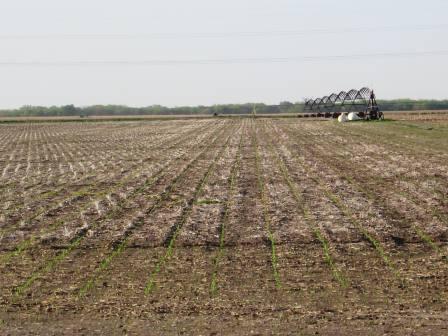
The ETgage I check outside of Geneva changed 2.0 inches for the week of June 9-15th. Corn in the V-8 stage has a coefficient of .51”. To calculate how much water, corn at V-8 stage used you simply multiply .51” x 2.0” for a weekly use of 1.02” or .15 inches/day. Corn at V-10 would have used 1.38”/week or .20” per day. We were very fortunate to receive rainfall. The field south of Geneva received 2.3 inches of rain as I write this; at my house we received 3.4 inches.

I did not estimate the crop use for soybeans, since for our area; we typically don’t recommend irrigating them until they reach R3 stage.  Watering too early causes taller beans that use more water but don’t yield more, so it’s important to hold off and apply it when it is need!

 Potential Corn Issues

            Recently in the area there has been the diagnosis of rootless corn syndrome and Goss’s wilt. In short, with the hot, dry and windy weather earlier in the season than normal, some corn was unable to develop its roots as normal and at risk for lodging. Tom Hoegemeyer, Professor of Practice, Department of Agronomy explains this problem along with management strategies on cropwatch.unl.edu.
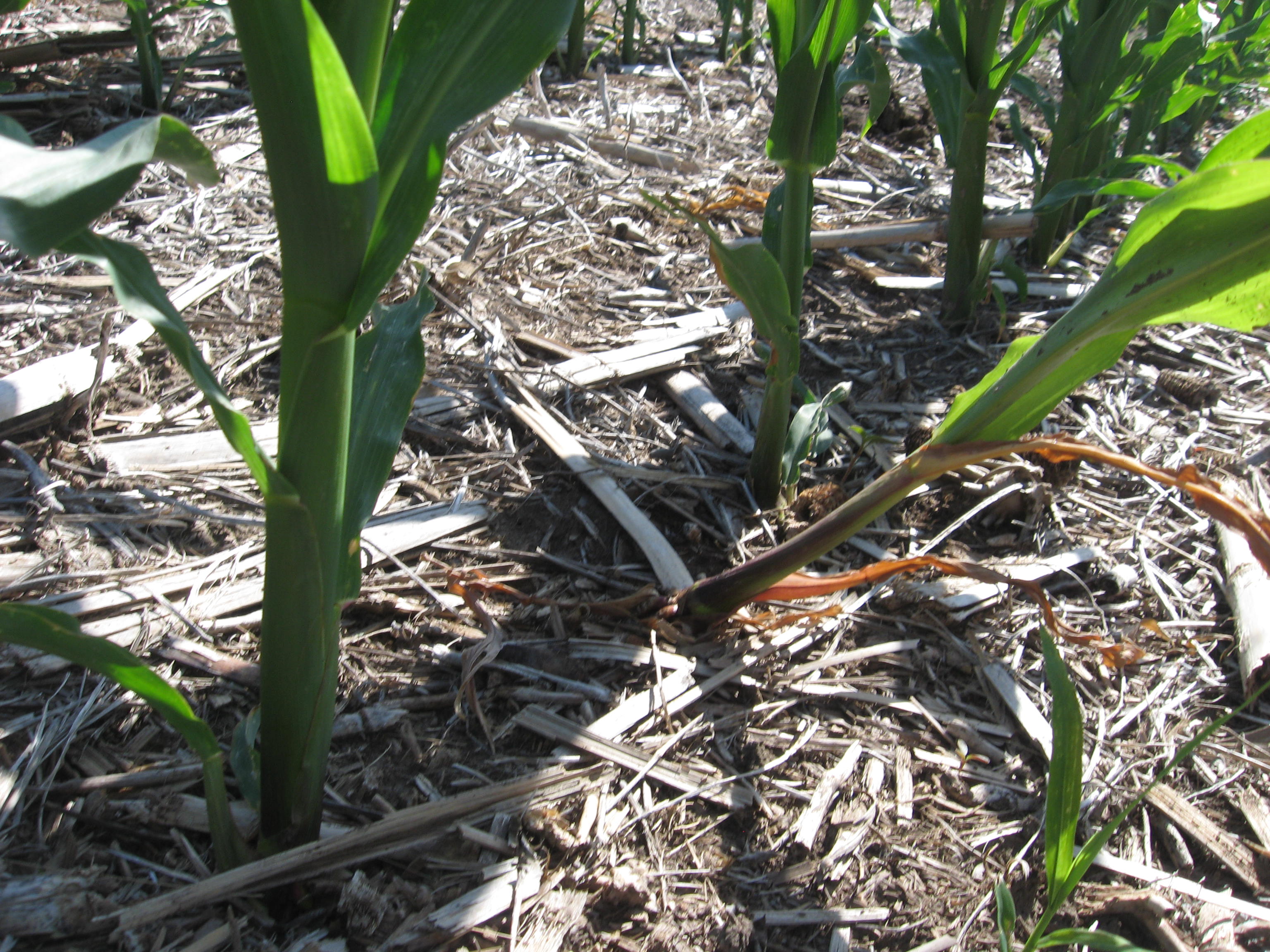
            The UNL Plant and Pest Diagnostic Clinic has received several samples from south central and eastern Nebraska which tested positive for the leaf blight phase of Goss’s bacterial wilt and blight. This early occurrence could have a severe impact on susceptible hybrids, but one needs to be scouting for it, especially in fields where hail damage has occurred, susceptible hybrids and fields with a history of the disease. Once again, if you think you have it, be sure to bring samples to the office so we can send them to the lab for a positive confirmation. More details can be found on cropwatch.unl.edu.

 Weed Resistance Management Field Day 2012

            Those interested in weed resistance management should attend the 2012 Weed Resistance Management Field Day. This program will be offered in two locations:

  • Big Springs on Wednesday, July 11th
  • David City on Thursday, July 12th

This program will include University and Industry presentations describing herbicide resistance and delivering a unified message about the need for integrated weed management programs to delay the evolution and/or spread of herbicide resistant weeds. Specific topics include glyphosate-resistant kochia at Brule and glyphosate-resistant giant ragweed at David City. The event will be concluded with a talk on how glyphosate-resistant weeds have changed agriculture in the southern US.

There is no cost to attend the Field Day and a complimentary meal will be served for those who have pre-registered. Participants are invited to register by Friday, July 6th so appropriate plans can be made for meals, teaching resources and tour logistics.  This program is sponsored by the Nebraska Soybean Board.

Crops, Horticulture, Irrigation

Crop ET Weekly Report

The ETgage I check outside of Geneva changed 2.1 inches for the week of June 1-8th. Corn in the V-6 stage has a coefficient of .36”. To calculate how much water, corn at V-6 stage used you simply multiply .36” x 2.1” for a weekly use of .75” or .11 inches/day. Corn at V-8 would have used 1.07”/week or .15” per day.

I did not estimate the crop use for soybeans, since for our area; we typically don’t recommend irrigating them until they reach R3 stage.  Watering too early causes taller beans that use more water but don’t yield more, so it’s important to hold off and apply it when it is need! For more information about ETgages and Watermark sensors, check out the NAWMN website.  

 Alfalfa Update

I’ve been wondering how alfalfa fields are holding up with the lack of moisture we’ve received and noticing alfalfa blooming already without a lot of growth. Just in time, Bruce Anderson, UNL Forage Specialist sent his news article answering some of my questions with the following information.

If you grow dryland hay you probably are hoping and praying for rain.  Let’s talk about this year’s hay crop and moisture in a moment.  Bruce reports he’s heard a lot lately about folks cutting alfalfa once, sometimes twice and then not getting hardly any regrowth.  What does come back isn’t very vigorous but it starts blooming in just a few weeks.  What’s going on?

Here’s what Bruce believes happened: it’s a combination of temperatures last winter and spring and moisture.  Winter temperatures were mild, to say the least.  So mild, in fact, that he doesn’t think alfalfa ever went fully dormant.  So all winter long its root system slowly depleted the nutrient reserves it had accumulated during fall winterization.  At the same time, unfrozen soil was slowly drying out.

All this didn’t hurt – at first.  Then the super early warm spring started alfalfa to grow rapidly, which left root reserves at lower than usual levels following first cutting.  That’s why some noticed that regrowth wasn’t as vigorous as expected.

Then he adds the final piece of the puzzle.  Dryland alfalfa fields more than about three years old have extracted most of their available subsoil moisture.  With winter drying out the surface soil, high early season water use to support the first growth, and relatively little spring rain, these fields are becoming exhausted for moisture needed to support growth, which also is needed to replenish nutrient reserves in the roots.  As a result, these fields may struggle to produce much more hay all year, even if they receive average summer precipitation. The take home message Bruce offers is that hay production could be short this year.  Get what you can, while you can.

 Horticultural Updates

Kelly Feehan, UNL Extension horticulturalist reported that if a number of small fruit suddenly drop from healthy fruit trees in June, this is most likely a natural thinning or due to poor pollination. Fruit trees sometimes produce more fruit than the tree can mature. Weather conditions may allow production of more fruit than a tree can support. For example, if late spring frosts that often damage flower buds do not occur, the tree may produce an over-abundance; and a number of tiny fruit may drop in June. This is referred to as natural thinning. Poor pollination can result in fruit drop. If a flower is not pollinated or only partially pollinated, fruit may develop to a pea sized or slightly larger and then drop. In either case, healthy fruit trees usually retain enough fruit to mature to a good size crop. Natural thinning also prevents fruit trees from going into alternate year bearing, where one year the tree has a heavy crop and the next year there is little or no fruit.

I’ve also received questions about chrysanthemums responding to our early season and unusual weather by already developing flower buds. If it is preferred that mums bloom later in the season, early blooming can be delayed by cutting mums back now. This will not harm Chrysanthemums and it will result in bushier plants with more flowers later this summer. Not only this year, when mums are setting buds early; but in all years it is recommended to pinch mums by removing the top two to three inches of grow one to three times early in the growing season. Pinching needs to stop by late June, or blooming of mums could be delayed too late into the season and increase the risk of frost damage this fall. Mums are pinched by snipping off the top two to three inches of each stem. Use your fingers or a snipping shears. Try to make the cut right above a leaf to eliminate a brown stub forming

Crops, Irrigation

Updates

Crop ET Weekly Report
Today I helped install an ETgage and Watermark Sensors for a couple producers with the assistance of an Intern who will be assisting me with irrigation tasks and working with area producers. Jordan Wachal started in our office after Memorial Day and will be specifically working with producers to help evaluate irrigation system efficiencies and offer any suggestions for improvement. Jordan comes from Schuyler, Nebraska and is working on his Bachelor of Science in Civil Engineering from the University of Nebraska-Lincoln.
The ETgage I check outside of Geneva changed 1.4 inches for the week of May 26-June 1st. Corn in the V-6 stage has a coefficient of .36”. To calculate how much water, corn at V-6 stage used you simply multiply .36” x 1.4” for a weekly use of .49” or .07 inches/day. Corn at or approaching V-8 would have used .71”/week or .10” per day. Producers with Watermark sensors, which monitor the amount of water available in the soil profile should get them installed soon. Watermark sensors are installed early in the growing season at 1’, 2’, 3’ and in some case 4’ depths! For more information about ETgages and Watermark sensors, check out the NAWMN website.

Forecasting Stalk Borer Growth Stage

Bob Wright, Extension Entomologist provided a short update on UNL’s CropWatch website on stalk borer development. Wright estimated stalk borer development indicates that growers from southwest to northeast Nebraska should be making treatment decisions based on field scouting. He pointed out that, based on research at Iowa State University, stalk borer egg hatch begins at about 575 DD and ends at 750 DD. Scouting should begin when 1,300-1400 DD have accumulated. This corresponds with the beginning of larvae moving out of grassy hosts. Determine the need for treatment when 1,400-1,700 DD have accumulated.

As I write this, Fillmore County accumulated a range of 1800-1900 degree days. For more information on stalk borer life cycle and scouting recommendations, see the May 11, 2012 CropWatch article, Timetable for Common Stalk Borer Scouting Moves Up.

Average Crop Revenue Election (ACRE) Production Certifications

Farms that are enrolled in ACRE must provide their 2011 production certification to FSA by July 15, 2012. A benchmark yield must also be established for farms that elected ACRE in 2011, or if this was the first year a certain commodity was planted since the farm elected ACRE in 2009. Establishment of the benchmark yield requires a certification of historic production for the 2006 thru 2010 crop years. Failure to certify 2011 actual production and applicable 2006-2010 benchmark production by July 15, 2012, will result in ineligibility for all 2012 ACRE payments, including the direct payments.

Crops

Field Flooding & Its Effects

 Last week’s heavy rains in parts of the county reminded me of an article I read last year about the survivable chances for corn that has been flooded in low-lying areas so I’ve summarized and put some excerpts from an article written by R.L. Bob Nielsen from the Purdue University, Agronomy Department. Obviously, plants that are completely submerged are at higher risk than those that are partially submerged and the longer an area remains ponded, the higher the risk of plant death.

Nielsen reported that most agronomists believe that young corn can survive up to about 4 days of outright ponding if temperatures are relatively cool (mid-60’s F or cooler); fewer days if temperatures are warm (mid-70’s F or warmer). As I write this, today’s high is expected to be 83 degrees and tomorrow at 90 degrees, so this isn’t necessarily good news for those corn plants in standing water. Soil oxygen is depleted within about 48 hours of soil saturation. Without oxygen, the plants cannot perform critical life sustaining functions; e.g. nutrient and water uptake is impaired and root growth is inhibited.

Even if surface water subsides quickly, the likelihood of dense surface crusts forming as the soil dries increases the risk of emergence failure for recently planted crops. Young corn (less than at the V6 stage, like our current conditions) is more susceptible to ponding damage than corn beyond the sixth leaf stage. This is because young plants are more easily submerged than older and taller plants and since the corn plant’s growing point remains below ground until about V6. The health of the growing point can be assessed initially by splitting stalks and visually examining the lower portion of the stem. Within 3 to 5 days after water drains from the ponded area, look for the appearance of fresh leaves from the whorls of the plants.

Another consideration is that extended periods of saturated soils AFTER the surface water subsides can also take their toll on the overall vigor of the crop, causing stunted roots and dying roots. As a result, plants may be subject to greater injury during a subsequently dry summer due to their restricted root systems.

Loss of nutrients is another concern on saturated soils. Significant loss of soil N will cause nitrogen deficiencies and possible additional yield loss. Lengthy periods of wet soil conditions also favor the development of seedling blight diseases, especially those caused by Pythium fungi. Poorly drained areas of fields are most at risk for the development of these diseases and will also be risky for potential replant operations. There are other diseases that can affect flooded areas of corn as well, but for now, it’s kind of a wait and see until you can get into the field and assess the health of the growing point.

More information can be found from the Effects of Flooding or Ponding on Young Corn article by R.L. Nielsen.

Crops, Irrigation

Crops Update & NRD Partnerships

As I drive across the area, I’ve noticed that corn is emerged and planting appears to be going well for producers. As I write this a thunderstorm is brewing so hopefully we’ll continue to receive adequate moisture and you won’t have to irrigate much this year, but I’d like you to consider joining a program that can not only improve your irrigation efficiency, reduce nutrient loss and save you money! I’ve been in Extension for nearly six years and a program I’ve been involved with that has been a very rewarding program and made a positive impact for many is the Nebraska Agricultural Water Management Network, or NAWMN.

My colleague, Gary Zoubek tracks the evaluation results and shared that in 2005 only a few producers in the Upper Big Blue NRD, (shortly followed by the Little Blue NRD) were participating, but this program has now grown to over 700 producers across the state and I’m sure we’ll add another 100 or 200 more this season! A couple of the tools we use are ETgages® or Atmometers which mimic crop evapotranspiration or ET and Watermark soil matrix sensors which measure soil matric potential or the energy required to remove water from the soil. These two tools have really worked well and have made irrigation management much easier than those gut feelings. The more information you have the better decisions you can make!

 If you would like to participate in this dynamic program, let me know and I’d be happy to help and get you started! If you are in the NAWMN, consider installing your ETgage soon and once done with planting, start the soaking/drying cycle on your Watermark sensors to be sure they work! It’s also important to replace the #54 alfalfa canvas covers and wafers on a regular basis at the start of each season. For more information, check out our website.

Natural Resource Districts Celebrate 40 years!
Speaking of Extension collaborating with NRDs, did you know that according to NRD staff, 2012 marks the 40th Anniversary of Nebraska’s unique Natural Resources District system. NRDs are local government entities with broad responsibilities to protect our natural resources. Major Nebraska river basins form the boundaries of the 23 NRDs, enabling districts to respond best to local conservation and resource management needs. NRDs rely on locally-elected conservation board members who have the ability, the heart, and the motivation to care for our natural resources.

According to Alyssa Smola, NARD, Nebraska’s natural resources districts protect lives, property and the future of Nebraska’s natural resources through a variety of projects, programs and partnerships. Projects and programs range from flood control structures, cost-share funding, tree plantings, and water quality and quantity management. Many of these would not be possible without strong partnerships with other organizations; partnerships that provide opportunities for land owners and provide protection and conservation of Nebraska’s natural resources.

Crops, Irrigation, Programming

Nebraska On-Farm Research Network

Several area Extension Educators and I have been involved with on-farm research for several years.  I’ve shared many of our Quad County On-farm Research results at meetings, in my columns and on the web.  These results are also posted on the CropWatch Website.

This year we’ve combined efforts across Nebraska and are working to investigate topics in three general areas:

1)  Irrigation – water application management in corn production

2)  Nitrogen management in corn production – both irrigated and dryland

3)  Corn population study in irrigated and dryland

If you’d be interested in any of these topics, give Gary Zoubek a call at: 402-362-5508 or email him at: gzoubek1@unl.edu or contact Keith Glewen, Extension Educator at: 402-624-8030 or email him at:  kglewen1@unl.edu. They are the statewide contacts for this statewide effort.


Crops, Programming

Tough family Conversations

 Conflict; I admit I am not a fan of it, but conflict is not always a bad thing. In fact, “different is not wrong; it’s just different.” If you had the opportunity to attend the last 2011-2012 Farmers & Ranchers College program for the season, you might recognize those words from Elaine Froese. In Discuss the Undiscussabull, she highlighted some important points every farm family should consider.

Froese points out that most parents want to retire with a secure income stream, a happy family who comes home, and not having to deal with conflicts and serve as a referee. So ask yourself, what do you desire for your parents? Do you wish they can enjoy their hard earned income and live life as they desire, or do you desire them to be in the middle of an ugly sibling fight and feel as if they are only wanted for their money or assets? Froese poised the question, “What do you as parents owe your children?” An overwhelming majority of participants, said, “Nothing.” I know personally I hope my parents are able to enjoy retirement and certainly don’t expect any inheritance from them, after all they raised me and as a parent myself can only imagine the grief they had to put up with along the way.

Often times conflict and hard feelings among one another are from miscommunication or not fully understanding each others’ expectations. Sit down with one another, not during a family meal or holiday, but during a family meeting so no one is blindsided and separate family from business. Froese provided ten tools for instigation of the tough issues:

 1. (Parents) TAKE CHARGE. Don’t let your children run all over you, no matter how old or stubborn they might be, it is your decision what you want to do with YOUR money/assets, but make sure you take time to discuss it.

2. Come from curiosity. Don’t assume you know what each side is thinking. Clarify everyone’s expectations.

3. Ask deeply. What are you trying to say to each other? Ask open-ended questions and be soft on the person and hard on the problem.

4. Play with possibility. Be positive and imagine the different scenarios that could transpire. Use a “talking stick” or some visual tool which allows only the person with that object to talk; everyone else should listen. Don’t prejudge each other or the situation.

5. Really listen. Build understanding by ensuring that you truly understand what that person is saying.

6. Ponder and perk, not prod. Its okay to give you time to process what is being said. It’s best to “let silence do the heavy lifting” and leave if you get too upset and might say something you will regret later. Consider the other’s perspective.

7. Cultivate trust. Be accountable for your actions and what you say you will do. Build a family culture of fairness, respect and commitment. Remember that fair is not always equal and equal is not always fair.

8. Respect boundaries. Clear each other’s roles. During family meetings, don’t think of Dad as “Dad” or Mom as “Mom”, think of them as the farm’s manager or president so if you don’t agree with that person’s decision you can at least appreciate they are making a business decision, and you should not take it personally.

9. We all end up in a box. “Why fight over stuff you can’t take with you in a box?” Have you ever seen a funeral procession with a trailer full of things behind it?

10. Extend the olive branch. Pass on authority and learn to “let go”. Stubbornness and pride won’t build families. Create a family legacy of open communication and relationships. Parents should ask their children, “When did you ever get the idea that you are entitled to xxxxx?”

Elaine then explained how there is an emerging group of baby boomers coined as “waiters”. They wait for their parents to die so they can collect their money or possessions often because they haven’t lived within their means, have difficulty holding jobs or other financial difficulties. Instead of taking the necessary steps in financial planning, they plan on their parents to give them a “nest egg” to retire.

Then there is the dynamic of the non-farm siblings coming home to “collect” from mom and dad, often with no understanding of the family farm or finances. The child who put sweat equity into the farm should be given credit for managing the farm through the good times and the bad. Too many families are destroyed by not just taking time to sit down and openly and clearly communicate with each other; using a neutral person as a mediator is better than just giving up. Michael Pantalon in “Instant Influence” asks the following: why might you change, how ready are you to change, think of positive outcomes, and what is the next step?

More information on family farm transitioning from Elaine can be found on her website. No farm is worth the price of losing a family; start those tough conversations now!

Crops, Youth

Youth Discover Crop Science

Are you interested in science, agriculture, plants, crops, insects, or diseases? If so, join our team of detectives to solve crop-related problems in the Crop Science Investigation (CSI) Big Red Camp! Become a detective while participating in hands-on sessions to learn about and increase your knowledge of crops, science, and agricultural careers. Youth detectives will interact with agronomic professionals across Nebraska to solve experiments in: nutrient management; managing disease, insect and weed problems; water management; crop production, and much more! Do you have what it takes to become a CSI detective?

There are a variety of careers related to plant sciences such as: Agricultural Communicator; Agronomist; Crop Consultant; Crop Insurance Adjuster; Educator; Co-op Manager; Farmer or Rancher; Farm Credit Banker; Field or Lab Researcher; Plant Breeder; Soil or Water Conservationist; Seed, Fertilizer, or Chemical Sales; or Technical Representative.

Scholarships are available in the amount of $300 to participants who enroll in the Crop Science focus area and submit the following:

  • A short (< 300 words) essay that highlights past crop or plant science related experience and/or interest in pursuing a degree in agronomy or plant-science related areas.
  • A brief essay (< 100 words) on the topic, “What do I hope to learn in the Crop Science Investigation camp?” application can be found at bigredcamps.unl.edu.

To apply for a scholarship, complete the 2012 Big Red Summer Academic Camp Scholarship Application and submit it along with your completed registration materials and a check for the full registration fee, postmarked by April 1, 2012. Winners will be notified by April 19 and will receive a refund when they arrive at camp this summer. Scholarships are for camp registration fees only and do not cover the cost of transportation or other expenses.

To register or download a camp brochure, visit BIGREDCAMPS.UNL.EDU. If you have questions about the camp or the required essays, please feel free to contact Brandy VanDeWalle at bvandewalle2@unl.edu or 402-759-3712.

Crops

Latest UNL Cash Rental Surveys Published

According to UNL’s Ag Economics Department, the 2012 UNL Nebraska Farm Real Estate Survey confirms what most people close to agriculture already knew – agricultural land values across the state have shot upward in recent months. Preliminary survey results show the state’s all-land average value as of February 1, 2012 to be at $2,410 per acre, 31 percent above the year-earlier level. The annual gain, in both dollar amount and percentage, is the largest ever recorded in the 34-year history of the UNL land market survey series. 

One thing to remember, however is that there is no “one magic” number that works for everyone, as there are so many variables that must be considered. A workshop has been designed to assist landowners, tenants and agri-business professionals with issues related to farmland ownership management, and leasing arrangements.  This workshop is planned for March 21st from 6:30 to 9:00 p.m. at the York County 4-H Building in York.  Please call 402-362-5508 to reserve a spot. This workshop is designed for both landlords and tenants.

Crops, Programming

Leasing Workshop & Protecting Ag Program Offered

Landowner/Tenant Lease Workshop 

Lots of questions regarding leases and land values come into the office during this time of year. This is no “one magic” number that works for everyone, as there are so many variables that must be considered. A workshop has been designed to assist landowners, tenants and agri-business professionals with issues related to farmland ownership management, and leasing arrangements.  This workshop is planned for Wednesday evening March 21st from 6:30 to 9:00 p.m. at the York County 4-H Building on the Fairgrounds in York.   

Topics include:  Trend is farmland values and cash lease values, good lease communications, writing a good lease, and flexible cash leases. 

The Nebraska Soybean Board is sponsoring the workshop, so there is no cost to attend and receive the handouts, but please call 402-362-5508 or email Gary Zoubek at gzoubek1@unl.edu to reserve a spot and ensure adequate handouts will be prepared. This workshop is designed for both landlords and tenants.

 Protecting Nebraska Agriculture Topic of Sutton Chamber of Commerce

The Sutton Chamber of Commerce and Ag Committee will be conducting a meeting on Monday – March 12, 2012 at the Sutton Community Center at 200 South Saunders Ave, in Sutton, NE. The evening will start at 6:00 pm with a social time and evening meal. The meal will be the precursor to the informative seminar program which is entitled: “Protecting Nebraska Agriculture”. The meeting is sponsored by the Sutton Chamber of Commerce and Ag Committee as well as area Cattlemen Associations, Breeders & Feeders, and Ag Producer groups. Anyone who is interested is cordially invited to attend.  Pre-registration is requested in order to get a meal count. There may be a minimal cost to attend the symposium.

The purpose of this seminar is to inform and educate farmers, ranchers and the public about groups who are at work spreading misinformation; influencing consumers and our youth; and attacking conventional agriculture and it producers, even our 4-H & FFA exhibitors — and in particular, the animal agriculture industry. Several states have had legislation forced on them, creating regulations that have adversely affected animal agriculture, all compliments of extreme animal rights and other activist groups. Think it can’t happen in Nebraska?  Think again, they are already at work in this state! How can this affect you? What can you do? Find out what is happening and what we can, and need to do to Protect Nebraska’s Agriculture!

The guest speaker will be Duane (Dewey) Lienemann, from Blue Hill, NE who is an active member of the South Central Cattlemen Association, and is speaking as a beef producer and on behalf of the SC Cattlemen group. Sutton Chamber of Commerce & Ag Committee; Area Cattlemen Associations, Breeders & Feeders, and Ag Producer groups encourages anyone interested in the preservation of Nebraska agriculture to attend this conference. You will learn the facts about the issues facing animal agriculture in Nebraska, and the detrimental effects that efforts of animal rights and other activist groups could have on consumers, society, youth, our local and state economy, and even our choice of foods and the prices we pay for them. It doesn’t just affect our farmers and ranchers it affects our whole state – including you as a consumer.

Pre-registration is requested for a meal count. To register or for more information please contact: Tory Duncan at 402-773-5576 or email ccntory@gmail.com or Todd Mau at 402-773-5224 or email todd@toddstrailers.com