Crops, Programming

“Discussing the Undiscussabull”

In working with so many family farm transitioning programs, the financial planning, wills and other legal matters are always discussed, but not much is said regarding how to take the first step by starting those tough conversations about family farm succession. The final 2011-2012 Farmers & Ranchers College program is addressing just that issue by bringing in a professional certified coach with an agricultural background, Elaine Froese from Manitoba, Canada.  Froese’s expertise in helping families get unstuck is sought after across the country. She has worked with families in business for over 20 years and is now coaching the next generation. Elaine is a professional certified coach from the Hudson Institute of Santa Barbara. She holds a Conflict Resolution Certificate from Mediation Services, mediating for the Farm Debt Mediation Service. Her degree as a professional home economist is from the University of Manitoba.

She listens and coaches in the sacred space of family business meetings, and she inspires new scenarios for people of all ages. Elaine believes that change is an opportunity, not a threat…she has practical tools to help people discuss the “undiscussabull” to make their dreams come true. She has authored the award winning book Planting the Seed of Hope: a celebration of prairie life.   Elaine farms in southwestern Manitoba, and enjoys hikes, camping, watercolors, and watching the prairie sky. Like you, Elaine understands agriculture, and she wants a happy family.

This dynamic program, “Discuss the Undiscussabull” will be held on March 15, 2012 at the San Carlos Community Room (next to the Pour House) in Friend, NE. Registration starts at 5:30 p.m. with the meal starting at 6:00 with the program to follow. Programs such as those would cost well over $100 to cover costs, however with the generous success of the Farmers & Ranchers College sponsors, this program is free. In order to save your spot and reserve a meal, registration is needed by calling the Fillmore County Extension office at (402) 759-3712 or emailing bvandewalle2@unl.edu.

The Farmers & Ranchers College is sponsored by area agribusiness, commodity groups in collaboration with the University of Nebraska-Lincoln Extension.


Crops, Programming, Youth

Innovative Youth Corn Challenge

Projects are real life experiences that help 4-Hers learn to make sound decisions. Projects put the hands and mind to work. There are lots of opportunities for clubs to participate in community service projects and activities and it is important for clubs to participate in activities together as it builds teamwork and helps youth learn how to effectively accomplish a goal. A crops project that is also a contest is being piloted this year to provide youth the opportunity to think outside the box in producing an economical, but high yielding corn crop.  

The University of Nebraska-Lincoln Extension and the Nebraska Corn Board have teamed up to offer the first Innovative Youth Corn Challenge contest. This team-oriented contest, open to 4-H members (age 10 & older as of Jan. 1st) or FFA members (in-school members), will guide youth through all aspects of corn production, as well as the agricultural careers related to corn production.  Youth will be challenged to implement a production practice different than normal to determine if they increased their yield. Economics and sustainability of the practice will also be considered. Yields, cropping history, and production information will be collected in the Corn Yield Challenge management summary. 

Goals of the contest are:achieve new, innovative, and economically feasible crop production methods to improve yields; provide research data for producers to implement in their operations; distribute data to corn producers, researchers, and agri-businesses for decision making purposes; introduce youth to a variety of agronomic professionals, including corn producers. 

Youth will work with an adult mentor throughout the process. Mentors can be 4-H leaders, extension faculty, ag teachers, or other qualified agronomy professionals.

Cash prizes and plaques will be given to the first, second, and third place teams. First place will receive $1,000, second place will receive $500, and third place will receive $250.  A data completion and innovation award will also be given.

To participate, youth must complete and return an entry form by March 1st to the Fillmore County Extension Office in Geneva, NE. For more information, contact Brandy VanDeWalle at bvandewalle2@unl.edu or 402.759.3712.

Crops, Programming

From Farms to Families Program

A program designed to empower women in agriculture through education.


Today’s agriculture is constantly changing, making it important for producers and their families to stay knowledgeable of current issues. Risk management is more important now than ever for agricultural producers, so to address some of the issues producers face, a program was developed by UNL Extension.  From Farms to Families is a program designed to empower women in agriculture with a better understanding of the issues that affect their operation’s profitability.

 This exciting program for women will be held on February 2nd and 16th from 6:00 to 8:30 p.m. at the Opera House in Bruning, NE. During the first session, participants will learn how to develop their green thumb, become a more informed citizen about animal welfare policies and learn a quick and easy healthy meal that can be prepared in a crock-pot.  The second session focuses on canning and food preservation, learning about some basic animal health issues and learning another healthy meal option that can be prepared quickly and conveniently.  

Cost of the program is $25 for one session or $45 for both sessions. The price includes all materials and a light meal.  Deadline to register for the February 2nd session is January 26th and February 9th for the February 16th session.

To register, call UNL Extension offices in the following counties: Fillmore 759-3712, Nuckolls 225-2381 or Thayer 768-7212.

 Pesticide Safety Education Programs

Those needing to renew their Private Pesticide Applicators License or to be licensed for the first time may do so by attending a PSEP training session.  I will be holding sessions in Fillmore County:

February 8th, 2:00 p.m., Ag Hall – Fillmore County Fairgrounds, Geneva
February 9th, 2:00 p.m., Courthouse Clubroom – Thayer County Courthouse, Hebron
February 9th, 6:00 p.m., Courthouse Clubroom – Thayer County Courthouse, Hebron
February 21st, 6:00 p.m., Ag Hall – Fillmore County Fairgrounds, Geneva

The sessions last approximately 3 hours.  In addition to the core requirements concerning pesticide safety, I will present agronomy information that is pertinent to the area, on-farm research results and other UNL research updates.  The UNL Extension program fee is $30.00 for this session.  A complete list of locations across Nebraska accessed at this website . If you are unable to attend in Fillmore County, you may attend a session in a different county or by home study, which costs $60.00.

Crops, Irrigation, Programming

Farmers Overcoming Challenges to Increase Profit

 This week, I’m highlighting an article from Daryl Andersen from the Little Blue NRD promoting an upcoming event. Producers deal with challenges every day from weather concerns, plant conditions and fertilizer applications and costs. Today’s technology and current knowledge can help in easing these concerns. Representatives from UNL or the NRD are always available to assist producers in utilizing the technology and gaining the knowledge to increase the producer’s bottom line.

On January 4, 2012 the Little Blue NRD will be hosting a Soil and Water Conference in Davenport, NE. at the Community Building from 10 am to 3 pm. This is the second year of this type of conference in which producers can learn new ideas from presenters and also get a chance to talk to local exhibitor’s booths set up for the day. This conference is designed for everyone from rural to urban residents and attendance is strongly encouraged, as topics could affect everyone’s way of life.

A presenter from the EPA will talk about fertilizer applications on lawns and cropland and why this is becoming a national issue. Knowledge of these topics is necessary as what we do here does have a major effect on the river systems and groundwater. Learning how to cope with these topics will help in improving best management practices, gain knowledge on how weather patterns are affecting your farming practices and what you can do to protect yourself.

Other topics include predicting your corn yield with UNL Hybrid-Maize and interpreting the soil sample. Producers are always wondering what their corn yield will be and with this computer program this can be done during the season. Ever wondered how the fertilizer recommendations are formulated or what micro-nutrients should I be soil sampling for? Presenters will be explaining what is needed and what could be unnecessary tests.

Come see the map on a recently completed water study conducted by JEO for the Little Blue NRD. The LBNRD Board has changed the rules on well permitting utilizing these maps and a risk analysis point system is being used on each well permit. Staff will show how the point system works and you can even get your property analyzed.

The NRD and UNL-Extension have been working with cooperators within the area to improve irrigation management. Producers have been using crop ET (evaporation-transpiration) information, soil moisture sensors and data loggers to assist in making timely irrigation decisions. Information and cost-share sheets will be available at this conference.

Everyone is invited and a free lunch will be served. If you plan on attending, it is requested that you RSVP to the NRD office at 402-364-2145 or email dandersen@littlebluenrd.org by December 27, 2011 for a meal count. If you are interested in exhibiting your products at this conference, you can get more information by contacting the Little Blue NRD.

Crops, Programming

Crop Production Clinics

Pesticide resistance, crop production updates, and what’s new in pest management will be among the topics presented at this year’s Crop Production Clinics. The clinics, which will be held at nine sites across the state in January, also include provisions for pesticide applicator recertification.

Other topics being presented by Extension specialists and educators include:soil fertility

  • soil water and irrigation management,
  • ag business management & policy
  • pesticide safety
  • and disease, insect and weed pest management.

Representatives from the Nebraska Department of Agriculture will be present to verify attendance for pesticide applicator recertification. For commercial and noncommercial pesticide applicator, this will be the primary venue for you to renew your license in any of the following categories: Ag Plant (01), Regulatory (REG),  and Demonstration/Research (D/R).  For private pesticide applicators the Crop Production Clinics will serve as a venue for you to renew your license.

Certified Crop Advisors may earn CEUs in the following categories:

  • Integrated Pest Management (6 CEUs)
  • Soil and Water (2 CEUs),
  • Nutrient Management (1 CEU), and
  • Crop Production (3 CEUs).

Attendees can earn a maximum of 6 CEUs at a location. Certified Crop Advisors are required to bring their CCA number to apply for CEU credits.

For further information on pesticide applicator recertification costs, visit the Crop Production Clinic website.

            The annual Crop Production Clinics will be held at nine locations across Nebraska in January 2012. The Clinics will provide valuable information to help crop producers and agribusiness professionals improve their profitability and safety.  Closest locations to us include:

            Jan. 4th – Beatrice – Classic’s (Beatrice Country Club)
            Jan. 5th – York – The Auditorium
            Jan. 10th – Hastings – Adams County Fairgrounds

Crops

Aids to Selecting Soybean Varieties to Manage SCN

Soybean cyst nematodes
Courtesy of ISU Extension

An earlier CropWatch article by Loren Giesler and John Wilson, UNL Extension faculty focused on soybean cyst nematodes which I want to highlight this week:

Soybean producers and farm managers have several great resources available to help with variety selection for fields infested with soybean cyst nematode (SCN). In 2010, the Nebraska Soybean Board funded a project to provide a standard evaluation platform for the most common soybean varieties grown in Nebraska in SCN infested fields. The goal of this project is to help producers identify soybean varieties that yield well, yet do not allow significant reproduction of SCN. That’s right — even though soybean varieties are marketed as resistant; they can vary in their effects on SCN populations by influencing reproduction differently. The 2010 results from this Nebraska program are available and the 2011 data will be available by the end of the year.

If you’re not sure whether you have SCN and your soybean yields were lower than expected, please take advantage of the free soil testing service that is being funded through the Nebraska Soybean Board. Soil bags for this program can be picked up at your local UNL extension office. SCN continues to be the most yield robbing disease of soybean in Nebraska, costing producers an average of 5-6 bu/ac when susceptible soybeans are grown on infested fields.

Now is the time of year that UNL Extension’s Horticultural update reminds us of the following winter questions I often receive.

Mulching and cutting back roses– Pruning is not needed during fall for shrub and hybrid tea roses unless some pruning is needed for a rose to fit beneath a winter protection method, such as a rose cone. Wait until April and then prune to remove winter killed wood. Do not add winter protection to roses until the soil begins to freeze or night temperatures are consistently dropping into the 20s at night. A good mulching method is the encircle the rose with a chicken wire cage staked to hold it in place, then fill the cage with coarse leaves.

Pruning deciduous trees and shrubs is best done once plants are dormant. Use sharp, clean pruners. Make well-placed cuts being sure to leave the branch collar and branch bark ridge on trees. Avoid leaving branch stubs and do not make pruning cuts flush with tree trunks or large branches. Do not treat pruning wounds with a wound dressing or pruning paint. When pruning shrubs, use a combination of heading back cuts and thinning cuts that remove entire stems near the ground or back to another stem. Most multi-stemmed shrubs can also be pruned by cutting the entire plant near the ground. This severe of pruning is typically done with overgrown shrubs.

Crops

Returning to the Farm

 Bringing a young person into a farm/ranch operation presents challenges. However, the business operation can accomplish numerous goals by helping the young person get a solid start in the operation, keeping the farm/ranch in the family, and ensuring a comfortable retirement for all involved. However, success does not come automatically; it requires effort. Blending a variety of talents and personalities into one farming or ranching operation takes planning, communication, and management.

The Returning to the Farm program is designed to assist families and operations in developing a financial plan and successful working arrangements that will meet the needs of multiple families. During the program participants will:

  • Review financial feasibility, balance sheets and trend sheets
  • Identify estate planning issues
  • Develop a farm/ranch transition plan
  • Set both personal and professional goals
  • Look at the communication process between family members

 It is strongly recommend that all members of the management team attend all four days of sessions. Each day will build on material from the previous sessions. The registration deadline is November 30; registrations received after the Nov. 30 deadline will be charged an additional $25. Registration is limited to the first 15 families with paid registrations.

 The cost of the conference is $300 for the first 4 family members, plus $35 for each family member after the first 4. This fee covers instruction, handout materials, meeting room costs, refreshment breaks, Saturday continental breakfast and most meals. Program dates are: December 9 & 10th and January 6 & 7th To register or for more details, call Sandy Sterkel at 800-535-3456 or email her at ssterkel1@unl.edu.

Crops

Farm Service Agency Updates

Below are some items for producers to take notice from Fillmore County FSA Director, Ryne Norton.

Nebraska FSA to Implement GovDelivery

To manage budget constraints, Nebraska FSA will be implementing GovDelivery in FY2012 to distribute newsletters and program information electronically.  Information that is participant or farm specific will continue to be distributed by hard copy mailings.

Producers who choose to participate in GovDelivery will need to fill out Form AD-2047 with their local FSA Office.  The AD-2047 form authorizes us to provide information to customers electronically.  The collection of the AD-2047 is a requirement set by the Office of External Affairs for all email addresses loaded for GovDelivery.

Producers who do not elect to participate in GovDelivery, may not receive future newsletters and program reminders in the mail. 

 USDA Announces Disaster Assistance Sign up for 2010 Crop Losses

USDA Farm Service Agency (FSA) recently announced that the Supplemental Revenue Assistance Payments (SURE) program enrollment for 2010 crop year losses begins November 14, 2011.

Producers across the state experienced several natural disasters during the 2010 crop year that caused hardship and financial losses to many agricultural operations.  According to Ryne Norton, Fillmore County FSA director, “The SURE program provides assistance to producers when disaster strikes, it is encouraged that any producers with 2010 crop losses contact the Fillmore County FSA office to learn more about the program.”

To qualify for a SURE payment, at the 10 percent production loss level the producer’s operation must be located in a county that was declared a disaster for 2010.

Fillmore County did not receive a disaster designation for 2010 therefore producers are eligible for SURE benefits if they had a production loss greater or equal to 50 percent of the normal production for a single crop on the farm.  The definition of a farm for SURE is all crops in which the producer has an interest for the given year.

To meet program eligibility requirements, producers must have obtained a policy or plan of insurance for all insurable crops through the Federal Crop Insurance Corporation and obtained Noninsured Crop Disaster Assistance Program (NAP) coverage on non-insurable crops, if available, from FSA. Eligible farmers and ranchers who meet the definition of a socially disadvantaged, limited resource or beginning farmer or rancher do not have to meet this requirement. Forage crops intended for grazing are not eligible for SURE benefits.

For more information on SURE program eligibility requirements contact the Fillmore County FSA office at 402-759-4463 or visit the website.

Crops, Programming

Landlord/Tenant Cash Lease Workshops

 Do you as a landlord feel that you are not receiving enough money for their cash rent? Do you as a tenant worry about how you will be able to afford to pay rent when yields are poor and/or prices drop? Answers to these and other land lease questions will be provided at the Landlord/Tenant Cash lease workshops being held State-Wide in November and December of 2011. The main purpose of these workshops is to help with establishing and maintaining positive farm leasing relationships.

Topics for discussion include: 1) Expectations from the lease, including goal setting for the rental property; 2) Lease communication, determining appropriate information sharing for both the tenant and landlord; 3) Relatives – tips for farm leases that include relatives; 4) Irrigation System questions, as they pertain to setting lease rates; 5) Alternative cash lease arrangements, flexible provision considerations for your situation and 6) Other topics like grain bin rental will be covered as time allows.

See the list of locations for this set of workshops, which are being sponsored by the Nebraska Soybean Board. All of these workshops will begin with the registration at 5:00 and conclude at 9:00 pm at each location. The meal and handouts are provided. Participation is limited, to register contact the local Extension Office hosting the workshop. The Workshops are free, but you need to register to reserve your spot. Putting together the right lease isn’t about what is being discussed at the coffee shop, or what a University survey of cash lease rates says; it is about what fits both the landlord and tenant for their circumstance and situation. Attending this presentation will provide a set of ideas to work from as those specifics are discussed.

Several sessions include:

November 15 – Wilber – at Sokol Hall – call Saline County Extension – 402-821-2151

December 6 – Hastings – Adams County Fairgrounds – call Adams County Extension – 402-461-7209

December 7 – Central City – Community Room – call Merrick County Extension at 308-946-3843

For more information, please contact Allan Vyhnalek, Extension Educator, UNL, Extension in Platte County. Phone: 402-563-4901 or e-mail AVYHNALEK2@unl.edu

Crops, Youth

Agriculture Careers Galore

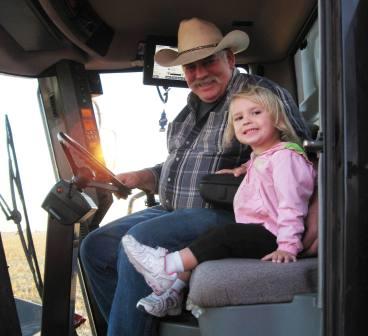
Recently, my three year old daughter had the opportunity to ride with my dad in a combine and loved it!  While this is usually an experience that rural kids have the opportunity to participate, several thoughts came to mind. First, I was somewhat saddened by the fact that my husband and I don’t have a farm and won’t be able to immerse her with all the joys and challenges that living on a farm provides: hauling irrigation pipe, digging thistles, feeding livestock, and also seeing calves born, driving tractors, playing on hay bales, etc.

Then I came to realize that even though my husband and I don’t actually farm, we have been blessed with careers in agriculture that allow us access to work with others in production agriculture, learn about cutting-edge technologies, work with great people and most importantly have the potential to exert a positive difference in the lives of others which is the reason we both majored in agricultural education.  (He is the Fillmore Central agriculture education instructor.)  The point I’m trying to make is that often times youth and even adults think that if you aren’t a farmer or rancher you aren’t involved in an agricultural career when in fact, that couldn’t be farther from the truth.

It is interesting to note that less than 1 percent of Americans claim farming as an occupation, but there are approximately 22 million people who work in agriculture related fields. Agriculture is the nation’s largest employer! There are over 200 different careers one can choose from in the agricultural field alone.  With the diverse careers offered in agriculture, there is practically something for everyone, even if you don’t directly farm or ranch!  

I am proud to say that I work for UNL Extension because of the high quality educational programming we offer. In the agricultural area alone, we teach elementary youth through school enrichment, ag awareness programs, 4-H projects, and assist with many other youth programs such as FFA. Extension provides Crop Production Clinics, Soybean Management Field Days, ag risk management programming, the Nebraska Agricultural Water Management Demonstration Network and many web-based resources such as CropWatch.unl.edu. Taking technical research from scientists and researchers and getting it into an applicable use into the hands of a producer, crop consultant, or rancher is why we are an “extension” of the University of Nebraska-Lincoln. Wherever agriculture is, Extension has a presence in some way, shape or form.

In Nebraska we are also fortunate to have the University of Nebraska-Lincoln’s College of Agricultural Sciences and Natural Resources (CASNR) which offers 28 highly rated academic programs and two pre-professional programs – from Agribusiness to PGA Golf Management – something for everyone.   Its goal is to prepare students as leaders for a future in which demands on food, energy and water systems will challenge sustainability.

When I have my crop science investigation workshops with 4-H’ers we investigate how many careers in our local community are related to agriculture and they are always surprised on the huge impact agriculture has. So whether or not you are the person driving the combine or helping with harvest, there are numerous careers involved in agriculture and I hope you will encourage young people to consider an agricultural career.