

Happy Veterans Day!
November is National Entrepreneurship Month! Did you know youth entrepreneurship is a program priority for Nebraska 4-H? Through various programs, Nebraska 4-H connects youth to important careers and strengthens their entrepreneurship skills. Entrepreneurship programs aim to increase the number of youths returning to rural communities in business and professions and to increase the number of youths who are entrepreneurs.

Nebraska Extension has created several programs to introduce youth to entrepreneurship and the mind set behind being an entrepreneur. Curriculum reach youth between grades 3-8. The curriculum, “T.E.C Box and “INVENTURE Day” have allowed youth to use their creativity through hands-on learning to explore the basics of Entrepreneurship while connecting them to their local communities.
Tinker. Explore. Create. (TEC) Box is an experiential learning and maker movement activity that actively engages learners by encouraging them to think for themselves, work hard and learn with hands-on, minds-on methods. Through this program, youth will engage with entrepreneurship, empathy and utilize their innovative spark. Two hundred sixty-five youth participated in TEC Box curriculum activities.
During INVENTURE Day, students familiarize themselves with local businesses and business owners to identify potential entrepreneurial careers. Using innovation and creation, youth work in teams to develop a unique business around a product that solves a problem in the community.
In celebration of National Entrepreneurship Month, teachers and educators are invited to utilize a toolkit of free resources, including:
A sample Spark to Start activities book is also being sent to all 4th-grade teachers in Nebraska. To access the free resources, simply complete a form at go.unl.edu/e-shipmonth.
Participants in Nebraska extension entrepreneurship and innovation programs have been shown to embrace an entrepreneurial mindset and gain skills to create new businesses, which ultimately contributes to the economic vitality of Nebraska communities and beyond.
Stress seems to be prevalent in the agriculture sector, with even more concerns arising due to the COVID-19 pandemic. Many farmers and ranchers are facing financial problems and market uncertainties, along with challenges such as production risks, farm transfer issues, and more. When temporary stress turns into chronic stress, it can impact physical health and mental wellness.

Nebraska Extension, in partnership with Michigan State University Extension, presents a free online webinar, “Communicating with Farmers Under Stress”, Tuesday, November 10, 2020 from 10:30 a.m. to noon, CST. This workshop is beneficial for individuals who work with farmers and ranchers on a regular basis, such as bank lenders, ag suppliers, healthcare professionals, and anyone involved with the lives of farmers and ranchers.
Workshop Objectives include:
* Build awareness around potentially stressful conditions affecting some farmers and ranchers.
* Learn stress triggers, identify signs of stress, and review helpful techniques for responding.
* Learn techniques for identifying, approaching, and working with farmers who may not cope with stress effectively.
* Learn where to find additional help.
In addition to being helpful for working with farmers and ranchers, the workshop educates participants about managing stress in their own lives and teaches how stressors can affect physical health and relationships with family or coworkers. Register for the free online workshop at: go.unl.edu/stress2020 . For more information, contact Nebraska Extension Educators Glennis McClure, gmcclure3@unl.edu or Susan Harris, susan.harris@unl.edu.
If you or your employees would like this program taught locally, feel free to contact me at brandy.vandewalle@unl.edu as I am also a certified trainer for the program.
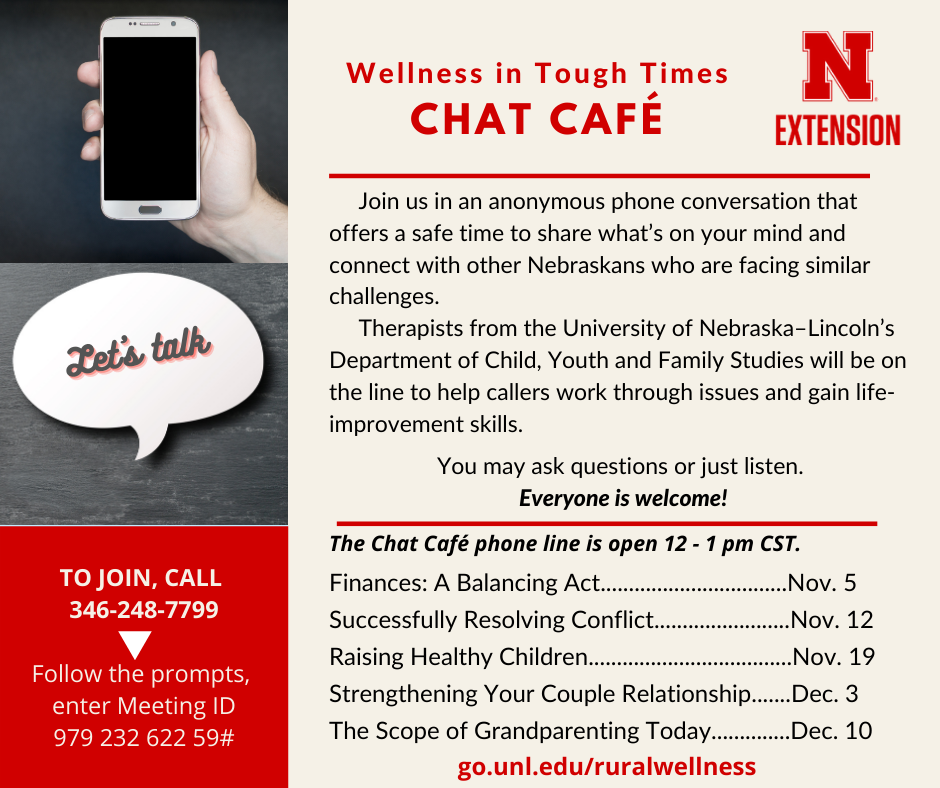
The Wellness in Tough Times Chat Café features an anonymous group of phone conversations that offer a safe time to share what’s on your mind and connect with other Nebraskans who are facing similar challenges. Therapists from the University of Nebraska–Lincoln’s Department of Child, Youth and Family Studies will be on the line to help callers work through issues connected to natural disaster recovery and gain skills to improve lives. You may ask questions or just listen. Everyone is welcome!
Mark your calendars to join our Wellness in Tough Times Chat Café for the following discussion topics: Follow the prompts and enter Meeting ID 979 232 622 59#.
For more information on the Wellness in Tough Times Team and resources similar to these programs, go to Nebraska Extension’s, ruralwellness.unl.edu.
For many, autumn events like Halloween are a time to wear costumes, go trick-or-treating, go to parties with friends, and eat sweet treats. Celebrations such as Halloween are a chance to not only have fun, but also provide healthy snack options and be physically active with friends and family. Make your Halloween season healthier this year by getting plenty of physical activity to balance food intake and help children choose wisely and eat their treats in moderation. Below are tips to make your Halloween healthier for trick-or-treaters and guests.

Hand out healthier treats.
Try out non-food treats.
Promote physical activity.
Moderation is key.
Survive sweet treats at work.
Find recipes and learn more at https://food.unl.edu.
This past week, I listened to a webinar hosted by Bryan LGH which featured Collin Kartchner who is an advocate for teen mental health. Specifically, fighting social media’s influence on teen mental health and emphasizing that their voice matters. There has been a lot of research which supports this, and results are shocking. This is one of the reasons, I as a parent was hesitant on allowing my 7th grader access to a smartphone. After Collin’s presentation and reading through literature, as a parent and educator there will be some changes made in our house and I hope you’ll read along to see key research points.

On his presentation sponsored by BLGH, Kartchner pointed out that parents need to be role models for their kids when it comes to phones and devices. This can be very hard to do in such an instantaneous society. Social media has made us share more than we have ever shared before. Think about it, how many posts do you see every day? It is easier to connect with others and keep them updated on events which is handy, and it is also easy to push your political, social or other differing views which can create tension. How many of us carry cameras with us to kids’ events or other celebrations? When is the last time you’ve actually printed off pictures to physically display? I know I have caught myself being too involved with watching my kids through my phone rather than firsthand with my eyes.
When you pick up kids from school, do they see you on your device? When you are at home on the couch debriefing everyone’s day, are you on your device? Have you checked your screen time lately? How many hours are you working or socially engaged on your phone? Is it fair to blame our kids for wanting to be on their phones? They have been conditioned that phones are a lifeline and connection.
Jean Twenge, a Professor of Psychology at San Diego State University authored a study that found teenagers are increasingly depressed, feel hopeless and are more likely to consider suicide. Her and colleagues found a sudden increase in teens’ symptoms of depression, suicide risk factors and suicide rates in 2012 — around the time when smartphones became popular. An excerpt from an article on NPR, found that, “Twenge’s research found that teens who spend five or more hours per day on their devices are 71 percent more likely to have one risk factor for suicide. And that’s regardless of the content consumed. Whether teens are watching cat videos or looking at something more serious, the amount of screen time — not the specific content — goes hand in hand with the higher instances of depression.” She found that half an hour or one hour seemed to be the time youth could handle electronic devices in terms of mental health. Twenge said that at 3 hours and more, there is a more pronounced increase in youth who had at least one risk for suicide.
Melanie Hempe, RN and founder of Families Managing Media summed up why social media is not for teens. 1) Social media was not designed for them. Biologically, their underdeveloped frontal cortex can’t manage all the temptations and information on social media. 2) Social media is an entertainment (and marketing) technology. It will not make them more prepared for real life of a job. 3) A tween’s “more is better” mentality is a dangerous match for social media. Do they really have as many “friends” as social media portrays? 4) Social media is an addictive form of screen entertainment. 5) Social media replaces learning the hard “work” of dealing face-to-face with peers. 6) Social media can cause teens to lose connection with family and instead view “friends” as their foundation. 7) Social media use represents lost potential for teams. It’s too easy for teens to waste their brain on a digital world, as it’s hard to balance everything.
So, what can we do? Twenge suggests both teens and adults limit time on social media and phones to no more than two hours. She encourages people to spend time resting, seeing friends face-to-face (of course in COVID-19 times, FaceTime or other electronic devices might have to be adapted), going outside, exercising, engaging in a non-electronic hobby, etc. If you use your phone to facilitate those things, that’s an acceptable route to take.
Collin Kartchner also provided ideas for families. First of all, one day each week, have a designated time for NO phones. He recommended the time of 5-9 p.m. because kids need time to talk to their parents and parents need to listen. Kids need family dinner with no phones or distractions. He said to talk like it’s 1994. He also recommends making sure your children get 8 hugs every day for 8 seconds minimum. That might seem like a lot, but kids need physical touch and connection with their parent/guardian. He recommended that parents, guardians and even grandparents also evaluate their own digital behaviors and make necessary changes. Create a Family Tech Contract that is voiced by all family members, signed and posted on the fridge or visible spot.
Extension Resources
For resources on mental health, check out Nebraska Extension’s webpage at https://ruralwellness.unl.edu/.
What ARE all those annoying little bugs biting us? Check out Nicole’s blog to find the answer!

With the cool temperatures, pests start seeking shelter for warm places like your house, so this week I’m sharing information on keeping these pests out of your house.
Some of the more common nuisance pests include occasional invaders like boxelder bugs, multicolored Asian Lady Beetles, millipedes, and crickets. These pests don’t do any harm once inside the home; they are just looking for a cozy place to spend the winter. Proper identification of the insect will assure the proper control method. Boxelder bugs are black and orange true ‘bugs’ that can be found in large numbers around foundations sunning themselves or trying to find their way inside. Multicolored Asian Lady Beetles are the orange ‘lady bugs’ with black spots. Their distinct smell and ability to bite makes them even more of a nuisance once inside the home. Millipedes are often misidentified as ‘wire worms.’ These skinny, brown critters have two legs per body segment and will curl up when disturbed. Crickets hop their way into homes and provide ‘music’ in the night with their chirping. Commonly it’s the black field cricket that migrates inside, but there are others that follow right behind.

Wolf spiders may look scary, but they are more bark than bite. These large, hairy spiders can be found both outdoors and occasionally inside the home. They are not poisonous, nor do they want to disturb people. They are hunting spiders, so they don’t spin a web or a trap, but prefer to chase down their prey. They often find their way into homes in the fall following their favorite food source the cricket.
The saying “an ounce of prevention is worth a pound of cure” has never been truer. Discouraging occasional invaders from entering the house is going to take a little work, but it will be worth it in the long run. Start by finding and sealing up any cracks or spaces they could enter through with silicone caulk or expanding foam. Make sure that window screens are in good repair and that doors are tight fitting. Also remove any dead plant debris from window wells.
Pests can be discouraged from entering the house in a number of ways. The most common way is by applying an outdoor perimeter insecticide treatment. These insecticides are labeled for various pests and often times have residual effects to help protect the house for longer. Read and follow the label instructions on how and where these products should be applied. Ideally, try to apply these insecticides out from the foundation about five to ten feet around the perimeter of the home. The insecticides will help to decrease the numbers of pests that make it inside the house, but don’t expect it to stop all of them.
Monitor the home regularly to see what pests have made their way inside. Glue boards are sticky boards used to catch and hold pests as they try to move throughout the home. Be sure to use sticky boards in locations where non-target animals, like pets, won’t get stuck in them. If something other than the target pest does happen to get ‘caught’ in the trap, use an oily material, like vegetable or mineral oil, to dissolve the sticky substance on the trap. When properly placed, these traps will allow you to see which pests are inside the home and their approximate numbers.
Once pests are found inside the home, there are a few techniques that you can use. The handy broom and dustpan or the vacuum are two techniques; they are also very environmentally friendly and very cost effective. Be careful when selecting insecticides for use inside the home. Read and follow instructions carefully as many of these products have to come into contact with the insect themselves and don’t offer much residual protection. With a little prevention and monitoring you can ensure that you are sharing your home with wanted house guests this fall and winter.
Every year, National 4-H Week sees millions of youth, parents, volunteers and alumni come together to celebrate the many positive youth development opportunities offered by 4-H. The theme for this year’s National 4-H Week, Opportunity4All, is a campaign that was created by National 4-H Council to rally support for Cooperative Extension’s 4-H program and identify solutions to eliminate the opportunity gap that affects 55 million kids across America.

With so many children struggling to reach their full potential, 4-H believes that young people, in partnership with adults, can play a key role in creating a more promising and equitable future for youth, families and communities across the country. In 4-H, we believe every child should have an equal opportunity to succeed. We believe every child should have the skills they need to make a difference in the world.
Fillmore and Clay County 4-H will observe National 4-H Week this year by highlighting some of the inspirational 4-H youth in our community who are working tirelessly to support each other and their communities.
“We believe youth perspectives are so important and a solution to eliminating the opportunity gap, because young people come with new ideas and new ways of seeing the world,” explains Jennifer Sirangelo, President and CEO of National 4-H Council. By encouraging diverse voices and innovative actions, 4-H believes that solutions can be found to address the educational, economic and health issues that have created the opportunity gap.
Check out all of the fun activities that are being done on the Fillmore County website at fillmore.unl.edu, including a pumpkin decorating contest. Wear a 4-H shirt on Wednesday and post on the Fillmore (https://www.facebook.com/fillmorecounty4h) or Clay County (https://www.facebook.com/UNLClayCounty) FaceBook pages! Fillmore County 4-H early enrollment opens October 15th.
In both Clay and Fillmore Counties one out of two, age-eligible 4-H youth from the community are involved in 4‑H. One of the most anticipated events of National 4-H Week every year is the 4-H STEM Challenge, formerly known as National Youth Science Day. The theme of this year’s event, which is expected to see hundreds of thousands of youth across the nation taking part throughout October, is Mars Base Camp. Developed by Google and Virginia Cooperative Extension, Mars Base Camp is a collection of activities that teaches kids ages 8-14 STEM skills, including mechanical engineering, physics, computer science and agriculture.

To learn more about how you can get involved, visit http://www.4-h.org/.
About 4-H
4-H, the nation’s largest youth development and empowerment organization, cultivates confident kids who tackle the issues that matter most in their communities right now. In the United States, 4-H programs empower six million young people through the 110 land-grant universities and Cooperative Extension in more than 3,000 local offices serving every county and parish in the country. Outside the United States, independent, country-led 4-H organizations empower one million young people in more than 50 countries. National 4-H Council is the private sector, non-profit partner of the Cooperative Extension System and 4-H National Headquarters located at the National Institute of Food and Agriculture (NIFA) within the United States Department of Agriculture (USDA).
Learn more about 4-H at www.4-H.org, find us on Facebook at www.facebook.com/4-H and on Twitter at https://twitter.com/4H.
 Views from VanDeWalle