Uncategorized

Census of Agriculture

Every five years, the U.S. Department of Agriculture’s National Agricultural Statistics Service (NASS) conducts the Census of Agriculture which provides detailed data covering land use and ownership, production practices, expenditures and other factors that affect the way farmers do business and succeed in the 21st Century.  The 2012 Census of Agriculture has been mailed to millions of farmers and ranchers across the United States.

According to Agriculture Secretary Tom Vilsack, “The 2012 Census of Agriculture provides farmers with a powerful voice. The information gathered through the Census influences policy decisions that can have a tremendous impact on farmers and their communities for years to come.” Vilsack strongly encourages all farmers, no matter how large or small their operation, to promptly complete and return their Census, so they can voice to the nation the value and importance of agriculture.

Results from the 2012 Census of Agriculture will play a role in determining future decisions about: farm programs, transportation and marketing locations, telecommunications connectivity, rural economic development, production practices, new agricultural technologies, conservation programs and more.

Completed forms are due by February 4, 2013. Farmers can return their forms by mail or online by visiting a secure website. Federal law requires all agricultural producers to participate in the Census and requires NASS to keep all individual information confidential.

Programming

Cow/Calf College

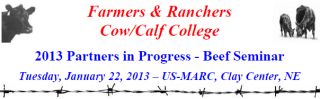
The annual Farmers and Ranchers Cow/Calf College “Partners in Progress – Beef Seminar” will be held at the U.S. Meat Animal Research Center and Great Plains Veterinary Education Center near Clay Center on Tuesday, January 22, 2013 with registration, coffee and donuts starting at 9:00 a.m. and going till 9:45 a.m.  The program will run from 9:50 a.m. until approximately 3:45 p.m. This program is sponsored by the University of Nebraska-Lincoln Extension’s Farmers and Ranchers College and will feature several outstanding speakers discussing issues and management strategies that can affect the profitability of all beef producers.

This year’s theme will center on recovering from the 2012 drought and preparing for the potential of a 2013 drought. There is no cost for the event and the public is invited. It does include a noon meal which means that early registration is necessary to reserve a plate. The seminar is packed with experts in climate, forages, animal nutrition and reproduction and will provide information that should help in planning for the upcoming year.

CowCalfHeading13

The “Cow/Calf College” will kick off at 9:50 a.m. with a welcome by Dr. John Pollak, Director of USMARC. He will also give a short overview on research that is happening at the Meat Animal Research Center. He will be followed by the first speaker, Allan Vyhnalek, UNL Extension Educator who will present: “Hay, Stalks, & Pastures: Costs & Considerations for 2013” which will give information on values, rental rates and considerations for coming out of a drought and possibly going into another. He will be followed by Dr. Bruce Anderson, UNL Extension Forage Specialist, who will give producers information on “Forage Planning for the Possible 2013 Drought”. This could be critical as beef producers face a shortage of pasture and now hay and other forages in 2012 and preparing for 2013.

The afternoon session will be kicked off by Dr. Rick Funston, UNL Beef Reproductive Physiology Specialist. In light of current feed costs many producers are looking at options and strategies for replacement heifer development in the months ahead. It may be advantageous to benefit from what he has learned in research on “Cost Effective Replacement Heifer Development”. He will be followed by Dr. Al Dutcher, UNL State Climatologist, who will give his take on the “Potential for 2013 Drought: Weather Update”. There is no doubt that most producers and especially beef producers are worried about what may be ahead for climate that will affect grass and forage production. We hope that he has good news for us, but must brace for the potential of bad news considering weather conditions ahead.Lunch will be provided and will be handled with a rotation system during two noon sessions featuring Aaron Stalker, UNL Beef Range Systems Specialist, who will provide two concurrent presentations on: “Corn Stalk Grazing: Values to Cattle Producers and Corn Farmers”. Also in the rotation will be a chance to see and hear about the new “New UNL Beef Body Condition Scoring App” developed by Dr. Rick Rasby and ready for distribution.

All presenters will then join on stage to pull everything together, give their final thoughts and considerations and then avail themselves for a coffee-shop style panel discussion during which cattlemen can ask questions and get answers on topic questions that came to them during the day’s sessions. A chance for door prizes will be awarded to those that stay for the entire event.

Any beef producer or other interested individual should pre-register by noon on Friday, January 18th, 2013, at the Webster County Extension Office at (402) 746-3417 to insure a seat, lunch, and proceedings for the day. You may also email your registration to Dewey Lienemann at:  dlienemann2@unl.edu.

Source: Dewey Lienemann, Extension Educator

Crops, Programming

Moving Forward in Agriculture

Those of us in agriculture are no stranger to risks involved with agriculture that are taken every day, whether it is financial, production, legal, price/market or human resources risks.  While we can’t control everything, there are measures that can be taken to protect one’s operation and reduce risk. Each year the Farmers & Ranchers College hosts Dr. David Kohl, Professor Emeritus from Virginia Tech who does an excellent job describing global risks which affect us locally and how those risks will affect the agricultural industry. In my seventh year of Extension, there are several key messages he largely emphasizes which I’ve summarized below.

First of all, “bigger is not better”, rather “better is better”. In other words improve the efficiency of your operation first before expanding. Also, to be successful (in anything really), be proactive and use the “HUT” principle: hear, understand and take action. While attending educational programs and undergoing professional development, unless you use the information and take action, you won’t fully succeed.

Kohl described common characteristics that the last four super cycles of the century possess: each had a rapid global real growth, conflict/geopolitical uncertainty, inflation, significant infrastructure investment, etc. Currently, we are in the longest of those super cycles (2003 – 2012), but one thing that is bound to happen is a crash. Be sure to have an exit strategy when this current super cycle crashes!

As the population increasingly grows more urban based disconnected to today’s production agriculture, there are many misconceptions of agriculture. There will also be a huge transfer of land in the coming years. Kohl warned of the spoiled brats emerging who want a “piece of their parents’ legacy”, thus invoking conflict among families, etc. When I attended Elaine Froese’s presentation she referred to baby-boomers as “waiters”, meaning they are waiting for their parents to collect inheritance because they haven’t prepared for their own retirement and feel entitled. In fact, there is a 500:1 odd that a business will make it to the 5th generation. Transition planning is increasingly important in order to beat the odds!

Kohl described what a “cut above super producer” possess. Among other things, they should follow the 60-30-10 profit plan, where 60% of profit focuses on efficiency first, and then growth. Thirty percent of one’s profit should build working capital and the last 10% is for you to do what you want with it – enjoy life!  Remember to not live above your means.

Finally, he ended with reasons to be optimistic about agriculture. By 2050, we will need 100% more food, fuel and fiber, thus the career opportunities for youth are enormous! One in six jobs is related to agriculture in some way; students taking college courses should remember to not only take the technical classes, but classes in business, science and communication. We need to “think globally and act locally”.

I encourage you to reflect on this past year and create/enhance your business plan for 2013. I wish you all a happy and joyous holiday season!
Programming

Annie’s Project: Risk Management for Women

Soon 2012 will be in the books and with the New Year approaching, what a better time to set resolutions for your business!  Developing management and decision-making skills for farms and ranches is becoming more important than ever before. Today’s volatile agricultural markets can increase your risk if not managed properly. The University of Nebraska-Lincoln Extension is offering a program to address these issues.

Annie’s Project is a six-week course designed especially for farm women to help them develop their management and decision-making skills for their farms. Sessions include brief presentations, discussions focused on the participant’s questions, and computer training to use spreadsheets. Annie’s Project gives farm women the opportunity to learn from agricultural professionals and network with other women in similar situations.

Annie was a woman who grew up in a small town in Northern Illinois. Her goal was to marry a farmer and she did. Annie spent her lifetime learning how to be an involved business partner with her farm husband. Together they did great things, but it wasn’t easy. Annie’s Project was developed to take her experiences and share it with farm women living and working in a complex business

This course will be offered in Geneva, NE at the Fillmore County Extension Office from 6-9:00 p.m. on the following days: January 16, 23, & 30 and February 6, 20 and 27. This program has a $75 registration fee which covers all program materials and a light meal each night.   To facilitate discussion, enrollment is limited to the first 12 participants; pre-registration is due January 11, 2013. For more information, please contact me at brandy.vandewalle@unl.edu or (402)759-3712.

Crops, Programming

Agriculture: What’s Around the Corner & Down the Road?

Back by popular demand is Dr. Dave Kohl, Professor Emeritis from Agricultural and Applied Economics at Virginia Tech.  He will speak on “Agriculture: What’s Around the Corner & Down the Road” from 1:00-4:00 p.m. at the Opera House in Bruning, NE on December 10th. Focusing on the wild world of global and domestic economics, Dr. Kohl will highlight the unusual events around every corn and discuss the “black swans” and how they impact agricultural businesses and producers. He will discuss the major game changers influencing the agriculture landscape along with a quick tour of the economics of the world and how it is influencing land values, commodities, and input costs.  Is agriculture in an asset or credit bubble?  What can you do financially in this business environment to capitalize on the economic volatility?  Dr. Kohl will give tips on management practices that will help you think globally but act locally in strategic and everyday decision making. Logo

The Farmers & Ranchers College was formed in January, 2000 with the purpose of providing high quality, dynamic, up to date educational workshops for area agricultural producers in south central Nebraska through a collaborative effort between business, industry and higher education leaders.  The Farmers and Ranchers College Committee consists of Fred Bruning of Bruning, Bryan Dohrman of Grafton, Sarah Miller of Carleton, Eric Milton of Milligan, Jim Donovan of Geneva, Bryce Kassik of Geneva, Gordy Nuss of Sutton, and Brandy VanDeWalle of Ohiowa.

For more information on the various Farmers & Ranchers College programs, please go to the Fillmore Co. website or call the Fillmore County Extension office at (402) 759-3712.

Uncategorized

Producers, read about a great opportunity on fertilizer research options for your farm by Jenny Rees:

JenBrhel's avatarJenResources

November 1 is just around the corner-the beginning of when fall fertilizing occurs in this area of the State.  Hopefully many of you have taken soil samples as excess nitrate is to be expected after this drought year.  This is an excellent time to consider evaluating your nitrogen program by starting an on-farm research trial!

On-farm research is using your own equipment, in your own fields, over single or multiple growing seasons allowing you to determine the most economical, efficient, and sustainable practice for the production of irrigated and/or dryland crops on your own farm.

What are the soil fertility questions you have for your farm?

Right now, with fertilizing on producers’ minds, we’re hoping you will consider a soil fertility study.  We have several example nutrient protocols including the UNL N fertility rate compared to +/- 30 lbs, and considerations for nitrogen timing…

View original post 433 more words

Crops, Programming

Landlord/Tenant Workshop & Returning to the Farm Program

Developing farm cash leases that meet the needs of both landlord and tenant, while maintaining a positive relationship, is the goal of these workshops.  Both tenants and the landlord are encouraged to attend!  A team of UNL Extension Educators will be on hand to discuss these topics and provide common sense tips during the presentation.  Managing the 2012 drought and implications for 2013 will also be discussed.

Session presenter Al Vyhnalek points out that “Putting together the right lease isn’t about what is being discussed at the coffee shop, or what a university survey of cash lease rates says; it is about what fits both the landlord and tenant for their circumstance and situation. Attending this presentation will provide a set of ideas to work from as those specifics are discussed.”

Topics include:  Expectations from the lease, including goal setting for the rental property; Lease communication, determining appropriate information sharing for both the tenant and landlord; Tips for farm leases that include relatives; Alternative cash lease arrangements, flexible provision considerations for your situation; How the 2012 drought affects leases, irrigation systems, grain bin rental, and other topics related to leases will be discussed as time allows.ing this presentation will provide a set of ideas to work from as those specifics are discussed.”

This free workshop is sponsored by the Nebraska Soybean Board and the North Central Risk Management Agency in collaboration with our local Famers & Ranchers College committee.  A meal and handouts are included. Handouts and materials will be available on a first-come, first-serve basis. This program will be on November 13, 2012 at theFairmont Legion from 11-3:00 p.m. with registration at 10:30 a.m. Please RSVP by November 6th. To register, contact our office at (402)759-3712 or via email at brandy.vandewalle@unl.edu.

 Returning to the Farm Workshop Planned

The past several years our UNL Agricultural Economic Department has conducted “Returning to the Farm Workshops” designed for farm families transitioning their operation.  This year the sessions will be held Friday Dec. 7th from 2:00 – 9:00 p.m. & Saturday Dec. 8th from 8:30 a.m. to 3:30 p.m. and Friday Jan. 11th from 2:00 – 9:00 p.m. and Sat. 12th from 8:30 a.m. to 3:30 p.m. in Lincoln at the Holiday Inn Downtown.

The cost of the conference is $350 for the first 4 family members, plus $40 for each family member after the first 4. This fee covers instruction, handout materials, meeting room costs, refreshment breaks, Saturday continental breakfast and most meals.  The registration deadline is November 30, 2012 and it’s limited to the first 15 families with paid registrations.

Crops, Programming

Farmers & Ranchers College Year Planned

The Farmers & Ranchers College was formed in January, 2000 with the purpose of providing high quality, dynamic, up to date educational workshops for area agricultural producers in south central Nebraska through a collaborative effort between business, industry and higher education leaders. Furthermore, the Farmers & Ranchers College will provide the tools necessary so that agricultural producers will be able to respond positively to these changes using a profitable decision making process.

The Farmers and Ranchers College is a unique opportunity to educate agricultural producers in south central Nebraska. Four hundred producers from twenty counties and three states participated in the 2011-2012 Farmers & Ranchers College programs. Producers attending these workshops managed over 284,000 acres. Participants surveyed indicated an average of $12.12/acre of knowledge gained from participating for a potential impact of $3.4 million.

Contributions and support of area businesses allow participants to attend at no cost, however for programs that have meals, it is requested that people RSVP at least a week in advance for an accurate meal count by calling Fillmore County Extension at (402) 759-3712.

The Farmers and Ranchers College Committee consists of Fred Bruning of Bruning, Bryan Dohrman of Grafton, Sarah Miller of Carleton, Eric Milton of Milligan, Jim Donovan of Geneva, Bryce Kassik of Geneva, Gordy Nuss of Sutton, and Brandy VanDeWalle of Ohiowa.

2012 -2013 Farmers & Ranchers College Programming

  • November 13, 2012 – Landowner/Tenant Lease Workshop – Fairmont Legion, 11-3:00, registration at 10:30 a.m.*
  • December 10, 2012 – “Agriculture: What’s Around the Corner & Down the RoadFeaturing Dr. David Kohl Professor Emeritus, Dept. of AAEC, VA TECH at the Bruning Opera House – Bruning, NE at 1:00 p.m.
  • January 22, 2013 – “Partners In Progress – Beef Seminar” at the U.S. Meat Animal  Research Center near Clay Center from 10:00 a.m. to 3:30 p.m., registration at 9:30 a.m.*
  • March 14,2013 – Keeping Your Farm in the Family for the Next Generation” Featuring Ron Hanson, UNL at Evening with Friends in Milligan with meal at 6:00 p.m. and program to follow.*

* Programs are provided at no cost to the public, but registration is appreciated for a meal count. Please call the Fillmore Co. Extension Office at (402) 759-3712 one week prior to the program.

Uncategorized

Next Year’s Field Plans

With harvest almost complete for some producers or in full swing, now is the time to reflect on both the challenges and successes from this dry growing season. As you harvested many fields, did you notice any trouble-some spots where excess weeds were present?  Did you notice areas that were pretty variable in yield?  Did you evaluate any practices you might have implemented for the first time?  Were you surprised by any yields from your fields?  While this was a very trying year with the drought, there are many things you can control or work to improve if you didn’t obtain desirable results.

Harvest provides an opportunity for a final evaluation of your weed management program and to a lesser extent, your insect management program. As you travel over all of your fields, take a minute to record observations such as where weeds are present.  Be sure to note the exact locations and details so you know how to correct it for next year.

It is also important to take soil samples with this year’s drought. Have you sampled for soybean cyst nematode in soybean fields with less yield than anticipated?

On-Farm Research Opportunities

Now is also a good time to think how weather conditions in 2012 might impact performance of crop inputs and management practices in 2013. Locally, we have the Greater Quad County On-Farm Research group who participates in various trials, but last year a collaborative statewide effort was launched, the Nebraska On-Farm Research Network. Two of my colleagues, Gary Zoubek and Keith Glewen are co-coordinators for the project and recently suggested in a CropWatch article that whether one’s corn and soybean production is dryland or irrigated, inputs and certain production practices may respond differently in 2013 as a result of unprecedented drought conditions this past growing season.

The Nebraska On-Farm Research Network provides growers the framework and opportunity to conduct relevant research in their own fields, using their own farm machinery. With the assistance of UNL faculty, farm operators can make valid, field-sized and replicated comparisons which can provide growers valuable economic information.

For more information, see the On-Farm Research section of CropWatch. The Nebraska On-Farm Research Network is sponsored by UNL Extension in partnership with the Nebraska Corn Growers Association and the Nebraska Corn Board.

Programming

Mentally Coping with Drought

With harvest underway, most likely producers are suffering yield losses in rainfield fields. Many producers will have very high energy bills from the long irrigation season. High nitrate issues are of concern for livestock producers. The list goes on for the problems this year’s drought caused. With that can come an emotional stress that directly impact farm families as they cope with those burdens.

After the Drought, a September 27 one-hour national webinar will address this topic and the resources available to help farm families cope. The program’s goal is to provide farm families, Extension educators, and other agriculture professionals with basic resources to address mental/behavioral issues related to the drought.

Program topics will include:

  • Mental health issues likely to be encountered by drought-stressed farmers, such as depression, anxiety disorders, suicidal thoughts and actions, and substance abuse
  • Proper identification of signs and symptoms
  • Appropriate responses when interacting with farm family members
  • Referral sources for additional assistance
  • Training opportunities available through Mental Health First Aid.

More information is available at UNL Extension’s CropWatch website.