Crops, Programming

Agriculture: What’s Around the Corner & Down the Road?

Back by popular demand is Dr. Dave Kohl, Professor Emeritis from Agricultural and Applied Economics at Virginia Tech.  He will speak on “Agriculture: What’s Around the Corner & Down the Road” from 1:00-4:00 p.m. at the Opera House in Bruning, NE on December 10th. Focusing on the wild world of global and domestic economics, Dr. Kohl will highlight the unusual events around every corn and discuss the “black swans” and how they impact agricultural businesses and producers. He will discuss the major game changers influencing the agriculture landscape along with a quick tour of the economics of the world and how it is influencing land values, commodities, and input costs.  Is agriculture in an asset or credit bubble?  What can you do financially in this business environment to capitalize on the economic volatility?  Dr. Kohl will give tips on management practices that will help you think globally but act locally in strategic and everyday decision making. Logo

The Farmers & Ranchers College was formed in January, 2000 with the purpose of providing high quality, dynamic, up to date educational workshops for area agricultural producers in south central Nebraska through a collaborative effort between business, industry and higher education leaders.  The Farmers and Ranchers College Committee consists of Fred Bruning of Bruning, Bryan Dohrman of Grafton, Sarah Miller of Carleton, Eric Milton of Milligan, Jim Donovan of Geneva, Bryce Kassik of Geneva, Gordy Nuss of Sutton, and Brandy VanDeWalle of Ohiowa.

For more information on the various Farmers & Ranchers College programs, please go to the Fillmore Co. website or call the Fillmore County Extension office at (402) 759-3712.
Crops, Programming

Landlord/Tenant Workshop & Returning to the Farm Program

Developing farm cash leases that meet the needs of both landlord and tenant, while maintaining a positive relationship, is the goal of these workshops.  Both tenants and the landlord are encouraged to attend!  A team of UNL Extension Educators will be on hand to discuss these topics and provide common sense tips during the presentation.  Managing the 2012 drought and implications for 2013 will also be discussed.

Session presenter Al Vyhnalek points out that “Putting together the right lease isn’t about what is being discussed at the coffee shop, or what a university survey of cash lease rates says; it is about what fits both the landlord and tenant for their circumstance and situation. Attending this presentation will provide a set of ideas to work from as those specifics are discussed.”

Topics include:  Expectations from the lease, including goal setting for the rental property; Lease communication, determining appropriate information sharing for both the tenant and landlord; Tips for farm leases that include relatives; Alternative cash lease arrangements, flexible provision considerations for your situation; How the 2012 drought affects leases, irrigation systems, grain bin rental, and other topics related to leases will be discussed as time allows.ing this presentation will provide a set of ideas to work from as those specifics are discussed.”

This free workshop is sponsored by the Nebraska Soybean Board and the North Central Risk Management Agency in collaboration with our local Famers & Ranchers College committee.  A meal and handouts are included. Handouts and materials will be available on a first-come, first-serve basis. This program will be on November 13, 2012 at theFairmont Legion from 11-3:00 p.m. with registration at 10:30 a.m. Please RSVP by November 6th. To register, contact our office at (402)759-3712 or via email at brandy.vandewalle@unl.edu.

 Returning to the Farm Workshop Planned

The past several years our UNL Agricultural Economic Department has conducted “Returning to the Farm Workshops” designed for farm families transitioning their operation.  This year the sessions will be held Friday Dec. 7th from 2:00 – 9:00 p.m. & Saturday Dec. 8th from 8:30 a.m. to 3:30 p.m. and Friday Jan. 11th from 2:00 – 9:00 p.m. and Sat. 12th from 8:30 a.m. to 3:30 p.m. in Lincoln at the Holiday Inn Downtown.

The cost of the conference is $350 for the first 4 family members, plus $40 for each family member after the first 4. This fee covers instruction, handout materials, meeting room costs, refreshment breaks, Saturday continental breakfast and most meals.  The registration deadline is November 30, 2012 and it’s limited to the first 15 families with paid registrations.

Crops, Programming

Farmers & Ranchers College Year Planned

The Farmers & Ranchers College was formed in January, 2000 with the purpose of providing high quality, dynamic, up to date educational workshops for area agricultural producers in south central Nebraska through a collaborative effort between business, industry and higher education leaders. Furthermore, the Farmers & Ranchers College will provide the tools necessary so that agricultural producers will be able to respond positively to these changes using a profitable decision making process.

The Farmers and Ranchers College is a unique opportunity to educate agricultural producers in south central Nebraska. Four hundred producers from twenty counties and three states participated in the 2011-2012 Farmers & Ranchers College programs. Producers attending these workshops managed over 284,000 acres. Participants surveyed indicated an average of $12.12/acre of knowledge gained from participating for a potential impact of $3.4 million.

Contributions and support of area businesses allow participants to attend at no cost, however for programs that have meals, it is requested that people RSVP at least a week in advance for an accurate meal count by calling Fillmore County Extension at (402) 759-3712.

The Farmers and Ranchers College Committee consists of Fred Bruning of Bruning, Bryan Dohrman of Grafton, Sarah Miller of Carleton, Eric Milton of Milligan, Jim Donovan of Geneva, Bryce Kassik of Geneva, Gordy Nuss of Sutton, and Brandy VanDeWalle of Ohiowa.

2012 -2013 Farmers & Ranchers College Programming

  • November 13, 2012 – Landowner/Tenant Lease Workshop – Fairmont Legion, 11-3:00, registration at 10:30 a.m.*
  • December 10, 2012 – “Agriculture: What’s Around the Corner & Down the RoadFeaturing Dr. David Kohl Professor Emeritus, Dept. of AAEC, VA TECH at the Bruning Opera House – Bruning, NE at 1:00 p.m.
  • January 22, 2013 – “Partners In Progress – Beef Seminar” at the U.S. Meat Animal  Research Center near Clay Center from 10:00 a.m. to 3:30 p.m., registration at 9:30 a.m.*
  • March 14,2013 – Keeping Your Farm in the Family for the Next Generation” Featuring Ron Hanson, UNL at Evening with Friends in Milligan with meal at 6:00 p.m. and program to follow.*

* Programs are provided at no cost to the public, but registration is appreciated for a meal count. Please call the Fillmore Co. Extension Office at (402) 759-3712 one week prior to the program.

Programming

Mentally Coping with Drought

With harvest underway, most likely producers are suffering yield losses in rainfield fields. Many producers will have very high energy bills from the long irrigation season. High nitrate issues are of concern for livestock producers. The list goes on for the problems this year’s drought caused. With that can come an emotional stress that directly impact farm families as they cope with those burdens.

After the Drought, a September 27 one-hour national webinar will address this topic and the resources available to help farm families cope. The program’s goal is to provide farm families, Extension educators, and other agriculture professionals with basic resources to address mental/behavioral issues related to the drought.

Program topics will include:

  • Mental health issues likely to be encountered by drought-stressed farmers, such as depression, anxiety disorders, suicidal thoughts and actions, and substance abuse
  • Proper identification of signs and symptoms
  • Appropriate responses when interacting with farm family members
  • Referral sources for additional assistance
  • Training opportunities available through Mental Health First Aid.

More information is available at UNL Extension’s CropWatch website.

Crops, Programming

Crop Update

Crop ET Weekly Report

The ETgage I check outside of Geneva changed 2.0 inches for the week of June 9-15th. Corn in the V-8 stage has a coefficient of .51”. To calculate how much water, corn at V-8 stage used you simply multiply .51” x 2.0” for a weekly use of 1.02” or .15 inches/day. Corn at V-10 would have used 1.38”/week or .20” per day. We were very fortunate to receive rainfall. The field south of Geneva received 2.3 inches of rain as I write this; at my house we received 3.4 inches.

I did not estimate the crop use for soybeans, since for our area; we typically don’t recommend irrigating them until they reach R3 stage.  Watering too early causes taller beans that use more water but don’t yield more, so it’s important to hold off and apply it when it is need!

 Potential Corn Issues

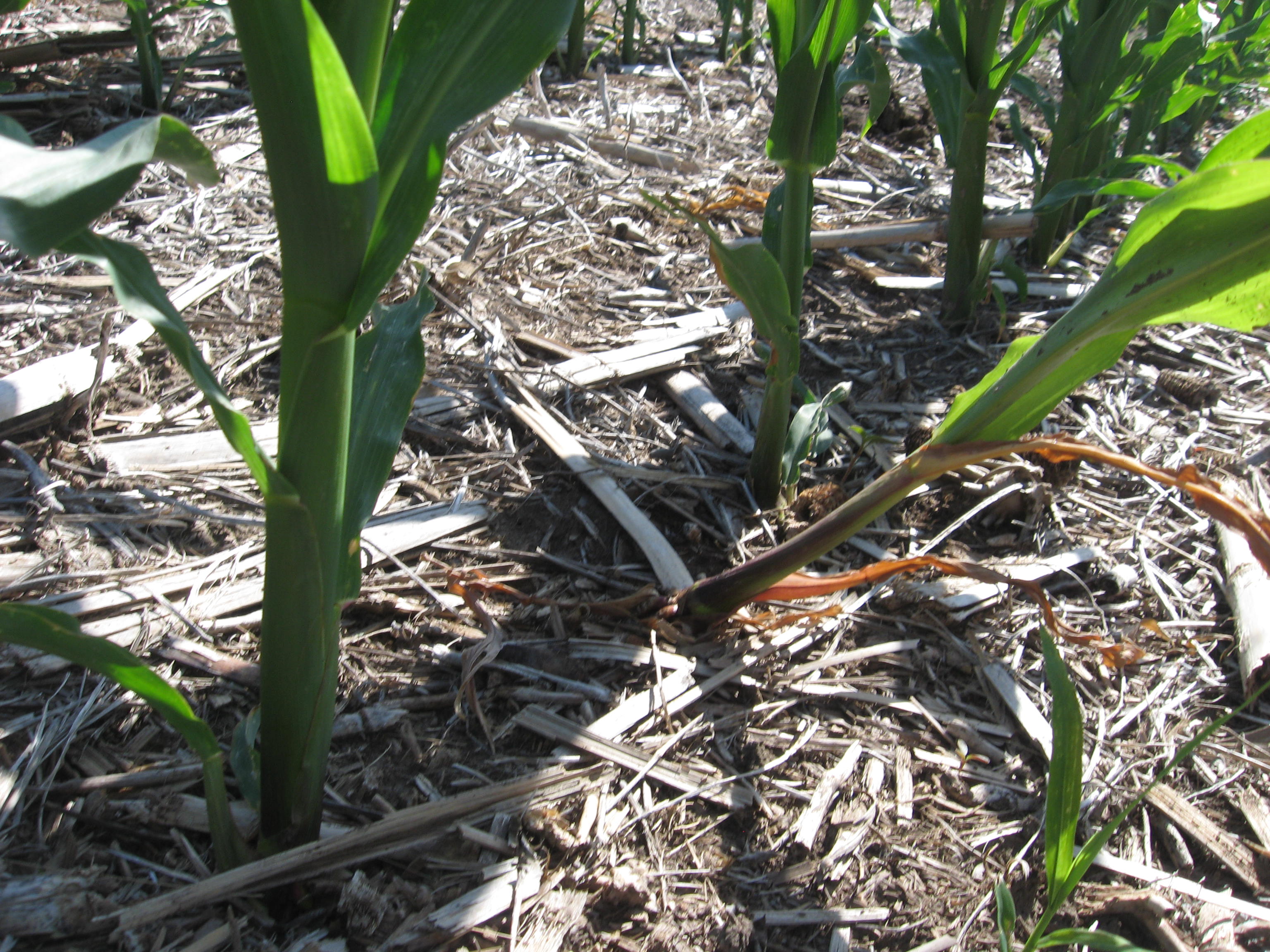
            Recently in the area there has been the diagnosis of rootless corn syndrome and Goss’s wilt. In short, with the hot, dry and windy weather earlier in the season than normal, some corn was unable to develop its roots as normal and at risk for lodging. Tom Hoegemeyer, Professor of Practice, Department of Agronomy explains this problem along with management strategies on cropwatch.unl.edu.

            The UNL Plant and Pest Diagnostic Clinic has received several samples from south central and eastern Nebraska which tested positive for the leaf blight phase of Goss’s bacterial wilt and blight. This early occurrence could have a severe impact on susceptible hybrids, but one needs to be scouting for it, especially in fields where hail damage has occurred, susceptible hybrids and fields with a history of the disease. Once again, if you think you have it, be sure to bring samples to the office so we can send them to the lab for a positive confirmation. More details can be found on cropwatch.unl.edu.

 Weed Resistance Management Field Day 2012

            Those interested in weed resistance management should attend the 2012 Weed Resistance Management Field Day. This program will be offered in two locations:

  • Big Springs on Wednesday, July 11th
  • David City on Thursday, July 12th

This program will include University and Industry presentations describing herbicide resistance and delivering a unified message about the need for integrated weed management programs to delay the evolution and/or spread of herbicide resistant weeds. Specific topics include glyphosate-resistant kochia at Brule and glyphosate-resistant giant ragweed at David City. The event will be concluded with a talk on how glyphosate-resistant weeds have changed agriculture in the southern US.

There is no cost to attend the Field Day and a complimentary meal will be served for those who have pre-registered. Participants are invited to register by Friday, July 6th so appropriate plans can be made for meals, teaching resources and tour logistics.  This program is sponsored by the Nebraska Soybean Board.

Programming

Rural Futures

Last week, I had the opportunity to attend the Rural Futures Conference (RFC) in Lincoln. This was an excellent conference with cutting edge and interactive presenters and panelists. This conference was the beginning of the creation of a Rural Futures Institute (RFI). IANR Vice Chancellor, Ronnie Green pointed out that the University of Nebraska is committed to creating a transformative institution focused on rural Nebraska, the Great Plains and beyond.

This RFC allowed nearly 500 individuals from 10 different land grant institutions, community economic development professionals, stakeholders and anyone with a passion on rural communities to brainstorm fundamentals of what the RFI will look like. It also helped participants gain an understanding of four core values the RFI should address.

  1. Transdisciplinary work is essential. UNL Extension has already recognized this, but it is important we all practice this more. In other words, it is essential for University professionals to network and brainstorm with others outside of their areas of specialty or department. Speaker, Frans Johansson provided excellent examples of how “diversity drives innovation”. “Intersections” are the best way to create new ideas by linking multidisciplinary ideas together to create an innovative approach to solving a problem.
  2. Innovation and entrepreneurship are crucial. In order for rural communities to remain viable, they must think outside of the box and develop an entrepreneurial and innovative culture.
  3. It is more than economics. In order for rural communities to survive or thrive, basic human services such as health care and education should be present in communities. The RFC fore ward also stated that “an important level of consideration is the civic, cultural, design and artistic elements that attend to aspects of human and community development that can’t be counted and measured, and can’t be justified only with economic returns.” The RFI must build on the legacy and richness of communities.
  4. Deep collaborations are a foundational element. The creation of the Rural Futures Institute must create deep and meaningful partnerships which allows for adequate collaboration.

The thought of forming a Rural Futures Institute and providing resources towards improving rural communities seems daunting, but as one speaker best put it, “small bests can equal big wins”, meaning to start small and build upon those small (often times more manageable) tasks. We also need to improve the messages we convey to others about our communities. Too often, we depreciate our communities’ assets by assuming there is nothing special/unusual about our communities; instead we should be bragging about all the things we appreciate about our communities or rural way of life.

In summary, UNL will be celebrating the 150th year of the Morrill Act (which created land grant universities among others) in September. Stay tuned for more about the Rural Futures Institute as more develops.

Programming, Youth

UNL Extension Tractor Safety Courses

 University of Nebraska-Lincoln Extension Tractor Safety/Hazardous Occupations Courses will be offered at seven locations in Nebraska during May and June.

Federal law prohibits youth under 16 years of age from working on a farm other than their parents’. Certification through the course grants an exemption to the law allowing 14- and 15-year-olds to drive a tractor and to do field work with mechanized equipment. The most common cause of death in agriculture accidents in Nebraska is overturn from tractors and all-terrain-vehicles (ATV), said Sharry Nielsen, UNL Extension Educator and course instructor, and are topics covered in-depth in the class work.

Classes consist of two days of instruction plus homework assignments. Classes are from 8 a.m.- 5 p.m. each day. Dates and locations closest to our area include:

— May 24-25, Fairgrounds, Kearney 
— June 14-15, Fairgrounds, Beatrice
— June 18-19, College Park, Grand Island

Pre-registration is strongly encouraged at least one week before a location’s start date to site coordinator’s Extension office. Cost is $60, which includes educational materials, testing, supplies, lunches and breaks. For more information, contact the Extension Office or Sharry Nielsen at (308) 832-0645, snielsen1@unl.edu.

The first day of class will consist of intensive classroom instruction with hands-on demonstrations, concluding with a written test that must be completed satisfactorily before the student may continue driving tests the next day. Classroom instruction will cover the required elements of the National Safe Tractor and Machinery Operation Program. Homework will be assigned to turn in the next day.

The second day will consist of testing, driving and operating machinery. Students must demonstrate competence in hitching equipment and driving a tractor and trailer through a standardized course as well as hitching PTO and hydraulic systems.

Programming, Youth

Progressive Agriculture Safety Day

Each year, many children are killed or injured on America’s farms and ranches. This summer, safety days such as the one being conducted on May 30, 2012 in Geneva, are being held in many locations across the United States and Canada.  These events teach rural children how to prevent injuries and reduce the risk of farm incidents. During safety days, children participate in interactive activities that reinforce the importance of taking responsibility for their own safety, respecting parents’ safety rules and sharing safety tips with their friends and family. 

Any youth who will be completing 3rd through 6th grade is invited to attend Progressive Agriculture Safety Day on Wednesday, May 30, 2012 at the Fillmore County Fairgrounds. This event is hosted by UNL Extension in Fillmore County, Shickley and Fillmore Central FFA chapters, 4-H and W.I.F.E.

Specifically at this year’s event, youth will participate in a variety of events designed to help them be aware of safety in potentially hazardous situations such as being on a farm or living in rural communities, severe weather, bike riding, etc. Youth will also enjoy sessions such as pedestrian bingo, seatbelt safety, assemble first aid kits to take home, learn more about where their food comes from and even receive a FREE bicycle helmet!  This year’s premier event will feature a mock accident conducted by local emergency responders.

Local agribusiness professionals, merchants, and community members donate their time and resources to ensure this event is a day of fun as well as a valuable learning experience. April 23rd is the deadline for early bird registration which is only $3.00 and includes lunch, snacks, a t-shirt and “goodie bag” with lots of fun materials. Youth are still able to register after April 23rd for a $5 registration fee. Registration forms can be found on the Fillmore County Extension website   For more information or to register, call 402-759-3712 or email bvandewalle2@unl.edu.

Programming

LEAD 32 Application Deadline is June 15

As the number of individuals involved in agriculture continues to decrease, the need for highly trained, effective and articulate spokespersons and leaders in the agricultural industry becomes even more critical. 

As Terry Hejny, LEAD Program director said,  “Often people wait until their lives appear to slow down before contact them about LEAD, but waiting sometimes means the no longer fall into our preferred range of 25-55 years of age!  In other words now is the time to complete an application.

Nebraska LEAD (Leadership Education/Action Development) applications are now available for men and women involved in production agriculture or agribusiness and are due on June 15.  If you are passionate about our industry I’d encourage you to apply.

The program will include monthly three-day seminars throughout Nebraska from mid-September through early April each year, LEAD Fellows also participate in a 10-day National Study/Travel Seminar to Kansas City, Washington, D.C. and Chicago during the first year, and a two week International Study/Travel Seminar during the second year.

Seminar themes include leadership assessment and potential, natural resources and energy, agricultural policy, leadership through communication, our political process, global perspectives, nuclear energy, social issues, understanding and developing leadership skills, agribusiness and marketing, advances in health care, and the resources and people of Nebraska’s Panhandle.

Applications are due no later than June 15 and are available via e-mail from the Nebraska LEAD Program. Application materials can be requested by contacting Shana at sgerdes2@unl.edu, by calling (402) 472-6810.

Crops, Irrigation, Programming

Nebraska On-Farm Research Network

Several area Extension Educators and I have been involved with on-farm research for several years.  I’ve shared many of our Quad County On-farm Research results at meetings, in my columns and on the web.  These results are also posted on the CropWatch Website.

This year we’ve combined efforts across Nebraska and are working to investigate topics in three general areas:

1)  Irrigation – water application management in corn production

2)  Nitrogen management in corn production – both irrigated and dryland

3)  Corn population study in irrigated and dryland

If you’d be interested in any of these topics, give Gary Zoubek a call at: 402-362-5508 or email him at: gzoubek1@unl.edu or contact Keith Glewen, Extension Educator at: 402-624-8030 or email him at:  kglewen1@unl.edu. They are the statewide contacts for this statewide effort.